Choosing the right word can make your message clearer and help you communicate with confidence. Hola or Ola is a common comparison that often confuses English learners, travelers, and anyone interacting with Spanish or Portuguese words. While the two terms look almost identical, they have different meanings, pronunciations, and language origins. Understanding when to use each one helps you avoid misunderstandings and ensures your writing and conversations stay accurate.
The confusion usually comes from their similar spelling, but Hola and Ola belong to different languages and contexts. Hola is the standard Spanish greeting meaning “hello,” while Ola commonly means “wave” in Spanish and Portuguese. Knowing the distinction is useful for language learning, vocabulary development, correct word usage, pronunciation, and cross-cultural communication, especially when reading, writing, or speaking with native speakers.
In this guide, you’ll learn the meaning of each word, their pronunciation, key differences, real-life examples, common mistakes to avoid, and simple tips for using the correct term with confidence. Keep reading to master Hola vs. Ola and improve your communication skills.
What “Hola” Means and Why It Matters
Hola is the standard Spanish word for “hello.” It is one of the most widely recognized greetings in the world and is commonly used to begin conversations in both formal and informal settings. Whether you’re meeting someone for the first time, greeting a friend, or starting a phone call, hola is a polite and natural way to say hello in Spanish.
Unlike many greetings that change based on the time of day, hola works at any time. It can also be paired with other expressions to create more complete greetings, such as:
- Hola, ¿cómo estás? (Hello, how are you?)
- Hola, buenos días. (Hello, good morning.)
- ¡Hola a todos! (Hello, everyone!)
Understanding the meaning of hola matters because it helps you communicate accurately with Spanish speakers and prevents confusion with similar-looking words like ola. Although they differ by only one letter, they have completely different meanings.
From a language learning perspective, mastering simple greetings builds confidence and improves everyday communication. Since hola is often the first Spanish word beginners learn, knowing its correct meaning, pronunciation, and usage creates a strong foundation for expanding vocabulary and speaking naturally.
Origins of “Hola”: History, Evolution & Linguistic Roots
The word hola has a long linguistic history that reflects the natural evolution of the Spanish language. Like many common expressions, it developed over centuries through changes in pronunciation, cultural influences, and everyday speech. Although its exact origin is still debated by language historians, there is broad agreement that hola evolved gradually rather than appearing suddenly.
Studying the history of hola offers insight into how languages change over time. It also explains why modern Spanish contains sounds and spelling patterns that may seem unusual to new learners. Understanding these historical developments makes it easier to appreciate both the word itself and the broader evolution of the Spanish language.
Where did “Hola” come from?
Most linguists believe hola developed from older forms of greeting used in medieval Spain. Some researchers connect it to exclamations such as “oh” or “ola,” which were used to attract someone’s attention before evolving into a friendly greeting.
Unlike words borrowed directly from Latin, hola appears to have emerged naturally through spoken language. As Spanish developed from Vulgar Latin, everyday expressions changed to match the pronunciation habits of speakers. Over time, these spoken forms became accepted in written Spanish as well.
Today, hola is recognized throughout the Spanish-speaking world as the standard greeting, regardless of regional dialects or accents.
Why did the “H” become silent?
One distinctive feature of hola is its silent H. In modern Spanish, the letter H is generally not pronounced, which is why hola sounds like “OH-la.”
This silent letter is the result of historical sound changes. During the development of Spanish, words that originally contained the Latin letter F often experienced pronunciation shifts. In many cases, the F sound gradually weakened, eventually becoming silent while the written spelling evolved to include H.
Although hola does not directly follow every stage of that historical pattern, it reflects the broader pronunciation rules that characterize modern Spanish. For learners, remembering that the H is silent is essential for speaking naturally and avoiding common pronunciation mistakes.
Cultural shift
Over the centuries, hola became more than just a greeting. It evolved into a symbol of warmth, openness, and everyday courtesy across Spanish-speaking cultures. Today, people use it in homes, schools, workplaces, businesses, social media, emails, text messages, and video calls.
The rise of global travel, international business, and digital communication has also made hola familiar to many non-Spanish speakers. Even people with little knowledge of Spanish often recognize it instantly because of its widespread presence in films, music, tourism, and online culture.
This cultural growth highlights how a simple greeting can cross language barriers. While hola remains deeply rooted in the Spanish language, it has also become an internationally recognized expression that reflects friendly communication and cultural connection.
Pronunciation Essentials: Why the “H” in Hola Is Silent
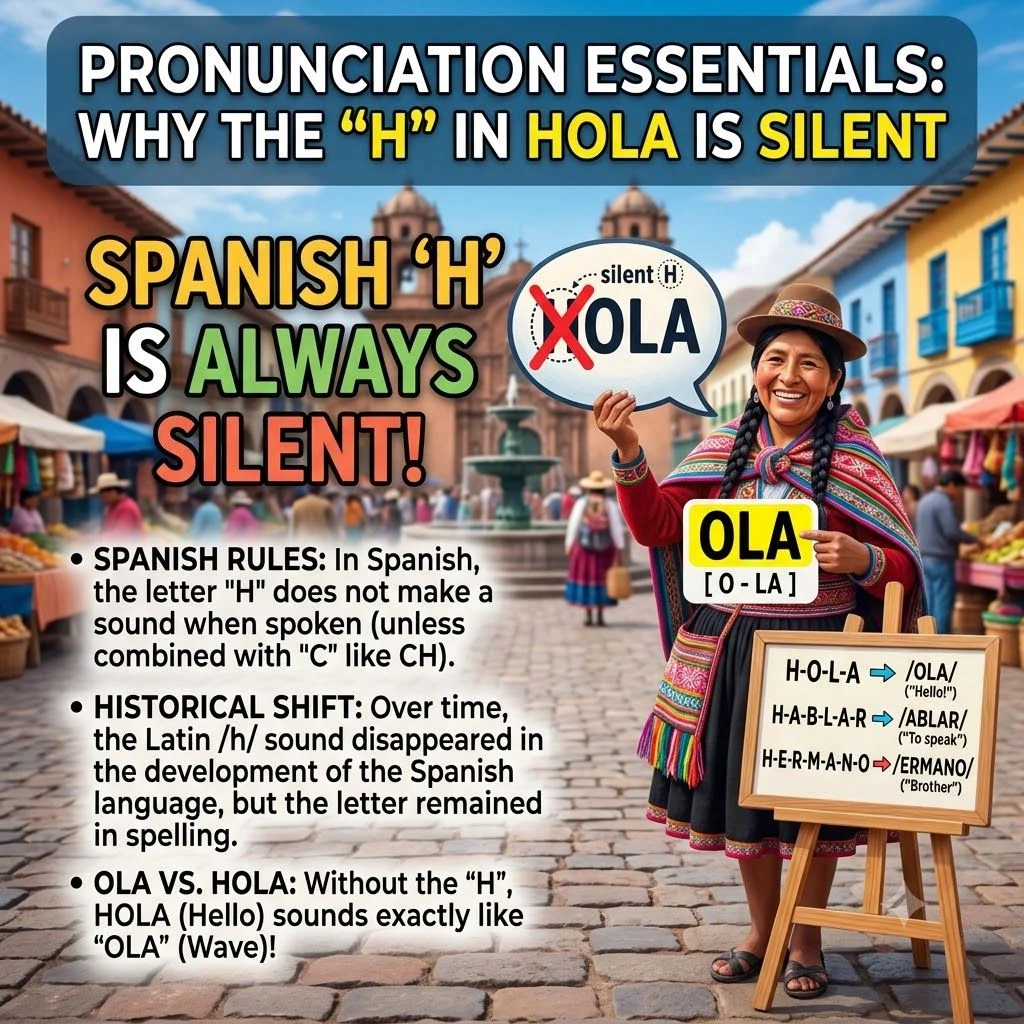
Pronouncing hola correctly is just as important as knowing its meaning. One of the first things Spanish learners notice is that the word begins with the letter H, yet that letter is completely silent in modern Spanish. This pronunciation rule often surprises English speakers because the H is usually pronounced in English words like house or happy. Learning this difference helps you sound more natural, improves your listening skills, and prevents common speaking mistakes.
Spanish pronunciation is generally consistent, making it easier to learn once you understand a few basic rules. By mastering the correct pronunciation of hola, you’ll build confidence in everyday conversations and gain a stronger understanding of how Spanish spelling and pronunciation work together.
How to pronounce “Hola”
Hola
Hola is pronounced as OH-lah, with the stress placed on the first syllable. Since the H is silent, the word begins directly with the “O” sound.
Here’s a simple breakdown:
- Ho → Pronounced like “oh”
- La → Pronounced “lah”
When spoken naturally, the word sounds smooth and relaxed: OH-lah.
Examples in everyday conversation include:
- Hola, ¿cómo estás? (Hello, how are you?)
- ¡Hola, amigos! (Hello, friends!)
- Hola, mucho gusto. (Hello, nice to meet you.)
Listening to native speakers and repeating the word aloud is one of the best ways to develop accurate pronunciation.
Why the H is silent
In modern Spanish, the letter H is almost always silent. Although it remains in the spelling for historical reasons, it produces no sound when spoken.
This pronunciation pattern developed over centuries as the Spanish language evolved. Earlier forms of the language contained sounds that gradually disappeared from speech, while the written spelling was preserved. As a result, words like hola, hora (hour), hermano (brother), and hacer (to do or make) all begin with a silent H.
Understanding this rule makes Spanish pronunciation more predictable because you can confidently ignore the H in most native Spanish words.
Common mistakes to avoid
Many beginners make pronunciation errors because they apply English pronunciation rules to Spanish. Avoiding these mistakes will help your speech sound clearer and more natural.
- Don’t pronounce the H. Saying “HO-lah” is incorrect because the H has no sound.
- Don’t overemphasize the second syllable. The natural stress falls on OH, not lah.
- Don’t confuse “hola” with “ola.” Although both are pronounced the same, hola means “hello,” while ola means “wave.” The correct meaning depends entirely on the spelling and context.
- Avoid English vowel sounds. Spanish vowels are generally short and consistent, so pronounce the O and A clearly instead of stretching or changing them.
With regular practice and exposure to spoken Spanish, pronouncing hola correctly becomes second nature and helps you communicate with greater confidence.
Also Read: Family and Friends or Friends and Family: Which Is Correct?
Ola vs Hola: Exact Meaning & Key Differences
Although Hola and Ola differ by just one letter, they have completely different meanings. This small spelling difference often causes confusion among language learners, travelers, and people searching for translations online. The key is to remember that hola is a greeting, while ola refers to a physical wave.
Because the letter H is silent in Spanish, both words are pronounced almost the same. However, their spelling, meaning, and usage are entirely different. Choosing the correct word is essential for clear communication and accurate writing.
“Hola” = Hello
Hola means “hello” in Spanish. It is the standard greeting used to welcome someone, begin a conversation, answer a phone call, or acknowledge another person.
You can use hola in many everyday situations, including:
- Greeting friends and family.
- Meeting someone for the first time.
- Starting an email or informal message.
- Speaking with coworkers or classmates.
Examples:
- Hola, ¿cómo estás? (Hello, how are you?)
- ¡Hola, María! (Hello, Maria!)
- Hola a todos. (Hello, everyone.)
Since hola is suitable for both casual and polite conversations, it is one of the first Spanish words most learners memorize.
“Ola” = Wave
Ola means “wave” in both Spanish and Portuguese. It refers to a moving wave of water in the sea, ocean, lake, or other body of water. Unlike hola, it is not used as a greeting in Spanish.
Examples:
- La ola era enorme. (The wave was enormous.)
- Las olas golpeaban la playa. (The waves crashed against the beach.)
- El surfista montó una ola perfecta. (The surfer rode a perfect wave.)
Because ola is a common noun rather than a greeting, its meaning always depends on the context of water or movement.
Side-by-side comparison
| Feature | Hola | Ola |
| Meaning | Hello | Wave |
| Part of speech | Greeting (interjection) | Noun |
| Language | Spanish | Spanish and Portuguese |
| Primary use | Greeting people | Referring to a water wave |
| Pronunciation | OH-lah | OH-lah |
| Context | Conversations, messages, introductions | Beaches, oceans, surfing, nature |
The easiest way to remember the difference is:
- Hola = Hello
- Ola = Ocean wave
Although they sound alike, context and spelling determine the correct word.
Real examples in sentences
Seeing the words in complete sentences makes their meanings much easier to understand.
Correct use of “Hola”:
- Hola, mucho gusto. (Hello, nice to meet you.)
- Hola, ¿qué tal? (Hello, how’s it going?)
- Ella dijo: “Hola” al entrar en la habitación. (She said “hello” as she entered the room.)
Correct use of “Ola”:
- Una gran ola llegó hasta la orilla. (A large wave reached the shore.)
- Los niños observaban las olas desde la playa. (The children watched the waves from the beach.)
- El viento creó olas más altas. (The wind created higher waves.)
Incorrect: Ola, ¿cómo estás? ❌
Correct: Hola, ¿cómo estás? ✅
Remember this simple rule: Use “hola” when greeting someone and “ola” when talking about waves. This distinction will help you avoid one of the most common spelling mistakes involving these two Spanish words.
Hola in Other Languages & Global Usage
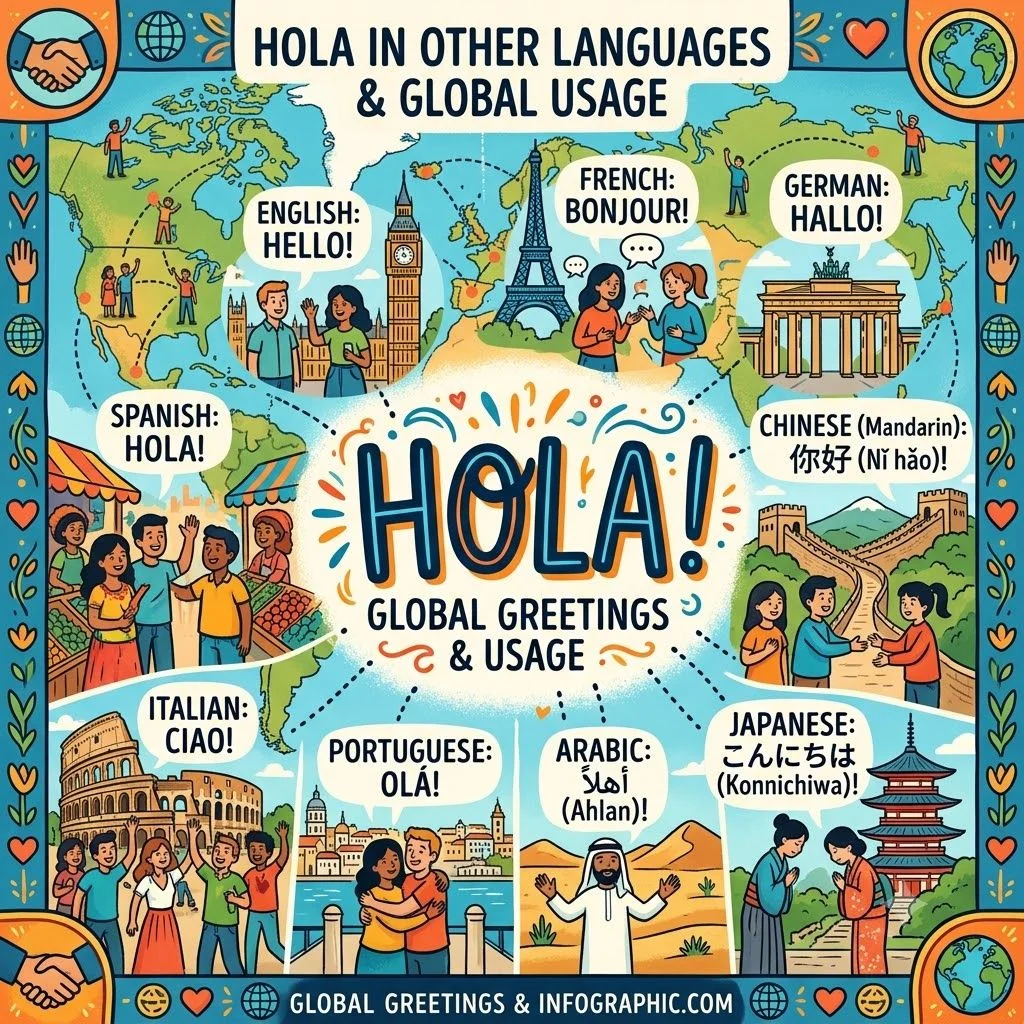
Although hola is a Spanish greeting, its popularity extends far beyond Spanish-speaking countries. Thanks to international travel, social media, music, movies, and cultural exchange, millions of people recognize hola even if they do not speak Spanish. Today, it is one of the world’s most familiar greetings and is often used to create a friendly, welcoming tone.
At the same time, every language has its own way of saying “hello.” Learning these greetings helps you communicate respectfully with people from different cultures while also improving your understanding of language diversity. Although hola may be widely recognized, it should not replace the native greeting of another language unless you’re intentionally speaking Spanish.
Where “Hola” appears globally
Hola is the standard greeting throughout the Spanish-speaking world. It is used in everyday conversations, schools, workplaces, businesses, customer service, television, literature, and online communication.
You’ll commonly hear or see hola in:
- Spain
- Mexico
- Argentina
- Colombia
- Peru
- Chile
- Costa Rica
- Cuba
- Dominican Republic
- Most other Spanish-speaking countries in Latin America
Beyond these regions, hola frequently appears in:
- International tourism and travel
- Language-learning courses
- Social media captions and comments
- Movies, TV shows, and music
- Multilingual advertising campaigns
- Friendly online conversations
Its widespread recognition has made hola one of the easiest foreign-language greetings for English speakers to identify, even if they know very little Spanish.
Comparison table
| Language | Greeting | Meaning in English | Notes |
| Spanish | Hola | Hello | Standard greeting used in all situations |
| English | Hello | Hello | Universal English greeting |
| Portuguese | Olá | Hello | Includes an accent mark (á) and differs from Spanish hola |
| French | Bonjour | Good day / Hello | Common daytime greeting |
| Italian | Ciao | Hi / Bye | Used informally for both greetings and farewells |
| German | Hallo | Hello | Everyday greeting similar to English “hello” |
| Dutch | Hallo | Hello | Widely used in both casual and polite conversations |
| Japanese | Konnichiwa | Hello / Good afternoon | Used during the daytime |
| Arabic | As-salāmu ʿalaykum | Peace be upon you | Traditional greeting in many Arabic-speaking communities |
| Hindi | Namaste | Greetings | A respectful greeting often accompanied by folded hands |
This comparison shows that while hola is unique to Spanish, every language has its own greeting that reflects its culture and communication style. Learning these differences not only expands your vocabulary but also helps you greet people appropriately in different linguistic and cultural settings.
Read More: Newfound vs New-Found: What’s The Difference 2026
Is “Hola” Formal or Informal?
Hola is one of the few Spanish greetings that works in both formal and informal situations. Unlike some languages that use different greetings depending on the level of respect, hola is universally accepted as a polite way to say “hello.”
You can use hola when greeting:
- Friends and family
- Coworkers and classmates
- Teachers and professors
- Customers and clients
- Neighbors and strangers
The level of formality usually comes from the words that follow hola, not the greeting itself.
For example:
- Hola, Ana. (Casual)
- Hola, señor García. (Formal)
- Hola, buenos días. (Polite and professional)
Because it is simple, respectful, and widely understood, hola is considered a safe greeting in almost every everyday situation.
When Should You Say “Hola”?
You can say hola whenever you want to greet someone in Spanish. It is appropriate regardless of the time of day and can be used in both spoken and written communication.
Common situations include:
- Meeting someone for the first time.
- Greeting friends or family.
- Starting a phone or video call.
- Sending a text message.
- Beginning an email (especially informal or semi-formal ones).
- Entering a store or restaurant.
- Joining an online meeting with Spanish speakers.
Examples:
- Hola, ¿cómo estás?
- Hola, equipo.
- Hola, gracias por tu ayuda.
Although hola works at any time, speakers often combine it with greetings such as buenos días, buenas tardes, or buenas noches to sound even more natural.
Common Responses to “Hola”
When someone says hola, there are many appropriate ways to respond. Your reply depends on the situation, your relationship with the speaker, and the level of formality.
Casual replies
These responses are common among friends, family members, classmates, and people you know well.
- ¡Hola!
- Hola, ¿cómo estás?
- ¡Qué tal!
- Muy bien, gracias. ¿Y tú?
- Todo bien, ¿y tú?
Example:
A: Hola.
B: ¡Hola! ¿Cómo estás?
Formal replies
In professional or respectful settings, these responses sound more polite.
- Hola, mucho gusto.
- Buenos días.
- Buenas tardes.
- Muy bien, gracias. ¿Y usted?
- Es un placer conocerle.
Example:
A: Hola, señor López.
B: Buenos días. ¿Cómo está usted?
Other Ways to Say Hello in Spanish
While hola is the most common greeting, Spanish offers several alternatives depending on the time of day, formality, and conversation style.
Buenos días
Buenos días means “good morning.”
It is commonly used from morning until around noon and is suitable for both formal and informal situations.
Example:
- Buenos días. ¿Cómo amaneció?
- Buenos días, profesora.
Buenas tardes
Buenas tardes means “good afternoon.”
It is typically used from around noon until evening and is appropriate in workplaces, schools, businesses, and everyday conversations.
Example:
- Buenas tardes, ¿en qué puedo ayudarle?
- Buenas tardes a todos.
Buenas noches
Buenas noches means “good evening” or “good night.”
People use it when greeting someone during the evening or saying goodbye before bedtime.
Example:
- Buenas noches, hasta mañana.
- Buenas noches, familia.
¿Qué tal?
¿Qué tal? literally means “How’s it going?” or “How are things?”
It is an informal greeting used with friends, coworkers, and acquaintances.
Example:
- ¡Hola! ¿Qué tal?
- ¿Qué tal tu día?
¿Cómo estás?
¿Cómo estás? means “How are you?”
It is one of the most common follow-up questions after saying hola. The phrase is informal and is typically used with friends, family, classmates, or people your own age.
Example:
- Hola, ¿cómo estás?
- Estoy muy bien, gracias.
For formal situations, Spanish speakers usually say:
- ¿Cómo está usted?
Read More: Annunciate vs Enunciate: Understanding the Difference in 2026
Common Phrases That Start with “Hola”
Many everyday Spanish expressions begin with hola. These phrases make greetings sound more complete and help conversations start naturally.
Hola, ¿cómo estás?
This is one of the most common greetings in Spanish.
Meaning:
“Hello, how are you?”
Example:
- Hola, ¿cómo estás? Hace tiempo que no te veo.
It is friendly, polite, and suitable for most informal conversations.
Hola a todos
Hola a todos means “Hello, everyone.”
It is commonly used when addressing a group of people.
Examples:
- Hola a todos, bienvenidos al curso.
- Hola a todos, gracias por acompañarnos hoy.
You’ll often hear this phrase in classrooms, presentations, livestreams, podcasts, and YouTube videos.
Hola, mucho gusto
This phrase means “Hello, nice to meet you.”
It is commonly used when meeting someone for the first time.
Example:
- Hola, mucho gusto. Soy Laura.
- Hola, mucho gusto en conocerlo.
It creates a friendly and respectful first impression.
Hola, ¿qué tal?
Hola, ¿qué tal? combines “hello” with “how’s it going?”
It is one of the most natural greetings among friends, coworkers, neighbors, and classmates.
Example:
- Hola, ¿qué tal? ¿Cómo estuvo tu fin de semana?
Because it is relaxed and conversational, this phrase is frequently heard in everyday spoken Spanish
How English Speakers Can Use “Hola” Naturally
As Spanish has become one of the most widely spoken languages in the world, many English speakers occasionally use hola in conversation, text messages, and online posts. When used appropriately, it can sound warm and friendly. However, using it in the wrong setting may seem unnatural or confusing, especially if the people you’re speaking with do not understand Spanish.
The best approach is to consider your audience, purpose, and communication context. Using hola should feel genuine rather than forced, and it should never replace clear communication.
When it feels natural
Using hola feels natural when there is a clear connection to the Spanish language or culture.
Common situations include:
- Greeting Spanish-speaking friends or colleagues.
- Traveling in a Spanish-speaking country.
- Participating in bilingual conversations.
- Writing social media posts with a Spanish theme.
- Attending cultural events or language classes.
- Beginning casual conversations with people who commonly use Spanish.
Examples:
- Hola, everyone! Welcome to today’s livestream.
- Hola! Hope you’re having a great day.
- Hola, amigos! Thanks for joining us.
In these situations, hola adds a friendly touch without distracting from the message.
When it feels forced
There are times when using hola may not fit the situation.
Avoid using it when:
- Your audience does not understand Spanish.
- It appears random or unrelated to the conversation.
- You’re trying to sound trendy instead of communicating clearly.
- It replaces standard greetings in formal situations without reason.
- It could create confusion about the language being used.
For example:
❌ Hola everyone, let’s discuss quarterly tax compliance.
While not technically incorrect, a formal business meeting usually sounds more natural with “Hello everyone.”
Choosing the greeting that best matches the audience always improves clarity and professional communication.
Examples of natural integration
Here are examples of hola used naturally in English conversations and writing.
- Hola! I just arrived in Barcelona.
- Hola, friends! Thanks for all the birthday wishes.
- Hola everyone—today we’re sharing our travel highlights from Spain.
- Our Spanish teacher greeted us with “Hola” every morning.
- She smiled and said, “Hola,” before introducing herself.
These examples work because hola fits the topic, audience, or cultural setting.
Professional use
In most professional environments, Hello, Good morning, or Good afternoon remain the safest greetings. However, hola can be appropriate when:
- Communicating with Spanish-speaking clients.
- Working for bilingual organizations.
- Hosting multicultural events.
- Creating Spanish-language marketing materials.
- Managing international customer support.
For example:
- Hola, thank you for contacting our support team.
- Hola, Carlos. We appreciate your message.
Using hola professionally works best when it supports effective communication rather than replacing standard business etiquette.
Hola in Pop Culture, Media & the Internet
The popularity of hola extends well beyond everyday conversation. Over the past few decades, it has become a familiar expression in music, movies, television, social media, and digital communication. Many people who have never formally studied Spanish still recognize the word because of its frequent appearance in global entertainment.
Its widespread use reflects the growing influence of Spanish-speaking cultures and the increasing popularity of bilingual communication around the world.
Key influences
Several factors have contributed to the worldwide recognition of hola.
These include:
- Spanish-language songs reaching international audiences.
- Movies and television featuring bilingual characters.
- Travel and tourism across Spanish-speaking countries.
- Online language-learning platforms.
- International brands using Spanish greetings in marketing.
- YouTube creators, influencers, and streamers greeting viewers with hola.
- Cultural festivals celebrating Hispanic traditions.
Together, these influences have made hola one of the most recognizable greetings across different cultures.
Case Study: Bilingual Social Media
Social media platforms often blend English and Spanish to create engaging, inclusive content.
For example, a travel creator visiting Mexico might write:
Hola, everyone! Today we’re exploring Mexico City’s hidden gems.
A lifestyle influencer may begin a video with:
Hola, friends! Welcome back to my channel.
These greetings feel natural because the surrounding content relates to Spanish-speaking culture, travel, or bilingual audiences. Rather than replacing English, hola serves as a welcoming expression that reflects the creator’s audience or theme.
This style of communication demonstrates how languages can coexist naturally while maintaining clarity and authenticity.
Read More: Froze vs Frozen: When to Use Each Correctly? 2026
Fun Facts About the Word “Hola”
The Spanish greeting hola may seem like a simple word, but it has a fascinating history and a remarkable global presence. Here are 10 interesting facts that make hola one of the world’s most recognizable greetings.
1. Hola means “hello”
The most basic fact is also the most important. Hola is the standard Spanish greeting for “hello” and is used in both formal and informal conversations.
2. The H is completely silent
Although hola begins with the letter H, it is pronounced OH-lah because the H is silent in modern Spanish.
3. It works at any time of day
Unlike greetings such as buenos días (good morning) or buenas noches (good evening/night), hola can be used in the morning, afternoon, or evening.
4. It’s one of the first Spanish words people learn
Whether someone is taking a Spanish class or using a language-learning app, hola is usually among the very first vocabulary words introduced.
5. It’s recognized around the world
Even people who don’t speak Spanish often understand hola thanks to movies, music, travel, social media, and international culture.
6. Hola and ola sound almost identical
Because the H is silent, hola and ola are pronounced nearly the same. The difference lies in their spelling and meaning—hola means “hello,” while ola means “wave.”
7. It’s used in more than 20 countries
Spanish is an official language in over 20 countries, and hola is the everyday greeting across nearly all of them.
8. It appears in countless songs and movies
Many Spanish-language songs, television shows, films, and advertisements begin with or include hola, helping the word become familiar to audiences worldwide.
9. It fits almost every conversation
You can use hola when greeting friends, coworkers, teachers, customers, neighbors, or even strangers. Its versatility makes it one of the safest and most useful Spanish greetings.
10. One simple word opens the door to Spanish
Learning hola is often the first step toward understanding the Spanish language. It introduces learners to Spanish pronunciation, conversation, and everyday communication, making it an excellent starting point for building language skills.
Frequently Asked Questions
Is hola only used in Spanish?
Yes. Hola is the standard greeting in Spanish, although many non-Spanish speakers recognize and occasionally use it because of its global popularity.
What does hola mean in English?
Hola translates directly to “hello.”
Is hola formal or informal?
It is suitable for both formal and informal situations. You can greet friends, coworkers, teachers, customers, or strangers with hola.
Is hola the same as ola?
No. Hola means “hello,” while ola means “wave.” Although they are pronounced almost the same, their meanings and uses are completely different.
Why is the H silent in hola?
Modern Spanish generally does not pronounce the letter H. Therefore, hola is pronounced OH-lah.
Can English speakers say hola?
Yes. English speakers can naturally use hola when speaking with Spanish speakers, discussing Spanish culture, traveling, or participating in bilingual conversations.
Is hola used around the world?
While it is a Spanish greeting, hola is widely recognized internationally because of travel, entertainment, education, and social media.
Conclusion
Understanding the difference between hola and ola helps you communicate more accurately and confidently. Although the two words look and sound similar, hola is the Spanish greeting meaning “hello,” while ola refers to a wave. Recognizing this distinction prevents common spelling mistakes and ensures you choose the correct word in both writing and conversation.
Learning the meaning, pronunciation, history, and real-world usage of hola also provides valuable insight into Spanish language and culture. Whether you’re studying Spanish, traveling abroad, communicating with native speakers, or simply expanding your vocabulary, using hola correctly is a small step that can make your interactions more natural and respectful.
The more you practice greetings in their proper context, the easier it becomes to communicate across languages with confidence and cultural awareness.

Hi, I am Zadie Smith, the author of Grammargide.com. I write clear, easy-to-understand guides that explain commonly confused words and phrases, helping readers choose the right expression with confidence.