
Choosing between full time and fulltime can be confusing because both forms appear in English writing, but they do not serve the same grammatical purpose. The correct form often depends on whether the phrase is being used as an adverb, adjective, or part of a job description. Understanding this distinction is important when writing resumes, applications, workplace documents, academic work, or everyday messages, where a small spelling difference can affect clarity and correctness.
In this guide, you will learn the difference between full time and fulltime, including when each form is appropriate, how the words function in a sentence, and which spelling is generally preferred in standard English. You will also see practical usage guidance to help you avoid common writing mistakes. Continue reading to understand the rule clearly and use the correct form with confidence.
The Origin of Full Time or Fulltime
The expression full time developed from the broader use of full to describe something complete, entire, or occupying the whole available period. In employment and scheduling contexts, it came to describe work or activity performed for the normal or complete working period rather than on a reduced schedule. Over time, full time became a common expression in phrases such as “work full time” and “a full-time position.”
The spelling can become confusing because English often combines frequently used word pairs into compound forms. However, fulltime is generally not the standard spelling when the phrase functions as an adjective or adverb. In modern standard English, full-time is normally used before a noun, while full time is commonly used after a verb or in other adverbial constructions.
For example:
- She works full time.
- He accepted a full-time position.
- They are looking for a full-time employee.
This distinction is mainly about grammatical function and punctuation, rather than a difference in meaning.
British English vs American English Spelling
Both British and American English generally recognize full time as an open phrase and full-time as a hyphenated compound adjective. The important point is not usually a different national spelling, but where the expression appears in a sentence.
The form fulltime, written as one word, is not the usual standard form in either variety when referring to working or studying for the whole normal period. Writers should therefore avoid treating fulltime as simply an alternative spelling of full time.
American English
In American English, full time is commonly written as two words when it functions adverbially.
- She works full time at the hospital.
- He studies full time at the university.
When the expression comes directly before a noun and acts as a compound modifier, American English normally uses a hyphen:
- She has a full-time job.
- He is a full-time student.
- They hired a full-time manager.
This distinction helps readers immediately understand how the expression functions in the sentence. The spelling fulltime is generally not preferred in standard American English.
British English
British English follows essentially the same distinction. Full time is normally written as two words when it follows a verb or functions adverbially:
- She works full time.
- He studies full time.
The hyphenated full-time form is used when the expression modifies a noun:
- She has a full-time position.
- He is a full-time employee.
- They offer full-time education.
Therefore, British and American English do not normally differ by using fulltime versus full time. In both varieties, the standard choice depends mainly on sentence position and grammatical function.
Comparison Table
| Usage | American English | British English | Example |
|---|---|---|---|
| After a verb | full time | full time | She works full time. |
| Before a noun | full-time | full-time | She has a full-time job. |
| One-word form | fulltime is generally avoided | fulltime is generally avoided | Use full time or full-time instead. |
| Main distinction | Grammar and sentence position | Grammar and sentence position | Hyphenation depends on function. |
The key rule is simple: use “full time” when it functions as an adverbial phrase and “full-time” when it works as a compound adjective before a noun.
Read More: Coach vs Couch: Which Word Should You Use? 2026
Which Spelling Should You Use?
For most standard English writing, the choice should be between full time and full-time, not fulltime. The correct form depends on the role the expression plays in your sentence.
Use full time when describing how someone works, studies, or performs an activity:
- I work full time.
- She studies full time.
Use full-time when the expression comes before a noun and describes that noun:
- I have a full-time job.
- She is a full-time student.
This pattern is especially useful in resumes, job applications, workplace communication, educational writing, and formal documents, where consistent standard usage improves clarity.
For US Audiences
When writing for a US audience, follow standard American English conventions:
- She works full time.
- He is a full-time employee.
- They advertised a full-time position.
Avoid using fulltime as a general replacement for both forms. If the expression modifies a noun, the hyphen makes the relationship between the two words clear.
For example, full-time employee clearly works as one descriptive unit. Without the hyphen, readers can still understand the phrase, but standard compound-modifier punctuation favors full-time.
For UK Audiences
For a UK audience, the same basic rule applies:
- She works full time.
- He is a full-time employee.
- They offer full-time courses.
British English does not normally require fulltime as a separate British spelling. The distinction remains primarily grammatical: full time is used in adverbial contexts, while full-time is used as a compound adjective before a noun.
If you are writing for both US and UK readers, using full time and full-time according to their grammatical function provides a clear and widely accepted approach.
For International Audiences
For international readers, the same basic distinction between full time and full-time is useful because it follows standard English grammar rather than a country-specific spelling difference. When the phrase describes how someone works or studies, use full time as two words. When it comes before a noun and acts as a compound adjective, use full-time with a hyphen.
Examples:
- She works full time.
- He studies full time.
- She found a full-time job.
- They need a full-time employee.
The one-word form fulltime should generally be avoided in standard English writing. This approach works well for international communication, including resumes, websites, emails, applications, and educational writing.
Quick Rule
A simple way to remember the difference is:
- Full time = describes how someone works, studies, or does something.
- Full-time = describes a noun that follows it.
- Fulltime = generally avoid this one-word spelling.
Compare:
- I work full time.
- I have a full-time job.
The hyphen connects full and time when they work together as a single modifier before a noun.
Common Mistakes with Full Time or Fulltime
Confusion about full time, full-time, and fulltime usually comes from treating the expression as though it has only one fixed spelling. In fact, its form changes according to its grammatical position. Recognizing whether the phrase modifies a noun or describes an action can prevent most errors.
Mistake 1: Using Fulltime as One Word
A common mistake is writing fulltime as one word in standard English.
Incorrect:
She works fulltime at the company.
Correct:
She works full time at the company.
The standard form in this type of sentence is full time, because the expression describes the manner or schedule of working. The same rule applies to similar sentences involving studying or other activities.
Mistake 2: Forgetting the Hyphen
Another common mistake occurs when full time comes directly before a noun but the writer leaves out the hyphen.
Incorrect:
He is a full time employee.
Correct:
He is a full-time employee.
Here, full-time acts as a compound adjective describing employee. The hyphen shows that the two words function together as one modifier.
Other examples include:
- full-time student
- full-time position
- full-time worker
- full-time course
Mistake 3: Using a Hyphen After the Noun
The opposite mistake is adding a hyphen when full time follows the noun or verb.
Incorrect:
She works full-time.
Correct:
She works full time.
In this construction, the phrase is used adverbially rather than as a compound adjective before a noun. Therefore, the hyphen is normally unnecessary.
Compare the two structures:
- She works full time.
- She has a full-time job.
The position of the expression determines whether the hyphen is needed.
Mistake 4: Mixing Styles
Writers sometimes use fulltime, full time, and full-time inconsistently within the same document. This can make otherwise polished writing look careless.
For example, a resume might contain:
- Fulltime employee
- Full-time experience
- Works full-time
A clearer approach is to apply the grammatical rule consistently:
- full-time employee
- full-time experience
- works full time
Consistency is especially important in professional documents, resumes, academic writing, and formal websites. Once you identify whether the phrase is modifying a noun or describing an action, choosing the correct form becomes much easier.
Read More: Vender or Vendor: Which One Is Correct in 2026?
Full Time or Fulltime in Everyday Examples
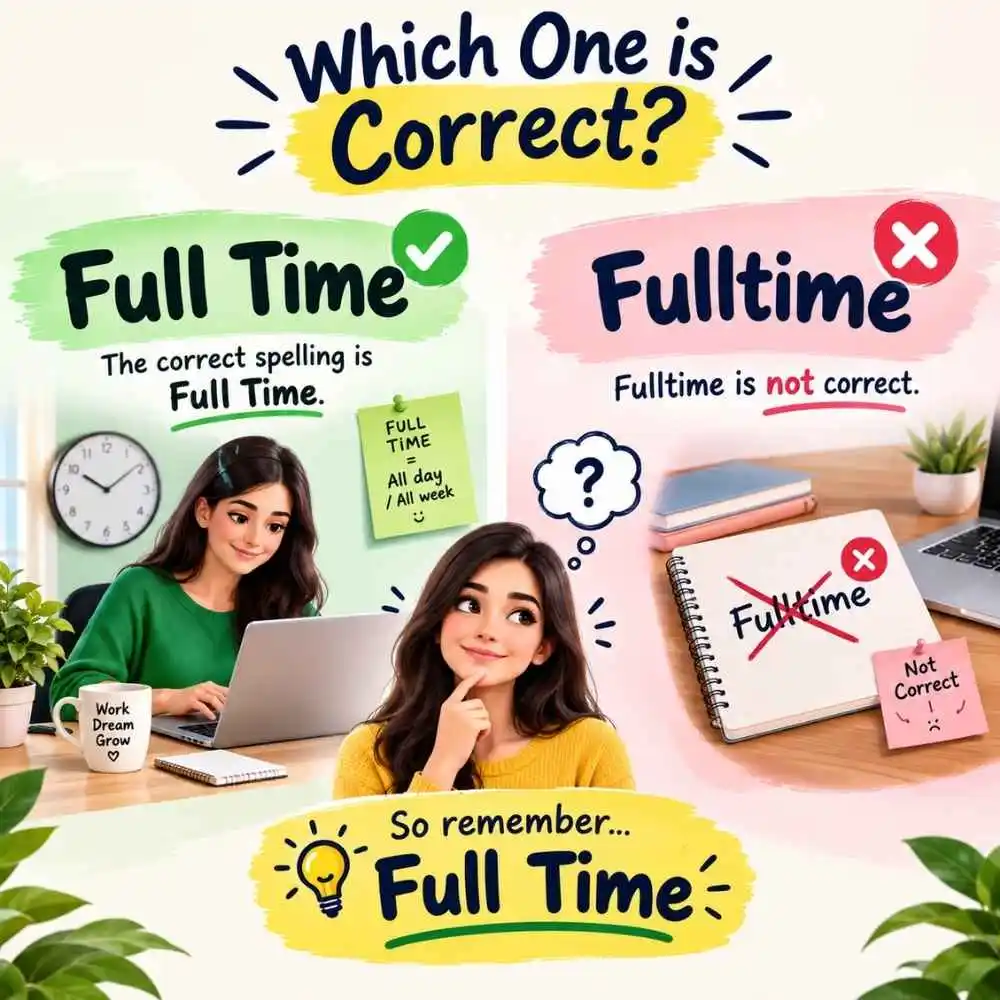
The difference between full time, full-time, and fulltime becomes easier to understand when you see how the expression works in real writing. The main rule remains consistent: use full time when it describes an activity, and use full-time when it comes before a noun as a compound adjective. The one-word form fulltime is generally not the standard choice.
Emails
In emails, especially workplace communication, use the form that matches the sentence structure.
- I am available to work full time.
- We are hiring a full-time assistant.
- She has accepted a full-time position.
Using the correct form helps keep professional emails clear and polished.
News Articles
News writing often uses both forms because journalists may describe someone’s work schedule or a position.
- The company said it would hire employees to work full time.
- The organization announced several full-time positions.
- He joined the company as a full-time employee.
The choice depends on whether the phrase describes an action or modifies a noun.
Social Media
Social media posts are usually informal, but standard spelling still makes the message easier to read.
- Finally working full time!
- Starting my first full-time job.
- Looking forward to my new full-time role.
Although informal posts sometimes contain shortened or unconventional spellings, fulltime is not normally needed.
Resume Writing
A resume may use full-time frequently because it often describes jobs, positions, roles, and experience.
Examples:
- Full-Time Marketing Assistant
- Full-Time Web Developer
- Worked full time as a content writer.
- Seeking a full-time position in web development.
When full-time appears directly before a job title or another noun, the hyphen helps show that the words form one descriptive unit.
Business Documents
Business documents require consistent and precise wording. Use full time when describing an employee’s schedule and full-time when modifying a noun.
- Employees who work full time receive the standard benefits.
- The company created a full-time position.
- The department needs a full-time manager.
Avoid using fulltime simply to shorten the phrase. Standard compound-word punctuation provides a clearer structure.
Is “Full Time” Hyphenated?
Full time is not normally hyphenated when it functions as an adverbial phrase.
- She works full time.
- He studies full time.
However, full-time is normally hyphenated when it appears before a noun as a compound adjective.
- She has a full-time job.
- He is a full-time employee.
- They offer full-time courses.
A useful test is to look at the word immediately after the expression. If full-time directly describes a noun, the hyphen is generally appropriate. If the phrase describes how someone works or studies, use full time.
The one-word spelling fulltime should generally be avoided in standard English.
Full-Time Meaning in Job
In a job context, full-time describes employment that involves working the normal or complete schedule established for that position or workplace. The exact number of hours can vary by employer, industry, and location, so full-time does not always represent one universal number of hours.
For example:
- She applied for a full-time job.
- He is looking for full-time employment.
- The company offered her a full-time position.
When the expression comes before a job-related noun, full-time functions as a compound adjective. If you describe the person’s work activity instead, use full time:
- She works full time.
- He is employed full time.
This distinction is useful in job advertisements, resumes, employment applications, and workplace communication.
Full-Time or Full-Time Student?
A full-time student is a student who is enrolled in an educational program at a level or course load that the relevant institution classifies as full-time. The exact study load can differ between schools, programs, and education systems.
The standard form before student is full-time student, with a hyphen:
- She is a full-time student.
- He works while studying as a full-time student.
- The university offers support for full-time students.
When the expression follows the verb and describes the student’s study schedule, full time is normally used:
- She studies full time.
- He attends the program full time.
Compare:
| Sentence | Correct Form | Why |
|---|---|---|
| She works full time. | full time | Describes how she works. |
| She has a full-time job. | full-time | Modifies the noun job. |
| He studies full time. | full time | Describes how he studies. |
| He is a full-time student. | full-time | Modifies the noun student. |
| She applied for a full-time position. | full-time | Modifies the noun position. |
The easiest rule to remember is: full time usually follows the action it describes, while full-time comes before a noun that it modifies.
Full Time or Full-Time?
Full time and full-time are both used in standard English, but their form depends on how they function in a sentence. The main distinction is whether the expression is describing an action or directly modifying a noun. The one-word form fulltime is generally best avoided in ordinary standard English writing.
Use full-time as a compound adjective:
Use full-time when the two words work together as a compound adjective before a noun. The hyphen shows that full and time form one descriptive unit.
Examples:
- She has a full-time job.
- He accepted a full-time position.
- They need a full-time employee.
- She is a full-time student.
- The university offers a full-time program.
In each example, full-time directly describes the noun that follows it. The hyphen therefore helps make the grammatical relationship clear.
Use full time when it functions as an adverb:
Use full time as two words when it describes how or to what extent someone works, studies, or performs an activity.
Examples:
- She works full time.
- He studies full time.
- I am employed full time.
- They decided to work full time.
Here, full time does not directly modify a noun. Instead, it provides information about the action expressed by the verb. Some style guides may retain a hyphen in certain adverbial constructions, but full time is a clear general form for standard usage.
Read More: Greatful or Grateful: Is There a Difference Between Them? 2026
Full Time or Fulltime – Google Trends & Usage Data
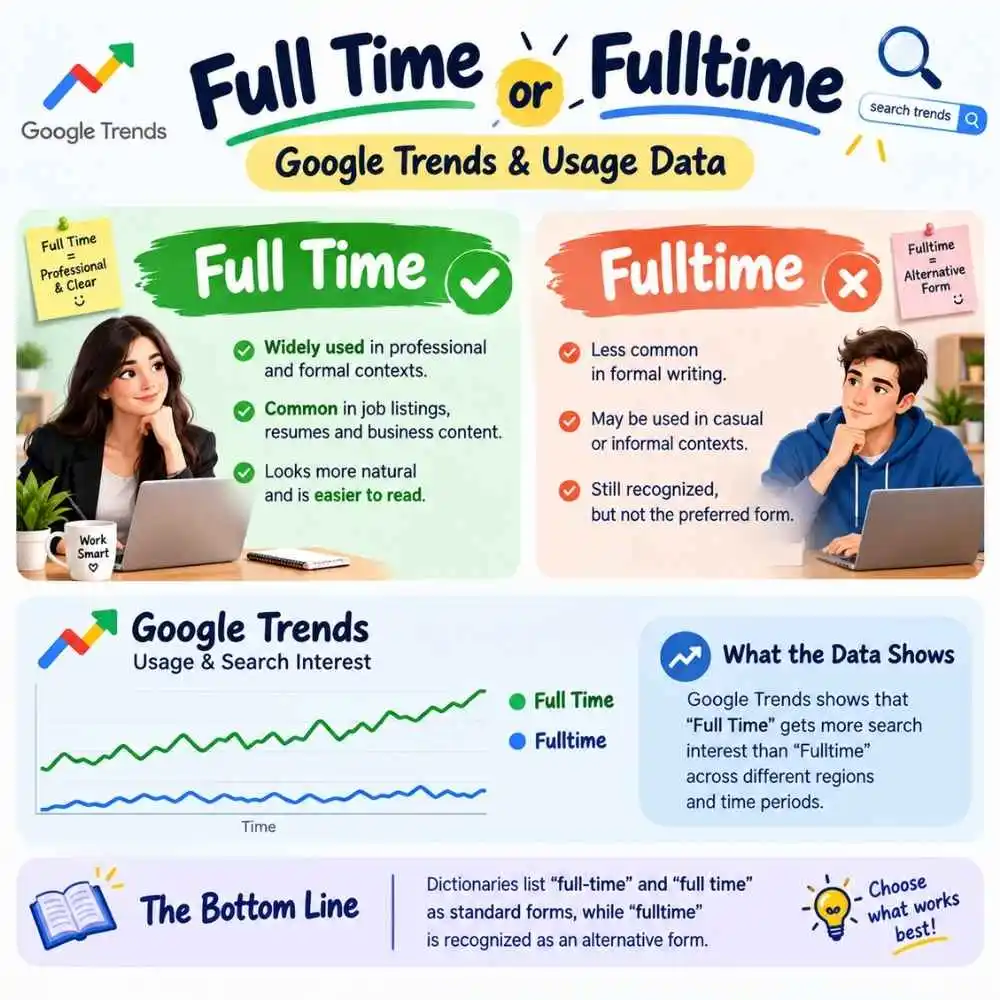
Search interest can help explain why people encounter several versions of this expression online, but search frequency does not determine grammatical correctness. People may search full time, full-time, or fulltime because they are checking spelling, looking for employment, searching for education options, or trying to understand hyphenation.
The available usage discussions consistently distinguish full time and full-time according to grammatical function, while fulltime appears as a less standard or alternative one-word form in some online sources.
Because Google Trends values can change over time and depend on the selected country, date range, and search category, exact trend numbers should not be presented without a specific Trends dataset. It is more useful to interpret the searches by country and intent rather than treating search volume as proof of the correct spelling.
Popular Countries
Searches involving full time and full-time occur in English-speaking markets such as the United States, United Kingdom, Canada, Australia, and New Zealand. The phrase also appears frequently in international English because employment and education websites use it globally.
However, country-level search interest can change depending on the topic. Employment-related searches may be influenced by local job markets, while grammar-related searches are more likely to reflect users checking spelling or punctuation.
For international content, the safest standard forms remain:
- full time when used adverbially.
- full-time before a noun.
- fulltime generally avoided in edited prose.
Common Search Intent
People searching Full Time or Fulltime may have several closely related questions:
- Is fulltime one word?
- Should full time have a hyphen?
- Is it full time or full-time?
- How should full-time be written on a resume?
- Is full-time student hyphenated?
- Should I write “I work full time” or “I work full-time”?
- What does full-time mean in a job?
This search intent is mainly about spelling, hyphenation, grammar, and practical usage. Employment and education are also common contexts because the expression frequently appears in job descriptions, resumes, university information, and workplace communication.
Full Time vs Full-Time vs Fulltime Comparison Table
| Form | Standard Use | Main Function | Example |
|---|---|---|---|
| full time | Yes | Adverbial expression | She works full time. |
| full-time | Yes | Compound adjective | She has a full-time job. |
| fulltime | Generally avoid | One-word alternative/nonstandard form in ordinary prose | Avoid fulltime in formal writing. |
| full time | Common after a verb | Describes an activity or schedule | He studies full time. |
| full-time | Common before a noun | Describes a job, person, position, or program | He is a full-time student. |
The simplest rule is “work full time” but “full-time job.” This distinction covers most everyday, professional, academic, and online writing situations.
FAQS
1. Is “Full Time” One Word or Two Words?
Full time is normally written as two words when it functions as an adverbial phrase, as in “She works full time.” When it comes before a noun as a compound adjective, use full-time, as in “She has a full-time job.”
2. Is “Fulltime” Correct?
Fulltime is generally not the preferred form in standard English writing. In most situations, choose full time or full-time according to the grammatical role of the phrase.
3. Should “Full-Time” Always Have a Hyphen?
No. Use full-time when it works as a compound adjective before a noun, such as “a full-time employee.” When it follows a verb and describes an activity, full time is normally used: “He works full time.”
4. Is It “Full Time Job” or “Full-Time Job”?
The standard form is full-time job. The hyphen connects the two words because together they modify the noun job.
5. Is It “I Work Full Time” or “I Work Full-Time”?
The usual form is I work full time. Here, the phrase describes how the person works rather than directly modifying a noun.
6. Is “Full-Time Student” Correct?
Yes. Full-time student is the standard form when the phrase appears before the noun student. For example: “She is a full-time student.”
7. Is “Full-Time” Used in Resumes?
Yes. Full-time is commonly used in resumes when describing a job, position, role, or employment type. For example, “Full-Time Web Developer” and “Full-Time Content Writer” use the hyphenated form as a compound modifier.
8. Is “Full Time” the Same in British and American English?
The basic distinction is similar in British and American English. Both commonly use full time when the expression functions adverbially and full-time when it modifies a noun. The one-word form fulltime is generally avoided in both varieties.
9. What Does Full-Time Mean in a Job?
Full-time describes employment that involves the normal or complete work schedule established for a particular job or employer. The exact number of hours can vary by workplace, industry, and location.
10. Which Is Correct: Full Time, Full-Time, or Fulltime?
Both full time and full-time are correct when used in the appropriate grammatical position. Fulltime is generally best avoided in standard edited writing. Remember: “She works full time,” but “She has a full-time job.”
Conclusion
Understanding full time, full-time, and fulltime becomes much easier once you focus on grammatical function. Full time is generally used when the expression describes an action or schedule, while full-time is used as a compound adjective before a noun. The one-word form fulltime is generally not the preferred choice in standard English.
This distinction is useful in everyday communication as well as resumes, job applications, emails, academic writing, business documents, and online content. Instead of memorizing several unrelated rules, look at how the expression is being used in the sentence. If it directly modifies a noun, the hyphenated form is usually appropriate.
For a quick reminder, write “I work full time” but “I have a full-time job.” Applying this simple pattern will help you choose the correct form consistently and make your writing clearer and more polished.

I’m Jane Austen, the admin of GrammarGuide.com, where words come to life in smarter, sharper, and more creative ways. I focus on simplifying grammar, exploring powerful synonyms, and sharing fun, engaging expressions that make everyday communication more effective. My goal is to help readers write with clarity, confidence, and a touch of personality, whether it’s for professional use or just for fun.



