Choosing the right article before abbreviations can be confusing, especially when pronunciation does not always match spelling. The question “A MA or An MA” often appears in academic writing, resumes, professional documents, and everyday conversations where people want to use correct English grammar rules.
The confusion happens because many writers focus on the first letter instead of the first sound. Understanding whether to use “a” or “an” depends on pronunciation, not simply on how a word looks. This small grammar choice can affect the clarity and accuracy of your writing.
In this article, you will learn the correct usage of A MA or An MA, the pronunciation rule behind indefinite articles, common mistakes people make, and how to apply this rule in academic and professional contexts. Continue reading to understand the simple rule that makes this grammar choice easier.
Understanding A MA or An MA: The Definitive Guide
The correct choice between “A MA” and “An MA” depends on how the abbreviation is pronounced, not how it appears in writing. Since MA begins with the letter M, many people assume that “a MA” should be correct because the letter itself is a consonant. However, English articles follow sound rules, and the pronunciation of M starts with a vowel sound: “em.”
Because MA is pronounced as “em-ay,” the correct form is “an MA.” For example, you would write, “She earned an MA in English Literature” because the first sound the reader hears is the vowel sound /e/.
This rule applies to many abbreviations and acronyms in English. Writers often make mistakes when they choose articles based only on the first written letter. Learning the difference between visual spelling and spoken pronunciation helps improve accuracy in academic writing, professional communication, and everyday language use.
Using “an MA” correctly also shows a strong understanding of English grammar conventions. Whether you are writing a resume, university application, research paper, or formal email, choosing the right article makes your sentence sound natural and polished.
How English Articles Work: A vs An
English uses the indefinite articles “a” and “an” before singular nouns when the listener or reader does not need to know a specific person, place, thing, or idea. The choice between these two articles depends on the initial sound of the following word or abbreviation.
The article “a” comes before words that begin with a consonant sound, while “an” comes before words that begin with a vowel sound. This pattern makes speech smoother because it avoids difficult sound combinations.
For abbreviations like MA, the same pronunciation-based rule applies. Since MA sounds like “em-ay,” it begins with a vowel sound, so “an MA” is grammatically correct. The written form may start with the letter M, but the spoken form begins with the sound “em.”
Understanding this article rule helps writers avoid common grammar errors. It also improves confidence when using academic abbreviations, professional titles, and shortened forms in formal communication.
The Basic Rule of A and An
The basic rule of “a” and “an” is simple: use “a” before a consonant sound and “an” before a vowel sound. The rule focuses on pronunciation rather than spelling because English contains many words where letters and sounds do not match perfectly.
For example:
- A university → The word “university” starts with the sound “yoo,” which is a consonant sound.
- An hour → The word “hour” begins with a vowel sound because the h is silent.
- An MA → The abbreviation starts with the sound “em,” which is a vowel sound.
The same principle works with other abbreviations. If an abbreviation begins with a sound like “A,” “E,” “I,” “O,” or “U,” it usually takes “an.” If it begins with a consonant sound, it usually takes “a.”
Correct examples:
- She completed an MA in History.
- He is studying for an MBA degree.
- She wants to become a PhD student.
Incorrect examples:
- She completed a MA in History. ❌
- He is studying for a MBA degree. ❌
By focusing on pronunciation, writers can easily choose the correct article even when dealing with abbreviations and academic terms.
Why Sound Matters More Than Spelling
English grammar depends heavily on spoken sounds, which is why pronunciation matters more than spelling when choosing between “a” and “an.” Many learners make mistakes because they look at the first letter instead of listening to the first sound.
In the case of MA, the written letter M may appear to be a consonant, but its pronunciation is “em.” The sound begins with a vowel, so the correct article is “an.”
This sound-based approach makes English articles easier to understand. Consider these examples:
- An MA program ✅
(“MA” sounds like “em-ay”) - A Master of Arts program ✅
(“Master” begins with the consonant sound “m”)
Although MA and Master of Arts refer to the same academic qualification, the article changes because their starting sounds are different.
Recognizing the role of phonetics and pronunciation helps writers make better grammar choices. Instead of memorizing every phrase, learners can apply the sound rule to new words, abbreviations, and expressions with confidence.
Why Abbreviations Cause So Much Grammar Trouble
Abbreviations often create grammar confusion because writers usually focus on the written form instead of the spoken sound. When people see a shortened form like MA, they may choose an article based on the first letter rather than how the abbreviation is pronounced. This mistake happens because English articles follow pronunciation rules, not simple spelling rules.
The challenge becomes greater because abbreviations can begin with letters that sound different from their appearance. For example, MA starts with the letter M, but it is pronounced as “em,” which begins with a vowel sound. That is why the correct phrase is “an MA” instead of “a MA.”
Understanding how abbreviations work helps writers use articles correctly in academic, professional, and everyday communication. Whether you are writing about degrees, organizations, or technical terms, the sound of the abbreviation determines the correct article choice.
Abbreviations That Use AN
Abbreviations use “an” when their pronunciation begins with a vowel sound. The first sound matters more than the first written character. If saying the abbreviation starts with sounds like “A,” “E,” “I,” “O,” or “U,” the article “an” usually comes before it.
Examples include:
- An MA in English → MA is pronounced “em-ay,” starting with a vowel sound.
- An MBA degree → MBA is pronounced “em-bee-ay,” beginning with the vowel sound “em.”
- An FBI investigation → FBI starts with “eff,” which begins with a vowel sound.
- An HR manager → HR is pronounced “aitch-ar,” starting with a vowel sound.
These examples show why spelling alone cannot determine article usage. Even though some abbreviations begin with consonant letters, their pronunciation may require “an.”
Abbreviations That Use A
Abbreviations use “a” when they begin with a consonant sound. The sound at the beginning of the abbreviation controls the article choice, just like it does with regular words.
Examples include:
- A PhD student → PhD is pronounced “pee-aitch-dee,” beginning with the consonant sound “p.”
- A URL address → URL is commonly pronounced “you-are-el,” beginning with the consonant sound “y.”
- A CEO → CEO is often pronounced “see-ee-oh,” beginning with the consonant sound “s.”
These examples prove that abbreviations do not follow a separate grammar system. They follow the same a vs an pronunciation rule used throughout English.
Why Abbreviations Change the Rule
Abbreviations seem to change the usual grammar pattern because their written appearance can hide their actual pronunciation. English speakers do not read every abbreviation as a complete word. Instead, they often pronounce each letter individually, creating a different starting sound.
For instance, MA represents Master of Arts, but speakers usually say the letters separately: “em-ay.” Because the spoken form begins with a vowel sound, it requires “an.”
This difference between letters and sounds explains why article selection can feel confusing. English grammar depends on how words and abbreviations are heard, not only how they are written. Once you understand this principle, choosing between “a” and “an” becomes much easier.
How Acronyms Follow Pronunciation Rules
Acronyms and initialisms follow the same pronunciation-based grammar rules as normal words. The article depends on the first sound a speaker hears when saying the shortened form.
Some abbreviations are pronounced as complete words, while others are pronounced letter by letter. Both forms follow the same rule:
- If the first sound is a vowel sound, use “an.”
- If the first sound is a consonant sound, use “a.”
For example:
- An MA program → “em-ay” begins with a vowel sound.
- An MBA course → “em-bee-ay” begins with a vowel sound.
- A PhD program → “pee-aitch-dee” begins with a consonant sound.
Learning this pronunciation rule helps writers handle unfamiliar abbreviations without memorizing every example. Simply say the abbreviation aloud and listen to the first sound.
Why Initial Letters Can Affect Article Choice
Initial letters can affect article choice because English readers often connect letters with their sounds. However, the first letter itself does not always decide whether to use “a” or “an.” The pronunciation of that letter determines the correct article.
For MA, the initial letter M creates confusion because it looks like a consonant. However, when spoken, it becomes “em,” which starts with a vowel sound. This makes “an MA” the correct grammatical choice.
Writers should remember that English grammar follows phonetics and pronunciation patterns rather than visual spelling. By paying attention to the sound of initial letters, learners can avoid common mistakes and communicate more naturally in academic and professional writing.
Examples That Prove It’s About Sound
The difference between “A MA” and “An MA” becomes clearer when you focus on pronunciation instead of spelling. English articles follow the sound of the first word or abbreviation, which is why some words that begin with consonant letters still use “an.”
The abbreviation MA provides a perfect example. Although it begins with the letter M, it is pronounced as “em-ay.” Since the first sound is a vowel sound, the correct phrase is “an MA.”
Looking at different examples helps explain why the sound-based grammar rule works. Whether an abbreviation starts with a vowel or consonant sound determines the correct article choice. This approach makes article usage easier because you can apply the same rule to new words and abbreviations without memorizing each one.
Examples With Vowel Sounds
Abbreviations that begin with vowel sounds take the article “an.” These abbreviations may start with consonant letters, but their spoken pronunciation begins with a vowel sound.
Examples:
- She completed an MA in Psychology before starting her career.
- He earned an MBA from a leading university.
- The company launched an AI project to improve customer service.
- The reporter covered an FBI investigation.
- She works as an HR specialist.
In each example, the abbreviation begins with a sound like “em,” “ay,” “eff,” or “aitch.” These sounds begin with vowel sounds, so “an” creates a smoother and more natural pronunciation.
The same rule applies to MA. When you say “MA” aloud, the first sound is “em,” which is why “an MA” follows standard English grammar.
Examples With Consonant Sounds
Abbreviations that begin with consonant sounds use the article “a.” Even if the abbreviation contains vowel letters, the starting sound decides the correct choice.
Examples:
- She is a PhD student at the university.
- He applied for a NASA internship.
- She created a URL link for the website.
- He became a CEO of the company.
- She joined a UN program.
These abbreviations begin with sounds such as “pee,” “n,” “yoo,” “see,” or “you.” Since these are consonant sounds, they require “a.”
These examples show that article selection depends on how an abbreviation is spoken, not how it looks on the page. This simple pronunciation rule helps writers make accurate choices in formal and informal communication.
So… Is It A MA or An MA?
The correct form is “an MA.” The article “an” comes before MA because the abbreviation begins with the vowel sound “em” when pronounced.
Although MA starts with the written letter M, English grammar does not choose articles based on letters alone. Instead, it follows the initial sound rule. Since saying MA starts with a vowel sound, “an MA” is the grammatically correct expression.
You should write:
- She earned an MA in English Literature. ✅
- He completed an MA program online. ✅
You should avoid:
- She earned a MA in English Literature. ❌
- He completed a MA program online. ❌
Using the correct article makes your writing sound natural and follows standard English usage.
The Correct Form Is: An MA
The correct phrase is “an MA” because MA is pronounced “em-ay,” and the first sound is a vowel sound. English uses “an” before words and abbreviations that begin with vowel sounds to make speech smoother.
For example:
- She has an MA in History.
- He is studying for an MA degree.
- They offer an MA course in Linguistics.
The phrase “an MA” appears frequently in academic writing, university descriptions, resumes, and professional profiles. Using it correctly shows attention to grammar and clear communication.
Why “An MA” Is Grammatically Correct
“An MA” is grammatically correct because English articles depend on pronunciation, not spelling. The abbreviation MA does not begin with the spoken sound “m.” Instead, speakers pronounce each letter as “em-ay,” and “em” begins with a vowel sound.
This follows the same rule used in examples like “an hour” and “an MBA.” The written letters may look different, but the opening sound controls the article.
Understanding this rule prevents a common grammar mistake. When you choose between “a” and “an,” always listen to the first sound you hear. This simple habit helps you use abbreviations like MA correctly in academic, professional, and everyday writing.
Understanding What MA Means (Pronunciation + Meaning)
The abbreviation MA appears frequently in academic and professional settings, but many people are unsure about its meaning and correct pronunciation. Understanding what MA stands for helps writers use the term correctly and also explains why the phrase takes the article “an” instead of “a.”
The abbreviation MA represents an advanced academic qualification and follows specific pronunciation rules in English. Since abbreviations are often spoken letter by letter, their sounds determine how they work with grammar. In this case, MA begins with the vowel sound “em,” which is why we say “an MA.”
Learning the pronunciation and meaning of MA makes academic writing clearer. Whether you are discussing education, career qualifications, or professional achievements, knowing how to use this abbreviation correctly improves communication and avoids common grammar mistakes.
How to Pronounce MA Correctly
The correct pronunciation of MA is “em-ay.” The abbreviation is usually spoken by saying each letter separately rather than pronouncing it as a single word.
MA (em ay)
The first sound in MA is “em,” which begins with a vowel sound. This pronunciation explains why the correct phrase is “an MA” instead of “a MA.”
For example:
- She completed an MA in English.
- He is applying for an MA program.
- She earned an MA degree from the university.
Pronouncing abbreviations correctly helps writers understand article choices naturally. Instead of focusing only on the letter M, consider the sound you make when saying the abbreviation aloud.
What Does MA Stand For?
MA stands for “Master of Arts.” It is a postgraduate academic degree usually awarded to students who complete advanced study in subjects related to arts, humanities, social sciences, languages, education, and other related fields.
The term Master of Arts comes from the traditional structure of higher education, where universities classified advanced degrees based on areas of study. An MA degree generally involves coursework, research, written assignments, and sometimes a final thesis or project.
Common MA fields include:
- English Literature
- History
- Psychology
- Education
- Communication
- Political Science
- Languages
When referring to this qualification, writers often use the abbreviation MA because it is shorter and widely recognized in academic and professional environments.
Key Facts About the MA Degree
An MA degree is one of the most recognized postgraduate qualifications worldwide. It allows students to develop deeper knowledge, research skills, and specialized expertise in a chosen subject area.
People often mention an MA degree in resumes, academic profiles, job applications, and professional discussions. Because the abbreviation appears frequently in formal writing, using the correct grammar with MA is important.
The key grammar point remains the same: because MA is pronounced “em-ay,” it begins with a vowel sound, making “an MA” the correct form.
What Is a Master of Arts Degree?
A Master of Arts degree is a graduate-level qualification that focuses on advanced learning in fields connected to humanities, social sciences, creative disciplines, and communication-based subjects.
Students pursuing an MA usually explore their chosen field in greater depth than they did during undergraduate study. Programs may include lectures, research work, practical projects, academic writing, and independent study.
For example:
- An MA in English focuses on literature, language, and critical analysis.
- An MA in Education explores teaching methods, learning theories, and educational systems.
- An MA in History involves research into historical events, cultures, and societies.
The abbreviation MA provides a shorter way to refer to the degree while maintaining the same meaning as Master of Arts.
Who Typically Earns an MA Degree?
People from many academic and professional backgrounds earn an MA degree to expand their knowledge, improve career opportunities, or specialize in a particular area.
Common MA students include:
- Recent graduates who want advanced education.
- Professionals seeking career growth.
- Researchers developing expertise in a specific subject.
- Teachers improving their academic qualifications.
- Individuals changing career paths through further study.
An MA can support careers in education, research, writing, communication, public service, and many other fields. When discussing this qualification, using the correct phrase “an MA” ensures your writing follows standard English grammar rules while clearly communicating the intended meaning.
A Master of Arts or An Master of Arts?
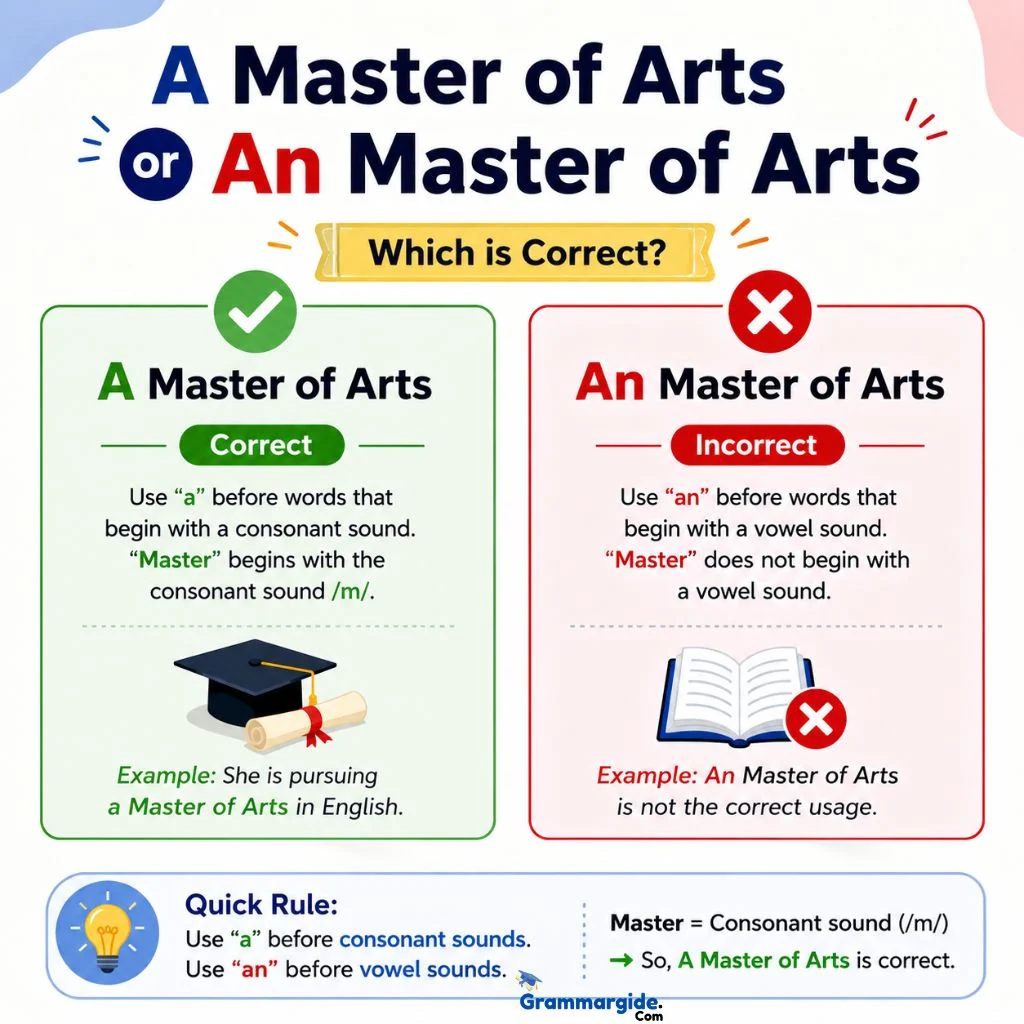
The choice between “A Master of Arts” and “An Master of Arts” depends on the pronunciation of the word that follows the article. Unlike abbreviations such as MA, the full phrase Master of Arts begins with the word “Master,” which starts with a consonant sound.
Because the first sound in Master is “m,” the correct article is “a.” Therefore, the grammatically correct phrase is “a Master of Arts.” The incorrect form “an Master of Arts” does not follow standard English article rules because “an” only comes before words that begin with vowel sounds.
Understanding this difference helps writers avoid confusion between the abbreviation MA and its full form Master of Arts. Although both refer to the same degree, their article choices are different because their pronunciations begin with different sounds.
Why “A Master of Arts” Is Correct
“A Master of Arts” is correct because the word Master begins with a consonant sound. English uses “a” before consonant sounds, and the first sound you hear in Master is “m.”
Examples:
- She earned a Master of Arts in English Literature.
- He completed a Master of Arts degree in History.
- She is pursuing a Master of Arts program in Education.
The article choice depends on the pronunciation of the complete phrase, not the meaning of the degree. Even though MA starts with a vowel sound when spoken as “em-ay,” the full term Master of Arts starts with a consonant sound.
This distinction shows why pronunciation plays an important role in English grammar. Writers should always consider the first spoken sound before selecting “a” or “an.”
Why “An Master of Arts” Is Incorrect
“An Master of Arts” is incorrect because the word Master does not begin with a vowel sound. The article “an” should only appear before words that start with sounds like a, e, i, o, or u.
Incorrect example:
- She earned an Master of Arts degree. ❌
Correct example:
- She earned a Master of Arts degree. ✅
The mistake usually happens because some writers remember that MA takes “an” and incorrectly apply the same rule to the full phrase. However, MA and Master of Arts have different pronunciations, so they require different articles.
Correct Sentence Examples With MA
Using MA correctly requires understanding that the abbreviation is pronounced “em-ay.” Since it begins with a vowel sound, it takes the article “an.” This rule applies across academic, professional, and everyday writing.
Correct examples:
- She completed an MA in Psychology.
- He received an MA from a respected university.
- They offer an MA program in Communication Studies.
These examples show how the abbreviation works naturally in sentences while following standard English grammar rules.
Examples in Academic Writing
In academic writing, MA often appears when discussing degrees, qualifications, research backgrounds, and educational achievements. Using the correct article helps maintain a professional and polished writing style.
Examples:
- The researcher holds an MA in Sociology from a leading institution.
- She is studying for an MA in English Literature.
- The university offers an MA focused on modern language studies.
- He completed an MA before beginning his doctoral research.
Academic documents such as applications, essays, and research profiles often use degree abbreviations. Correct article usage improves clarity and demonstrates strong command of formal English.
Examples in Professional Writing
In professional writing, an MA degree may appear in resumes, biographies, company profiles, and career documents. Using the correct phrase makes professional communication more accurate.
Examples:
- Sarah has an MA in Marketing and Communication.
- The candidate earned an MA before joining the organization.
- Our team includes professionals with an MA in different fields.
- He listed an MA qualification on his professional profile.
Clear grammar choices help readers understand qualifications quickly and create a more professional impression.
Incorrect Examples and Why They Are Wrong
Many mistakes with MA usage happen because writers confuse the abbreviation with the full degree name. The abbreviation MA and the phrase Master of Arts follow different article rules because their opening sounds are different.
Remember:
- An MA ✅ → “MA” sounds like “em-ay.”
- A Master of Arts ✅ → “Master” begins with the consonant sound “m.”
Choosing the wrong article can make a sentence sound unnatural and grammatically incorrect.
Common Sentence Errors
Here are common mistakes and their corrections:
- She earned a MA in History. ❌
She earned an MA in History. ✅ - He completed an Master of Arts degree. ❌
He completed a Master of Arts degree. ✅ - She is studying for a MA program. ❌
She is studying for an MA program. ✅ - He received an Master’s degree in English. ❌
He received a Master’s degree in English. ✅
These errors usually come from focusing on spelling rather than pronunciation. English articles depend on the first sound, not simply the first letter.
How to Fix Incorrect MA Usage
To fix MA-related grammar mistakes, identify whether you are using the abbreviation or the full degree name.
Use this simple rule:
- Use “an MA” when using the abbreviation because it starts with the vowel sound “em.”
- Use “a Master of Arts” when writing the full phrase because it starts with the consonant sound “m.”
Before writing, say the phrase aloud and listen to the first sound. This pronunciation-based method helps you choose the correct article naturally.
Correct usage:
- She earned an MA in Literature. ✅
- She earned a Master of Arts in Literature. ✅
By understanding this small but important grammar difference, writers can use academic terms confidently in both formal and everyday communication.
Using A and An Before Academic Abbreviations
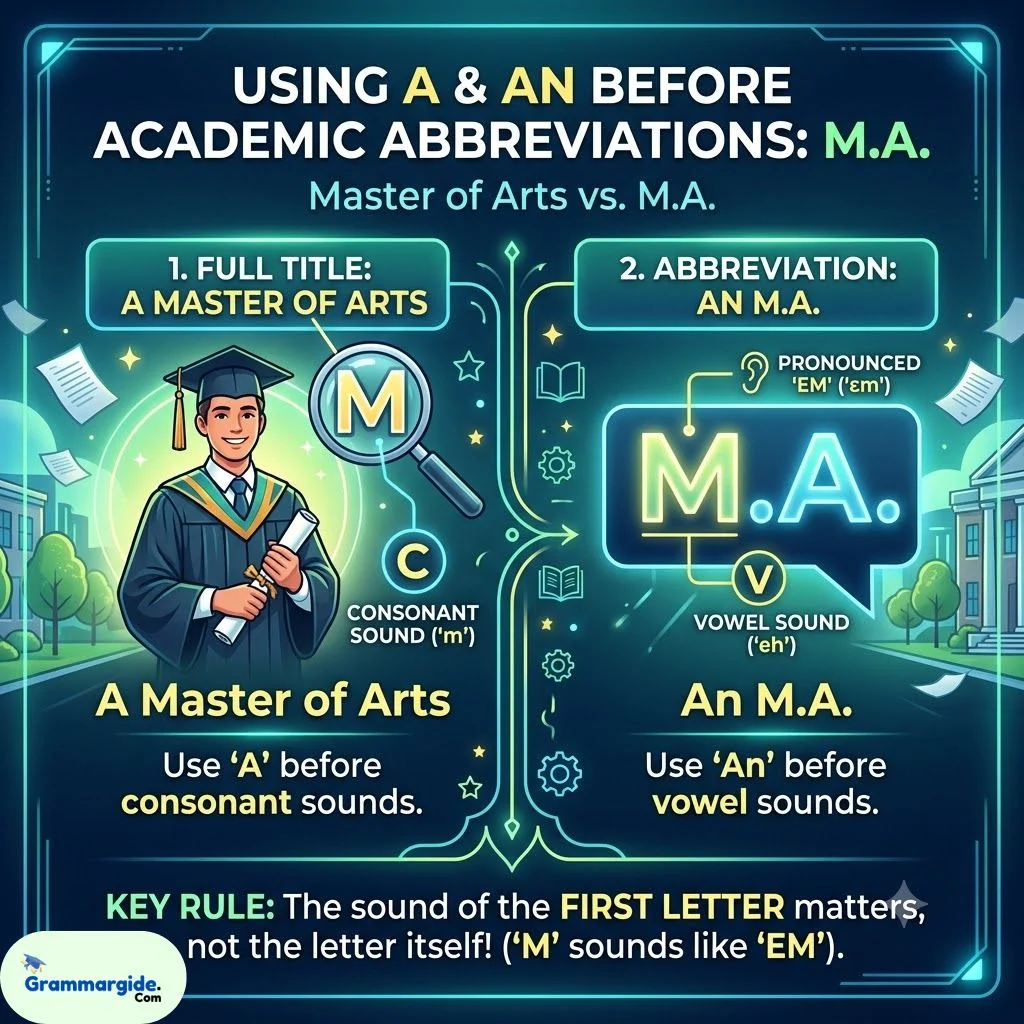
Academic abbreviations often create confusion because writers must consider both grammar rules and academic formatting conventions. When using articles like “a” and “an” before degree abbreviations, the correct choice depends on the pronunciation of the abbreviation, not the letters used in the shortened form.
For example, MA is pronounced “em-ay,” so it begins with a vowel sound and takes “an.” The correct phrase is “an MA.” However, abbreviations that begin with consonant sounds use “a.”
Understanding this rule helps students, researchers, and professionals write academic qualifications correctly in essays, resumes, applications, and formal documents. The same pronunciation principle applies to many degree abbreviations used in education and professional communication.
MA vs MBA vs MSc Examples (Table)
Different academic abbreviations require different articles based on their opening sounds. The table below shows how pronunciation affects article choice.
| Academic Abbreviation | Full Form | Pronunciation Start | Correct Article | Example |
| MA | Master of Arts | “em” sound | An | She earned an MA in English. |
| MBA | Master of Business Administration | “em” sound | An | He completed an MBA in Finance. |
| MSc | Master of Science | “em” sound | An | She received an MSc in Biology. |
| PhD | Doctor of Philosophy | “pee” sound | A | He is a PhD student. |
| BA | Bachelor of Arts | “bee” sound | A | She has a BA in History. |
| BSc | Bachelor of Science | “bee” sound | A | He completed a BSc degree. |
This comparison shows that the first sound controls the article choice. Even though some abbreviations begin with letters that may look similar, their pronunciation determines whether “a” or “an” is correct.
Understanding Similar Degree Abbreviations
Many degree abbreviations look similar in writing, but their article usage can change depending on pronunciation. Understanding these differences prevents common grammar mistakes.
For example:
- An MA → “em-ay” begins with a vowel sound.
- An MBA → “em-bee-ay” begins with a vowel sound.
- An MSc → “em-ess-see” begins with a vowel sound.
- A BA → “bee-ay” begins with a consonant sound.
- A PhD → “pee-aitch-dee” begins with a consonant sound.
These abbreviations represent different academic qualifications, but the grammar rule remains the same. Writers should say the abbreviation aloud and identify the first sound before choosing an article.
Capitalization Rules for Academic Degrees
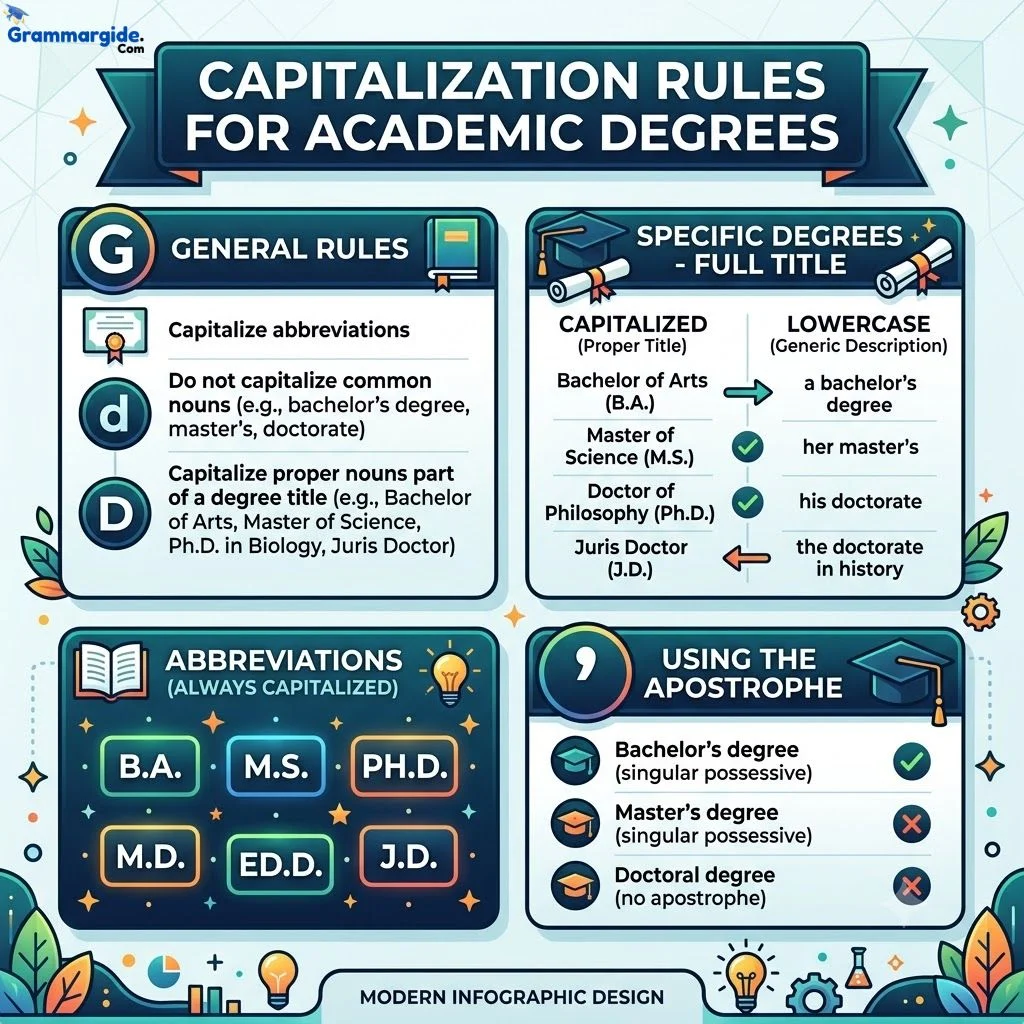
Academic degree capitalization can also create confusion because rules change depending on how the degree name appears in a sentence. Writers often wonder whether terms like Master of Arts or master’s degree should use capital letters.
The general rule is that official degree names are capitalized, while general references to degrees are usually written in lowercase. Correct capitalization improves clarity and keeps academic writing consistent.
Examples:
- She earned a Master of Arts in English. ✅
- She earned a master’s degree in English. ✅
The first example uses the formal name of the degree, while the second uses a general description.
General Rules for Degree Names
Follow these capitalization rules when writing about academic degrees:
Capitalize official degree titles:
- Bachelor of Arts.
- Master of Science.
- Master of Arts.
Examples:
- He completed a Master of Arts in History.
- She received a Bachelor of Science in Biology.
Use lowercase for general degree references:
- bachelor’s degree.
- master’s degree.
- doctoral degree.
Examples:
- She completed a master’s degree before starting her career.
- He plans to earn a doctoral degree in education.
When using abbreviations, capitalize every letter because academic abbreviations follow standard shortened forms:
- MA.
- MBA.
- MSc.
- PhD.
Table: What to Capitalize in Academic Writing
| Term Type | Correct Style | Example |
| Official degree name | Capitalize | Master of Arts |
| General degree reference | Lowercase | master’s degree |
| Degree abbreviation | Capitalize letters | MA, MBA, MSc |
| Academic field after degree | Usually lowercase | an MA in history |
| Named program or department | Capitalize official names | Department of English |
Using consistent capitalization helps academic writing look professional and organized. Writers should consider whether they are naming a specific qualification or describing a general level of education.
Examples From Style Guides
Academic and professional style guides generally follow the same principles for articles, abbreviations, and capitalization. They emphasize clarity, consistency, and correct usage based on standard English grammar rules.
When writing about degrees, writers should focus on pronunciation for a/an selection and use capitalization according to whether the term represents an official title or a general description.
Formal Academic Style Examples
Formal academic writing often includes degree information in research papers, university profiles, and educational documents.
Examples:
- The researcher holds an MA in Linguistics.
- She completed a Master of Arts in History.
- The university offers an MSc program in Environmental Studies.
- He is currently pursuing a PhD in Psychology.
These examples follow both grammar and academic writing conventions by using correct articles and capitalization.
Professional Writing Examples
Professional documents such as resumes, biographies, and company profiles also require accurate degree formatting.
Examples:
- John earned an MA in Communication Studies from a recognized university.
- Sarah holds a Master of Arts in Education.
- The applicant has an MBA in Business Management.
- The candidate completed a master’s degree before joining the company.
Using correct forms like “an MA” and “a Master of Arts” helps maintain a polished professional tone and shows attention to language accuracy.
Possessive Forms: Master’s vs Masters
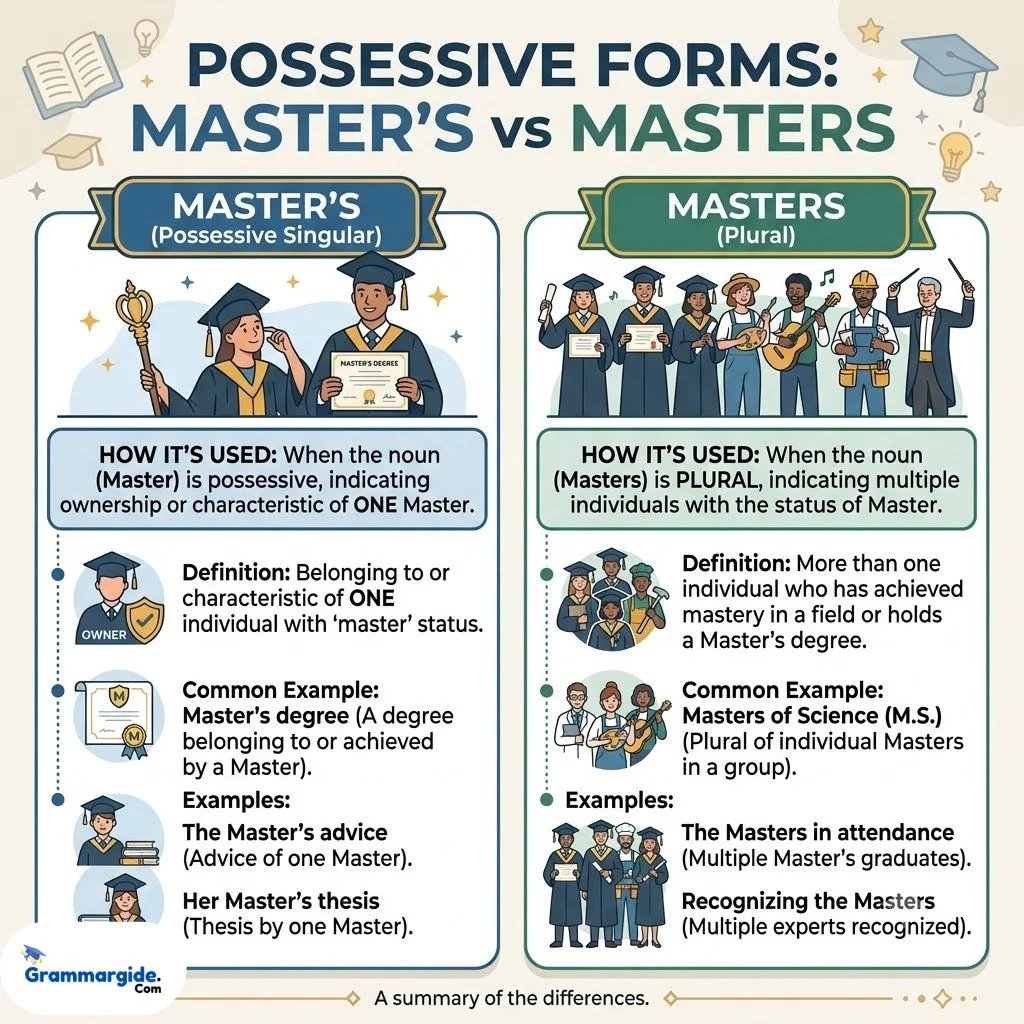
The terms “Master’s” and “Masters” often confuse writers because they look almost identical but have different meanings and uses. In academic writing, resumes, and professional documents, choosing the correct form helps communicate qualifications clearly.
The correct term for an academic qualification is usually “master’s degree.” The apostrophe shows that the degree is connected to a master-level qualification. On the other hand, “masters” without an apostrophe usually refers to more than one master or can appear in other contexts unrelated to academic degrees.
Understanding this small punctuation difference helps prevent mistakes when writing about education, qualifications, and career achievements.
Why Does the Apostrophe Matter?
The apostrophe in “master’s degree” matters because it shows a possessive relationship. The phrase originally means a degree belonging to a master-level academic classification.
The apostrophe helps readers understand that the word master’s describes the type of degree rather than referring to multiple masters.
Examples:
- She earned a master’s degree in English. ✅
- He completed a master’s program in Psychology. ✅
Without the apostrophe:
- She earned a masters degree. ❌
The missing apostrophe changes the grammatical structure and makes the phrase incorrect in standard English.
Difference Between Master’s and Masters
The difference between master’s and masters comes down to meaning and grammar.
Master’s:
- Refers to a graduate-level academic qualification.
- Used in phrases like master’s degree and master’s program.
- Includes an apostrophe because it shows possession.
Example:
- She completed a master’s degree in History.
Masters:
- Usually refers to a plural form of “master.”
- Can describe multiple people who have mastery or authority in something.
- Does not normally describe an academic degree.
Example:
- The competition included several masters of art.
For academic writing, the correct form is almost always master’s degree.
Correct Usage of Master’s Degree Terms
When writing about graduate education, use master’s when referring to a specific degree level or program. The apostrophe should remain before the s because it is part of the standard spelling.
Correct examples:
- She earned a master’s degree in Communication.
- He is applying for a master’s program at the university.
- A master’s thesis requires detailed research.
- She completed her master’s studies last year.
The term master’s degree can refer to many qualifications, including:
- Master of Arts (MA).
- Master of Science (MSc).
- Master of Business Administration (MBA).
Each abbreviation represents a specific type of master’s-level education.
Incorrect Usage of Master’s Degree Terms
Many writers remove the apostrophe or use unnecessary capitalization when referring to graduate degrees. These mistakes can make academic and professional writing appear less polished.
Common errors include:
- He earned a Masters degree. ❌
He earned a master’s degree. ✅ - She completed a Master’s Degree in English. ❌
She completed a master’s degree in English. ✅ - He has a master degree. ❌
He has a master’s degree. ✅
The word master’s is not usually capitalized when it appears as a general description. However, the official degree title, such as Master of Arts, uses capitalization.
Abbreviating the Degree: MA vs M.A.
The abbreviation for Master of Arts can appear as MA or M.A. depending on the style guide, region, and publication preference. Both forms refer to the same academic degree.
Examples:
- She earned an MA in Literature.
- She earned an M.A. in Literature.
Modern academic and professional writing often prefers MA without periods because many international institutions and organizations use this cleaner format.
However, some traditional writing styles still use M.A. with periods. The important point is to choose one format and use it consistently.
Regional Differences in Formatting
The use of MA and M.A. varies across regions and institutions.
In many modern academic settings, especially in international and digital writing, abbreviations without periods are common:
- MA.
- MBA.
- MSc.
Some traditional style preferences use periods:
- M.A.
- M.B.A.
- M.Sc.
Neither format changes the meaning. The difference is mainly a matter of style preference and formatting standards.
Why Consistency Is Key
Consistency is important because academic writing depends on clear formatting. Mixing different abbreviation styles in the same document can make your writing appear unorganized.
For example:
- She earned an MA and later completed an M.B.A.. ❌
A consistent style would be:
- She earned an MA and later completed an MBA. ✅
or:
- She earned an M.A. and later completed an M.B.A.. ✅
Following one style throughout resumes, research papers, and professional documents improves readability.
Read More: Appreciative Of vs Appreciative For: Which One Is Correct? 2026
Degree vs Field of Study: Understanding the Difference
A common mistake in academic writing is confusing the degree name with the field of study. These two parts provide different information.
The degree explains the qualification earned, while the field explains the subject area studied.
For example:
- Master of Arts = degree type.
- English Literature = field of study.
Together, they create a complete academic description:
- Master of Arts in English Literature.
Understanding this difference helps writers format education details correctly in resumes, applications, and academic documents.
Correct Formats for Degrees
When writing degree names, follow these common formats:
Official degree title:
- Master of Arts.
- Master of Science.
- Bachelor of Arts.
Degree with field of study:
- Master of Arts in History.
- Master of Science in Biology.
- Bachelor of Arts in Psychology.
Abbreviated form:
- MA in History.
- MSc in Biology.
- BA in Psychology.
The degree title is capitalized when written as an official name, while the subject area is usually lowercase unless it is a proper noun.
Examples of Degree and Subject Usage
Correct examples:
- She earned a Master of Arts in English Literature.
- He completed an MA in History.
- She holds a Master of Science in Biology.
- He received an MBA in Finance.
Incorrect examples:
- She earned a Master of Arts in english literature. ❌
- He completed an MA In History. ❌
Correct formatting makes academic information easier to understand and keeps professional writing accurate. Understanding the difference between the degree name, abbreviation, and field of study helps writers present qualifications clearly.
Quick Comparison Table: A MA vs An MA
The difference between “A MA” and “An MA” depends on pronunciation. Although the abbreviation MA begins with the letter M, the way it sounds determines the correct article. Since MA is pronounced “em-ay,” it starts with a vowel sound, making “an MA” the correct form.
| Feature | A MA | An MA |
| Correctness | Incorrect ❌ | Correct ✅ |
| Pronunciation | Treats M as a consonant sound | Uses the vowel sound “em” |
| Grammar Rule | Uses “a” before consonant sounds | Uses “an” before vowel sounds |
| Example | She earned a MA in History. ❌ | She earned an MA in History. ✅ |
| Reason | Focuses on the written letter | Focuses on the spoken sound |
The key rule is simple: choose the article based on the first sound, not the first letter. This same principle applies to other academic abbreviations such as MBA and MSc.
Common Mistakes People Make With MA
Many writers make mistakes with MA usage because abbreviations combine spelling, pronunciation, and formatting rules. Some people choose articles based on appearance, while others confuse the abbreviation with the full degree name.
For example, MA and Master of Arts refer to the same qualification, but they require different articles:
- An MA in English. ✅
- A Master of Arts in English. ✅
The difference happens because “MA” starts with the sound “em,” while “Master” starts with the consonant sound “m.”
Frequent Article Errors
The most common mistake is using “a” instead of “an” before MA.
Incorrect:
- She completed a MA in Psychology. ❌
Correct:
- She completed an MA in Psychology. ✅
This error occurs because writers see the letter M and assume it begins with a consonant sound. However, English articles depend on pronunciation.
Other examples:
- He earned an MA degree. ✅
- She applied for an MA program. ✅
Remembering the spoken form “em-ay” makes the correct choice easier.
Capitalization Mistakes
Academic abbreviations require proper capitalization because they represent official shortened forms of degree names.
Correct:
- MA ✅
- MBA ✅
- MSc ✅
Incorrect:
- ma ❌
- Ma ❌
- m.a. (when following a style that avoids periods) ❌
Writers also sometimes capitalize general degree descriptions incorrectly.
Incorrect:
- She earned a Master’s Degree in English. ❌
Correct:
- She earned a master’s degree in English. ✅
However, official degree names use capitalization:
- She earned a Master of Arts in English. ✅
Apostrophe Mistakes
Apostrophes often create confusion when writing about master-level qualifications. The correct general term is “master’s degree,” not “masters degree.”
Incorrect:
- He completed a Masters degree. ❌
- She earned a masters in Education. ❌
Correct:
- He completed a master’s degree. ✅
- She earned a master’s degree in Education. ✅
The apostrophe shows the possessive form and is part of the standard spelling used in academic writing.
Read More: Driver’s License vs Drivers License: Which Is Correct? 2026
Why These MA Grammar Mistakes Happen
Mistakes with MA grammar usage usually happen because English combines written letters with spoken sounds. Writers often rely on visual patterns instead of pronunciation rules.
Understanding the reason behind these errors makes it easier to avoid them in future writing.
Confusion Between Letters and Sounds
The biggest source of confusion is the difference between a letter and its sound. Many people see M in MA and think it should use “a” because M is a consonant letter.
However, when spoken, MA becomes “em-ay.” The first sound is a vowel sound, so the correct phrase is “an MA.”
This same rule applies to other abbreviations:
- An MBA → “em-bee-ay.”
- An MSc → “em-ess-see.”
- A PhD → “pee-aitch-dee.”
Focusing on pronunciation instead of spelling helps writers make correct article choices.
Influence of Informal Writing
Informal online writing can also contribute to MA grammar mistakes. Social media posts, quick messages, and casual communication often ignore punctuation and grammar rules.
People may write:
- a MA degree.
- masters degree.
- ma program.
These forms may appear in informal settings, but they do not follow standard academic and professional writing conventions.
Using correct grammar in resumes, applications, emails, and academic documents creates clearer and more professional communication.
How to Avoid These Mistakes
Avoiding MA-related grammar errors becomes easier when you follow a few simple checks. Reviewing pronunciation, capitalization, and punctuation helps maintain accuracy in academic and professional writing.
Article Checklist
Before using a or an, check the first sound of the abbreviation.
Use:
- An MA because “MA” starts with the vowel sound “em.” ✅
- A PhD because “PhD” starts with the consonant sound “pee.” ✅
Ask yourself:
“What sound do I hear first when I say this abbreviation aloud?”
Capitalization Checklist
Follow these capitalization rules:
✅ Capitalize degree abbreviations:
- MA.
- MBA.
- MSc.
✅ Capitalize official degree names:
- Master of Arts.
- Master of Science.
✅ Use lowercase for general terms:
- master’s degree.
- bachelor’s degree.
Consistency Checklist
Choose one style and use it throughout your writing.
Examples:
Correct:
- She earned an MA and later completed an MBA. ✅
Avoid mixing:
- She earned an M.A. and later completed an MBA. ❌
Consistent formatting makes documents look more professional and organized.
Apostrophe Checklist
Remember these apostrophe rules:
✅ Use:
- master’s degree.
- master’s program.
- master’s thesis.
❌ Avoid:
- masters degree.
- masters program.
Read More: Tomatoes or Tomatos: Which Spelling Is Correct?
A Simple Trick to Remember An MA Forever
Remembering whether to use “a MA” or “an MA” becomes easy when you focus on pronunciation instead of spelling. The key idea is simple: articles depend on sounds, not letters.
Since MA is pronounced “em-ay,” the first sound is a vowel sound. That is why the correct phrase is “an MA.” This pronunciation-based trick works for other abbreviations too, making it easier to choose the right article in different situations.
Instead of memorizing every abbreviation, train yourself to listen for the opening sound. This method helps you use English articles naturally in academic writing, professional communication, and everyday conversations.
Use the Pronunciation Test
The pronunciation test is the fastest way to decide between “a” and “an.” Simply say the abbreviation aloud and listen to the first sound.
For MA:
- Say it: “em-ay.”
- First sound: “em”
- Sound type: Vowel sound
- Correct article: An MA ✅
The same test works with other abbreviations:
- An MBA → “em-bee-ay”
- An MSc → “em-ess-see”
- A PhD → “pee-aitch-dee”
The spelling may look confusing, but pronunciation gives the correct answer every time.
Read the Sentence Aloud
Reading sentences aloud helps you notice whether the article sounds natural. English speakers naturally choose articles that create smoother speech.
Compare:
- She completed a MA in History. ❌
- She completed an MA in History. ✅
The second sentence sounds smoother because “an” connects naturally with the vowel sound in “em-ay.”
Making a habit of reading your writing aloud can help identify grammar mistakes before submitting academic papers, resumes, or professional documents.
Practice Test: Choose A MA or An MA
Testing yourself is one of the best ways to remember grammar rules. Choose the correct article before each sentence.
Fill-in-the-Blank Exercises
Complete each sentence with a or an:
- She earned ___ MA in English Literature.
- He completed ___ Master of Arts degree in History.
- The university offers ___ MA program in Psychology.
- She is pursuing ___ MBA after graduation.
- He received ___ PhD from the university.
Try answering before checking the explanations below.
Answer Key With Explanations
- She earned an MA in English Literature. ✅
Reason: MA is pronounced “em-ay,” which begins with a vowel sound. - He completed a Master of Arts degree in History. ✅
Reason: Master begins with the consonant sound “m.” - The university offers an MA program in Psychology. ✅
Reason: The abbreviation starts with the vowel sound “em.” - She is pursuing an MBA after graduation. ✅
Reason: MBA begins with the sound “em.” - He received a PhD from the university. ✅
Reason: PhD begins with the consonant sound “pee.”
This practice shows that article choice depends on pronunciation, not the first written letter.
MA Usage in Resumes, Emails, and Professional Writing
Using MA correctly is especially important in professional communication. Resumes, cover letters, emails, and online profiles often include educational qualifications, and small grammar mistakes can affect the overall quality of your writing.
When mentioning an MA, use “an MA” because the abbreviation begins with the vowel sound “em.”
Correct:
- She holds an MA in Communication Studies.
- He completed an MA in Business Management.
Using the correct form creates a polished and professional impression.
Writing Your Degree on a Resume
A resume should present academic qualifications clearly and consistently. You can write the degree using either the full name or the abbreviation.
Examples:
- Master of Arts in English Literature
- MA in English Literature
- Master’s degree in English Literature
When using the abbreviation in a sentence:
- I earned an MA in English Literature. ✅
When listing education details without a sentence, you may simply write:
Master of Arts in English Literature
or
MA in English Literature
Both formats are acceptable when used correctly.
Mentioning MA in Formal Documents
Formal documents such as applications, academic profiles, and professional biographies require accurate grammar and formatting.
Examples:
- The candidate holds an MA in Psychology.
- She completed an MA before starting her research career.
- The applicant has an MA in International Relations.
Using correct article placement helps maintain credibility and clarity in formal writing.
How Grammar Experts Explain A MA vs An MA
Grammar experts explain that article selection follows a basic English pronunciation rule. The choice between “a” and “an” depends on the sound that begins the following word or abbreviation.
This means MA takes “an” because its spoken form begins with a vowel sound.
Expert View on Article Rules
Standard English grammar follows the rule:
- Use “a” before consonant sounds.
- Use “an” before vowel sounds.
Examples:
- An MA → “em-ay” begins with a vowel sound.
- A Master of Arts → “Master” begins with a consonant sound.
Grammar experts emphasize that letters and sounds are not always the same. A written consonant can create a vowel sound when pronounced, which changes the article choice.
Why Pronunciation Always Wins
Pronunciation always wins because English developed around spoken communication. Articles help speech flow smoothly, so speakers choose forms that match sounds.
The difference between “a MA” and “an MA” proves this rule. The letter M looks like a consonant, but the spoken sound “em” begins with a vowel sound.
Remember:
- An MA = correct because of the “em” sound. ✅
- A MA = incorrect because it ignores pronunciation. ❌
Following sound-based grammar rules helps you handle not only MA but also many other abbreviations confidently.
Final Tips for Using Academic Abbreviations Correctly
Using academic abbreviations correctly requires attention to three things: pronunciation, capitalization, and consistency.
Keep these tips in mind:
- Use an MA, not a MA, because MA begins with the vowel sound “em.”
- Use a Master of Arts, not an Master of Arts, because Master begins with a consonant sound.
- Capitalize official abbreviations like MA, MBA, and MSc.
- Use master’s degree when referring to the qualification generally.
- Choose one formatting style and use it consistently throughout your writing.
By focusing on pronunciation and standard grammar rules, you can confidently use academic abbreviations in essays, resumes, emails, and professional documents.
Frequently Asked Questions About A MA or An MA
1. Is it A MA or An MA?
The correct form is “an MA.” The abbreviation MA is pronounced “em-ay,” and the first sound is a vowel sound. English uses “an” before vowel sounds, so the correct phrase is “an MA degree” or “an MA in English.”
2. Why do we say an MA instead of a MA?
We say “an MA” because the abbreviation starts with the sound “em,” not the consonant sound “m.” English articles follow the first spoken sound of a word or abbreviation.
3. Is MA written with periods as M.A.?
Both MA and M.A. can be correct depending on the style guide, region, or institution. Many modern academic and professional documents prefer MA without periods because it looks cleaner and is widely used internationally.
4. Should I capitalize Master of Arts?
Yes, Master of Arts should be capitalized when you use it as the official name of the degree. Each main word in the formal degree title begins with a capital letter.
5. Is “an Master of Arts” correct?
No, “an Master of Arts” is incorrect. The correct form is “a Master of Arts” because the word Master begins with the consonant sound “m.”
Conclusion
Understanding the difference between “A MA” and “An MA” becomes simple when you focus on pronunciation instead of spelling. The correct form is “an MA” because the abbreviation is pronounced “em-ay,” which begins with a vowel sound. English articles always depend on the first sound, not just the first letter you see.
The same rule helps you use other academic terms correctly. Remember that “an MA” refers to the abbreviation Master of Arts, while “a Master of Arts” uses “a” because the full phrase begins with the consonant sound in “Master.” Paying attention to pronunciation, capitalization, and apostrophe rules improves accuracy in academic and professional writing.
Whether you are preparing a resume, writing an email, completing an application, or creating academic content, using the correct grammar form builds clearer communication. Once you understand that sounds guide article choices, choosing between “a” and “an” becomes easier and more natural.

Hi, I am Zadie Smith, the author of Grammargide.com. I write clear, easy-to-understand guides that explain commonly confused words and phrases, helping readers choose the right expression with confidence.