
Choosing the right word form can make your writing clearer and more professional, especially when two terms look almost identical. Newfound vs New-Found is a common grammar confusion because both forms appear in writing, but many readers wonder whether they have the same meaning, when to use each version, and which spelling is considered correct.
Understanding the difference between newfound and new-found helps improve your vocabulary, spelling accuracy, and overall communication skills. While both forms relate to something recently discovered, gained, or experienced, their usage can depend on modern writing conventions, style preferences, and sentence structure.
In this article, you will learn the meaning of newfound, the role of the hyphen in new-found, their grammatical differences, examples of correct usage, and tips to choose the right form. Continue reading to understand how these similar-looking terms work in everyday and formal writing.
The True Origin of “Newfound”
The word newfound has a long history in English and did not appear as a modern shortcut. It developed from combining the adjective new with the past participle found, meaning “discovered” or “obtained.” Over time, English speakers began treating the two words as a single compound adjective, especially when describing something recently discovered, gained, or experienced.
Today, newfound is the standard spelling in dictionaries, style guides, books, newspapers, and academic writing. While you may still come across new-found in older publications, the closed form has become the preferred choice because it reflects modern English spelling conventions.
Key Historical Notes
Historically, English often connected compound words with a hyphen before eventually merging them into a single word. This pattern happened with many familiar terms, and newfound followed the same path.
Some important historical facts include:
- New-found appeared frequently in English writing during the 17th, 18th, and 19th centuries.
- As spelling became more standardized, publishers and dictionaries increasingly adopted newfound.
- Modern style guides generally recommend the closed compound because it improves consistency and readability.
- Older literature may still preserve the hyphen as part of the writing style of its time rather than because it represents a different meaning.
Understanding this evolution helps explain why both spellings exist, even though one is now far more common.
Definition of Newfound
Newfound is the modern standard spelling. It describes something recently discovered, recently developed, or newly gained.
It commonly appears before nouns such as:
- newfound confidence
- newfound freedom
- newfound appreciation
- newfound interest
- newfound respect
Examples:
- She spoke with newfound confidence after completing the course.
- They developed a newfound appreciation for nature.
- His newfound passion inspired a career change.
In each example, newfound emphasizes a positive change or recent development.
Definition of New-Found
New-found carries the same meaning as newfound but uses the older hyphenated spelling.
You may encounter it in:
- Classic literature
- Historical documents
- Older newspapers
- Traditional writing styles
Examples:
- The explorer celebrated his new-found freedom.
- She enjoyed her new-found success.
Although these sentences are correct, most modern publications would remove the hyphen and write newfound instead.
Similarities Between Both Forms
The two spellings have far more in common than differences.
| Feature | Newfound | New-Found |
| Meaning | Recently discovered or gained | Recently discovered or gained |
| Part of Speech | Compound adjective | Compound adjective |
| Typical Usage | Before a noun | Before a noun |
| Grammatical Function | Describes a noun | Describes a noun |
| Overall Meaning | Identical | Identical |
Whether you use newfound or new-found, readers will understand the same idea. The difference lies mainly in modern spelling preference, not in meaning.
Main Difference in Modern Usage
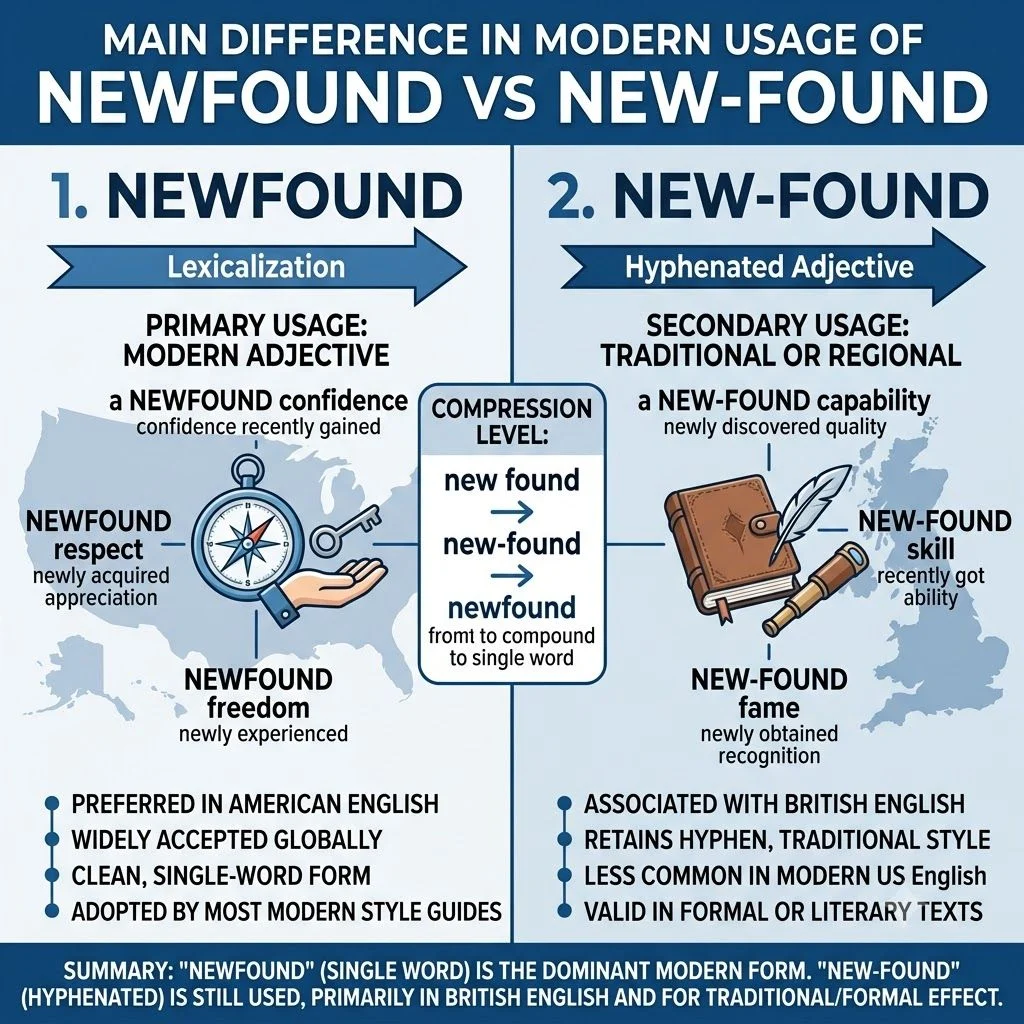
The biggest distinction is current writing practice.
- Newfound is the preferred spelling in modern English.
- New-found is considered an older or stylistic variant.
- Most dictionaries, publishers, and editors recommend newfound for contemporary writing.
- The hyphenated form may still appear when preserving historical style or quoting older texts.
If you’re writing an email, article, essay, blog post, or business document, choosing newfound helps your writing align with current English standards.
Common Words Similar to Newfound
Many English words express the idea of something that has recently appeared, developed, or been obtained. While they are not exact synonyms, they often convey a similar sense depending on the context.
Newly Discovered
Newly discovered refers to something that has just been found or identified for the first time.
Examples:
- Scientists examined a newly discovered species.
- The museum displayed a newly discovered artifact.
Unlike newfound, this phrase usually emphasizes discovery rather than a personal feeling or quality.
Recently Gained
Recently gained highlights something that someone has acquired through effort, experience, or change.
Examples:
- Her recently gained confidence improved her public speaking.
- He used his recently gained knowledge to solve the problem.
This expression focuses on the process of gaining something rather than simply describing it as new.
Newly Acquired
Newly acquired often refers to possessions, skills, responsibilities, or abilities obtained in the recent past.
Examples:
- She practiced her newly acquired language skills every day.
- The company integrated its newly acquired technology into production.
Compared with newfound, this phrase usually sounds more formal and is common in business, education, and professional writing.
Freshly Experienced
Freshly experienced describes emotions, situations, or events that have occurred only recently.
Examples:
- The team reflected on their freshly experienced success.
- His advice came from freshly experienced challenges in the industry.
Although less common than newfound, this phrase emphasizes the recency of an experience rather than the discovery or acquisition of something. It is often used when discussing personal growth, learning, or life events.
Read More: Annunciate vs Enunciate: Understanding the Difference in 2026
How Pronunciation Changes (or Does Not Change) Between Forms
One reason people compare newfound and new-found is that they assume the hyphen changes how the word is spoken. In reality, the pronunciation remains the same. The hyphen is simply a spelling feature and has no effect on stress, rhythm, or sound. Whether you read the word in a modern article or an older book, native English speakers pronounce both forms identically.
Pronunciation of Newfound

newfound (NOO-found)
Newfound is pronounced exactly as it looks: “NOO-found.” The first syllable carries the word new, while the second comes from found. The stress naturally falls on the first syllable.
Examples:
- She gained newfound confidence after months of practice.
- Their newfound friendship quickly became meaningful.
- He approached the challenge with newfound determination.
In everyday conversation, the word flows smoothly as a single compound adjective.
Pronunciation of New-Found
new-found (NOO-found)
Although new-found contains a hyphen, it is pronounced exactly like newfound.
Examples:
- The author described his new-found enthusiasm for travel.
- They celebrated their new-found independence.
The hyphen serves only as a visual separator in writing. It does not create a pause or change the spoken form.
Why Spelling Does Not Affect Sound
English pronunciation is not always determined by punctuation. A hyphen helps readers recognize compound words, but it rarely changes how those words are spoken.
For newfound and new-found:
- Both have the same number of syllables.
- Both use identical word stress.
- Both sound the same in conversation.
- The only difference is orthography (spelling), not pronunciation.
This is why dictionaries list the same pronunciation for both forms while identifying newfound as the preferred modern spelling.
Final Grammar Checklist for Newfound vs New-Found
Use this quick checklist whenever you’re unsure which form belongs in your writing.
Meaning Check
✔ Both newfound and new-found mean recently discovered, developed, or gained.
Examples:
- newfound confidence
- newfound respect
- newfound interest
Their meanings are identical, so your choice depends on spelling style rather than definition.
Spelling Check
Ask yourself:
- Am I writing for a modern audience?
- Am I following current dictionary recommendations?
If the answer is yes, choose newfound.
Use new-found only when:
- Quoting historical material
- Preserving an older writing style
- Reproducing the original wording of a published source
Style Check
For modern English:
- ✔ Newfound — preferred
- ✔ Accepted by most dictionaries and style guides
- ✔ Best for articles, essays, emails, blogs, and business writing
For historical contexts:
- ✔ New-found may still be appropriate
- ✔ Mostly seen in older literature and archived publications
When in doubt, newfound is the safest and most natural choice.
Does Newfound Always Mean Something Positive?
Many people associate newfound with positive emotions, but the word itself is neutral. It simply indicates that something has appeared, developed, or been gained recently. Whether the outcome is good or bad depends on the noun it describes.
Positive Uses of Newfound
Most often, newfound introduces positive changes, personal growth, or improved circumstances.
Common examples include:
- newfound confidence
- newfound hope
- newfound freedom
- newfound appreciation
- newfound motivation
- newfound success
Examples:
- She spoke with newfound confidence during the presentation.
- They shared a newfound appreciation for teamwork.
- His newfound optimism inspired everyone around him.
In these cases, the word highlights beneficial change.
Neutral Uses of Newfound
Newfound can also describe situations that are neither clearly positive nor negative.
Examples include:
- newfound responsibility
- newfound awareness
- newfound popularity
- newfound attention
- newfound knowledge
Examples:
- The manager handled his newfound responsibilities carefully.
- Researchers examined their newfound evidence.
- She adjusted to her newfound role at work.
Here, newfound simply indicates that something is recent. The surrounding context determines whether it carries a positive, neutral, or even negative meaning.
Read More: Froze vs Frozen: When to Use Each Correctly? 2026
Why English Eventually Dropped the Hyphen
English spelling constantly evolves to reflect common usage. As certain compound words become more familiar, writers gradually stop using the hyphen because readers no longer need it to recognize the word.
This process explains why many older hyphenated words now appear as single words in modern dictionaries. Newfound is one example of this natural language evolution.
Why do hyphens disappear?
Hyphens often disappear when a compound becomes widely accepted and easy to recognize.
Several factors contribute to this change:
- Frequent use makes the compound familiar.
- Dictionaries standardize the preferred spelling.
- Publishers adopt consistent editorial style.
- Readers process closed compounds more quickly.
- Modern writing favors cleaner, less cluttered text.
This pattern appears in many English compounds that evolved from open form → hyphenated form → closed form over time.
As a result, newfound is now the standard spelling in contemporary English, while new-found remains a historical or stylistic variant that reflects earlier stages of the language rather than a different meaning.
“Newfound” Today: The Modern Standard
Today, newfound is the spelling you will see most often in newspapers, books, academic papers, business communication, and online content. It has become the standard closed compound adjective, replacing the older hyphenated form in most modern English writing.
Writers prefer newfound because it matches current spelling conventions and creates a cleaner reading experience. Most readers immediately recognize it as a single descriptive word, making the hyphen unnecessary.
Examples include:
- newfound confidence
- newfound freedom
- newfound appreciation
- newfound success
- newfound interest
If you’re writing for a general audience, using newfound is usually the best choice.
Why Most Writers Default to “Newfound”
Modern writers choose newfound for several practical reasons.
- It is the preferred spelling in many major dictionaries.
- It aligns with current editorial and publishing standards.
- It improves consistency across professional writing.
- Readers recognize it instantly without needing a hyphen.
- It reflects the natural evolution of English compound words.
Whether you’re writing an essay, article, email, or business report, newfound gives your writing a modern and polished appearance.
“New-Found”: Still Correct — But Only in Certain Contexts
Although new-found is less common today, it has not become incorrect. It remains an accepted historical spelling that appears in specific writing situations.
Readers are most likely to encounter the hyphenated form in older books, archived newspapers, classic essays, or works that intentionally preserve traditional language.
When the Hyphen Helps
Sometimes the hyphen serves a stylistic or editorial purpose rather than a grammatical one.
The hyphen may be useful when:
- Reproducing historical documents
- Quoting older literary works
- Following the original wording of a published source
- Preserving a traditional writing style
For example:
The explorer celebrated his new-found freedom.
Here, the spelling reflects the style of the original text rather than a different meaning.
When Both Forms Are Acceptable
Both spellings can be considered acceptable in limited circumstances because they share the same meaning.
| Situation | Preferred Form |
| Modern articles and blogs | newfound |
| Academic writing | newfound |
| Business communication | newfound |
| Historical quotations | new-found |
| Classic literature | new-found |
Outside historical or stylistic contexts, newfound remains the better choice.
“New Found”: Why Two Words Is Almost Always Incorrect
Unlike newfound and new-found, writing new found as two separate words is generally considered incorrect when the phrase functions as a compound adjective.
English combines these words because together they express one complete idea: something recently discovered or recently gained.
Why It’s Incorrect in Most Cases
When describing a noun, the compound should remain together.
❌ Incorrect:
- She had new found confidence.
- They shared new found respect.
- His new found interest surprised everyone.
✔ Correct:
- She had newfound confidence.
- They shared newfound respect.
- His newfound interest surprised everyone.
Keeping the compound together avoids awkward wording and follows modern English conventions.
When “New Found” Can Occur Correctly
Although uncommon, new found can appear correctly when new and found belong to different parts of a sentence rather than forming one adjective.
Examples:
- The police found new evidence yesterday.
- Scientists found new species in the rainforest.
- We found new opportunities after expanding the business.
In these sentences:
- new modifies a noun (evidence, species, opportunities).
- found is the past tense of the verb find.
Because the words perform different grammatical roles, writing them separately is completely correct.
Read More: Me Too vs Me As Well vs I As Well: Which One Is Correct? 2026
Regional Patterns: US vs. UK Usage
Many people wonder whether newfound and new-found differ between American and British English. In practice, both varieties overwhelmingly prefer the closed form newfound in modern writing.
The difference today is much smaller than it was in earlier centuries.
United States
In American English, newfound is the standard spelling.
It commonly appears in:
- Newspapers
- Business writing
- Academic publications
- Government documents
- Online articles
American editors generally reserve new-found for historical quotations or stylistic purposes.
United Kingdom
Modern British English follows a similar pattern.
Although older British literature often contains new-found, contemporary publishers increasingly use newfound because it matches current dictionary recommendations and editorial practices.
Readers in the UK are likely to encounter both spellings, but newfound dominates current publications.
Current Trend
Across both American and British English, the trend is clear:
- Newfound continues to grow as the preferred spelling.
- New-found survives mainly in historical texts and older editions.
- New found remains incorrect when used as a compound adjective.
For most writing today, regional differences have little impact on your choice.
What the Major Style Guides Actually Say
Professional editors rely on trusted style guides and authoritative dictionaries to maintain consistent spelling. While wording may vary slightly, these references generally support the modern preference for newfound.
AP Stylebook (Associated Press)
The Associated Press Stylebook emphasizes consistency and favors spellings that reflect current usage.
For journalists and news organizations, newfound fits modern editorial practice because it is the standard closed compound recognized by contemporary dictionaries.
If quoting older material, the original hyphenated spelling may be preserved.
Chicago Manual of Style (CMOS)
The Chicago Manual of Style encourages writers to follow established dictionary spellings for compound words.
Because newfound has become the accepted modern form, it is generally preferred in books, scholarly writing, and professional publishing.
Historical quotations, however, should retain their original spelling.
Dictionaries (Merriam-Webster, Oxford, Cambridge)
Leading dictionaries consistently recognize newfound as the standard spelling.
They also acknowledge new-found as an older or alternative variant that appears primarily in historical or literary contexts.
These dictionary entries reinforce the same practical recommendation:
- ✔ Use newfound for modern writing.
- ✔ Preserve new-found when quoting or reproducing historical texts.
Real Examples From Literature, Media & Writing
Looking at real-world usage shows how English has shifted over time. Modern publications overwhelmingly choose newfound, while older works often preserve new-found.
Modern Journalism
Current newspapers, magazines, blogs, and online publications typically write:
- newfound confidence
- newfound popularity
- newfound optimism
- newfound support
- newfound interest
Editors favor the closed form because it matches contemporary style and keeps writing consistent.
Literary Writing
Classic literature frequently contains new-found, reflecting the spelling conventions of its era.
Modern novelists, however, generally use newfound unless they intentionally imitate historical language or quote an older source.
This shift illustrates how English spelling evolves over time while the underlying meaning remains unchanged.
Academic Writing
In academic writing, consistency and adherence to modern language standards are essential. Universities, research journals, and educational publishers generally favor newfound because it reflects current dictionary spelling and contemporary editorial practices.
Using newfound also improves readability by presenting the compound as a single unit of meaning.
Examples:
- The study revealed a newfound understanding of consumer behavior.
- Students demonstrated newfound confidence after completing the training.
- Researchers reported a newfound appreciation for the historical evidence.
Unless you’re quoting an older source, newfound is the recommended choice for essays, dissertations, research papers, and scholarly articles.
Digital Media & Blogs
Most websites, blogs, online magazines, and digital publications use newfound because it matches modern English usage and is familiar to today’s readers.
Content creators also prefer the closed form for consistency across articles and improved readability.
Examples include:
- A newfound passion for photography
- Newfound motivation to exercise
- Newfound success in business
- Newfound interest in learning languages
Whether you’re writing blog posts, social media captions, newsletters, or website content, newfound is the safest and most natural spelling.
Quick Decision Guide: When to Use Each Form
If you’re still unsure which version to choose, use this simple guide.
✔ Use newfound (preferred)
Choose newfound for nearly all modern writing.
Best for:
- Articles
- Blogs
- Business writing
- Academic papers
- Emails
- Reports
- Books
- Website content
- Everyday communication
Examples:
- newfound confidence
- newfound respect
- newfound freedom
- newfound appreciation
This is the spelling most readers expect today.
✔ Use new-found (optional)
Use new-found only when the context calls for the older spelling.
Appropriate situations include:
- Historical quotations
- Classic literature
- Archived publications
- Preserving an author’s original wording
- Traditional stylistic choices
Although still correct, it is much less common than newfound.
✘ Avoid new found (mostly incorrect)
Avoid writing new found as two separate words when describing a noun.
❌ Incorrect:
- new found confidence
- new found interest
- new found opportunity
✔ Correct:
- newfound confidence
- newfound interest
- newfound opportunity
The only time new found appears correctly is when found functions as a verb rather than part of a compound adjective.
Example:
- Scientists found new evidence during the investigation.
Read More: Recurring vs Reoccurring Which One Is Correct? 2026
FAQs
Is newfound one word or two?
Newfound is written as one word in modern English. It is the preferred spelling in contemporary dictionaries and professional writing.
Is new-found still correct?
Yes. New-found is still considered correct, but it is primarily used in historical writing, literary works, or when preserving the original spelling of older texts.
Is new found ever correct?
Usually, no. When describing a noun, the correct forms are newfound or, less commonly, new-found. Writing new found as two words is only correct when found is used as the verb find.
Which spelling should I use in an essay or article?
Use newfound. It is the modern standard and is widely accepted in academic, professional, and online writing.
Do newfound and new-found have different meanings?
No. Both forms mean recently discovered, recently developed, or newly gained. The difference lies in spelling style, not meaning.
Does the hyphen change pronunciation?
No. Newfound and new-found are pronounced the same. The hyphen affects only the written form.
Conclusion
Understanding the difference between newfound, new-found, and new found is mainly a matter of recognizing how English spelling has evolved. While newfound and new-found share the same meaning, newfound has become the preferred spelling in modern English because it aligns with current dictionary standards, editorial practices, and everyday usage.
For most writing—including emails, articles, academic papers, business documents, and digital content—newfound is the best choice. Reserve new-found for historical quotations or stylistic reasons, and avoid new found as two separate words unless found is functioning as a verb. By following these simple guidelines, you’ll write with greater clarity, consistency, and confidence.

Hi, I am Zadie Smith, the author of Grammargide.com. I write clear, easy-to-understand guides that explain commonly confused words and phrases, helping readers choose the right expression with confidence.