Writing clearly requires knowing the difference between similar-looking words, and Froze vs Frozen is a common confusion that can affect everyday communication, writing, and grammar accuracy. Many learners use these words interchangeably because both relate to the past form of the verb freeze, but they serve different roles in a sentence. Understanding when to use froze as a past tense verb and when to use frozen as a past participle helps you express ideas correctly and avoid common grammar mistakes.
In this guide, you will learn the key difference between froze and frozen, their meanings, sentence structures, and the grammar rules that explain their usage. You will also discover practical examples that show how these words work in real conversations and written communication. Continue reading to understand the correct usage of these commonly confused forms and improve your English vocabulary with confidence.
Understanding the Verb “Freeze” (Freeze → Froze → Frozen)
The verb freeze describes the process of becoming solid because of extreme cold or causing something to become cold enough to turn into ice. It is an irregular verb, which means it does not follow the regular pattern of adding -ed to form its past tense. Instead, freeze changes its form depending on the tense and grammatical role.
The three main forms are:
- Freeze – the base form used for present tense or after helping verbs.
Example: Water can freeze at 32°F (0°C). - Froze – the simple past form used for actions that happened and finished in the past.
Example: The lake froze overnight. - Frozen – the past participle form used with helping verbs like has, have, had, or be in perfect and passive structures.
Example: The food has frozen in the freezer.
Many English learners confuse froze and frozen because both refer to the same action, but their grammatical functions are different. Knowing this difference helps writers and speakers create clearer sentences and avoid common verb mistakes.
Conjugation Table for “Freeze”
| Verb Form | Usage | Example Sentence |
| Freeze (Base Form) | Used for present actions, general facts, or after modal verbs | Plants can freeze during a cold night. |
| Freezes (Present Tense) | Used with singular third-person subjects | The river freezes every winter. |
| Froze (Simple Past) | Used for completed actions in the past | The water froze inside the bottle. |
| Frozen (Past Participle) | Used with helping verbs in perfect or passive forms | The vegetables have frozen completely. |
| Freezing (Present Participle) | Used for ongoing actions or descriptions | The temperature is freezing today. |
The main point to remember is that “froze” works as a past tense verb, while “frozen” usually needs a helping verb to complete the sentence. For example, “The machine froze” is correct because the action happened in the past. However, “The machine has frozen” is correct because has supports the past participle form.
Difference Between “Froze” and “Frozen” in Everyday English
The difference between froze and frozen depends on how the verb functions in a sentence. Although both words come from freeze, they cannot always replace each other.
Froze shows that an action happened at a specific time in the past. It focuses on the event itself and does not need another verb.
Examples:
- My phone froze during the video call.
- The water froze overnight.
- The roads froze after the heavy snowfall.
In these examples, froze tells the reader what happened in the past.
On the other hand, frozen describes a completed state or condition and usually appears with a helping verb such as has, have, had, is, or was.
Examples:
- The screen has frozen again.
- The meat was frozen before delivery.
- The lake has been frozen for several days.
A simple way to remember the difference is:
Froze = happened in the past.
Frozen = already in a frozen state or completed with a helping verb.
Common mistakes happen when speakers use frozen alone as a past tense verb.
❌ The water frozen last night.
✅ The water froze last night.
❌ My computer froze has again.
✅ My computer has frozen again.
Understanding this distinction improves accuracy in conversations, emails, school assignments, and professional writing. When you choose the correct form, your sentences become clearer and more natural for readers and listeners.
When to Use “Froze”: The Simple Past Tense
“Froze” is the simple past tense form of the verb freeze. Use it when an action happened and was completed at a specific time in the past. Unlike frozen, froze does not need a helping verb because it already shows that the freezing action occurred before now.
You can use froze when describing past events, sudden changes, weather conditions, or situations where something became solid because of cold temperatures. The sentence usually answers the question “What happened?”
Examples of time references that often work with froze include yesterday, last night, last winter, a few hours ago, or during the storm.
Examples
- The water froze in the pipes during the cold night.
- My phone froze while I was watching a video.
- The lake froze completely last January.
- The children’s hands froze because they forgot their gloves.
- The machine froze after running for several hours.
- The temperature dropped, and the roads froze quickly.
In everyday conversations, froze can also describe technology problems. When a computer, phone, or application stops responding, English speakers often use freeze as a figurative verb.
Examples:
- My laptop froze during the presentation.
- The app froze when I tried to upload the file.
Common Learner Mistakes with “Froze”
Many English learners confuse froze with frozen because both forms describe the same basic action. The main mistake happens when learners use the past participle form as a simple past verb.
Incorrect:
- ❌ The water frozen last night.
Correct:
- ✅ The water froze last night.
Another common mistake is adding unnecessary helping verbs with froze.
Incorrect:
- ❌ The ice has froze overnight.
Correct:
- ✅ The ice has frozen overnight.
A useful rule is that froze stands alone as the past tense, while frozen needs a helping verb in most sentence structures.
Incorrect:
- ❌ My computer was froze yesterday.
Correct:
- ✅ My computer froze yesterday.
- ✅ My computer was frozen because of a system error.
Learning this difference helps writers avoid verb form errors and communicate past events more naturally.
Read More: Tomatoes or Tomatos: Which Spelling Is Correct?
When to Use “Frozen”: The Past Participle
“Frozen” is the past participle form of the verb freeze. It is commonly used with helping verbs such as has, have, had, is, are, was, or were. Unlike froze, it usually does not show a completed past action by itself.
The word frozen appears in different grammatical structures:
- Present perfect: has/have + frozen
Example: The water has frozen. - Past perfect: had + frozen
Example: The lake had frozen before the storm arrived. - Passive voice: be + frozen
Example: The food was frozen before shipping.
Using frozen correctly helps show that something is already in a frozen condition or that the freezing process has been completed.
Examples
- The vegetables have frozen inside the refrigerator.
- The river had frozen before winter officially began.
- The company sells frozen food products worldwide.
- The pipes have frozen because of the extremely low temperature.
- The water was frozen into a solid block.
- The screen has frozen and needs to be restarted.
Notice how frozen often focuses more on the result or condition rather than the moment when the action happened.
Compare:
- The water froze overnight.
→ Focuses on the action that happened. - The water has frozen.
→ Focuses on the current frozen state.
Frozen as an Adjective
Besides being a past participle, frozen can also work as an adjective to describe something that is already solid, extremely cold, or unable to move. In this use, frozen describes a condition rather than an action.
Examples:
- We bought frozen vegetables from the store.
- The ground was completely frozen after the cold weather.
- She stood there with a frozen expression of surprise.
- The door was frozen shut because of the ice.
In everyday English, frozen as an adjective appears frequently in food, weather, technology, and emotional descriptions.
For example:
- Frozen food means food kept at a very low temperature for preservation.
- A frozen screen means a device display that stops responding.
- A frozen look describes a face that shows no movement or emotion.
Understanding when frozen acts as a verb form and when it acts as an adjective helps you build more accurate sentences and recognize its meaning from context.
Using “Frozen” in Perfect Tense Constructions
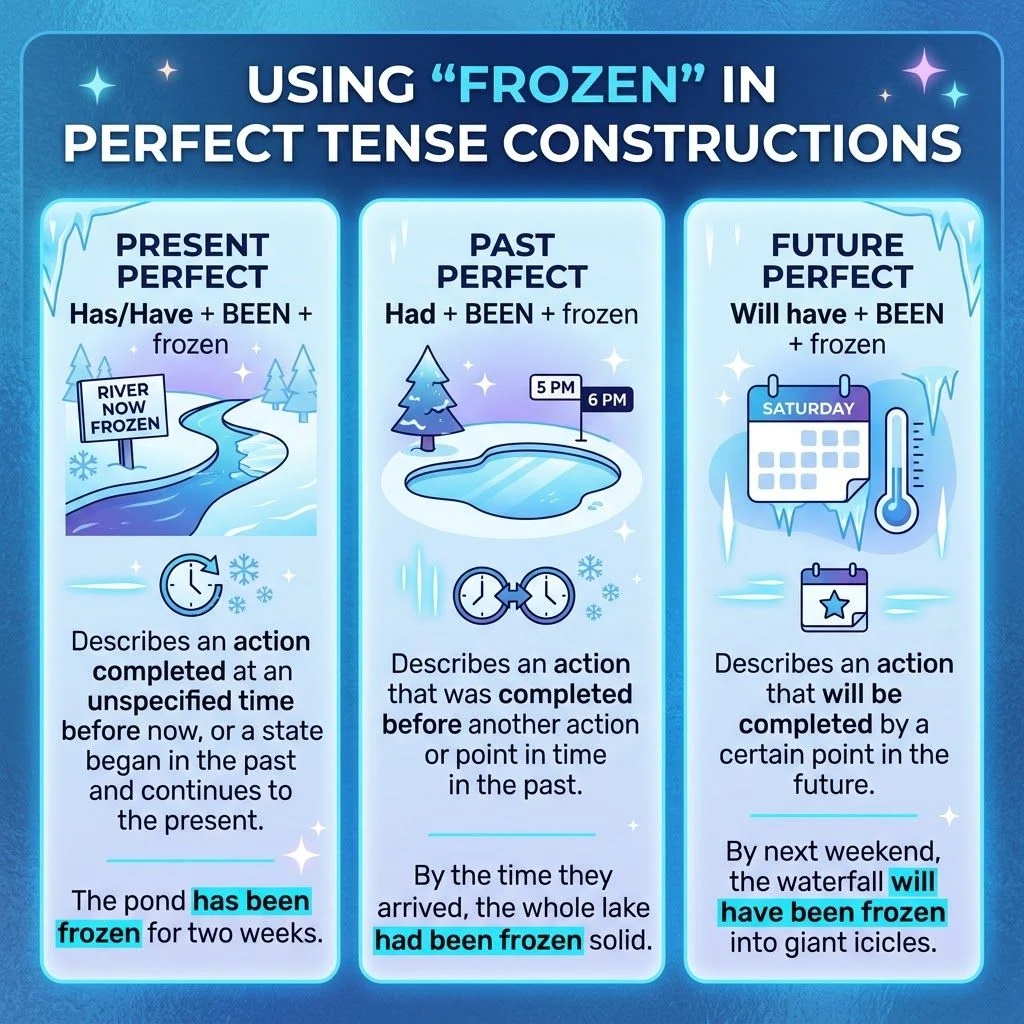
The word “frozen” plays an important role in perfect tense constructions because it acts as the past participle form of the verb freeze. Perfect tenses describe actions that are completed or connected to a specific point in time. To use frozen correctly, English speakers combine it with helping verbs such as has, have, had, or will have.
Unlike froze, which shows a completed action in the simple past, frozen in perfect tenses highlights the result, duration, or relationship between the freezing action and another time period.
Understanding how frozen works in different perfect tenses helps improve sentence accuracy in conversations, academic writing, and professional communication.
Present Perfect (“has/have frozen”)
The present perfect tense uses has/have + frozen to describe an action that happened in the past but still has a connection to the present. It often shows that something has reached a frozen state and remains that way now.
Use:
- Has frozen with singular subjects.
- Have frozen with plural subjects and the pronouns I, you, we, and they.
Examples:
- The lake has frozen because of the extremely cold weather.
- The pipes have frozen overnight.
- My computer has frozen again while opening the program.
- The vegetables have frozen completely in the freezer.
In these examples, the focus is not only on when the freezing happened but also on the current result. The lake is still frozen, the pipes are still blocked, or the computer is still not responding.
Past Perfect (“had frozen”)
The past perfect tense uses had + frozen to show that one freezing action happened before another event in the past. It helps create a clear timeline when talking about two past situations.
Examples:
- The water had frozen before we noticed the broken pipe.
- The roads had frozen by the time the workers arrived.
- The food had frozen before it was moved to another container.
- The lake had frozen when the winter festival began.
In each sentence, had frozen shows the earlier event, while another past action happens afterward. This tense is useful when explaining past experiences, reports, stories, or events that require clear order.
Future Perfect (“will have frozen”)
The future perfect tense uses will have + frozen to describe something that will be completed before a specific time or future event. It predicts that an object or substance will reach a frozen state in the future.
Examples:
- The water will have frozen by tomorrow morning.
- The pipes will have frozen if the temperature stays below zero overnight.
- The lake will have frozen before the winter competition begins.
- The food will have frozen completely by the time we check it.
This structure is less common in casual conversations but appears in weather forecasts, scientific discussions, planning, and formal writing.
A simple way to remember these perfect tense forms is:
- Has/have frozen → connected to the present.
- Had frozen → completed before another past event.
- Will have frozen → completed before a future point.
Using frozen correctly in perfect tenses makes your writing more precise and helps you describe time relationships clearly.
Read More: Appreciative Of vs Appreciative For: Which One Is Correct? 2026
How “Frozen” Works in Passive Voice and Adjective Form
The word “frozen” has two common uses beyond perfect tense structures: it can appear in the passive voice or function as an adjective. Although both uses look similar, they serve different purposes in a sentence. In passive voice, frozen shows that something experienced the action of freezing, while as an adjective, it describes a condition, quality, or state.
Understanding these differences helps avoid confusion because the same word can communicate either an action result or a description depending on the sentence structure.
Frozen in Passive Voice
In the passive voice, frozen is used with forms of the verb be such as is, are, was, were, or been. This structure focuses on the thing that receives the action rather than the person or force causing it.
The general pattern is:
Subject + form of “be” + frozen + (by + doer)
Passive voice with frozen is useful when the person or cause of freezing is unknown, less important, or already understood.
Examples:
- The food was frozen before transportation.
- The water bottles were frozen overnight.
- The samples have been frozen for scientific testing.
- The meat is frozen to keep it fresh for longer.
- The lake was frozen by extremely low temperatures.
In these sentences, the focus is on the condition or result of the freezing process rather than who performed the action.
Examples:
- The vegetables were frozen immediately after harvesting.
- The ice cream was frozen at the correct temperature.
- The pipes were frozen during the cold weather.
- The medical samples have been frozen for future research.
- The frozen products are stored in a cold facility.
A common mistake is using froze in passive structures.
Incorrect:
- ❌ The food was froze yesterday.
Correct:
- ✅ The food was frozen yesterday.
The helping verb was requires the past participle form, which is frozen, not the simple past form froze.
Frozen as an Adjective
Frozen can also work as an adjective when it describes the state or condition of something. In this use, it does not focus on the action of freezing but simply tells what something is like.
As an adjective, frozen often describes objects, weather conditions, food, surfaces, or even emotions and reactions.
Examples:
- We bought frozen fruits from the supermarket.
- The lake has a frozen surface during winter.
- She gave me a frozen smile after hearing the news.
- The door remained frozen shut because of the ice.
The meaning depends on the context. For example, frozen food means food preserved at a low temperature, while a frozen expression describes a face that shows little movement or emotion.
Examples:
- The store sells frozen vegetables and ready-to-cook meals.
- The frozen ground made digging difficult.
- He stood with a frozen look of surprise.
- The frozen screen stopped responding to my commands.
- The lake looked beautiful with its frozen surface.
Knowing whether frozen acts as a past participle or an adjective allows you to understand its meaning more accurately. The sentence structure and surrounding words usually reveal whether it describes an action result or simply a state.
Examples of “Frozen” with Common Auxiliary Verbs
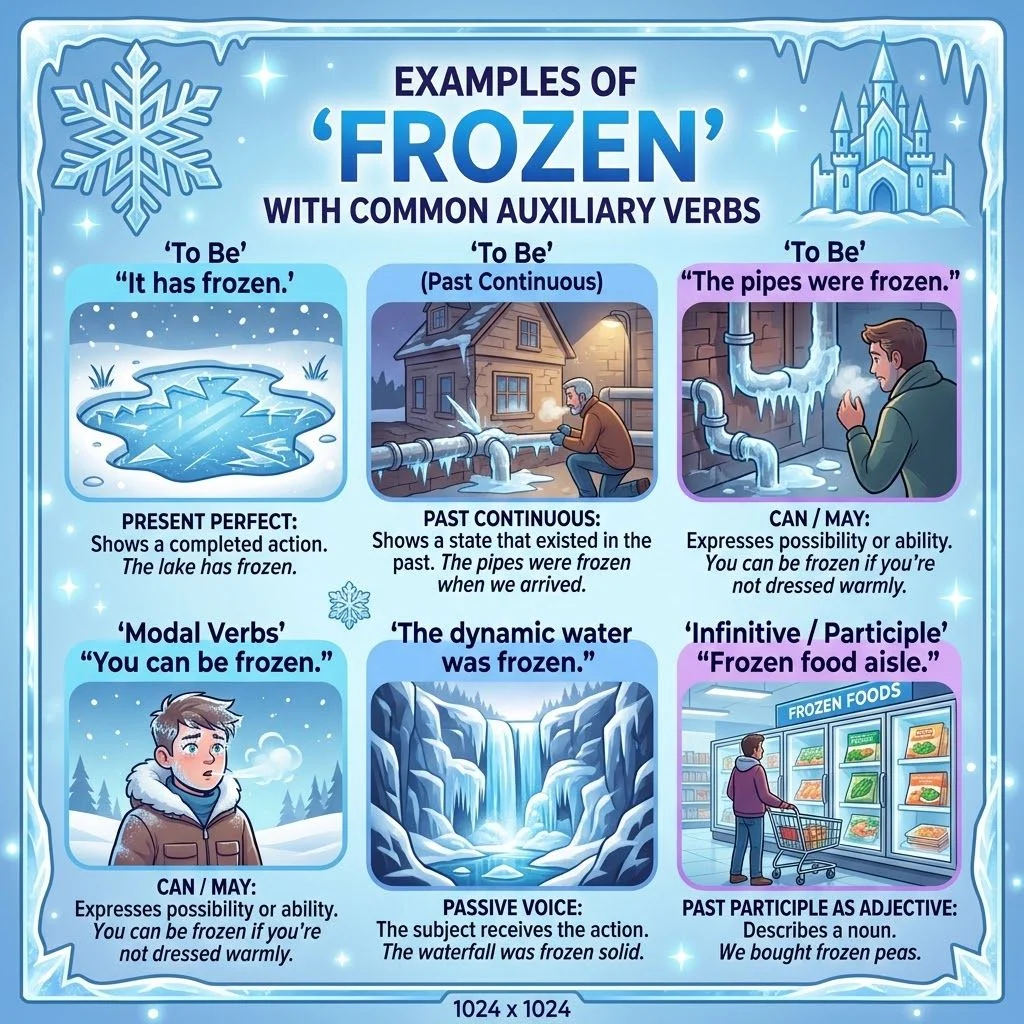
The word “frozen” often appears with auxiliary verbs (helping verbs) because it is the past participle form of freeze. These helping verbs show the tense, time relationship, or sentence structure. The meaning of frozen can change slightly depending on the auxiliary verb used.
Learning how frozen works with different auxiliary verbs helps you create grammatically correct sentences and understand how English describes completed actions, current conditions, and past events.
With “has/have”
The structure has/have + frozen creates the present perfect tense. It describes a freezing action that happened in the past but still has a connection to the present.
Use:
- Has frozen with singular subjects.
- Have frozen with plural subjects and I, you, we, they.
Examples:
- The water has frozen inside the bottle.
- The pipes have frozen because of the cold weather.
- My computer has frozen during the update.
- The lake has frozen completely this winter.
- The vegetables have frozen in the freezer.
These sentences focus on the result of freezing and show that the condition may still exist now.
With “had”
The structure had + frozen creates the past perfect tense. It shows that something became frozen before another event happened in the past.
Examples:
- The river had frozen before the fishermen arrived.
- The food had frozen before we moved it to another freezer.
- The roads had frozen when the storm started.
- The water had frozen overnight before we checked the pipes.
The word had helps establish a clear timeline by showing which past action happened first.
With “will have”
The structure will have + frozen creates the future perfect tense. It describes something that is expected to become frozen before a specific time or future event.
Examples:
- The lake will have frozen by next week.
- The pipes will have frozen if temperatures continue to drop.
- The ice cubes will have frozen by the time we return.
- The food will have frozen completely before delivery.
This form is more common in predictions, planning, weather discussions, and formal writing than in casual conversation.
With “am/is/are” (Passive)
The structure am/is/are + frozen creates a present passive construction. It focuses on something that receives the action of freezing or is kept in a frozen condition.
Examples:
- The meat is frozen before shipping.
- The samples are frozen for laboratory testing.
- The water is frozen into ice cubes.
- The products are frozen to maintain quality.
In passive voice, the focus remains on the object or result rather than the person or process causing the freezing.
With “was/were” (Passive)
The structure was/were + frozen creates a past passive construction. It describes something that was frozen in the past or was placed into a frozen state.
Examples:
- The food was frozen after preparation.
- The pipes were frozen during the winter storm.
- The samples were frozen for later examination.
- The lake was frozen for several weeks last year.
A common mistake is using froze after passive auxiliary verbs.
Incorrect:
- ❌ The vegetables were froze yesterday.
Correct:
- ✅ The vegetables were frozen yesterday.
Remember that auxiliary verbs like has, had, will have, is, and was require the past participle form, so frozen is the correct choice.
Read More: Driver’s License vs Drivers License: Which Is Correct? 2026
The Grammar Behind Freeze → Froze → Frozen
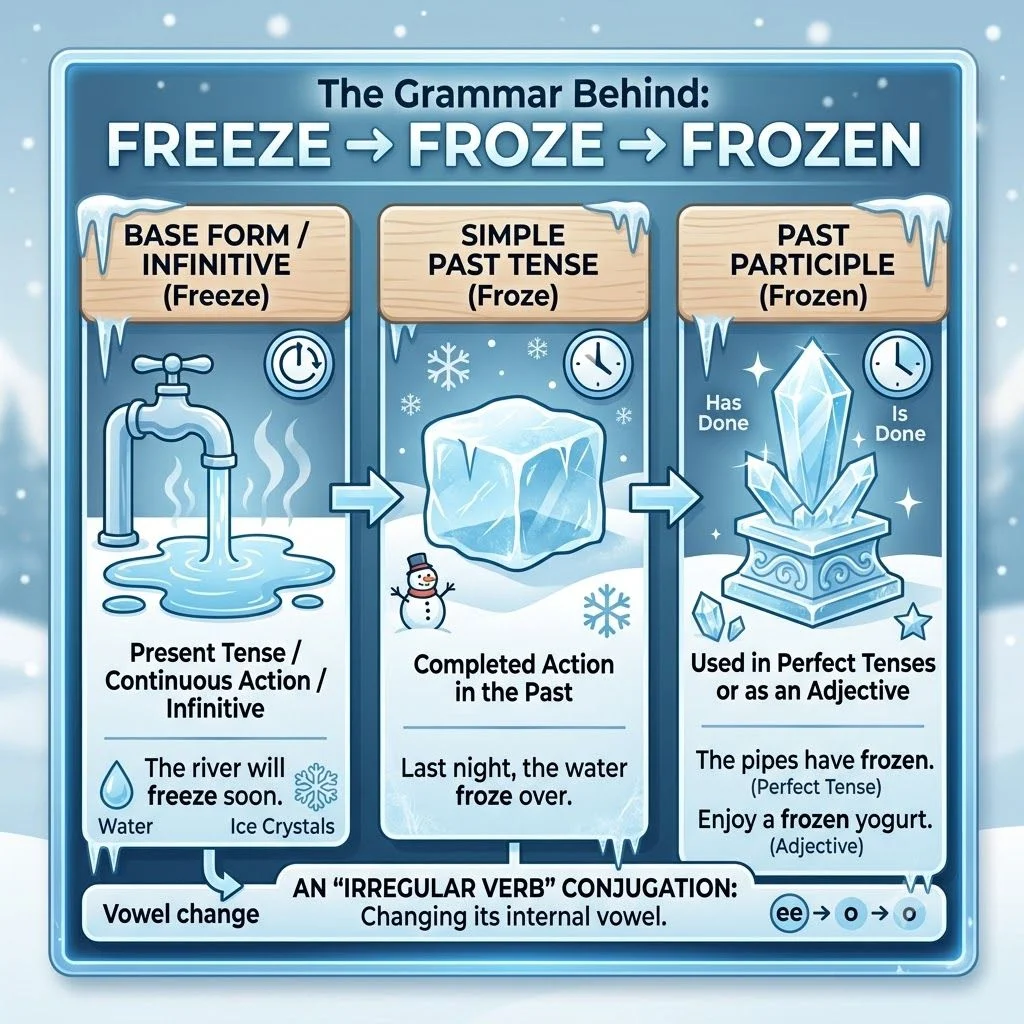
The changes from freeze → froze → frozen follow an important pattern in English grammar called an irregular verb transformation. Unlike regular verbs that usually add -ed to form the past tense and past participle, irregular verbs change their spelling or internal vowel sounds.
The verb freeze changes its vowel pattern across different forms:
- Freeze → base form used in the present tense.
- Froze → simple past form used for completed actions in the past.
- Frozen → past participle form used with auxiliary verbs or as an adjective.
These changes help English speakers understand the time and grammatical role of the verb in a sentence. The form you choose depends on whether you are describing a current action, a completed past event, a perfect tense structure, or a condition.
Examples:
- Water can freeze at low temperatures.
- The lake froze last winter.
- The lake has frozen completely.
Understanding this pattern makes it easier to use froze vs frozen correctly and recognize similar changes in other irregular verbs.
Example of Ablaut Pattern in “Freeze”
The verb freeze follows an ablaut pattern, which means the vowel inside the word changes to show different grammatical forms. This pattern comes from the history of the English language and appears in many strong verbs.
In freeze → froze → frozen, the vowel changes:
- Freeze → “ee” sound in the base form.
- Froze → “o” sound in the past tense.
- Frozen → “o” sound with an added -en ending in the past participle.
Examples:
- I usually freeze leftover food.
- The food froze overnight.
- The food has frozen completely.
The vowel change does not follow a simple rule like adding letters. Instead, it must be learned as part of the verb’s natural conjugation. This is why freeze, froze, and frozen are often grouped together when studying irregular verbs.
Other English Verbs That Follow This Pattern
Many English verbs follow a similar irregular pattern where the vowel changes between the base form, past tense, and past participle. These verbs are known as strong verbs because they historically changed their internal vowel rather than adding a regular ending.
Some examples include:
| Base Form | Simple Past | Past Participle |
| Speak | Spoke | Spoken |
| Break | Broke | Broken |
| Choose | Chose | Chosen |
| Write | Wrote | Written |
| Drive | Drove | Driven |
| Take | Took | Taken |
| Give | Gave | Given |
Like freeze → froze → frozen, these verbs require learners to remember each form because their changes do not follow regular past tense rules.
For example:
- I write emails every day.
- I wrote an email yesterday.
- I have written many emails.
Learning common irregular verb patterns improves grammar accuracy and helps avoid mistakes in both speaking and writing.
Common Mistakes with Froze vs Frozen
The confusion between froze and frozen happens because both words describe the same basic action, but they have different grammatical roles. Froze is a simple past verb, while frozen is a past participle or adjective.
Using the wrong form can make sentences sound unnatural or grammatically incorrect. Understanding the role of each word helps you choose the correct form in different situations.
Mistake 1: Using “froze” with helping verbs
One common mistake is using froze after auxiliary verbs such as has, have, had, or will have. These helping verbs require the past participle form, which is frozen.
Incorrect:
- ❌ The water has froze inside the pipe.
Correct:
- ✅ The water has frozen inside the pipe.
Incorrect:
- ❌ The lake had froze before winter ended.
Correct:
- ✅ The lake had frozen before winter ended.
Remember:
Helping verb + frozen = correct
Helping verb + froze = incorrect
Mistake 2: Using “frozen” without helping verbs
Another common error is using frozen as a simple past verb without a helping verb. Since frozen is a past participle, it usually needs support from an auxiliary verb.
Incorrect:
- ❌ The water frozen last night.
Correct:
- ✅ The water froze last night.
Incorrect:
- ❌ My computer frozen during the meeting.
Correct:
- ✅ My computer froze during the meeting.
However, frozen can appear without a helping verb when it works as an adjective.
Example:
- ✅ The frozen water covered the road.
Mistake 3: Confusing adjective vs participle
The word frozen can act as both a past participle and an adjective, which creates confusion for many learners.
As a past participle:
- The pipes have frozen because of the cold weather.
Here, frozen completes the verb phrase have frozen.
As an adjective:
- The frozen pipes blocked the water supply.
Here, frozen describes the condition of the pipes.
A simple way to identify the difference is to check the sentence structure:
- If frozen follows a helping verb, it is usually a past participle.
- If frozen describes a noun, it is usually an adjective.
Recognizing these patterns helps you use froze and frozen accurately in everyday English, formal writing, and academic communication.
Read More: A MA or An MA: Which Article Is Correct? 2026
Practical Tips to Remember the Difference
Remembering the difference between froze and frozen becomes easier when you focus on how each word functions in a sentence. Since both words come from the verb freeze, many learners mix them up because they share the same meaning. The key is to pay attention to the sentence structure, especially the presence of helping verbs and the role of the word in the sentence.
These simple strategies can help you quickly identify whether you need froze or frozen in everyday writing and conversation.
Tip 1: Look for a helping verb
The easiest way to choose between froze and frozen is to check whether the sentence contains a helping verb.
Words like has, have, had, is, are, was, and were often signal that you need the past participle form frozen.
Examples:
- The water has frozen overnight. ✅
- The pipes had frozen before the repair team arrived. ✅
- The food was frozen before delivery. ✅
Without a helping verb, frozen is usually incorrect as a verb.
Incorrect:
- ❌ The lake frozen last night.
Correct:
- ✅ The lake froze last night.
Tip 2: No helping verb? Use “froze.”
When a sentence describes a completed action in the past and does not include a helping verb, choose froze.
Think of froze as the action that happened before now.
Examples:
- The pond froze during the winter.
- My phone froze while I was using it.
- The water bottle froze in the car.
A quick question can help:
“Did something happen in the past?”
If the answer is yes and there is no helping verb, froze is usually the correct choice.
Tip 3: Frozen = finished
A helpful memory trick is:
Frozen = finished state.
The word frozen often shows that the freezing process has already happened and the result exists.
Examples:
- The ice cream is frozen.
- The vegetables have frozen.
- The lake has frozen completely.
In these sentences, the focus is on the final condition rather than the moment when freezing happened.
Remember:
- Froze → the action happened.
- Frozen → the action is completed or the result remains.
Tip 4: Say it out loud
Reading sentences aloud can help you recognize which form sounds natural. English speakers often use rhythm and sentence structure to choose the correct verb form.
Compare:
- “The water froze last night.” ✅
- “The water has frozen.” ✅
The second sentence feels incomplete without the helping verb has because frozen needs support in that structure.
Practicing sentences aloud improves your understanding of natural English patterns and helps you avoid common grammar mistakes.
Tip 5: Use group learning
Learning freeze → froze → frozen with other irregular verbs can make the pattern easier to remember. Grouping similar verbs helps your brain recognize changes in spelling and vowel sounds.
Examples of similar irregular verbs:
- Speak → spoke → spoken
- Break → broke → broken
- Choose → chose → chosen
- Write → wrote → written
Creating small groups of irregular verbs and practicing them together can improve vocabulary retention and grammar accuracy. Whether you are learning English for school, work, or daily communication, understanding these patterns makes verb usage more automatic.
Emotional Meanings of “Frozen” in English
Beyond its literal meaning related to cold temperatures, “frozen” can also describe emotional states, reactions, and moments when someone feels unable to act or respond. In these contexts, frozen works as an adjective that explains a person’s mental or physical reaction.
For example, when someone experiences fear, shock, surprise, or nervousness, they may feel frozen because they cannot move, speak, or react immediately.
Examples:
- I was frozen with fear when I heard the strange noise.
- She stood frozen in shock after receiving the unexpected news.
- He became frozen with anxiety before the important interview.
- The audience sat frozen during the dramatic scene.
The phrase “frozen in time” is also common in English. It describes something that feels unchanged or preserved from the past.
Example:
- The old village looks frozen in time.
Understanding these emotional uses helps you recognize that frozen can describe more than physical temperature. It can also express feelings, reactions, and experiences in everyday communication.
Read More: Me Too vs Me As Well vs I As Well: Which One Is Correct? 2026
Common Phrases and Idioms With “Freeze”
The verb freeze appears in many common English expressions. These phrases often use the idea of stopping movement or becoming unable to continue.
Freeze up
This means to suddenly become unable to think, speak, or act, usually because of pressure or nervousness.
Example:
- I always freeze up when I speak in front of a large crowd.
Freeze someone out
This means to intentionally exclude someone from a group or situation.
Example:
- They tried to freeze him out of the conversation.
Freeze assets
This phrase means to legally stop someone from accessing money or property.
Example:
- The court decided to freeze the company’s assets.
Freeze frame
This refers to stopping a video or image at one exact moment.
Example:
- The editor used a freeze frame to highlight the final scene.
These expressions show how freeze has developed meanings beyond temperature and connects to actions, emotions, and situations.
Common Phrases and Idioms With “Frozen”
The word frozen also appears in several expressions that describe emotional states, conditions, or situations.
Frozen in fear
This means being so scared that you cannot move or react.
Example:
- The child stood frozen in fear during the storm.
Frozen in time
This describes something that appears unchanged for a long period.
Example:
- The historic building feels frozen in time.
Frozen solid
This means something has become completely frozen.
Example:
- The lake was frozen solid after several days of extreme cold.
Frozen with shock
This describes being unable to react because of surprise or disbelief.
Example:
- She was frozen with shock after hearing the announcement.
These phrases show how frozen can describe physical conditions as well as strong emotions and reactions.
How to Teach Freeze, Froze, and Frozen Easily
Teaching freeze, froze, and frozen becomes easier when learners understand the purpose of each form instead of memorizing them separately.
Start with the basic pattern:
- Freeze → present or base form.
- Froze → completed past action.
- Frozen → past participle used with helping verbs or as an adjective.
A simple teaching method is to use a timeline:
Now: Water can freeze in cold weather.
Past: The water froze last night.
Result: The water has frozen completely.
Visual examples can also help learners connect grammar with real situations:
- Show ice forming → freeze
- Show yesterday’s cold event → froze
- Show the final icy condition → frozen
Practice with short sentences and everyday examples helps learners understand when each form belongs naturally.
Practice Exercises: Choose Freeze, Froze, or Frozen
Complete each sentence with the correct form of the verb freeze.
- Water can ______ when the temperature drops below zero.
- The lake ______ during the cold winter night.
- The food has ______ inside the broken freezer.
- My computer ______ while I was working yesterday.
- The pipes have ______ because of the cold weather.
- The ice cream was completely ______ before serving.
- The river had ______ before the boat arrived.
- The roads ______ after the snowstorm.
Answers:
- freeze
- froze
- frozen
- froze
- frozen
- frozen
- frozen
- froze
Practice like this helps you recognize the difference between the base form, simple past, and past participle forms of irregular verbs.
FAQs About Froze vs Frozen
1. What is the difference between “froze” and “frozen”?
Froze is the simple past tense of freeze and describes an action completed in the past. Frozen is the past participle form and usually appears with helping verbs like has, have, or had.
Examples:
- The water froze last night.
- The water has frozen.
2. Is “frozen” a past tense verb?
No, frozen is not the simple past tense. The simple past form of freeze is froze. Frozen is the past participle form used in perfect tenses and passive voice.
3. Can I use “frozen” without a helping verb?
Yes, but only when frozen works as an adjective.
Example:
- The frozen food is ready to cook.
As a verb form, it usually needs a helping verb:
- The food has frozen.
4. Which one is correct: “The water froze” or “The water frozen”?
The correct sentence is:
- ✅ The water froze.
The word frozen needs a helping verb:
- ✅ The water has frozen.
5. Is “freeze, froze, frozen” an irregular verb?
Yes. Freeze, froze, frozen is an irregular verb pattern because its forms change instead of following the regular -ed ending rule.
6. Why do people confuse froze and frozen?
People often confuse them because both words come from the same verb and have similar meanings. The difference depends on grammar structure and the role each word plays in a sentence.
7. What tense uses “has frozen”?
The phrase has frozen uses the present perfect tense. It describes an action that happened in the past and still has a connection to the present.
8. What tense uses “had frozen”?
The phrase had frozen uses the past perfect tense. It shows that freezing happened before another past event.
9. Can “frozen” describe emotions?
Yes. Frozen can describe emotional reactions such as fear, shock, or surprise.
Example:
- She stood frozen in fear.
10. How can I remember froze vs frozen?
Remember this simple rule:
- Froze = past action.
- Frozen = finished state or needs a helping verb.
This quick difference can help you choose the correct form in most sentences.
Conclusion
Understanding the difference between froze vs frozen helps you use the verb freeze correctly in everyday English, academic writing, and professional communication. While both words come from the same irregular verb, they have different grammatical roles. Froze describes a completed action in the past, while frozen works as a past participle with helping verbs or as an adjective that describes a condition.
Learning the pattern freeze → froze → frozen makes it easier to recognize how irregular verbs change in English. By paying attention to sentence structure, auxiliary verbs, and context, you can quickly decide which form fits your sentence. Simple practice with real examples can strengthen your grammar skills and improve your confidence.
Whether you are writing an email, having a conversation, or studying English grammar, choosing the correct form creates clearer communication. Keep practicing these verb patterns, and the difference between froze and frozen will become natural over time.

Hi, I am Zadie Smith, the author of Grammargide.com. I write clear, easy-to-understand guides that explain commonly confused words and phrases, helping readers choose the right expression with confidence.