Clear communication depends on choosing the right words and using them correctly. Annunciate vs Enunciate is a common source of confusion because both words relate to speaking and expressing ideas, yet they have different meanings and uses. Many writers and speakers mix these terms because they sound similar and both connect to pronunciation, speech clarity, and verbal expression.
Understanding the difference between annunciate and enunciate helps improve vocabulary accuracy, language skills, and professional communication. While one word focuses more on making an announcement or declaring something, the other refers to expressing words clearly and distinctly. Knowing when to use each term prevents misunderstandings in writing, conversations, presentations, and academic contexts.
In this article, you will learn the meaning, usage, differences, examples, and practical tips for using annunciate and enunciate correctly. Continue reading to discover how these two similar-looking words have unique roles in the English language.
The Origins Behind Annunciate and Enunciate
The confusion between annunciate and enunciate comes from their similar sounds and shared Latin roots. Both words relate to speaking or expressing something, which makes them easy to mix up. However, they developed different meanings over time and now serve different purposes in English communication.
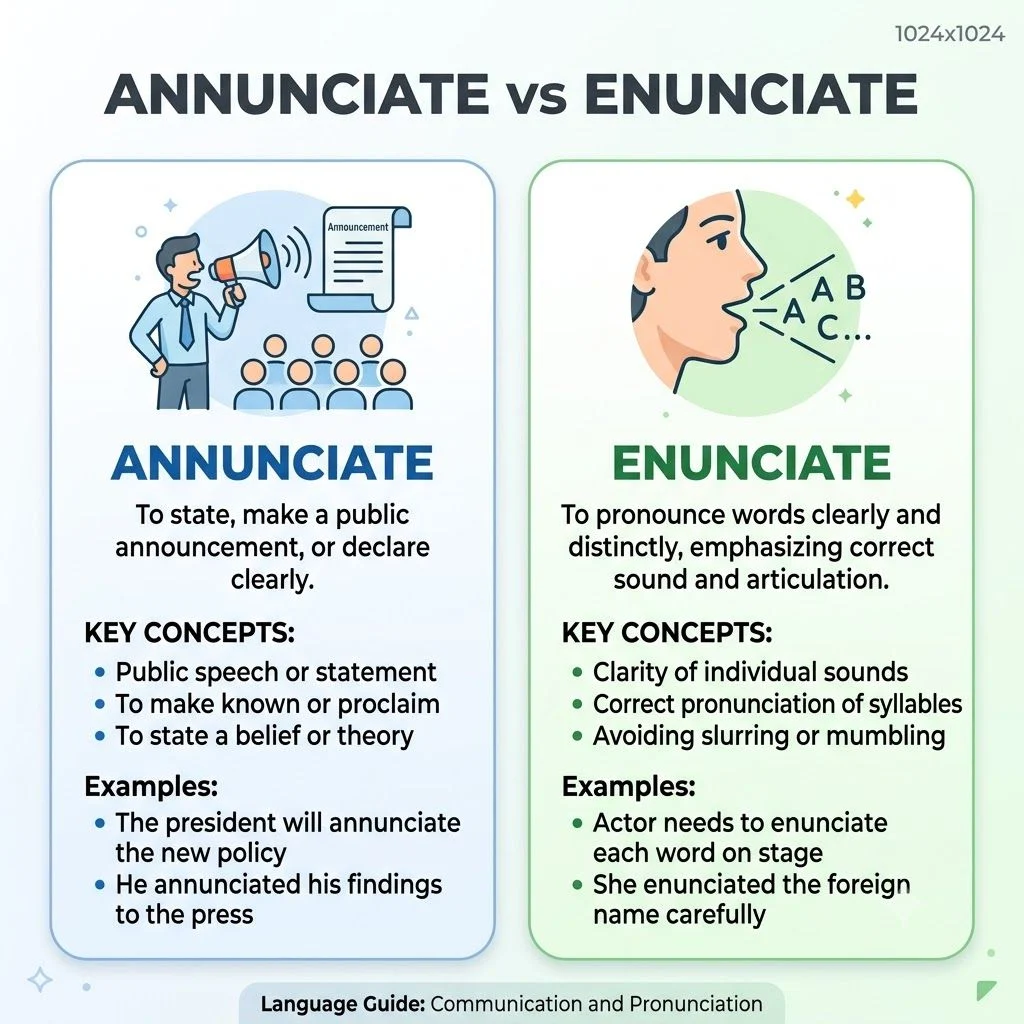
Annunciate focuses on the act of announcing or making something known, especially something important, formal, or public. Enunciate, on the other hand, focuses on speaking clearly and pronouncing words properly so the listener can understand the message.
Understanding their history helps explain why these words look and sound alike but are used in different situations. One connects more with the delivery of information, while the other connects with the clarity of speech.
Etymology & Historical Roots
Both annunciate and enunciate come from Latin roots connected to the idea of speaking, declaring, or making something known.
The word annunciate comes from the Latin word annuntiare, meaning “to announce” or “to report.” It combines ad- (toward) with nuntiare (to tell or report). This root highlights the idea of delivering news, a message, or an important statement to others.
The word enunciate comes from the Latin enuntiare, meaning “to declare clearly” or “to state.” It combines ex- (out) with nuntiare (to tell). This origin reflects the idea of bringing words out clearly and expressing thoughts in an understandable way.
Over centuries, English adapted both terms from Latin through Old French and scholarly Latin usage. Their meanings became more specialized. Annunciate became linked with announcements and formal declarations, while enunciate became connected with pronunciation, articulation, and clear expression.
Today, these words remain closely related but have separate roles in modern English. A person may annunciate a message by announcing it, but they enunciate their words by speaking clearly.
How Each Word Evolved
Annunciate
Annunciate developed from the idea of delivering news, information, or a formal message to an audience. Historically, it was often used in religious, ceremonial, or official contexts where an important announcement needed to be made.
Over time, the word became less common in everyday conversation. Modern English speakers usually choose announce instead because it sounds more natural and familiar. However, annunciate still appears in formal writing, historical discussions, and specific expressions.
For example:
- The leader came forward to annunciate the new policy changes.
- The ceremony was held to annunciate an important message.
Although these sentences are understandable, many writers would use announce instead:
- The leader came forward to announce the new policy changes.
- The ceremony was held to announce an important message.
The key idea behind annunciate is making information known. It is about the message itself and the act of sharing it with others.
Enunciate
Enunciate evolved with a stronger connection to speech clarity, pronunciation, and expression. It describes how someone forms and delivers words rather than what information they share.
Today, teachers, public speakers, actors, and communication coaches often use this word when discussing effective speaking skills. Good enunciation helps listeners understand every word, especially during presentations, interviews, or performances.
Examples:
- The speaker was asked to enunciate each word clearly.
- Actors must enunciate their lines so the audience can follow the story.
- She learned to enunciate better during public speaking practice.
The modern meaning of enunciate focuses on clear articulation and careful pronunciation. It does not mean announcing news. Instead, it describes the quality and clarity of spoken communication.
Knowing this difference makes it easier to choose the right word: annunciate tells people something, while enunciate helps people understand what is being said.
Is Annunciate Still Used in Modern English?
Annunciate is still a valid English word, but it is much less common in everyday conversations. Most modern speakers prefer the simpler and more natural word announce when they want to describe sharing news, information, or an important statement.
You may still find annunciate in formal writing, historical texts, religious contexts, or situations that require a more elevated style. It often carries a sense of making something known in a serious or official way.
For example:
- The organization will announce the winner tomorrow. (Common modern usage)
- The ceremony was created to annunciate a significant message. (Formal usage)
In most cases, choosing announce will sound more natural. However, understanding annunciate helps readers recognize its meaning when they encounter it in formal or literary contexts.
Read More: Froze vs Frozen: When to Use Each Correctly? 2026
Is Enunciate Only About Pronunciation?
Many people think enunciate only means pronouncing words correctly, but its meaning goes beyond basic pronunciation. While clear speech is a major part of enunciation, the word also includes the way someone expresses ideas, delivers messages, and communicates thoughts clearly.
Good enunciation involves several communication skills:
- Speaking words clearly.
- Using the correct tone and pace.
- Organizing thoughts in a way others can follow.
- Expressing ideas with confidence and accuracy.
For example, a speaker can pronounce every word correctly but still fail to communicate effectively if their message lacks structure or clarity. True enunciation combines clear speech with clear expression.
Enunciation Beyond Clear Speech
Enunciation plays an important role in effective communication because it helps people understand both the words and the meaning behind them. A strong communicator does not simply speak loudly; they deliver ideas in a way that connects with the audience.
In conversations, enunciation can improve:
- Understanding: Listeners can follow the message more easily.
- Confidence: Clear speakers often appear more prepared and professional.
- Connection: Well-expressed ideas create stronger communication.
Actors, teachers, presenters, and leaders often practice enunciation because their success depends on how clearly they share information.
For example, an actor must enunciate a script so the audience understands every emotion and detail. A teacher must enunciate explanations so students can learn complex concepts.
Enunciation in Writing and Expression
Although enunciate is commonly connected with speaking, the concept also applies to writing and written expression. In writing, enunciation means presenting ideas in a clear, organized, and understandable way.
A well-enunciated written message usually has:
- A clear main idea.
- Logical sentence structure.
- Precise word choices.
- A suitable tone for the audience.
For example, a professional email should clearly explain the purpose, request, or information without confusing the reader. A poorly structured message may contain correct words but fail to communicate effectively.
Strong writers focus on clarity, accuracy, and expression, which are the same principles behind good verbal enunciation.
How Meaning Changes With Clear Expression
Clear expression can change how people understand and respond to a message. The same words may create different impressions depending on tone, pronunciation, and delivery.
For example:
- A carefully enunciated statement can sound confident and trustworthy.
- A rushed or unclear statement may create confusion.
- A change in emphasis can change the listener’s interpretation.
This is why effective communication requires more than vocabulary. Speakers must consider tone, emotion, audience, and context when delivering a message.
Whether speaking in a meeting, teaching a lesson, or having a conversation, clear enunciation helps ensure the intended meaning reaches the listener.
Annunciate vs Enunciate in Professional Communication
In professional settings, the difference between annunciate and enunciate becomes especially important. Businesses, educators, and public speakers rely on clear communication to share ideas and build trust.
Annunciate relates to the information being officially shared, while enunciate relates to how clearly that information is delivered.
For example:
- A company may announce a new policy.
- A manager should enunciate the details clearly during a meeting.
Using the right word helps create more accurate and professional communication.
Workplace Presentations
During workplace presentations, enunciation is essential because employees need to explain ideas clearly to colleagues, managers, or clients.
A presenter who enunciates well:
- Speaks at a comfortable pace.
- Pronounces important terms clearly.
- Uses pauses to highlight key points.
- Keeps the audience focused.
If a company introduces a major change, the leader may announce the update, but the success of that message depends on how well they enunciate the details.
Public Speaking
Public speakers rely heavily on enunciation to make their message powerful and memorable. A strong voice, clear pronunciation, and organized delivery help audiences understand complex topics.
Professional speakers often practice:
- Breathing techniques.
- Word pronunciation.
- Voice control.
- Audience awareness.
While a speaker may annunciate an important announcement, they must enunciate the message so listeners understand its importance.
Teaching and Training
Teachers and trainers use enunciation as a key communication skill. Students learn better when instructions and explanations are delivered clearly.
A teacher who enunciates effectively can:
- Explain difficult concepts more easily.
- Reduce misunderstandings.
- Keep learners engaged.
For example, a language teacher must carefully enunciate new vocabulary words so students learn the correct pronunciation and meaning.
In training environments, clear communication helps employees understand procedures, goals, and expectations.
Media and Broadcasting
In media and broadcasting, enunciation is one of the most important skills for professionals. News anchors, radio hosts, and presenters must deliver information clearly because audiences often hear information only once.
Broadcasters focus on:
- Clear pronunciation.
- Proper pacing.
- Strong vocal expression.
- Accurate delivery.
A news presenter may announce breaking news, but their ability to enunciate determines whether viewers understand the information correctly.
Clear enunciation builds credibility and helps media professionals communicate effectively with large audiences.
Read More: Me Too vs Me As Well vs I As Well: Which One Is Correct? 2026
How to Remember the Difference Between Annunciate and Enunciate
Remembering the difference between annunciate and enunciate becomes easier when you focus on what each word does. Both words connect to communication, but they describe different parts of the process.
Annunciate is about sharing or announcing information. It focuses on the message being made known to others.
Enunciate is about speaking or expressing words clearly. It focuses on the quality of delivery and how easily others understand the message.
A simple way to separate them is:
- Annunciate = Announce something.
- Enunciate = Express something clearly.
When you think about the purpose of the word, the difference becomes much easier to remember.
Memory Trick for Annunciate
Use the beginning sound of annunciate to connect it with announce. Both words start with “ann-”, and both relate to making information known.
Think:
Annunciate → Announcement → Announce
If someone shares important news, a decision, or an official statement, they are annunciating that information.
Examples:
- The company will annunciate its new plans.
- The speaker annunciated an important message to the audience.
A quick memory phrase:
“Annunciate announces.”
The word focuses on what information is being shared, not how clearly someone says it.
Memory Trick for Enunciate
Remember enunciate by connecting it with enunciation, which means clear speech and expression.
Think:
Enunciate → Expression → Explain clearly
When you enunciate, you make sure your words come out clearly so others can understand you.
Examples:
- Please enunciate your words during the presentation.
- The actor practiced to enunciate every line clearly.
A quick memory phrase:
“Enunciate explains clearly.”
The focus is not on announcing new information but on delivering words with clarity and accuracy.
Simple Rule to Avoid Confusion
Use this easy rule:
If you are sharing news, use annunciate. If you are improving clarity, use enunciate.
Ask yourself one question:
“Am I making something known, or am I making something clear?”
- Making something known → Annunciate
- Making something clear → Enunciate
For example:
- ❌ The teacher annunciated every word slowly so students could understand.
✅ The teacher enunciated every word slowly so students could understand. - ❌ The company enunciated its new product launch.
✅ The company annunciated its new product launch.
A simple shortcut:
Annunciate = Announcement.
Enunciate = Expression.
This small distinction will help you choose the correct word in writing, speaking, and professional communication.
Annunciate vs Enunciate in Different Contexts
The difference between annunciate and enunciate becomes clearer when you see how each word works in real situations. Both words relate to communication, but they focus on different goals.
Annunciate deals with sharing information, declaring something, or making a message known. Enunciate focuses on clear pronunciation, accurate expression, and making ideas easy to understand.
Choosing the right word depends on whether you are talking about the announcement itself or the clarity of the delivery.
Everyday Conversations
In everyday conversations, people rarely use annunciate because the more common word announce sounds more natural. However, the idea behind it still appears whenever someone shares news, updates, or important information.
Examples:
- She announced her new job to her friends.
- He clearly enunciated his opinion during the discussion.
In casual conversations, enunciate is more likely to appear when talking about speech clarity. Someone may ask another person to speak slowly or pronounce words more clearly.
Examples:
- Please enunciate your words; I cannot hear you clearly.
- He needs to enunciate better when speaking on the phone.
A simple way to remember the difference in daily life:
- Sharing news or information → Annunciate/announce
- Speaking clearly → Enunciate
Academic Settings
In academic environments, enunciate is more commonly used because students and teachers need clear communication. Presentations, lectures, and discussions depend on accurate pronunciation and well-organized explanations.
A professor may need to enunciate complex terms so students understand the lesson. Students also improve their communication skills by learning how to express ideas clearly.
Examples:
- The lecturer enunciated each scientific term carefully.
- Students should enunciate their arguments during debates.
Annunciate may appear in academic writing when discussing historical, religious, or formal announcements. However, writers usually choose announce for modern academic work.
Example:
- The university announced the results of the research project.
In academic communication, clarity and accuracy matter more than using uncommon vocabulary.
Formal Speeches
Formal speeches can involve both annunciate and enunciate, but they describe different parts of the speech process.
A leader, speaker, or official may annunciate an important decision or public statement. The focus is on the act of making information known.
Example:
- The president will annunciate the new policy changes.
However, the speaker must also enunciate the message clearly so the audience understands the details.
Example:
- The speaker enunciated every point with confidence and precision.
A powerful speech requires both:
- Annunciation: Delivering the message.
- Enunciation: Delivering the message clearly.
Written Communication
In written communication, enunciate has a broader meaning because it can refer to expressing ideas clearly through words. Writers who enunciate their thoughts create messages that readers can easily follow.
Good written enunciation includes:
- Clear sentence structure.
- Precise word choices.
- Logical organization.
- A suitable tone for the audience.
Examples:
- The author clearly enunciated the main argument in the article.
- The report clearly expresses the company’s goals.
Annunciate is less common in modern writing. When writers need to describe sharing news, they usually use announce instead.
Example:
- The organization announced the upcoming changes.
Understanding the difference helps writers choose accurate words and communicate with greater precision. Annunciate focuses on presenting information, while enunciate focuses on expressing that information clearly.
Read More: Recurring vs Reoccurring Which One Is Correct? 2026
Grammar Rules for Using Annunciate and Enunciate Correctly
Using annunciate and enunciate correctly requires understanding their meanings and grammatical roles. Both words function mainly as verbs, but they describe different communication actions.
Annunciate means to announce, declare, or make something known. It focuses on the information being shared.
Enunciate means to express clearly or pronounce words carefully. It focuses on the delivery, clarity, and accuracy of speech or expression.
A helpful grammar rule is:
- Use annunciate when the focus is on the message being presented.
- Use enunciate when the focus is on how the message is communicated.
Correct word choice improves clarity and prevents confusion in both spoken and written English.
Word Forms and Variations
Both words have related forms that appear in different sentence structures.
Annunciate Word Forms
Verb: Annunciate
- The speaker will annunciate the official statement.
Past tense: Annunciated
- The organization annunciated its new plans.
Present participle: Annunciating
- The leader is annunciating the upcoming changes.
Noun form: Annunciation
- The annunciation of the decision surprised many people.
The word family of annunciate connects with the idea of announcing or declaring information.
Enunciate Word Forms
Verb: Enunciate
- She needs to enunciate her words clearly.
Past tense: Enunciated
- The teacher enunciated the instructions carefully.
Present participle: Enunciating
- He is enunciating each phrase during practice.
Noun form: Enunciation
- Good enunciation improves communication skills.
The word family of enunciate connects with clear expression, pronunciation, and communication quality.
Verb Usage Rules
Because both words are verbs, they usually appear with a subject that performs the communication action.
Using Annunciate
Use annunciate when someone officially shares information, news, or a declaration.
Structure:
Subject + annunciate + information/message
Examples:
- The spokesperson annunciated the official announcement.
- The organization will annunciate its final decision.
However, in modern English, announce is usually preferred because it sounds more natural.
Example:
- The company announced the new policy. ✅
Using Enunciate
Use enunciate when someone speaks, explains, or expresses something clearly.
Structure:
Subject + enunciate + words/ideas/message
Examples:
- The presenter enunciated every word clearly.
- She enunciated her ideas in a simple way.
A common mistake is using enunciate when you mean “announce.”
Incorrect:
- The company enunciated a new product launch.
Correct:
- The company announced a new product launch.
Common Sentence Structures
Learning common sentence patterns can help you use both words naturally.
Annunciate Sentence Patterns
1. Subject + annunciate + a message
- The official annunciated a message to the audience.
2. Subject + annunciate + important information
- The leader annunciated important information during the ceremony.
3. Subject + be + annunciating + a statement
- The organization is annunciating a formal statement today.
Enunciate Sentence Patterns
1. Subject + enunciate + words clearly
- The actor enunciated the words clearly during the performance.
2. Subject + enunciate + an idea/thought
- The writer enunciated the main idea effectively.
3. Subject + need to + enunciate + better
- The speaker needs to enunciate better during presentations.
A quick grammar check can help:
- Does the sentence involve sharing news or making something known? → Annunciate.
- Does the sentence involve clear speech or clear expression? → Enunciate.
Using these rules will help you choose the correct word based on meaning, context, and communication purpose.
What “Annunciate” Means (and When to Use It)
Annunciate is a formal verb connected with the idea of announcing, declaring, or making something known. It describes the action of delivering information to others, especially when the message has importance or a formal purpose.
Although annunciate is a correct English word, it appears less often in modern conversations. Most people use announce instead because it feels simpler and more natural. Still, understanding annunciate helps readers recognize its meaning in formal, historical, or literary contexts.
Core Definition of Annunciate
The core meaning of annunciate is to announce or communicate something publicly. It focuses on the act of presenting information rather than the way someone speaks.
The word is often associated with:
- Declaring important news.
- Making a formal statement.
- Sharing information with an audience.
- Presenting a message officially.
For example:
- The organization decided to annunciate its new mission statement.
- The leader annunciated the decision during the ceremony.
In simple terms, annunciate means to make something known.
When Should You Use Annunciate?
You should use annunciate when you want to describe a formal or deliberate announcement. It works best in situations where the focus is on the information being delivered.
Common situations include:
- Official declarations.
- Formal ceremonies.
- Historical discussions.
- Religious or traditional contexts.
- Literary writing.
Examples:
- The king annunciated a new law to the public.
- The ceremony was held to annunciate an important message.
However, in everyday English, announce is usually the better choice:
- The company announced a new product. ✅
- The company annunciated a new product. (Correct but less natural)
Using annunciate in casual conversation may sound overly formal or uncommon.
Examples of Annunciate Used Correctly
Here are examples showing the correct meaning of annunciate:
- The speaker came forward to annunciate the final decision.
- The organization will annunciate its goals at the annual event.
- The official document was created to annunciate new policies.
- The ceremony helped annunciate a significant change.
These examples show that annunciate focuses on the announcement itself, not pronunciation or speaking style.
Key Characteristics of “Annunciate”
The main features of annunciate include:
- It means to announce or declare something.
- It focuses on the message being shared.
- It often appears in formal or specialized writing.
- It is less common than announce in modern speech.
- It does not describe clear pronunciation.
Remember:
Annunciate = making information known.
What “Enunciate” Means (and Why It’s Common Today)
Enunciate is a more commonly used word because clear communication is important in everyday life. It describes the way someone pronounces words, expresses ideas, and delivers a message clearly.
Unlike annunciate, which focuses on announcing information, enunciate focuses on the quality of communication. Speakers, teachers, actors, and professionals often use this word when discussing effective speech.
Core Definition of Enunciate
The core meaning of enunciate is to express something clearly, especially through careful pronunciation and organized communication.
It can refer to:
- Speaking words clearly.
- Pronouncing sounds accurately.
- Expressing thoughts in an understandable way.
- Communicating ideas with precision.
Examples:
- The presenter enunciated every word during the speech.
- She enunciated her opinion clearly during the meeting.
In simple terms, enunciate means to make your words clear.
When Should You Use Enunciate?
Use enunciate when the focus is on how someone speaks or communicates an idea.
Common situations include:
- Public speaking.
- Classroom discussions.
- Acting performances.
- Professional presentations.
- Voice training.
- Everyday conversations.
Examples:
- Please enunciate your words so everyone can understand.
- The actor practiced to enunciate each line clearly.
- Good speakers know how to enunciate their ideas.
It is especially useful when talking about clarity, pronunciation, and effective expression.
Examples of Enunciate Used in Context
- The teacher asked students to enunciate unfamiliar words.
- The news anchor enunciated the report clearly.
- The speaker enunciated each point with confidence.
- She learned to enunciate better during public speaking training.
In each example, the focus is on clear delivery rather than announcing new information.
Key Characteristics of “Enunciate”
The main features of enunciate include:
- It means to express clearly.
- It focuses on pronunciation and communication style.
- It is common in discussions about speaking skills.
- It applies to both spoken and written expression.
- It helps improve understanding between the speaker and listener.
Remember:
Enunciate = making communication clear.
Annunciate vs. Enunciate: The Core Comparison
Although annunciate and enunciate share similar roots, they have different meanings and uses.
| Word | Meaning | Main Focus | Common Use |
| Annunciate | To announce or declare | The information being shared | Formal announcements |
| Enunciate | To express clearly | The way words or ideas are delivered | Speech and communication |
The easiest difference to remember:
Annunciate tells people something.
Enunciate helps people understand something.
For example:
- A company may annunciate a major decision.
- A manager must enunciate that decision clearly to employees.
A Quick Analogy
Think of communication like sending a message.
Annunciate = Sending the message.
Enunciate = Making sure the message is understood.
Imagine a news reporter:
- The reporter annunciates the breaking news by sharing the information.
- The reporter enunciates the words clearly so viewers understand every detail.
Both words involve communication, but they describe different steps. Annunciate is about the announcement, while enunciate is about clarity and expression.
Why Speech Clarity Matters: Enunciation in Real Life
Clear speech plays an important role in everyday communication. Enunciation helps people understand your words, follow your ideas, and respond correctly. Even a strong message can lose its impact if the listener cannot understand the speaker clearly.
Good enunciation is not about changing your natural voice or speaking in a perfect way. It is about using clear pronunciation, proper pacing, and confident expression so your message reaches the audience effectively.
Whether you are having a casual conversation, giving a presentation, or teaching a lesson, clear speech helps build stronger connections and prevents misunderstandings.
Why Enunciation Matters
Enunciation matters because communication depends on clarity. When you pronounce words carefully and express ideas clearly, people can understand your message without extra effort.
Strong enunciation helps with:
- Better understanding: Listeners can follow your words more easily.
- Greater confidence: Clear speakers often appear more prepared and professional.
- Stronger connections: People respond better when they feel included in the conversation.
- Fewer misunderstandings: Clear speech reduces confusion.
For example, in a workplace meeting, unclear speech may cause someone to miss an important detail. A speaker who enunciates well makes sure the information is delivered accurately.
Enunciation also affects how others perceive your communication skills. A clear and confident speaking style can make your ideas sound more organized and trustworthy.
Where Enunciation Is Especially Important
Although clear speech benefits everyone, some situations require stronger enunciation skills than others.
Public Speaking:
Speakers must enunciate clearly because they communicate with larger audiences. Clear pronunciation helps listeners stay focused and understand key points.
Teaching and Training:
Teachers and trainers need good enunciation to explain concepts, introduce new terms, and provide instructions.
Professional Communication:
Meetings, interviews, and presentations require clear speech because small misunderstandings can affect decisions and results.
Media and Performance:
Actors, broadcasters, and voice professionals rely on enunciation to deliver scripts, emotions, and information effectively.
Daily Conversations:
Even casual conversations improve when people speak clearly and express their thoughts with confidence.
Practical Tips to Improve Your Enunciation
Improving enunciation requires regular practice and awareness. Small changes in speaking habits can make your words clearer and easier to understand.
Focus on controlling your speed, mouth movement, breathing, and pronunciation. With consistent practice, your speech can become more precise and confident.
Slow Down
Speaking too quickly is one of the most common reasons people become difficult to understand. When you rush, you may skip sounds, blend words together, or reduce clarity.
Try to:
- Pause between important ideas.
- Give each word enough space.
- Avoid rushing through sentences.
A slower speaking pace allows your mouth to form sounds correctly and gives listeners time to process your message.
Remember, clear communication is more important than speaking quickly.
Open Your Mouth More
Many unclear speakers do not move their mouth enough when talking. Limited mouth movement can make words sound incomplete or unclear.
Practice opening your mouth naturally when speaking. Focus on fully forming vowels and consonant sounds.
For example, instead of quickly saying a word and letting sounds disappear, pronounce each part clearly.
Better mouth movement improves:
- Word accuracy.
- Voice projection.
- Overall speech clarity.
Record Yourself
Recording your voice is a simple way to identify areas for improvement. Many people do not notice unclear speech patterns until they hear themselves.
When listening to a recording, pay attention to:
- Words that sound unclear.
- Speaking speed.
- Volume and tone.
- Repeated pronunciation mistakes.
Regular self-review helps you understand your speaking habits and make targeted improvements.
Practice Tongue and Lip Exercises
Your tongue and lips control many of the sounds you use while speaking. Simple exercises can improve flexibility and pronunciation.
Try practicing:
- Repeating difficult words slowly.
- Reading sentences aloud.
- Using tongue twisters.
- Stretching lip movements before speaking.
Examples of practice phrases:
- “Unique New York.”
- “Red leather, yellow leather.”
These exercises train your speech muscles and improve your ability to pronounce words clearly.
Use Controlled Breathing
Breathing affects your voice, volume, and speaking rhythm. Poor breathing habits can make your speech sound rushed or weak.
Practice taking steady breaths before speaking. This helps you:
- Maintain a consistent voice.
- Complete sentences comfortably.
- Speak with better control.
Good breathing supports natural and confident communication.
Speak With Intention
Clear speech starts with knowing what you want to communicate. When you speak with purpose, your words become more focused and meaningful.
Before speaking:
- Think about your main message.
- Choose words carefully.
- Use pauses for important points.
- Match your tone with your message.
Intentional speaking improves both enunciation and expression. It helps listeners understand not only your words but also the meaning behind them.
Sentence Examples: Annunciate vs. Enunciate
Seeing annunciate and enunciate in real sentences makes their difference easier to understand. Both words relate to communication, but they describe different actions.
Annunciate focuses on announcing or declaring information.
Enunciate focuses on speaking or expressing words clearly.
The examples below show how each word works in different communication situations.
Examples Using Annunciate
Annunciate is used when someone makes information, news, or a formal message known to others. In modern English, announce is usually more common, but annunciate can appear in formal or specialized contexts.
Examples:
- The organization will annunciate its new vision during the annual ceremony.
- The leader annunciated an important message to the public.
- The official statement was created to annunciate the changes in policy.
- The ceremony was held to annunciate a historic decision.
- The spokesperson arrived to annunciate the final results.
Incorrect usage:
- ❌ The actor annunciated every word clearly.
- ✅ The actor enunciated every word clearly.
In the incorrect example, the focus is on pronunciation, so enunciate is the correct choice.
Examples Using Enunciate
Enunciate is used when someone expresses ideas clearly or pronounces words carefully. It focuses on the quality of communication rather than the announcement itself.
Examples:
- The teacher asked students to enunciate each word during pronunciation practice.
- The speaker enunciated his points clearly during the presentation.
- The actor learned to enunciate every line for the performance.
- She needs to enunciate her ideas more clearly in meetings.
- The news anchor enunciated the report so viewers could understand every detail.
Incorrect usage:
- ❌ The company enunciated its new product launch.
- ✅ The company announced its new product launch.
The company is sharing news, so announce or annunciate fits better.
Case Study: How Enunciation Changed a Career
A young professional named Daniel struggled with public speaking early in his career. He had strong ideas, but his fast speaking style made it difficult for coworkers and clients to follow his presentations.
During meetings, Daniel often rushed through important points. His confidence was affected because he noticed people asking him to repeat information.
He began practicing enunciation techniques, including slowing down, improving pronunciation, recording his voice, and focusing on clear delivery. Over time, his communication became more effective.
After improving his enunciation, Daniel noticed major changes:
- Colleagues understood his ideas more quickly.
- His presentations became more engaging.
- He appeared more confident during meetings.
- He received more opportunities to lead projects.
This example shows that enunciation is not only about pronunciation. It is a communication skill that helps people express ideas with confidence, clarity, and impact.
Case Study: A Writer’s Confusion Between Annunciate and Enunciate
A content writer was preparing an article about communication skills and wanted to describe a speaker who delivered a message clearly. The writer used annunciate because it sounded similar to “announce.”
The sentence originally said:
- ❌ The speaker annunciated every word clearly during the presentation.
However, the meaning was about clear pronunciation, not sharing new information. The correct word was:
- ✅ The speaker enunciated every word clearly during the presentation.
After reviewing the meanings, the writer learned the key difference:
- Annunciate = announce or declare information.
- Enunciate = express or pronounce something clearly.
This small vocabulary mistake shows why understanding word meanings matters. Similar-looking words can have different purposes, and choosing the right term helps create clearer, more accurate writing.
Frequently Asked Questions
1. What is the main difference between annunciate and enunciate?
Annunciate means to announce, declare, or make information known to others. It focuses on the message being shared. Enunciate means to speak or express words clearly. It focuses on pronunciation, clarity, and communication style.
2. Is annunciate the same as announce?
Annunciate and announce have similar meanings, but announce is much more common in modern English. Annunciate sounds more formal and is often used in historical, literary, or specialized contexts.
3. What does enunciate mean in communication?
Enunciate means expressing words and ideas clearly so others can understand them easily. It includes proper pronunciation, clear speech patterns, and effective delivery.
4. Can enunciate be used for writing?
Yes, enunciate can describe clear expression in writing as well as speech. A writer who enunciates an idea presents it in a clear, organized, and understandable way.
5. Is annunciate commonly used today?
No, annunciate is not commonly used in everyday conversations. Most people use announce instead. However, the word still appears in formal writing and specific contexts.
6. Why do people confuse annunciate and enunciate?
People often confuse these words because they have similar spellings, sounds, and Latin origins. Both relate to communication, but they describe different actions.
7. How can I remember the difference between annunciate and enunciate?
A simple memory trick is:
Annunciate = Announce information.
Enunciate = Express clearly.
Think of annunciate as sharing a message and enunciate as making that message easy to understand.
8. Is enunciation only about pronunciation?
No. While pronunciation is an important part of enunciation, it also includes clear expression, proper tone, pacing, and effective communication of ideas.
9. Which word should I use in professional communication?
In most professional situations, use announce when sharing news and enunciate when discussing clear communication. Using the correct word helps make your message more precise.
10. Can a person both annunciate and enunciate?
Yes. A person can do both. For example, a company leader may annunciate a new policy by announcing it and then enunciate the details clearly so everyone understands.
Conclusion
Understanding the difference between annunciate vs. enunciate helps you communicate with greater accuracy. Although both words come from similar linguistic roots, they serve different purposes. Annunciate focuses on making information known, while enunciate focuses on expressing words and ideas clearly.
In modern English, enunciate is more common because clear communication is important in everyday conversations, education, public speaking, and professional settings. Annunciate still has value but usually appears in more formal or specialized situations.
The easiest way to remember the difference is simple: annunciate is about announcing a message, while enunciate is about delivering that message clearly. Choosing the right word improves your writing, speaking, and overall communication skills.

Hi, I am Zadie Smith, the author of Grammargide.com. I write clear, easy-to-understand guides that explain commonly confused words and phrases, helping readers choose the right expression with confidence.