
Choosing the correct plural form of a word may seem like a small detail, but it plays an important role in grammar, spelling, and clear communication. The question of Tomatoes or Tomatos is one of the most common English spelling doubts, especially for students, writers, and English learners. Many people wonder why one version appears in dictionaries while the other occasionally shows up online, leading to confusion about which form is actually correct. Understanding the rule behind this spelling helps you write with greater confidence in both everyday and professional situations.
The difference comes down to standard English pluralization rules and how nouns ending in -o change when they become plural. Learning the correct form improves your writing accuracy, strengthens your vocabulary, and helps you avoid common spelling mistakes in emails, school assignments, business documents, and online content. Knowing when to apply these grammar patterns also makes your communication more polished and reliable.
In this guide, you’ll discover the correct plural of tomato, learn why tomatoes is the accepted spelling, explore the grammar rule behind it, review practical examples, and understand the common exceptions that often confuse English learners. Keep reading to master this simple but important spelling rule with confidence.
Why “Tomatoes” Takes -ES: The Linguistic Explanation
The correct plural form is tomatoes, not tomatos, because it follows one of the standard English pluralization rules for many nouns ending in -o. While English contains several exceptions, words such as tomato, potato, and hero typically form their plural by adding -es instead of just -s. This rule developed over time through pronunciation, language history, and standardized spelling rather than by chance.
Many learners become confused because other -o nouns—such as pianos, photos, and radios—take only -s. Since English combines vocabulary from many languages, plural forms are not always perfectly consistent. Instead, dictionaries and accepted writing conventions determine which spelling is correct.
Today, tomatoes is the only standard plural accepted in formal writing, education, publishing, and professional communication. Understanding the linguistic reasons behind this spelling makes it easier to remember the rule and avoid common grammar mistakes.
1. Origin (Borrowed Word Behavior)
The word tomato did not originate in English. It entered the language through Spanish (tomate), which borrowed it from the Nahuatl word tomatl, spoken by the Aztec people in present-day Mexico. As English adopted the word, its spelling and pronunciation gradually became standardized according to English writing conventions.
When English borrows words from other languages, it does not always keep the original grammar rules. Instead, borrowed words usually adapt to existing English spelling patterns. Over time, tomato came to follow the same plural pattern as several other established nouns ending in -o, resulting in the accepted form tomatoes.
This historical development explains why the plural is not based solely on the word’s original language but also on centuries of English language evolution and standardization.
2. Phonetics (How It Sounds)
Pronunciation also plays an important role in why tomatoes feels natural to English speakers. The additional -es creates an extra syllable, making the word easier to pronounce as to-MAY-toes rather than ending with a sharp -tos sound.
English often uses -es after certain word endings to improve pronunciation and maintain a smoother rhythm in speech. This phonetic pattern appears in other plurals such as heroes, echoes, and potatoes, where adding only -s would produce a less natural sound.
Although pronunciation alone does not determine spelling, it has strongly influenced how many English plural forms developed. As a result, tomatoes became the preferred form in both spoken and written English.
3. Standardization (Dictionaries + Education)
Modern English dictionaries, grammar guides, and educational institutions consistently recognize tomatoes as the correct plural spelling. Trusted references such as major dictionaries and school style guides teach this form because it reflects accepted Standard English.
Students learn this spelling from an early age, and professional writers, editors, journalists, and publishers follow the same convention. Using tomatos in formal writing is generally treated as a spelling error because it does not match current dictionary standards.
Following standardized spelling improves writing accuracy, reduces confusion, and ensures your communication meets academic and professional expectations. Whether you’re writing an essay, report, email, or article, using tomatoes demonstrates correct grammar and careful attention to language.
Read More: Informational vs Informative: Which One Is Correct? 2026
History of the Word Tomato in English
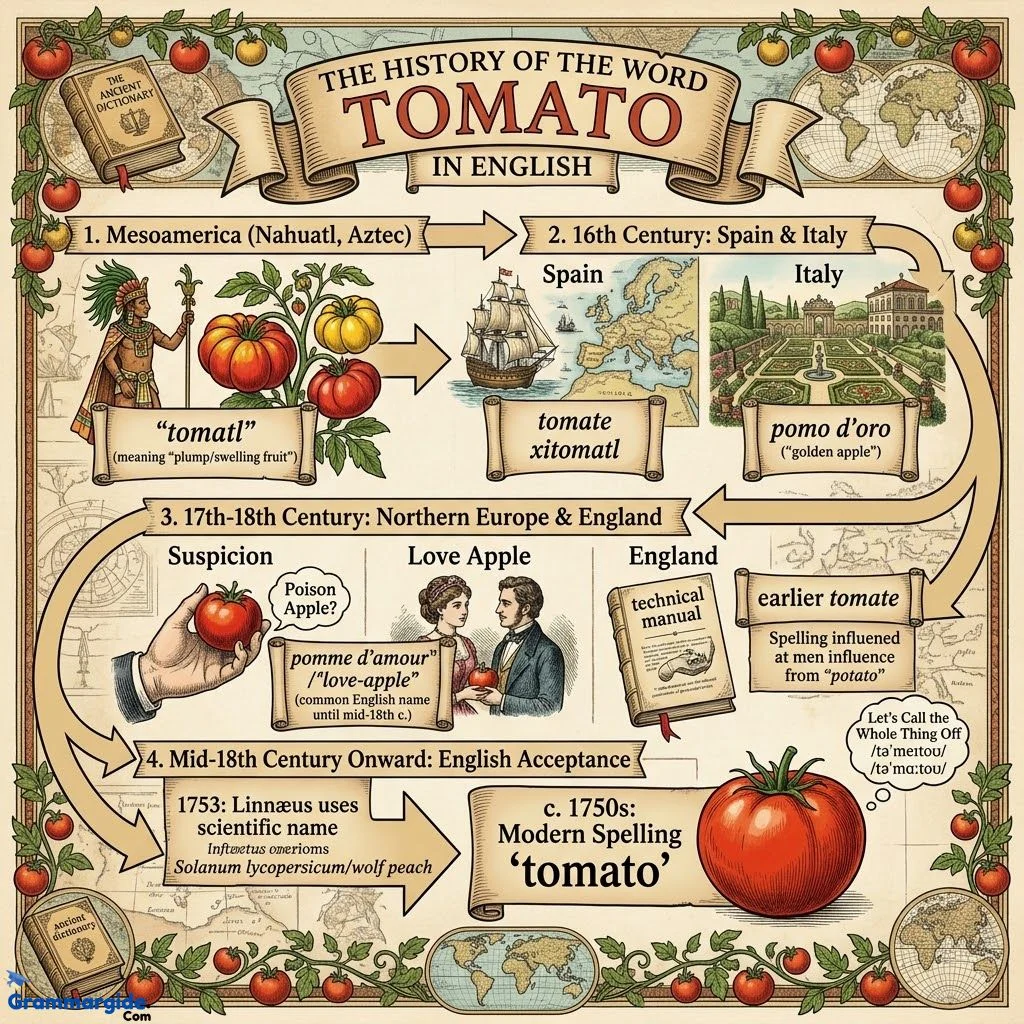
The history of tomato reflects the rich journey of words across cultures and languages. After traveling from Nahuatl into Spanish as tomate, the word entered English during the 16th century, when European exploration introduced the fruit to new regions. Early English texts sometimes showed different spellings because standardized dictionaries had not yet been established.
As English spelling became more consistent during the 18th and 19th centuries, dictionaries and grammar references settled on tomato as the singular form and tomatoes as the standard plural. This standard eventually became widely accepted in schools, books, newspapers, and official publications.
Today, the spelling tomatoes reflects both the historical development of the English language and modern grammar conventions. Understanding this history helps explain why the accepted plural is based not only on spelling rules but also on centuries of linguistic evolution and consistent educational practice.
Is “Tomatos” Ever Correct?
In Standard English, tomatos is not considered a correct spelling. The accepted plural of tomato is tomatoes, and this is the form used in dictionaries, school textbooks, academic writing, newspapers, and professional communication.
You may occasionally see tomatos in social media posts, informal messages, or user-generated content, but these examples are spelling mistakes rather than accepted language. Spell-checking tools and grammar checkers also flag tomatos as incorrect.
If you want your writing to appear accurate and professional, always use tomatoes as the plural form.
Why Do People Spell Tomatoes as Tomatos?
The mistake usually happens because English has inconsistent plural rules. Many nouns ending in -o simply add -s, such as photos, pianos, and radios. Learners naturally assume that tomato follows the same pattern.
Another reason is pronunciation. Since the final -es is not strongly emphasized in fast speech, some people believe that writing tomatos is acceptable. Others simply apply the general plural rule of adding -s without realizing that tomato belongs to a different spelling pattern.
Learning which -o nouns take -es helps eliminate this common spelling error.
Tomatoes vs Tomatos: Side-by-Side Comparison
| Feature | Tomatoes | Tomatos |
| Spelling Status | ✅ Correct | ❌ Incorrect |
| Dictionary Recognition | Yes | No |
| Grammar Rule | Adds -es | Incorrect plural formation |
| Used in Schools | Yes | No |
| Accepted in Formal Writing | Yes | No |
| Professional Communication | Recommended | Considered a spelling mistake |
| Example | We bought fresh tomatoes. | We bought fresh tomatos. ❌ |
British vs American English: Is There Any Difference?
Although British English and American English differ in some spellings, there is no difference in the plural of tomato. Both varieties use tomatoes.
| Language Variety | Correct Plural | Accepted? |
| British English | Tomatoes | ✅ Yes |
| American English | Tomatoes | ✅ Yes |
| Australian English | Tomatoes | ✅ Yes |
| Canadian English | Tomatoes | ✅ Yes |
| Tomatos | ❌ Not accepted | No |
Grammar Rule Behind Tomatoes
The word tomato follows a common English spelling rule for many nouns ending in -o.
Rule:
- If certain nouns end in -o, they form the plural by adding -es.
Examples include:
- Tomato → Tomatoes
- Potato → Potatoes
- Hero → Heroes
- Echo → Echoes
However, English also contains exceptions:
- Photo → Photos
- Piano → Pianos
- Radio → Radios
- Video → Videos
Because of these exceptions, memorizing commonly used words is often easier than trying to apply one universal rule.
Is Tomatoes an Irregular Plural?
Not exactly. Tomatoes is generally considered a regular plural because it follows an established spelling pattern in English. It simply belongs to the group of nouns ending in -o that take -es.
An irregular plural usually changes in a completely different way, such as:
- Child → Children
- Mouse → Mice
- Person → People
Since tomato changes predictably to tomatoes, linguists typically classify it as a regular spelling pattern rather than an irregular plural.
How Schools Teach the Plural of Tomato
Schools introduce the plural of tomato as part of basic English grammar and spelling lessons. Students learn that while many nouns become plural by adding -s, some require -es, especially certain nouns ending in -o.
Teachers often reinforce the rule through spelling lists, classroom exercises, and sentence-writing activities. For example:
- One tomato
- Two tomatoes
This repeated practice helps students recognize the correct spelling naturally and avoid common writing mistakes throughout their education.
Read More: Smooth vs Smoothe: Which One Is Correct? 2026
Does Pronunciation Affect the Spelling of Tomatoes?
Pronunciation has influenced the historical development of tomatoes, but it does not determine modern spelling by itself. The extra -es creates a smoother pronunciation and adds another syllable, making the plural easier to say.
Even though spoken English varies by accent, the written form remains standardized. Regardless of pronunciation, writers should always spell the plural as tomatoes.
Standard spelling exists to keep written communication clear and consistent across different regions and dialects.
How Dictionaries Define Tomatoes
| Dictionary Focus | Definition |
| Singular Form | Tomato |
| Plural Form | Tomatoes |
| Part of Speech | Noun |
| Standard Usage | Correct plural in English |
| Formal Writing | Recommended |
| Tomatos Listed? | No (treated as a misspelling) |
Why English Has Exceptions to the -O Plural Rule
English developed by borrowing words from many different languages, including Latin, French, Spanish, Greek, and Italian. As a result, spelling rules are not perfectly consistent.
Some -o nouns adopted the -es ending, while others retained a simple -s. Historical usage, pronunciation, and dictionary standardization all influenced which pattern became accepted.
This is why words such as tomatoes and potatoes differ from photos and pianos, even though they all end in -o.
Similar Words That Confuse English Learners
| Singular | Correct Plural | Common Mistake |
| Tomato | Tomatoes | Tomatos |
| Potato | Potatoes | Potatos |
| Hero | Heroes | Heros |
| Echo | Echoes | Echos |
| Mango | Mangoes or Mangos | Mangos (context-dependent) |
| Photo | Photos | Photoes |
| Piano | Pianos | Pianoes |
| Radio | Radios | Radioes |
Understanding these patterns makes it easier to recognize which English nouns require -es and which simply add -s, improving both spelling accuracy and writing confidence.
So Which Is Correct—Tomatoes or Tomatos?
If you’re deciding between Tomatoes or Tomatos, the answer is straightforward: tomatoes is the only correct plural spelling in Standard English. It follows accepted grammar rules, appears in major dictionaries, and is used in schools, academic writing, professional communication, and everyday English.
The spelling tomatos is a common mistake that usually happens when people apply the general rule of adding -s to make a noun plural. However, tomato belongs to a group of nouns ending in -o that typically take -es in the plural form. Using the correct spelling improves your writing, helps avoid grammar errors, and ensures your message is clear and credible.
✔ Correct: Tomatoes
Tomatoes is the correct plural of tomato. It is recognized by dictionaries, grammar guides, style manuals, and educational institutions worldwide. Whether you’re writing an essay, recipe, grocery list, business email, or social media post, tomatoes is the spelling you should use.
Examples:
- We picked fresh tomatoes from the garden.
- The salad contains ripe tomatoes and cucumbers.
- Farmers harvested thousands of tomatoes this season.
Using tomatoes demonstrates accurate spelling and proper English grammar.
✘ Incorrect: Tomatos
Tomatos is not an accepted English word. Although you may occasionally see it online or in informal writing, it is considered a spelling error rather than an alternative plural form.
Most spell-checkers, grammar tools, teachers, editors, and dictionaries identify tomatos as incorrect. Replacing it with tomatoes ensures your writing meets standard English conventions and avoids unnecessary mistakes.
Incorrect Example:
- ❌ We bought fresh tomatos from the market.
Correct Version:
- ✅ We bought fresh tomatoes from the market.
When in doubt, remember this simple rule: the correct plural is always tomatoes, never tomatos.
Understanding “-ES” Plurals for Words Ending in -O
Many English nouns become plural by simply adding -s, but some follow a different spelling rule. When certain nouns end with a consonant + o, they often form the plural by adding -es. This rule helps maintain standard spelling and pronunciation in English.
Common examples include tomato → tomatoes, potato → potatoes, hero → heroes, and echo → echoes. However, English also has exceptions, which is why learners sometimes become confused. Instead of relying on a single rule for every word, it’s best to learn commonly used -o nouns and check a dictionary when you’re unsure.
Understanding this spelling pattern helps improve grammar, writing accuracy, and confidence in both academic and everyday communication.
When the word ends in a consonant + O → add -ES
A useful guideline is that many nouns ending in a consonant followed by the letter “o” take -es to form their plural.
| Singular | Correct Plural |
| Tomato | Tomatoes |
| Potato | Potatoes |
| Hero | Heroes |
| Echo | Echoes |
| Torpedo | Torpedoes |
| Volcano | Volcanoes (Volcanos is also accepted in some contexts, but less common.) |
Keep in mind that this is not a universal rule. Several familiar words ending in -o simply add -s, including:
- Photo → Photos
- Piano → Pianos
- Radio → Radios
- Video → Videos
Because English contains exceptions, consulting a reliable dictionary is the best way to confirm the correct plural form.
Examples of “Tomatoes” Used Correctly in Sentences
Seeing tomatoes used in real sentences makes the grammar rule easier to remember. The examples below show the correct spelling in different types of everyday writing and conversation.
Correct Usage
These sentences use tomatoes correctly as the plural of tomato.
- We planted fresh tomatoes in the backyard garden.
- The chef sliced ripe tomatoes for the sandwiches.
- My grandmother grows the sweetest tomatoes every summer.
- The grocery store has organic tomatoes on sale today.
- Farmers delivered truckloads of tomatoes to the local market.
- Add two tomatoes to the soup before serving.
- The children picked red tomatoes from the vines.
- Fresh tomatoes are rich in vitamins and antioxidants.
Each example follows the accepted English plural spelling and is appropriate for formal and informal writing.
Incorrect Usage
The following examples contain the incorrect spelling tomatos. These sentences demonstrate mistakes that should be avoided.
- ❌ We bought fresh tomatos from the supermarket.
- ❌ The salad needs more tomatos.
- ❌ She grows delicious tomatos every year.
- ❌ The recipe calls for three tomatos.
- ❌ Our garden produced many tomatos this season.
Correct versions:
- ✅ We bought fresh tomatoes from the supermarket.
- ✅ The salad needs more tomatoes.
- ✅ She grows delicious tomatoes every year.
- ✅ The recipe calls for three tomatoes.
- ✅ Our garden produced many tomatoes this season.
Remember this simple rule: Whenever you need the plural of tomato, always write tomatoes, never tomatos.
Read More: Was There or Were There: Which One Should You Use Correctly?
Common Spelling Errors People Make (And Why They Happen)
The misspelling tomatos is one of the most common errors involving English plural nouns. It usually happens because learners try to apply familiar spelling patterns to every word or rely on pronunciation instead of standard grammar rules. Since English contains many exceptions, it’s easy to assume that all nouns ending in -o form their plural in the same way.
Understanding the reasons behind these mistakes can help you remember the correct form—tomatoes—and improve your overall spelling accuracy. Here are the most common causes of this error.
1. Over-applying the Photo Rule
One of the biggest reasons people write tomatos is that they copy the pattern used for words like photo, piano, radio, and video, which simply add -s to become plural.
For example:
- Photo → Photos
- Radio → Radios
- Piano → Pianos
Because these words are common, many writers naturally assume tomato should become tomatos. However, tomato belongs to a different group of nouns that take -es, making tomatoes the correct spelling.
2. Phonics Confusion
Another common cause is phonetic spelling. When people write based on what they hear, they may not notice the extra -es ending because spoken English often sounds fast and connected.
Someone might hear:
- “We bought tomatoes.”
and incorrectly write:
- Tomatos
This happens because pronunciation does not always reveal every spelling detail. English spelling follows established conventions, not just spoken sounds.
3. Fast Typing + Autocorrect
Typing quickly on phones, tablets, or computers can also lead to spelling mistakes. Writers sometimes leave out the -e without noticing, especially when sending text messages or posting online.
Autocorrect can make the problem worse in some situations. If a device has learned an incorrect spelling or fails to recognize the context, it may not immediately correct tomatos. Proofreading your writing remains the best way to catch these small but important errors.
4. Exposure to Bad Spelling Online
The internet contains millions of blog posts, comments, social media updates, and user-generated pages where spelling is not always checked carefully. Seeing tomatos repeatedly can make the incorrect form seem familiar or even correct.
This effect is known as visual familiarity—the more often people see a spelling, the more likely they are to believe it is acceptable. However, popularity does not determine correctness. Trusted dictionaries, grammar guides, and educational resources consistently recognize tomatoes as the only standard plural.
Whenever you’re uncertain, rely on authoritative language references rather than informal online examples. Doing so will help you build stronger writing habits and avoid common spelling mistakes.
Other Words That Follow the Same Pattern as “Tomatoes”
The word tomato is part of a group of English nouns that form their plural by adding -es. Learning these words together makes the spelling rule easier to remember and helps you avoid similar mistakes in writing.
Here are some common nouns that follow the same pattern:
| Singular | Correct Plural |
| Tomato | Tomatoes |
| Potato | Potatoes |
| Hero | Heroes |
| Echo | Echoes |
| Torpedo | Torpedoes |
| Volcano | Volcanoes (Volcanos is also accepted in some modern usage.) |
| Mosquito | Mosquitoes |
| Buffalo | Buffaloes (Buffalos is also accepted in some contexts.) |
These words are widely accepted in Standard English and are commonly taught in grammar and spelling lessons. Although a few have alternative plural forms, tomatoes remains the only correct plural of tomato.
A helpful way to remember this pattern is to group these words together when practicing English vocabulary instead of memorizing each one separately.
Words Ending in -O That Don’t Add -ES
One reason people mistakenly write tomatos is that many English nouns ending in -o form their plural by adding only -s. Because both patterns exist, learners often become unsure which rule applies.
The following words simply take -s:
| Singular | Correct Plural |
| Photo | Photos |
| Piano | Pianos |
| Radio | Radios |
| Video | Videos |
| Studio | Studios |
| Zoo | Zoos |
| Tattoo | Tattoos |
| Kangaroo | Kangaroos |
These nouns do not follow the same plural pattern as tomato. Their accepted spelling has been established through historical usage and dictionary standardization rather than by a single grammar rule.
Because English contains both -s and -es plural forms for words ending in -o, there is no shortcut that works every time. The most reliable approach is to learn common words individually and consult a trusted dictionary whenever you’re unsure. This habit improves spelling accuracy, strengthens your English grammar, and helps you write with greater confidence.
How to Always Remember the Correct Spelling “Tomatoes”
Remembering the correct plural of tomato doesn’t have to be difficult. Instead of memorizing grammar rules alone, you can use simple memory techniques that connect the spelling with familiar words, pronunciation, and everyday situations. These tricks make it easier to recall that the correct plural is always tomatoes, not tomatos.
1. The Potato Rule
The easiest memory aid is to pair tomato with potato. Most people already know that the plural of potato is potatoes. Since both words follow the same English plural rule, they also share the same ending.
Think of them as a pair:
- Tomato → Tomatoes
- Potato → Potatoes
If you remember one, you’ll almost always remember the other.
2. The “Two Syllable” Trick
Say the plural aloud:
To-ma-toes
You’ll hear an extra syllable at the end that sounds like “toes.” That extra sound reminds you that the word needs -es, not just -s.
Although pronunciation should never replace grammar rules, this speaking trick helps many learners remember the correct spelling.
3. The Food Rule
Imagine a grocery basket filled with fresh vegetables. Foods such as tomatoes and potatoes both end in -oes when plural.
Creating this mental picture helps connect the spelling with familiar foods, making it easier to recall while writing recipes, shopping lists, or everyday sentences.
4. The “Add an E to Eat” Trick
Here’s a simple word association:
E = Eat
Since tomatoes are something you eat, remember to add the extra “e” before the final -s.
It’s not an official grammar rule, but it works as a fun memory aid for many students and English learners.
5. The Spanish Memory Hook
The English word tomato came from the Spanish word tomate. While English changed the plural to tomatoes, remembering the word’s Spanish origin can remind you that it has a unique spelling history.
This historical connection makes the correct spelling feel more meaningful rather than something you simply memorize.
Can Tomatos Ever Be Accepted in Informal Writing?
Even in casual conversations, text messages, or social media posts, tomatos is generally considered a misspelling, not an informal alternative. While readers will usually understand what you mean, the spelling does not follow accepted English grammar or dictionary standards.
Informal writing often allows relaxed punctuation and abbreviations, but standard word spellings usually remain the same. Using tomatoes helps your writing appear more accurate and polished, whether you’re sending a quick message, posting online, or writing professionally.
The only time you might encounter tomatos is in typing mistakes, unedited online content, or creative writing where a misspelling is intentional. In normal communication, always choose tomatoes.
Fun Memory Tricks for Remembering Tomatoes

Learning spelling can be easier when you use creative memory techniques. Try these simple tricks to remember that tomatoes is always the correct plural:
- 🥔 Tomato loves Potato. Since potato becomes potatoes, tomato becomes tomatoes too.
- 🍅 Think of ketchup bottles. They always contain tomatoes, never tomatos.
- 👣 Hear the word “toes.” Say to-ma-toes and let the ending remind you to add -es.
- 🛒 Picture a grocery sign. Stores advertise fresh tomatoes, not tomatos.
- ✍️ Remember the phrase: “If it grows in the garden like a tomato or potato, it usually ends in -oes.”
- 🧠 Use repetition. Write the word tomatoes several times in complete sentences to build long-term spelling memory.
These small memory aids reinforce the correct spelling naturally, helping you write tomatoes confidently every time.
Key Insight
1. Is the correct spelling tomatoes or tomatos?
The correct plural spelling is tomatoes. The word tomatos is considered a spelling mistake and is not accepted in Standard English.
2. Why does tomato become tomatoes instead of tomatos?
Tomato follows an English plural rule where many nouns ending in a consonant + o add -es to form the plural. Therefore, tomatoes is the correct form.
3. Is tomatos listed in dictionaries?
No. Reputable English dictionaries recognize tomatoes as the correct plural. Tomatos is generally identified as an incorrect spelling.
4. Do British and American English spell it differently?
No. Both British English and American English use tomatoes as the standard plural. There is no regional spelling difference.
5. Is tomatoes an irregular plural?
No. Although it may seem unusual, tomatoes follows an established English spelling pattern for many nouns ending in -o. It is not considered an irregular plural like children or mice.
6. Why do so many people write tomatos?
People often apply the plural rule used for words like photos and radios, which simply add -s. Others rely on pronunciation or make typing mistakes, leading to the incorrect spelling.
7. Are there other words that follow the same rule as tomatoes?
Yes. Words such as potatoes, heroes, echoes, mosquitoes, and torpedoes also form their plurals by adding -es.
8. Can I use tomatos in casual text messages or social media?
It is best to avoid it. Even in informal writing, tomatos is considered a misspelling. Using tomatoes keeps your writing accurate and professional.
9. How can I remember the correct spelling of tomatoes?
A simple trick is to remember potato → potatoes. Since tomato follows the same pattern, its correct plural is tomatoes.
10. Does pronunciation determine the spelling of tomatoes?
Not entirely. While pronunciation has influenced the word’s history, the spelling is determined by standard English grammar, dictionary usage, and accepted writing conventions.
Conclusion
Choosing between tomatoes and tomatos is easier once you understand the grammar rule behind the word. Although English contains many exceptions, tomatoes is the only correct plural recognized in dictionaries, schools, professional writing, and everyday communication. Using the correct spelling improves both clarity and credibility.
The confusion usually arises because some nouns ending in -o simply add -s, while others require -es. Learning common examples, understanding the history of the word, and practicing with real sentences can help you remember the correct form with confidence.
Whether you’re writing an essay, preparing a recipe, sending an email, or simply improving your English skills, always choose tomatoes. Mastering small grammar details like this strengthens your spelling, enhances your writing, and helps you communicate more effectively in every situation.

Hi, I am Zadie Smith, the author of Grammargide.com. I write clear, easy-to-understand guides that explain commonly confused words and phrases, helping readers choose the right expression with confidence.