Choosing the correct spelling can make a noticeable difference in how clearly and professionally you communicate. Smooth vs Smoothe is a common point of confusion because the two words look almost identical, yet they serve different purposes in the English language. Many writers wonder whether “smoothe” is simply an alternative spelling of “smooth”, a verb form, or an incorrect word altogether. Understanding the distinction helps you avoid spelling mistakes, improve grammar and vocabulary, and use the right form in both everyday and formal writing.
In this guide, you’ll learn the meaning, correct spelling, part of speech, pronunciation, and proper usage of both terms. We’ll also explain why the confusion exists, show how each word fits into different sentence structures, and provide practical examples to strengthen your writing skills. Keep reading to master the difference between smooth and smoothe with confidence.
What Does “Smooth” Mean?
Smooth is the standard and widely accepted spelling in modern English. It is most commonly used as an adjective, although it can also function as a verb. As an adjective, it describes something that has an even surface, happens without difficulty, or is calm and polished in appearance, movement, or communication.
For example:
- The table has a smooth finish.
- She gave a smooth presentation.
- Traffic was smooth throughout the morning.
As a verb, smooth means to make something even, flat, or free from roughness.
Examples:
- Please smooth the wrinkles out of the fabric.
- He carefully smoothed the paper before writing.
The word is used in everyday conversation, academic writing, business communication, and creative writing because it clearly expresses ideas related to texture, ease, refinement, and fluency.
Is “Smoothe” a Real Word?
Yes, smoothe is a real English word, but it is rarely used in modern English. It is an older or less common spelling of the verb smooth, meaning to make something smooth.
In contemporary English, dictionaries and style guides overwhelmingly recommend using smooth as both the adjective and the verb. Because of this, many people mistakenly believe that smoothe is simply an alternative spelling or even a typo.
For example:
- Less common: She tried to smoothe the blanket.
- Preferred modern form: She tried to smooth the blanket.
Unless you are quoting historical texts or preserving an older spelling, smooth is almost always the correct choice.
Smooth vs Smoothe: What’s the Difference?
Although the two words look nearly identical, they are not used equally in modern English.
| Feature | Smooth | Smoothe |
| Modern spelling | ✅ Yes | ❌ Rare |
| Functions as adjective | ✅ Yes | ❌ No |
| Functions as verb | ✅ Yes | ⚠ Historically yes |
| Common in everyday writing | ✅ Very common | ❌ Very uncommon |
| Recommended in modern English | ✅ Yes | ❌ No |
The main distinction is that smooth is the accepted modern spelling used in virtually all situations, while smoothe survives mainly as an archaic or historical verb form. Today, professional writing, education, journalism, and digital communication almost always favor smooth.
Which Spelling Is Correct: Smooth or Smoothe?
For modern English, smooth is the correct spelling in nearly every situation.
Whether you are describing a polished surface, a successful process, or the act of making something even, smooth is the spelling you should use.
Correct examples:
- The road is smooth.
- She has a smooth speaking style.
- Please smooth the edges before painting.
Avoid writing smoothe unless you intentionally want to preserve historical language or are quoting an older source. Using smoothe in ordinary writing may confuse readers because it is no longer the standard spelling.
If you’re ever unsure, remember this simple rule:
Use “smooth” for both the adjective and the verb in modern English.
Read More: Each Is or Each Are: Which One Is Grammatically Correct?
Why Do People Confuse Smooth and Smoothe?
Several factors contribute to the confusion between smooth and smoothe.
One reason is the pronunciation. Both words are pronounced almost identically, so many writers assume that adding an e at the end creates a verb, similar to pairs like breath/breathe or cloth/clothe.
Another reason is English spelling patterns. Since many verbs end with a silent e, learners sometimes expect smoothe to be the verb form of smooth. However, English does not follow one universal spelling rule, and smooth already serves as both the adjective and the verb.
Autocorrect tools, older publications, and historical references can also expose readers to smoothe, reinforcing the misconception that both spellings are equally acceptable.
Understanding that smooth performs both grammatical functions eliminates this common spelling mistake.
When to Use “Smooth” in a Sentence
Use smooth whenever you need the standard modern English spelling.
It can describe:
- A surface: The marble feels smooth.
- A process: The interview went smoothly.
- A personality: He remained smooth under pressure.
- Speech or writing: Her explanation was smooth and easy to follow.
- An action (verb): Please smooth the paper before scanning it.
Additional examples:
- We enjoyed a smooth flight.
- She smoothed her hair before the meeting.
- The software update created a smooth user experience.
- His calm tone helped make the discussion smooth.
Because it is standard English, smooth fits naturally in casual conversations, academic essays, business reports, emails, and published content.
When to Use “Smoothe” as a Verb
In present-day English, you generally do not need to use “smoothe.”
Although it historically functioned as a verb meaning to make smooth, modern dictionaries and style authorities recognize smooth as the preferred verb form.
Historical example:
- The craftsman sought to smoothe the wooden surface.
Modern equivalent:
- The craftsman sought to smooth the wooden surface.
If you encounter smoothe while reading older literature or historical documents, understand that it reflects an earlier spelling convention rather than current usage.
For modern writing, replacing smoothe with smooth improves clarity and aligns with current English standards.
Smooth vs Smoothe in Grammar
From a grammatical perspective, smooth is both an adjective and a verb, making it highly versatile in sentence construction.
As an adjective
It describes a noun.
Examples:
- The road is smooth.
- She has a smooth voice.
As a verb
It expresses an action.
Examples:
- Smooth the fabric before sewing.
- He smoothed the rough edges.
Read More: Disbalanced vs Unbalanced vs Imbalanced: What’s the Difference?
Why “Smoothe” Is Rare in Grammar?
While smoothe once appeared as a verb in older English, it has largely disappeared from standard grammar and modern usage. Most grammar references, dictionaries, and writing guides recommend using smooth in all contemporary contexts.
A simple grammar rule to remember is:
- ✅ Smooth = adjective and modern verb
- ❌ Smoothe = outdated verb spelling that is rarely appropriate today
Following this rule will help you write more accurately, avoid unnecessary spelling errors, and communicate clearly in both formal and informal English.
Smooth vs Smoothe in Everyday English
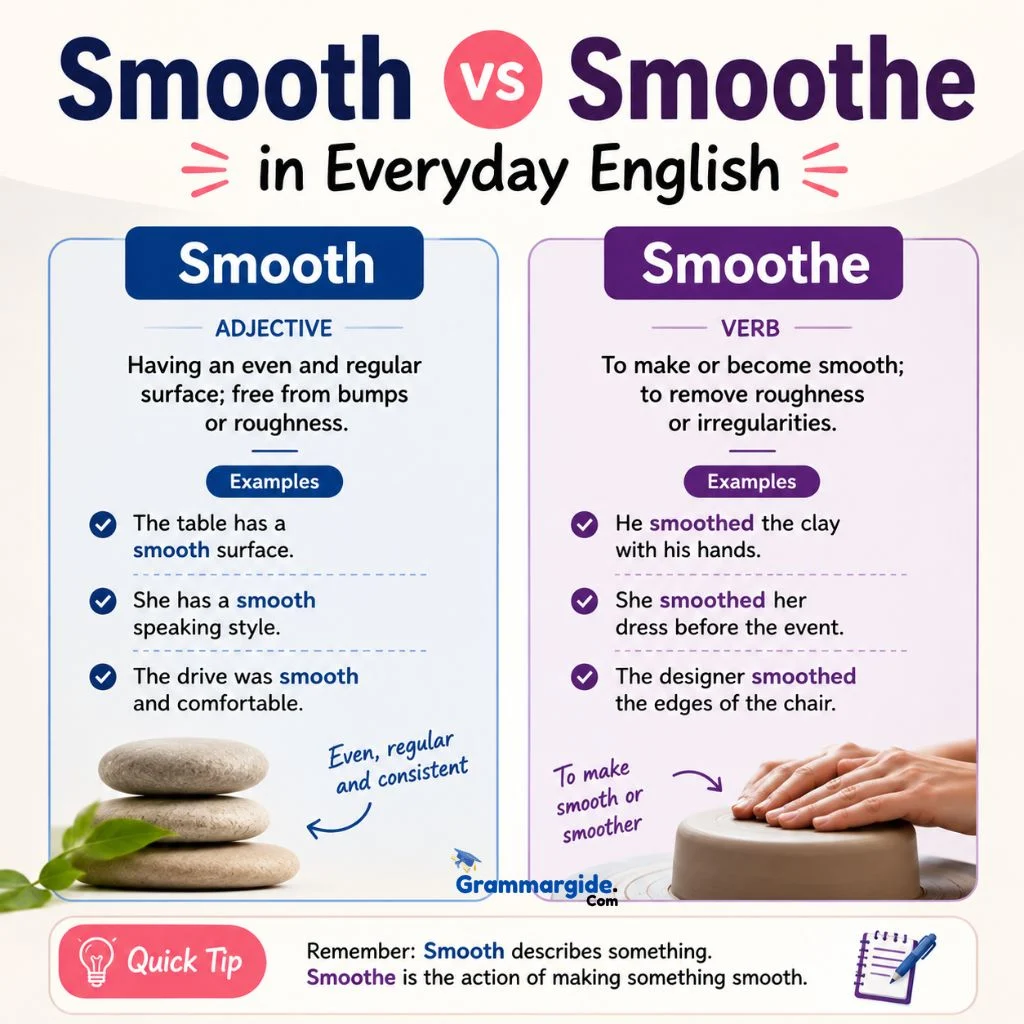
In everyday English, smooth is the spelling you will encounter almost everywhere. Whether you’re reading a novel, sending an email, writing a report, or having a conversation, smooth is the accepted form for both the adjective and the verb.
Examples include:
- The coffee has a smooth flavor.
- We had a smooth journey home.
- She smoothed the tablecloth before dinner.
- His explanation made the process smooth and easy to understand.
On the other hand, smoothe is extremely uncommon in modern communication. Most native English speakers never use it in daily writing or speech. If it does appear, it is usually in historical literature, older dictionaries, or quoted texts.
For clear and natural communication, always choose smooth unless there is a specific historical reason to preserve the older spelling.
| Feature | Smooth | Smoothe |
| Usage in modern English | Very common | Rare / outdated |
| Part of speech | Adjective & Verb | Mostly historical verb |
| Everyday writing | Standard choice | Not recommended |
| Formal communication | Correct and preferred | Avoid |
| Example sentence | The surface is smooth. | He tried to smoothe the cloth (old usage). |
| Modern acceptance | ✔ Widely accepted | ✘ Mostly obsolete |
Smooth vs Smoothe in American and British English
There is no difference between American English and British English when it comes to the preferred modern spelling.
Both varieties of English use smooth as the standard spelling for the adjective and the verb.
| Usage | American English | British English |
| Adjective | Smooth | Smooth |
| Verb | Smooth | Smooth |
| Preferred modern spelling | ✅ Yes | ✅ Yes |
| Smoothe in everyday writing | ❌ Rare | ❌ Rare |
Unlike spelling differences such as color/colour or center/centre, smooth has the same accepted spelling on both sides of the Atlantic.
If you are writing for an international audience, smooth is the correct choice regardless of the English variety you use.
Pronunciation of Smooth vs Smoothe
smooth
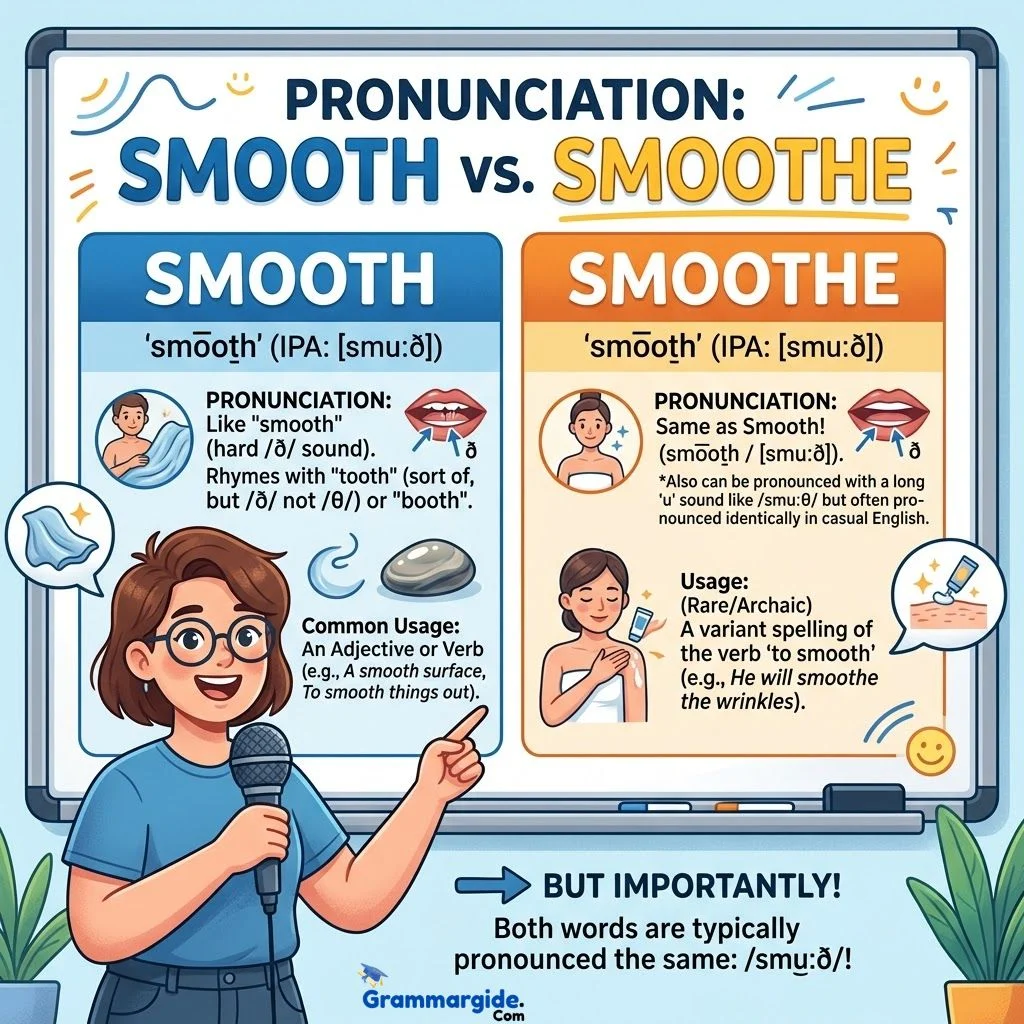
One reason people confuse smooth and smoothe is that they are pronounced almost exactly the same.
- Smooth → /smuːð/
- Smoothe → Traditionally pronounced the same in most contexts.
The th produces the voiced sound heard in words like this, breathe, and father, not the unvoiced sound in think.
Because the pronunciation does not change, many writers assume the extra e is required for the verb form. However, unlike breath → breathe or cloth → clothe, modern English does not require an extra e for smooth.
| Word | Pronunciation | Sound Explanation |
| Smooth | /smuːð/ | “smoo” + voiced “th” (like this) |
| Smoothe | Same as smooth (historical use) | No pronunciation difference in modern usage |
| Key note | — | The extra “e” does not change pronunciation |
Parts of Speech: Adjective vs Verb
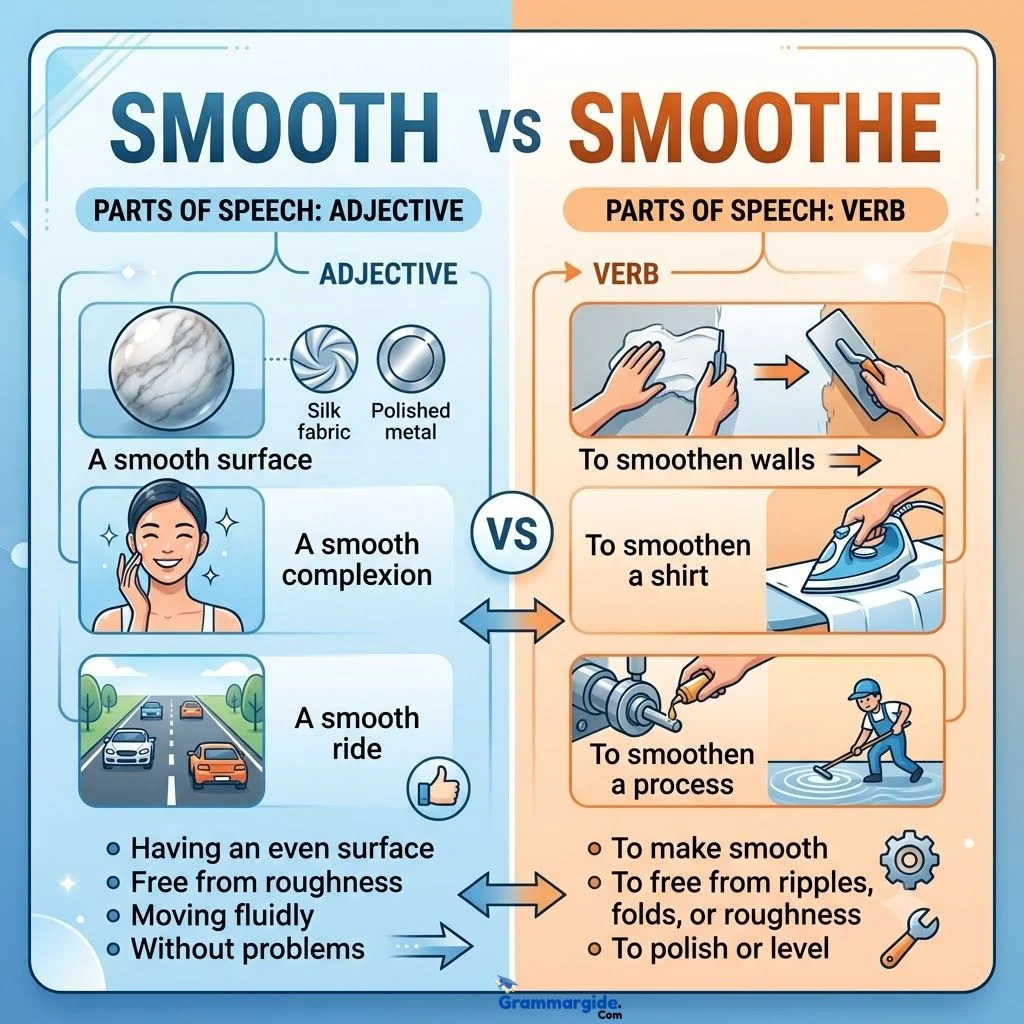
The word smooth performs two important grammatical roles.
As an adjective
An adjective describes a noun.
Examples:
- The glass feels smooth.
- She has a smooth writing style.
- The meeting ended with a smooth agreement.
As a verb
A verb expresses an action.
Examples:
- Please smooth the paper.
- She smoothed the wrinkles from her dress.
- Workers smoothed the concrete before it dried.
What About “Smoothe”?
Historically, smoothe functioned as a verb, but this spelling is now considered outdated. Modern grammar uses smooth as both the adjective and the verb.
Read More: People Do or People Does: Which One Is Grammatically Correct?
Common Mistakes When Using Smooth and Smoothe
Many learners make similar mistakes because of English spelling patterns.
Mistake 1: Adding an unnecessary “e”
❌ Please smoothe the blanket.
✅ Please smooth the blanket.
Mistake 2: Assuming every verb needs a different spelling
Unlike pairs such as advice/advise or breath/breathe, smooth already serves as both an adjective and a verb.
Mistake 3: Trusting outdated examples
Older books may contain smoothe, but copying that spelling into modern writing can make your work look incorrect or outdated.
Mistake 4: Believing both spellings are equally common
While smoothe exists historically, smooth is overwhelmingly preferred in dictionaries, schools, publishing, and professional communication.
Examples of Smooth in Sentences
Here are examples showing the correct modern usage of smooth.
As an adjective
- The lake became perfectly smooth after the wind stopped.
- She has a smooth speaking voice.
- The project had a smooth start.
- His handwriting is neat and smooth.
- The smartphone screen feels incredibly smooth.
As a verb
- Please smooth the bedsheet before folding it.
- She carefully smoothed the frosting on the cake.
- He smoothed the pages with his hands.
- The editor smoothed the wording of the report.
- Workers smoothed the fresh cement.
These examples reflect standard English used in everyday, academic, and professional writing.
Examples of Smoothe in Sentences
Although smoothe is rarely appropriate today, you may encounter it in historical or literary contexts.
Historical-style examples:
- The tailor began to smoothe the cloth.
- He paused to smoothe the parchment.
- She attempted to smoothe every crease in the fabric.
Modern equivalents:
- The tailor began to smooth the cloth.
- He paused to smooth the parchment.
- She attempted to smooth every crease in the fabric.
In nearly all modern situations, replacing smoothe with smooth is the recommended choice.
Read More: Was There or Were There: Which One Should You Use Correctly?
Synonyms of Smooth
Depending on the context, smooth has several useful synonyms.
For texture
- Even
- Flat
- Soft
- Sleek
- Polished
- Silky
For movement or progress
- Effortless
- Seamless
- Easy
- Uninterrupted
- Steady
For communication or behavior
- Fluent
- Polished
- Refined
- Graceful
- Diplomatic
- Well-spoken
Choose the synonym that best matches your intended meaning, as smooth can describe appearance, motion, speech, personality, or processes.
Antonyms of Smooth
The opposite of smooth depends on the context in which it is used.
For surfaces
- Rough
- Uneven
- Coarse
- Bumpy
- Jagged
For movement or processes
- Difficult
- Uneven
- Disrupted
- Complicated
- Problematic
For communication
- Awkward
- Hesitant
- Clumsy
- Unclear
- Rough
Using appropriate antonyms helps create precise contrasts in both speaking and writing while improving your vocabulary and overall language skills.
Key Insight
1. What is the difference between smooth and smoothe?
The main difference is that smooth is the modern, correct spelling used in all standard English writing, while smoothe is an outdated form that is rarely used today. In most contexts, smoothe is considered incorrect or obsolete.
2. Is smoothe still used in modern English?
No, smoothe is not commonly used in modern English. It occasionally appears in older texts, but contemporary writing, education, and professional communication all prefer smooth.
3. Can smooth be used as both a noun and a verb?
Smooth is mainly used as an adjective and a verb. As an adjective, it describes something even or polished, and as a verb, it means to make something even or flat.
4. Why do people write smoothe instead of smooth?
People often add an “e” because of confusion with similar English patterns like breathe or clothe. Since pronunciation doesn’t change, learners assume the spelling should also include an extra letter.
5. Is smooth correct in both American and British English?
Yes, smooth is the correct spelling in both American and British English. There is no regional variation in this case.
6. What does smooth mean in everyday English?
In everyday use, smooth means something that is even, soft, easy, or free from difficulty. It can describe surfaces, actions, speech, or experiences.
7. How do you pronounce smooth correctly?
Smooth is pronounced as /smuːð/, with a long “oo” sound and a voiced “th” like in this. The pronunciation stays the same regardless of spelling confusion.
H3: 8moothe a correct verb form?
Historically, smoothe was used as a verb, but in modern English it is not standard. Today, smooth is used for both adjective and verb forms.
9. What are common mistakes with smooth and smoothe?
A common mistake is adding an unnecessary “e” at the end. Another is assuming both spellings are equally valid. In reality, smooth should always be used in modern writing.
10. What is the easiest way to remember smooth vs smoothe?
A simple rule is: Always use “smooth” for both adjective and verb. The spelling smoothe is outdated and can safely be avoided in all modern contexts.
Conclusion
The confusion between smooth and smoothe mainly comes from historical spelling patterns and pronunciation similarities. However, modern English has clearly standardized smooth as the correct form for both adjective and verb usage. Understanding this distinction helps you avoid outdated spellings and ensures your writing remains clear, accurate, and professional across all contexts.
In everyday communication, whether you are writing emails, academic essays, or professional content, using smooth consistently improves readability and reflects strong language control. On the other hand, smoothe is now considered obsolete in most modern grammar systems and should generally be avoided unless referencing older texts.
Ultimately, mastering this small but important difference strengthens your overall grammar foundation. By remembering that smooth works for both meanings, you can write with more confidence, precision, and fluency in any English-speaking setting.

Hi, I am Zadie Smith, the author of Grammargide.com. I write clear, easy-to-understand guides that explain commonly confused words and phrases, helping readers choose the right expression with confidence.