
Role vs roll confuses many writers, speakers, and learners because the two words sound identical yet carry completely different meanings and spellings. In everyday writing, professional emails, academic papers, and casual conversation, mixing them up can make even clear ideas look careless or create unintended meanings.
Role refers to a function, position, or part someone plays, while roll covers actions like turning over, lists of names, or items such as bread. The mix-up is especially common in phrases about job responsibilities, acting parts, attendance sheets, or physical movement. Getting the distinction right strengthens clarity, professionalism, and credibility in both spoken and written English.
This article breaks down the precise definitions, common contexts, memory tricks, and practical examples that separate the two words. You will see exactly when to choose each spelling and how small corrections improve overall communication.
Keep reading to master the difference and avoid one of the most frequent English mix-ups.
What Does Role Mean?
Role is a noun that describes the function, position, or part a person (or thing) plays in a particular situation. It comes from the idea of a character in a play or the duties tied to a job, relationship, or social setting.
In everyday language, role points to responsibility or expected behavior. A teacher’s role is to guide students. A parent’s role often includes providing support and structure. In the workplace, someone might take on a leadership role during a project. Actors also use the word when they refer to the character they portray: “She landed the lead role in the film.”
The word stays consistent across formal writing, professional communication, and casual speech. Choosing role correctly signals clarity about function or position rather than physical action or a list.
What Does Roll Mean?
Roll is more versatile. As a verb, it means to turn over and over or to move by turning. As a noun, it can mean a list of names, a small piece of bread, or the act of rolling itself.
Common uses include:
- Physical movement: “The ball will roll down the hill.”
- Attendance or lists: “The teacher called the roll.”
- Food: “Would you like a dinner roll?”
- Continuous motion or sound: “Thunder began to roll across the sky.”
Because roll covers action, objects, and records, it appears frequently in both spoken and written English. The key is recognizing that none of these meanings relate to a person’s function or character part.
Role vs Roll: Quick Comparison Table
| Aspect | Role | Roll |
| Part of speech | Noun | Noun or verb |
| Core meaning | Function, position, or character part | To turn over; a list; bread |
| Typical context | Jobs, acting, social duties | Movement, attendance, food |
| Example | She accepted the management role. | Please roll the dice. / Call the roll. |
| Common mistake | Using “roll” for a job function | Using “role” for a list or movement |
This side-by-side view makes the distinction immediate and practical for writers who need a fast reference.
Are Role and Roll Homophones?
Yes. Role and roll are classic homophones—words that sound exactly the same but have different spellings and meanings. Both are pronounced /roʊl/ (rhyming with “pole” or “goal”).
This identical pronunciation is the main reason the two words are so often confused in writing. When people hear the word in conversation, nothing in the sound tells them which spelling to choose. Only context and knowledge of the correct meaning guide the right choice on the page. Recognizing them as homophones helps learners pause and check the intended sense before writing.
Read More: Disorganized vs. Unorganized: What’s the Difference?
Role vs Roll: Pronunciation and Spelling
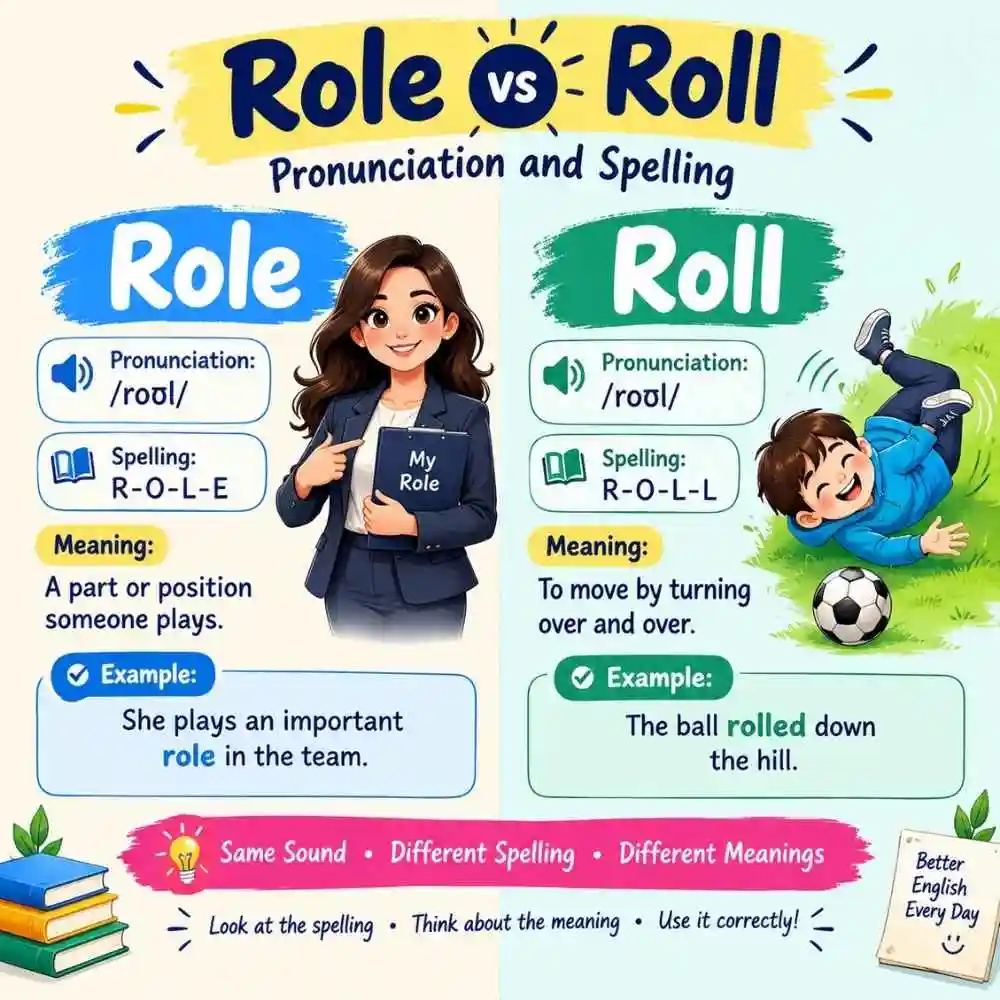
Both words share the same pronunciation: /roʊl/. The vowel sound is the long “o” followed by a clear “l.” No difference exists in spoken English, which is why the mix-up happens so easily.
The spelling difference is straightforward once the meanings are clear:
- Role always ends in -ole and is used only for function or character.
- Roll ends in -oll and covers the verb of turning, lists, or bread.
A simple memory tip: think of the double “l” in roll as the motion of something turning over twice, while role keeps a single “l” like the single part a person plays. Checking the surrounding words—job titles favor role, movement or lists favor roll—usually settles the choice quickly and accurately.
How to Use Role in a Sentence
Role appears in sentences when you want to describe someone’s function, position, or the part they play. It is almost always a noun and works best with verbs like “play,” “take,” “accept,” or “fill.”
Correct examples:
- She decided to accept the leadership role in the new project.
- His role as team captain required clear communication every day.
- In the school play, Maya played the role of the narrator.
- Parents often juggle more than one role at home and at work.
Avoid pairing role with movement or lists. Saying “call the role” or “role the ball” is incorrect. Stick to situations involving responsibility, character, or duty for accurate usage.
How to Use Roll in a Sentence
Roll can function as both a noun and a verb, so its placement in a sentence depends on the intended meaning.
As a verb (action):
- Please roll the dough until it is thin and even.
- The children watched the ball roll across the grass.
As a noun (list, bread, or action):
- The teacher began to call the roll at the start of class.
- Fresh dinner rolls were served with the soup.
- One more roll of the dice decided the winner.
These examples show how roll connects to movement, records, or objects. Choosing the right form keeps the sentence clear and natural.
Role as a Noun: Meaning and Examples
Role functions exclusively as a noun. It never acts as a verb. Its core meaning centers on the part a person plays or the duties attached to a position.
Key senses include:
- Social or professional function: “Her role in the company involves training new staff.”
- Character in performance: “He prepared carefully for the difficult role.”
- Expected behavior: “Everyone understood their role during the emergency drill.”
Because role is only a noun, it pairs with articles (“a,” “the”) and possessive forms (“her role,” “the manager’s role”). This limited part of speech makes it easier to spot and use correctly once the meaning is clear.
Roll as a Noun and Verb
| Form | Meaning | Example Sentence |
| Verb | To turn over or move by turning | Roll the carpet carefully before storing it. |
| Verb | To produce a continuous sound | Thunder began to roll in the distance. |
| Noun | A list of names (attendance) | The coach checked the roll before practice. |
| Noun | A small round piece of bread | She buttered a warm roll at breakfast. |
| Noun | An act of rolling | One lucky roll won him the game. |
This table highlights how roll shifts between action and object while role stays fixed as a noun of function.
When to Use Role vs Roll
Use role when the sentence focuses on a person’s function, job, character, or responsibility. Use roll when the idea involves turning, movement, a list of names, or bread.
Quick decision guide:
- Talking about a job or acting part → role
- Describing motion, attendance, or food → roll
Context almost always provides the clue. If the word can be replaced by “function” or “part,” choose role. If it can be replaced by “turn,” “list,” or “bread,” choose roll. This simple test prevents most mix-ups in both writing and editing.
Read More: Then vs. Than: What’s the Difference and When to Use Word?
Role vs Roll in American and British English
| Feature | American English | British English |
| Spelling of “role” | Role | Role |
| Spelling of “roll” | Roll | Roll |
| Pronunciation | /roʊl/ | /rəʊl/ (very similar) |
| Common usage of “role” | Job function, acting part | Same meanings |
| Common usage of “roll” | Movement, attendance, bread | Same meanings; “roll call” also used |
| Preference or variation | No difference in meaning or spelling | No difference in meaning or spelling |
Both varieties of English treat role and roll identically in spelling, core meanings, and most everyday contexts. Writers on either side of the Atlantic follow the same rules for choosing the correct word.
Role vs Roll in Education and School
In classrooms and school settings, role and roll appear in very different contexts. Teachers and students use role when discussing responsibilities or parts in activities. A student may take on the role of group leader during a project. In drama class, each person is assigned a specific role in the play.
Roll, on the other hand, most often refers to attendance. Teachers “call the roll” or “take the roll” at the start of class to check who is present. Students may also hear “roll call.” Physical education classes sometimes involve activities where balls or objects roll across the floor.
Understanding the difference helps students write clearer reports, scripts, and instructions while avoiding common classroom mix-ups.
Role vs Roll in Common Expressions
Certain everyday expressions rely on the correct choice between role and roll.
Expressions with role:
- Play a role (to have an influence or part)
- Lead role (the main character or primary responsibility)
- Dual role (two functions at once)
Expressions with roll:
- Call the roll / roll call (check attendance)
- On a roll (experiencing a streak of success)
- Roll with the punches (adapt to difficulties)
- Roll out (introduce or launch something)
Using the wrong word in these fixed phrases immediately signals an error, so matching the expression to the right spelling is essential for natural-sounding English.
Can Role Be Used as a Verb?
No. Role functions exclusively as a noun. It never acts as a verb in standard English.
You cannot say “She will role the project” or “Please role the ball.” Those sentences require the verb roll. Role only names a function, position, or character part. Recognizing this strict limitation prevents one of the most common errors with the pair.
Can Roll Be Used as a Noun?
Yes. Roll works comfortably as both a noun and a verb.
As a noun, it can mean:
- A list of names (“The teacher checked the roll.”)
- A small round piece of bread (“He ate a warm dinner roll.”)
- An act of rolling (“One lucky roll of the dice decided the game.”)
This flexibility makes roll more versatile than role, which remains limited to noun use only.
Role vs Roll: Which Word Fits the Context?
Context is the most reliable guide when choosing between the two words.
Use role when the sentence focuses on:
- A job or responsibility
- A character in a performance
- A social or expected function
Use roll when the sentence involves:
- Physical movement or turning
- Attendance lists
- Bread or similar objects
- Continuous motion or sound
Reading the full sentence and testing a quick substitution (“function/part” versus “turn/list/bread”) almost always reveals the correct choice.
Read More: Choose or Chose: How to Use Each Word Correctly?
Role vs Roll in Formal and Informal Writing
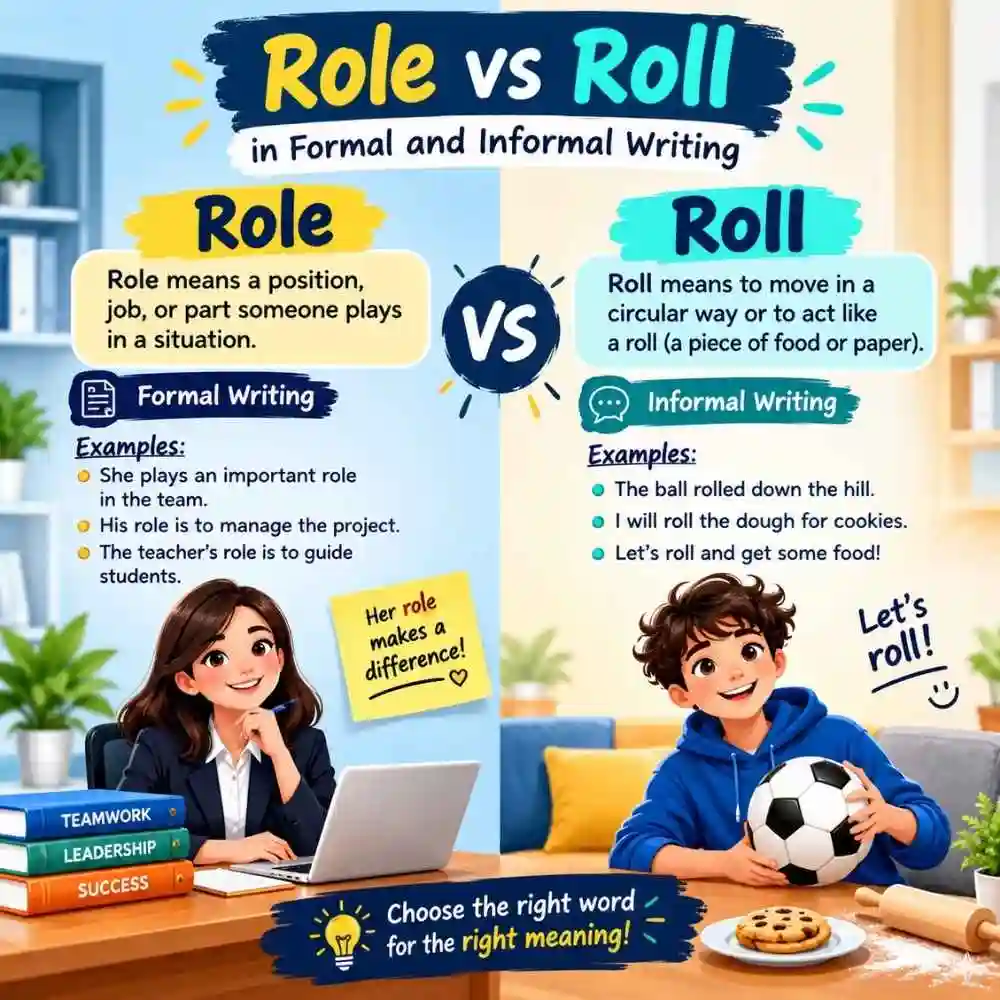
In formal writing—academic papers, business reports, professional emails—accuracy with role and roll signals care and credibility. Using the wrong word can distract readers or weaken the writer’s authority.
In informal writing—texts, social media, casual notes—the same rules still apply, though errors may be more common. Even in relaxed contexts, choosing the right word keeps the message clear and avoids unintended humor or confusion.
Both styles benefit from the same core principle: match the word to its precise meaning rather than its sound.
Role vs Roll: Advanced Usage Examples
Role in more complex contexts:
- “Her dual role as mentor and supervisor required careful boundary-setting.”
- “The study examines the role of socioeconomic factors in educational outcomes.”
- “He stepped into an expanded role after the department restructure.”
Roll in more complex contexts:
- “The company plans to roll out the new software across all regional offices next quarter.”
- “After several successful campaigns, the marketing team is clearly on a roll.”
- “The archival rolls of attendance records provided valuable historical data.”
These examples show how both words operate naturally in sophisticated, professional, and academic writing once their core meanings are secure.
Common Mistakes When Using Role and Roll
The most frequent error is swapping the two words because they sound identical. Writers often type “job roll” instead of “job role,” or “call the role” instead of “call the roll.”
Other common mistakes include:
- Treating role as a verb (“She will role the ball”)
- Using roll for acting or job functions (“He got the main roll”)
- Confusing plural forms or fixed phrases
These errors usually appear in rushed writing, emails, or student assignments. Proofreading with the core meanings in mind—function versus movement/list—catches most of them quickly.
Role vs Roll: Incorrect and Correct Examples
| Incorrect | Correct | Reason |
| She accepted the management roll. | She accepted the management role. | Job function requires role. |
| The teacher called the role. | The teacher called the roll. | Attendance list requires roll. |
| Please role the dice. | Please roll the dice. | Action of turning requires roll. |
| He played the lead roll in the play. | He played the lead role in the play. | Character part requires role. |
| Fresh dinner roles were served. | Fresh dinner rolls were served. | Bread requires roll. |
Side-by-side comparison makes the correct choice clear and memorable.
Role vs Roll: Singular and Plural Forms
Role forms its plural regularly by adding -s: one role, two roles.
Example: “The actors rehearsed their roles carefully.”
Roll also adds -s in the plural: one roll, several rolls.
Examples:
- “The baker sold a dozen rolls.”
- “The teacher kept the attendance rolls for each class.”
When roll is used as a verb, it follows normal verb endings: roll, rolls, rolled, rolling.
No irregular forms exist for either word, so pluralization stays straightforward once the base meaning is correct.
Role vs Roll: Common Phrases and Idioms
Phrases built around role focus on function or influence:
- Play an important role
- Take on a new role
- Define your role
Phrases and idioms with roll often involve movement, continuity, or lists:
- Roll up your sleeves (get ready to work)
- Heads will roll (people will be punished or fired)
- Roll out the red carpet (give special treatment)
- Let’s get the ball rolling (start an activity)
These expressions are fixed. Substituting one word for the other breaks the idiom and confuses the reader.
Read More: Colon vs. Semicolon: Which One Should You Use?
Easy Tricks to Remember Role vs Roll
A few simple memory aids help lock in the difference:
- Role has one “l” — think of one part or one function a person plays.
- Roll has two “l”s — picture something turning over twice or a long list.
- Replace the word in your mind: if “function” or “part” fits, use role. If “turn,” “list,” or “bread” fits, use roll.
- Link role to “actor” (both share the letter “o” in a key position) and roll to “ball” (both can move).
Practicing these quick checks while writing turns the choice into an automatic habit.
How to Choose Between Role and Roll
Choosing the right word becomes simple once you focus on meaning rather than sound. Ask yourself one quick question: Does the sentence describe a function, position, or character part? If yes, use role. Does it describe movement, a list of names, bread, or the act of turning? If yes, use roll.
Additional checks that help:
- Can you replace the word with “part” or “responsibility”? → role
- Can you replace it with “turn,” “list,” or “bread”? → roll
- Is the word acting as a verb? → It must be roll (because role is never a verb)
These three filters resolve nearly every case in everyday writing and editing.
Role vs Roll Practice Questions
Test your understanding with these short questions:
- Which word fits? “She was offered the lead ______ in the school play.”
- Which word fits? “The teacher will call the ______ before starting the lesson.”
- Is this sentence correct? “Please role the ball back to me.”
- Which word describes a job function?
- Which word can be both a noun and a verb?
(Answers appear in the quiz section below for easy checking.)
Role vs Roll Fill-in-the-Blank Exercises
Complete each sentence with role or roll.
- His main ______ at the company is training new employees.
- Watch the ball ______ down the driveway.
- The director cast her in a supporting ______.
- Fresh dinner ______ were served with the soup.
- Everyone must understand their ______ during the fire drill.
- The coach took the ______ to see who was absent.
- Let’s get this project on a ______ and finish strong.
- She plays an important ______ in the community.
Role vs Roll Quiz With Answers
Choose the correct word for each sentence.
- He accepted a new management ______.
a) role b) roll - Please ______ the windows down.
a) role b) roll - The actor prepared for his ______.
a) role b) roll - The baker made cinnamon ______.
a) role b) roll - Call the ______ at the beginning of class.
a) role b) roll
Answers:
- a) role
- b) roll
- a) role
- b) roll
- b) roll
Why Is It Important to Know the Difference Between Role and Roll?
Using the correct word improves clarity and professionalism in every form of communication. In school assignments, emails, reports, and creative writing, the wrong choice can distract readers or change the intended meaning.
Employers, teachers, and clients often notice small accuracy errors, so mastering this pair strengthens overall writing credibility. Clear word choice also supports better reading comprehension and helps language learners build stronger vocabulary habits.
Frequently Asked Questions About Role vs Roll
1. Are role and roll pronounced the same?
Yes. Both words are pronounced /roʊl/, which makes them classic homophones. The identical sound is the main reason writers often confuse the two spellings.
2. Can role ever be used as a verb?
No. Role functions only as a noun. The verb form that means “to turn” or “to move by turning” is always roll.
3. Is it “roll call” or “role call”?
The correct phrase is “roll call.” It refers to checking a list of names, usually for attendance.
4. What is the fastest way to choose between role and roll?
Ask whether the word means a function or part (use role) or whether it means movement, a list, or bread (use roll).
5. Do American and British English treat these words differently?
No. Both varieties of English use the same spellings, meanings, and most common expressions for role and roll.
6. How do you form the plural of role and roll?
Both words form regular plurals by adding -s: roles and rolls.
Example: “The actors rehearsed their roles.” / “The baker sold fresh rolls.”
7. Can roll be used for a job or acting part?
No. A job function or character part always requires role. Using roll in these contexts is a common error.
8. What are some common idioms with roll?
Popular expressions include “on a roll,” “roll with the punches,” “get the ball rolling,” and “roll out the red carpet.”
9. Why do so many people mix up role and roll?
Because the words are homophones—they sound exactly the same. Without careful attention to meaning and context, the wrong spelling is easy to choose.
10. How can I quickly remember the difference?
Link role (one “l”) to a single function or part a person plays. Link roll (two “l”s) to something turning over or a long list. This simple visual cue works for most writers.
Conclusion:
Role and roll sound identical but serve completely different purposes in English. Role always points to a function, position, or character part that someone plays. Roll covers movement, lists, bread, and related actions. Keeping these core meanings separate prevents the most common writing mistakes.
By focusing on meaning, checking whether the word is a noun or verb, and using simple memory tricks, anyone can choose the right spelling with confidence. Consistent practice with real sentences turns the distinction into an automatic skill rather than a repeated source of confusion.
Once the difference is clear, both writing and speaking become more precise and effective. Mastering this pair strengthens overall clarity, professionalism, and credibility in everyday communication.

Hi, I am Zadie Smith, the author of Grammargide.com. I write clear, easy-to-understand guides that explain commonly confused words and phrases, helping readers choose the right expression with confidence.



