
Choosing the correct spelling of a word matters in clear communication, especially in professional writing and business communication. When deciding between Vendor and Vender, writers often face spelling confusion because both forms refer to a seller or supplier. Understanding the difference between vendor and vender can help you avoid common errors and use the right form in different situations.
The word vendor is the standard spelling in modern English and is widely used for suppliers, sellers, and businesses operating through marketplaces. Vender can also appear as a spelling variant, but it is much less common. This distinction becomes especially useful in business contexts, including business writing, emails, contracts, business documents, and social media posts. In this guide, you’ll learn about the word origins, correct spelling, word usage, usage tips, and correct usage of both terms, so you can confidently choose the appropriate form in your writing.
Vender or Vendor: Which One Is Correct?
Vendor is the standard and widely preferred spelling in modern English when referring to a person, business, or company that sells goods or provides services. For example, you might describe a company that supplies software to another business as a vendor, or refer to a market seller as a vendor.
Vender is also a recognized spelling variant with the same basic meaning, but it is much less common in contemporary English. Because vendor is the form readers are most likely to expect, it is generally the better choice for business writing, professional communication, contracts, emails, and other formal documents.
The confusion mainly comes from pronunciation. Both vendor and vender are pronounced similarly, so hearing the word does not tell you which spelling appears in standard written usage. Their meanings are also closely related, which makes the distinction even less obvious.
For most everyday and professional situations, use vendor. For example:
- Correct and standard: We selected a new vendor for our office supplies.
- Less common variant: We selected a new vender for our office supplies.
Choosing vendor keeps your writing consistent with the spelling most commonly used in modern business and commercial contexts.
Vender or Vendor: Quick Answer
The quick answer is vendor. It is the standard spelling you should normally use when referring to a seller, supplier, or business that provides goods or services.
Vender is an alternative spelling that can be found in English, but it is uncommon compared with vendor. Therefore, if you are writing an email, contract, business document, website, marketplace listing, or professional message, vendor is the safer and more familiar choice.
For example:
The company contacted several vendors before choosing a supplier.
A simple way to remember the distinction is to use vendor whenever you need the ordinary modern term for a seller or supplier. Although vender may not always be considered a spelling error, using it can look unusual to readers because vendor is far more established in current usage.
What Does Vendor Mean?
A vendor is a person, company, or organization that sells goods or provides services to customers or other businesses. The term is common in everyday commerce as well as professional and corporate communication. Depending on the context, a vendor may sell products directly to consumers, supply materials to another company, or provide specialized services.
The word can describe both individuals and organizations. For example, a person selling food at a market can be called a vendor, while a technology company that provides software to businesses can also be described as a vendor. The exact meaning depends on what the seller provides and who receives it.
Vendor as a Seller
When vendor means a seller, it refers to someone who offers products or services for sale. This usage is common in markets, stores, events, online marketplaces, and other commercial settings.
For example:
- The street vendor sells fresh fruit every morning.
- Several vendors were offering handmade products at the event.
- Customers can compare prices from different vendors online.
In this sense, the word focuses on the act of selling to customers. A vendor can operate from a physical location or sell through an online platform.
Vendor as a Supplier
A vendor can also mean a supplier that provides products, materials, equipment, or services to another person or organization. This meaning is especially common in business and professional communication.
For example:
- The company works with a local vendor for office furniture.
- We need to contact the software vendor about the license.
- The restaurant changed its food vendor last year.
Here, the vendor is not necessarily selling directly to individual consumers. Instead, the vendor may provide something that another business needs to operate.
Vendor in Business and Commerce
In business and commerce, vendor is a broad term used for a person or organization involved in supplying products or services. Companies may work with vendors for everything from office supplies and technology to transportation, equipment, marketing, and professional services.
For example, a retailer may purchase products from several vendors and then sell those products to its customers. A large company may also have separate vendors for software, maintenance, security, and other business needs.
The term is therefore flexible, but its central idea remains the same: a vendor provides something for sale or use in exchange for payment.
What Does Vender Mean?
Vender is an English spelling variant of vendor. It refers to a person or business that sells goods or services. Although the meaning is essentially the same as vendor, the spelling vender is much less common in modern English.
The word may appear in dictionaries and older or less common forms of English usage, but most readers are more familiar with vendor. For that reason, writers who want the most recognizable spelling will usually choose vendor, particularly in professional or business communication.
For example, vender can describe someone who sells products at a market or a company that supplies goods to customers. The context determines exactly what is being sold and to whom.
Vender as an English Word
As an English word, vender functions as a noun. It names a person or organization that sells something. Its meaning closely matches the noun vendor, so the two words can sometimes be substituted without changing the basic meaning of a sentence.
For example:
- The vender sold handmade crafts at the market.
- The vender supplied equipment to local businesses.
However, vender is not the usual spelling in contemporary business writing. Vendor is far more familiar to modern English readers and is the form generally preferred in formal documents, emails, and commercial communication.
How Vender Is Used Today
Today, vender has limited use compared with vendor. You may encounter it in dictionaries, historical texts, older publications, or writing where the less common spelling is intentionally retained. In ordinary modern communication, however, vendor is the spelling most readers expect.
If you are writing a business email, contract, website, report, or other professional document, choosing vendor will usually make your wording feel more natural and familiar.
A useful rule is simple: vender means the same basic thing as vendor, but vendor is the standard modern choice for most writing situations.
The Origin of Vender and Vendor
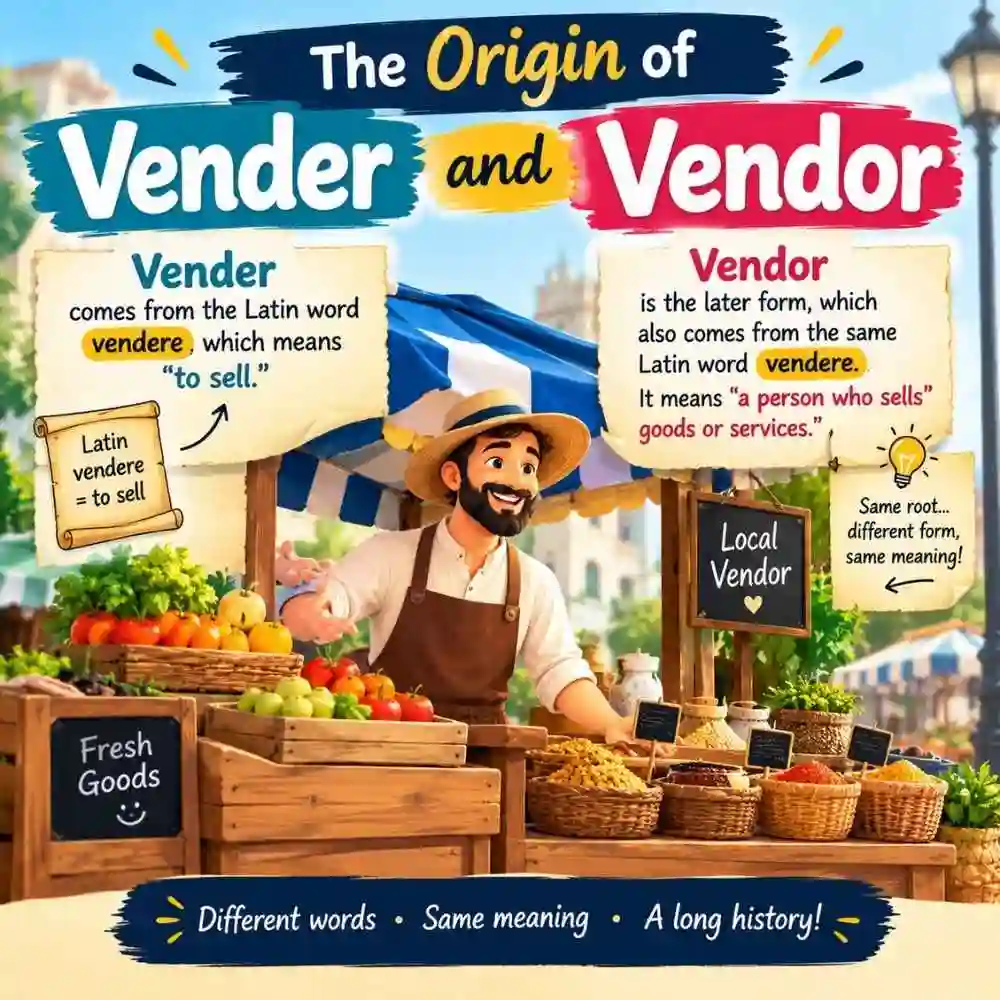
The history of vender and vendor is closely connected because both words developed around the idea of selling. The modern vendor comes through Anglo-French from Latin venditor, meaning a seller, while the related verb vend traces back to Latin vendere, meaning “to sell.” Dictionary sources date vendor in English to the late 16th century.
Vender developed as a spelling formed from the verb vend with the English agent suffix -er. Dictionary.com dates its first recorded use to 1590–1600 and defines it as a variant of vendor.
Where the Word Vendor Comes From (Table)
| Stage | Word or Form | Meaning / Role |
| Latin | vendere | To sell or offer for sale |
| Latin | venditor | A seller |
| Anglo-French | vendour / vendor | A person who sells |
| English | vendor | A person or business that sells goods or services |
The central root behind vendor is the Latin vendere, meaning “to sell.” The noun developed through forms associated with a person who carries out the act of selling. English eventually adopted vendor as the established noun for a seller or supplier.
The History of Vender

Vender has a somewhat different formation history. Rather than being an entirely separate word with a different meaning, it developed from vend + -er, creating a noun for someone who sells. Dictionary.com records vender from around 1590–1600 and identifies it as another form of vendor.
This helps explain why the two spellings have essentially the same meaning. Both can refer to a person or organization that sells something. However, vendor became the more familiar spelling in modern usage, particularly in commercial and professional contexts.
The spelling vender has not disappeared completely. It can still be found in some modern and historical writing, but readers are generally more accustomed to vendor.
How the Spellings Developed
| Feature | Vendor | Vender |
| Historical basis | From Anglo-French, ultimately Latin venditor | Formed from vend + -er |
| Basic meaning | A person or business that sells | A person or business that sells |
| English history | Recorded in the late 1500s | Recorded around 1590–1600 |
| Relationship | Established noun form | Spelling variant |
| Modern familiarity | Widely recognized | Less common |
| Typical recommendation | Preferred in most modern writing | Understandable but less usual |
The two spellings therefore share the same basic commercial meaning but have different formation paths within English. Their close pronunciation and meaning also help explain why they are easily confused. Today, vendor is the spelling most readers expect, while vender remains a recognized but less common variant.
Read More: Greatful or Grateful: Is There a Difference Between Them? 2026
What Is the Difference Between Vender and Vendor?
Vender and vendor have essentially the same meaning: both can refer to a person or organization that sells goods or services. The main difference is spelling and modern usage, rather than meaning. Dictionary.com lists vender as a noun meaning vendor, while vendor is the more established spelling for a person or agency that sells.
| Feature | Vendor | Vender |
| Meaning | A person or business that sells goods or services | A person or business that sells goods or services |
| Spelling | Standard and widely recognized | Less common spelling variant |
| Part of speech | Noun | Noun |
| Usage | Common in modern English | Less frequently used |
| Business writing | Widely preferred | Unusual |
| Professional documents | Common choice | Generally avoided when the standard form is intended |
| Example | We contacted the software vendor. | We contacted the software vender. |
| Main distinction | Established modern spelling | Variant spelling of vendor |
Difference in Spelling
The most obvious difference is the final part of the word: vendor ends in -or, while vender ends in -er. Despite this difference, the two forms have essentially the same pronunciation and meaning.
Vendor developed through Anglo-French from Latin venditor, while vender was formed from vend with the suffix -er. Dictionary.com records vender as a variant of vendor.
Because English spelling does not always correspond directly to pronunciation, hearing the word alone does not tell you which spelling to choose. In modern writing, vendor is the more familiar form.
Difference in Usage
There is little difference in the basic meaning or grammatical function of the two words. Both can describe someone who sells products or provides services.
For example:
- Vendor: The company selected a new vendor for its software services.
- Vender: The company selected a new vender for its software services.
The first version is much more natural for most contemporary readers. Vendor is especially common in commercial and professional contexts, where it can refer to a supplier, service provider, marketplace seller, or company providing specialized products. Dictionary.com also gives examples of vendor for sellers ranging from food sellers to technology companies.
Difference in Modern English
In modern English, vendor is the spelling most readers will recognize and expect. It is widely used in business, commerce, technology, retail, and everyday descriptions of sellers. Current dictionary usage also presents vender as a variant rather than as a word with a separate meaning.
This does not mean that vender has a completely different definition or is meaningless. It remains a recognized spelling, but its lower familiarity can make it look unusual in contemporary professional writing.
Simple rule: If you are unsure which spelling to use, choose vendor. It communicates the intended meaning clearly and matches the spelling most commonly encountered in modern English.
Is Vender a Real Word?

Yes, vender is a real English word. It is a recognized noun that means a person or business that sells goods or services. It is not simply a misspelling or meaningless version of vendor. However, vender is much less common in modern English than vendor.
The word appears in dictionaries as a variant of vendor, meaning that the two forms have essentially the same definition. Its use can be found in some dictionaries and written sources, but contemporary readers are far more likely to encounter vendor.
For example:
- The vender sold fresh produce at the market.
- The vendor sold fresh produce at the market.
Both sentences communicate the same basic idea, but the second uses the spelling that is more familiar in current English.
If you’re writing a business email, contract, report, website, or other professional document, vendor is generally the more natural choice. You can think of vender as a legitimate but uncommon spelling variant rather than a separate word with a different meaning.
Read More: Carmel or Caramel: Which Spelling Should You Use? 2026
Is Vendor the Correct Spelling?
Yes, vendor is the standard and widely preferred spelling in modern English. It refers to a person, company, or organization that sells goods or provides services. While vender is also a recognized spelling variant, it is considerably less common.
For most readers, vendor is the expected form, particularly when the word appears in business, commercial, or professional contexts. Choosing the familiar spelling helps make your writing immediately clear and avoids distracting readers with an unusual variant.
Standard English Usage
In standard English usage, vendor is the form you will most often see in dictionaries, business communication, commercial documents, and everyday writing. It can describe many types of sellers and suppliers.
For example:
- We need to find a reliable vendor for office equipment.
- The online marketplace connects customers with independent vendors.
- The company signed an agreement with a software vendor.
Although vender has the same basic meaning, its use is uncommon enough that some readers may assume it is a spelling mistake. For general writing, vendor is therefore the safer and more familiar choice.
Vendor in Formal Writing
Vendor is fully appropriate in formal writing, including contracts, business reports, proposals, emails, invoices, procurement documents, and professional correspondence.
For example:
- The vendor must provide the required equipment by the agreed delivery date.
In this context, vendor clearly identifies the party responsible for supplying the equipment. It can also be used when discussing vendor agreements, vendor management, vendor services, and supplier relationships.
If your goal is clear and conventional professional writing, use vendor rather than the less common vender.
British English vs. American English Spelling
The choice between vendor and vender is not mainly a British-versus-American spelling difference. Unlike words such as colour/color or centre/center, these two forms are not simply standard regional spellings. Vendor is the established spelling in both British and American English, while vender is a less common variant.
| Point | British English | American English |
| Common spelling | Vendor | Vendor |
| Alternative form | Vender may appear | Vender may appear |
| Standard business usage | Vendor | Vendor |
| Meaning of vendor | A seller or supplier | A seller or supplier |
| Regional spelling difference | No major difference | No major difference |
| Recommended form | Vendor | Vendor |
This means you generally do not need to change the spelling based on whether your audience uses British or American English. Vendor works naturally in both varieties.
When Should You Use Vendor?
Use vendor when referring to a person, company, or organization that sells goods or provides services. It is the best choice for most modern writing because it is familiar, widely accepted, and commonly used in commercial and professional contexts.
You can use vendor in:
- Business emails
- Contracts and agreements
- Company reports
- Online marketplaces
- Supplier communications
- Product descriptions
- Professional websites
- Everyday writing
For example:
- The company is looking for a new vendor to supply office equipment.
Here, vendor clearly identifies the business that will provide the equipment.
Read More: Lay Down or Lie Down: How Can You Tell the Difference? 2026
When Can You Use Vender?
You can use vender when you intentionally choose the recognized spelling variant of vendor. The word has the same basic meaning and can refer to someone who sells goods or services.
However, vender is uncommon in contemporary English, so it may look unusual to many readers. It is therefore not normally the preferred spelling for business or professional communication.
For example:
- The vender displayed handmade products at the market.
The sentence is understandable, but most modern readers would expect vendor instead. As a practical rule, use vendor in most situations. Use vender only when a particular source, publication, historical text, or established style specifically uses that spelling.
Vendor vs. Vender in Business Writing
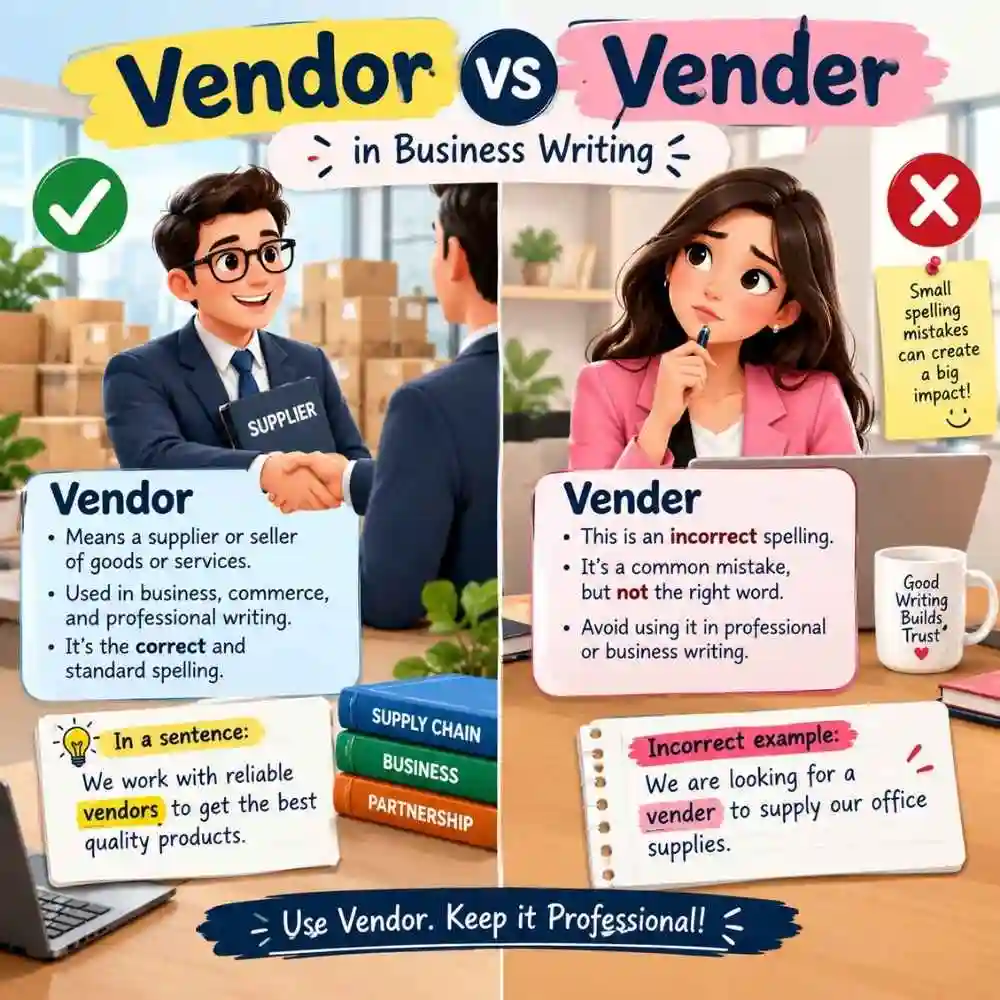
In business writing, the choice between vendor and vender is mainly a matter of conventional usage. Both words can refer to a person or company that sells goods or services, but vendor is far more common in modern professional communication.
Business documents often need to be clear to different readers, including customers, suppliers, employees, and legal or financial teams. Using the familiar spelling vendor reduces the chance that a reader will mistake the word for a spelling error.
For example:
- Preferred: We are reviewing our current vendor agreements.
- Less common: We are reviewing our current vender agreements.
This preference applies across many types of business writing, from routine messages to formal commercial documents.
Vendor in Emails
Vendor is the natural choice when writing professional emails about suppliers, sellers, or service providers. It can be used when discussing prices, orders, deliveries, services, payments, or business relationships.
For example:
Please contact the vendor to confirm the delivery date.
Using vendor in an email makes the message straightforward and consistent with common business terminology. Although vender can communicate the same basic meaning, it may look unusual to a professional reader.
Vendor in Invoices and Contracts
In invoices and contracts, precision and consistency are especially important. Vendor is commonly used to identify the party supplying products or services.
For example:
The vendor agrees to provide the services described in this agreement.
You may also encounter terms such as vendor name, vendor number, vendor agreement, and vendor payment in business records.
Because contracts and invoices are formal documents, using the more familiar spelling vendor helps maintain conventional business language. If an organization has a specific legal or historical name containing Vender, that established spelling should naturally be preserved.
Vendor in Professional Communication
In broader professional communication, vendor is suitable whenever you need to discuss a seller, supplier, or service provider. This includes meetings, reports, proposals, presentations, procurement discussions, and workplace messages.
For example:
- We are comparing three vendors before making a decision.
- Our technology vendor provides ongoing technical support.
- The purchasing team is negotiating with the vendor.
The key point is simple: vendor is the standard practical choice for modern business writing, while vender is a recognized but much less common variant.
Vendor vs. Vender in Everyday Examples
In everyday English, vendor and vender can both describe a person or business that sells something. However, vendor is much more common in current usage, so it is the spelling most readers expect.
Here are some practical examples:
- Vendor: The food vendor sells fresh sandwiches near the station.
- Vendor: We found a reliable vendor at the local market.
- Vendor: The online vendor shipped my order quickly.
- Vender: The vender sold handmade items at the fair.
The meaning remains understandable with vender, but vendor is generally the more natural choice for modern writing.
Read More: Aluminum or Aluminium: Which Spelling Is Correct?
Are Vendor and Vender Pronounced the Same?
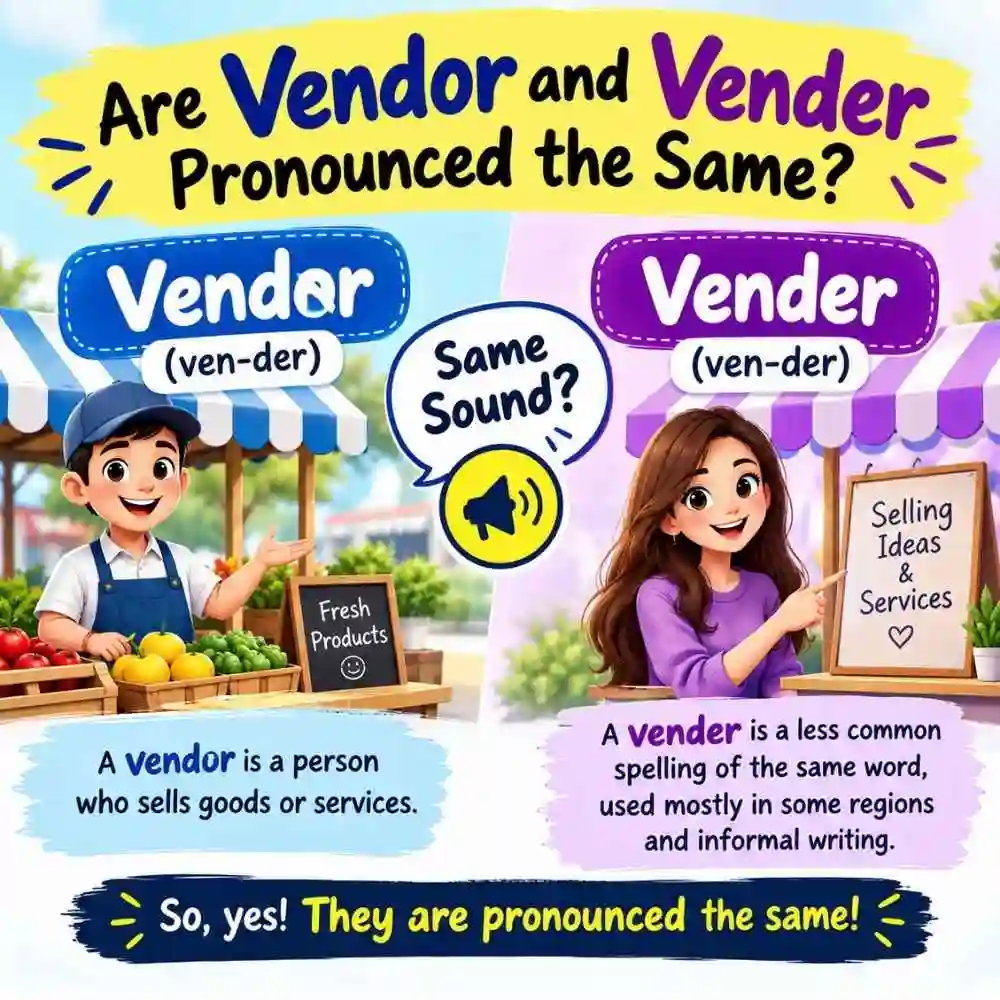
Yes. Vendor and vender are generally pronounced the same in standard English. The difference is primarily in spelling, not pronunciation.
- vendor
- VEN-dər
- Add to flashcards
- Give feedback
- vender
- VEN-dər
- Add to flashcards
- Give feedback
Because the words sound alike, you cannot rely on pronunciation to determine which spelling to write. When typing or writing the word, remember that vendor is the standard form most commonly used today.
Common Mistakes With Vender vs. Vendor
The most common mistake is assuming that vender is simply a misspelling of vendor. It is actually a recognized variant, but its limited use makes it unfamiliar to many readers.
Another mistake is treating the two words as if they have different meanings. In general, both refer to someone who sells goods or services.
For example:
- Preferred: The company chose a new software vendor.
- Less common: The company chose a new software vender.
Writers may also choose vender unintentionally because the ending -er seems natural for a person who performs an action. However, vendor is the established spelling you will most often see in business and professional contexts.
How to Remember the Correct Spelling
A simple way to remember the preferred spelling is to associate vendor with common business terms such as vendor agreement, vendor management, vendor payment, and vendor services.
You can also remember this practical rule:
When you mean a seller or supplier, use “vendor” in most modern writing.
This is especially useful for emails, contracts, reports, websites, invoices, and other professional documents. You may encounter vender in some sources, but vendor is the spelling that will usually look most natural to contemporary readers.
Vendor vs. Vender: Comparison Table
| Feature | Vendor | Vender |
| Meaning | A seller or supplier | A seller or supplier |
| Part of speech | Noun | Noun |
| Pronunciation | Generally the same | Generally the same |
| Spelling | Standard and widely used | Less common variant |
| Modern usage | Very common | Uncommon |
| Business writing | Preferred | Less usual |
| Professional documents | Recommended | Generally avoided when standard usage is intended |
| Meaning difference | None in ordinary usage | None in ordinary usage |
The key distinction is therefore frequency and convention, rather than meaning. For most readers and writing situations, vendor is the clearest choice.
Frequently Asked Questions About Vendor and Vender
Is vendor or vender correct?
Vendor is the standard and more commonly used spelling. Vender is also a recognized variant, but it is much less common.
Is vender a real English word?
Yes. Vender is a real English word meaning a person or business that sells goods or services. It is generally treated as a variant of vendor.
Do vendor and vender have the same meaning?
Yes. In ordinary usage, both words refer to a seller or supplier. The main difference is how commonly each spelling is used.
Are vendor and vender pronounced the same?
Yes. They are generally pronounced the same, which is one reason the two spellings can be confusing.
Which spelling should I use in business writing?
Use vendor. It is the familiar modern spelling used in business, commerce, professional communication, and formal documents.
Can I use vender in a sentence?
Yes. Vender is a recognized spelling, so it can be used when appropriate. However, vendor will usually be the better choice for contemporary writing.
Is vender a British spelling of vendor?
No. The difference is not simply a British-versus-American spelling distinction. Vendor is widely used in both British and American English.
Why do people confuse vendor and vender?
They have the same basic meaning and are generally pronounced alike. Their similar spelling also makes it easy to choose the less common vender accidentally.
Is vendor a noun?
Yes. Vendor is a noun used for a person, company, or organization that sells goods or provides services.
What is the easiest way to remember vendor?
Remember that vendor is the standard modern spelling. If you are writing about a seller or supplier and are unsure, vendor is normally the safest choice.
Conclusion
Understanding vendor and vender becomes much easier once you know that both spellings can refer to a seller, but vendor is the standard and far more common choice in modern English. For business writing, emails, contracts, invoices, and other professional documents, using vendor keeps your spelling clear and familiar to readers.
Vender may still appear as a legitimate variant, but it is uncommon and can create unnecessary spelling confusion. Knowing this difference helps you write with greater accuracy and confidence, especially when choosing words for formal or everyday communication. When in doubt, remember the simple rule: use vendor for most modern writing, and reserve vender for contexts where that spelling is specifically intended.

I’m Jane Austen, the admin of GrammarGuide.com, where words come to life in smarter, sharper, and more creative ways. I focus on simplifying grammar, exploring powerful synonyms, and sharing fun, engaging expressions that make everyday communication more effective. My goal is to help readers write with clarity, confidence, and a touch of personality, whether it’s for professional use or just for fun.



