Understanding Was There or Were There is essential in everyday English because it directly affects how we describe existence in past situations. This grammar choice often appears in writing, speaking, and academic communication, making accuracy important for clear expression.
Many learners confuse Was There with Were There because subject-verb agreement rules depend on whether the noun is singular or plural. Misusing these forms can lead to unclear sentences and weaken overall writing clarity, especially in formal contexts like exams, emails, and reports.
This guide explains the difference between these structures, when to use each form correctly, and simple rules to avoid common grammatical errors. By the end, you will gain confidence in choosing the right structure in both spoken and written English, improving overall communication skills.
Understanding “Was” and “Were”
In English grammar, choosing between “was” and “were” depends on subject-verb agreement and the number of the subject in a sentence. These past forms of the verb “to be” are essential for describing situations, existence, or events that already happened. The confusion around Was There or Were There often arises because learners fail to quickly identify whether the subject is singular or plural in context.
Understanding this difference is important for building grammatically correct sentences in speaking, writing, exams, and professional communication. Using the wrong form can change meaning or make a sentence sound incorrect or unnatural.
What “Was” and “Were” Really Mean?
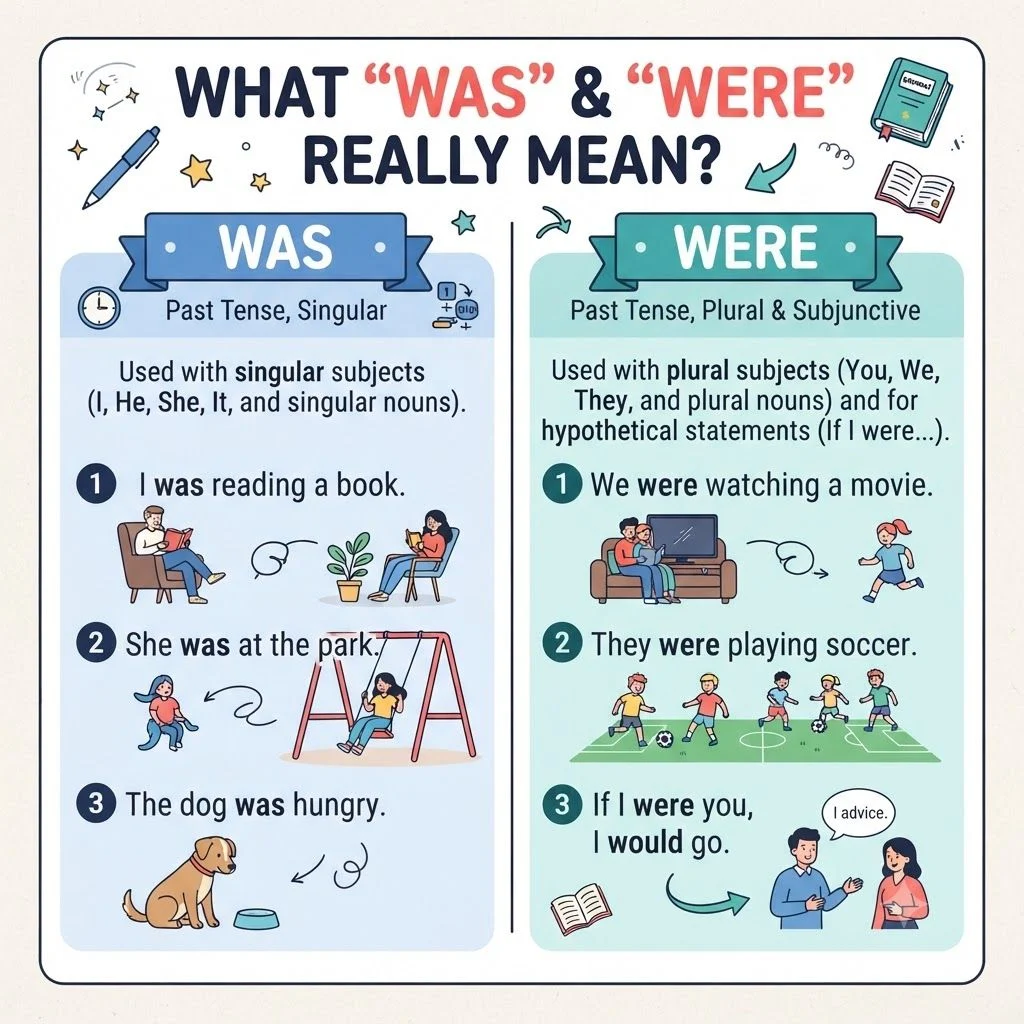
The verbs “was” and “were” are past tense forms of “to be,” used to describe states, existence, or conditions in the past.
- Was → used for singular subjects
- Were → used for plural subjects
Key usage points:
- Was is used with: I, he, she, it, and singular nouns
- Were is used with: we, you, they, and plural nouns
- Both forms are used in statements, questions, and negatives
Examples:
- “There was a mistake in the document.”
- “There were several mistakes in the document.”
- “Was there any issue with the file?”
- “Were there any issues with the file?”
Singular Subjects: Using “Was”
When the subject refers to a single person, object, or idea, we use “was.” This is a key rule in solving confusion around Was There structures in English grammar.
Common uses:
- Single noun subjects
- Singular pronouns (he, she, it)
- One item, idea, or event in past reference
Examples:
- “There was a problem with the system.”
- “There was a delay in the meeting.”
- “Was there a reason for the change?”
- “There was only one option available.”
Incorrect vs correct usage:
- ❌ There were a problem in the system
- ✔️ There was a problem in the system
Plural Subjects: Using “Were”
When talking about more than one person or thing, “were” is the correct form. This helps maintain grammatical accuracy in Were There structures.
Key points:
- Used with plural nouns (students, books, cars, issues)
- Used with pronouns like we, you, they
- Shows multiple existence or situations in the past
Examples:
- “There were many students in the class.”
- “There were two options available.”
- “Were there any changes in the schedule?”
- “There were several errors in the report.”
Incorrect vs correct usage:
- ❌ There was many students in the class
- ✔️ There were many students in the class
How “Was” and “Were” Work in Real vs Imaginary Situations
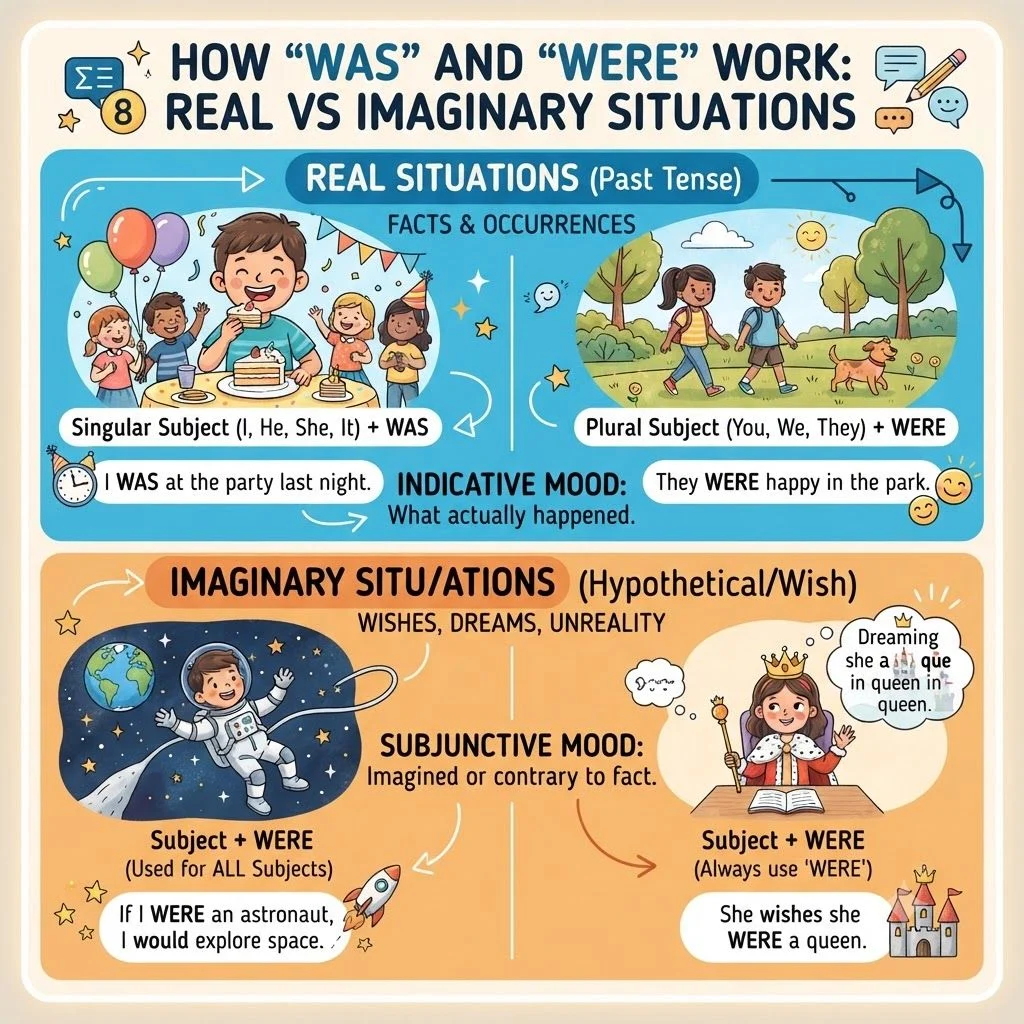
The verbs “was” and “were” are not only used to describe real past events but also to express imagined or hypothetical situations in English. This dual function often confuses learners because the same forms can shift meaning depending on the context. In the discussion of Was There or Were There, understanding this difference helps you recognize whether a sentence is describing reality or a situation that is not actually true.
In real situations, these verbs follow standard subject-verb agreement rules. However, in imaginary or conditional statements, grammar rules shift slightly to express unreality, wishes, or possibilities. This is where mood in English grammar becomes important for accurate communication.
The Indicative Mood: When You Describe Reality
The indicative mood is used when talking about real events, facts, or situations that actually happened or exist. In this case, “was” and “were” follow normal grammatical rules based on whether the subject is singular or plural.
For example, “There was a storm last night” describes a real event that occurred. Similarly, “There were many people at the station” reports an actual situation. In questions, we also use this structure to ask about real existence, such as “Was there any delay in the flight?” or “Were there any witnesses?”
This mood is the most commonly used form in everyday communication, academic writing, and professional language because it focuses on factual accuracy and clear reporting of events.
The Subjunctive Mood: When You Describe Unreal Ideas
The subjunctive mood is used to talk about situations that are not real, such as wishes, hypothetical conditions, or imaginary scenarios. In this structure, “were” is often used even with singular subjects, which is different from the normal rule.
For example, “If I were there, I would help you” describes an imaginary situation, not a real one. Similarly, “I wish there were more opportunities” expresses a desire for something that does not currently exist. This usage helps speakers communicate emotions, possibilities, and unreal conditions more effectively.
Understanding the subjunctive mood is essential for mastering advanced English grammar, especially in conditional sentences and expressive writing where meaning depends on imagination rather than reality.
“If I Was” vs “If I Were”
The difference between “If I was” and “If I were” is one of the most common grammar challenges in English. Both forms are used in conditional sentences, but they express different levels of reality. Understanding this distinction is essential when discussing the Was There or Were There concept, especially in situations involving possibility, imagination, or past uncertainty.
Many learners mix these forms because spoken English often blurs the distinction. However, in formal writing and clear communication, choosing the correct structure improves accuracy, tone, and grammatical correctness.
| Feature | If I Was | If I Were |
| Grammar Type | Past tense (real or possible situations) | Subjunctive mood (imaginary or unreal situations) |
| Meaning | Refers to something that may have actually happened | Refers to something not real or hypothetical |
| Usage Context | Uncertain or factual past conditions | Unreal, wishful, or imaginary conditions |
| Formality Level | Common in spoken English and informal writing | Preferred in formal writing and academic English |
| Example Sentence | If I was late, I apologize. | If I were rich, I would travel the world. |
| Subject Agreement | Used when speaker considers possibility in real past | Used even with singular subjects for imagination |
| Tone | More realistic and factual | More hypothetical and expressive |
| Common Mistake | Used incorrectly in unreal situations | Sometimes overused in informal speech |
When “If I Was” Is Correct
The phrase “If I was” is correct when you are referring to a real or possible past situation where you are unsure about what actually happened. It is often used when the condition might have been true in reality.
For example, “If I was rude yesterday, I apologize” suggests that there is a real possibility of being rude. Similarly, “If I was late, it was because of traffic” refers to an actual event that may have occurred. In these cases, the speaker is not imagining a situation but referring to a factual or uncertain past condition.
This form is commonly used in everyday speech and informal writing because it reflects natural, real-life uncertainty.
When “If I Were” Is Correct
The phrase “If I were” is used for imaginary, unreal, or hypothetical situations. It belongs to the subjunctive mood, where the condition is not true in reality but is being imagined.
For example, “If I were rich, I would travel the world” clearly describes a situation that is not real. Similarly, “If I were you, I would study harder” is a classic conditional structure used for advice or imagination. In these cases, “were” is used even with singular subjects like I, he, or she, which is a key grammar rule.
This form is widely used in formal writing, creative expression, and polite suggestions because it sounds more refined and grammatically precise.
A Quick Rule for Fast Decision-Making
A simple way to decide between “If I was” and “If I were” is to check reality versus imagination. If the situation is real or possibly true in the past, use “was.” If the situation is imaginary, hypothetical, or impossible, use “were.”
For example, real uncertainty: “If I was unclear, let me explain again.”
Imaginary condition: “If I were a bird, I would fly freely.”
This quick rule helps learners avoid common mistakes and improves fluency in both spoken and written English. Mastering this distinction also strengthens overall understanding of conditional sentences and enhances grammatical confidence in everyday communication.
Agreement Between “Was/Were” and Different Pronouns
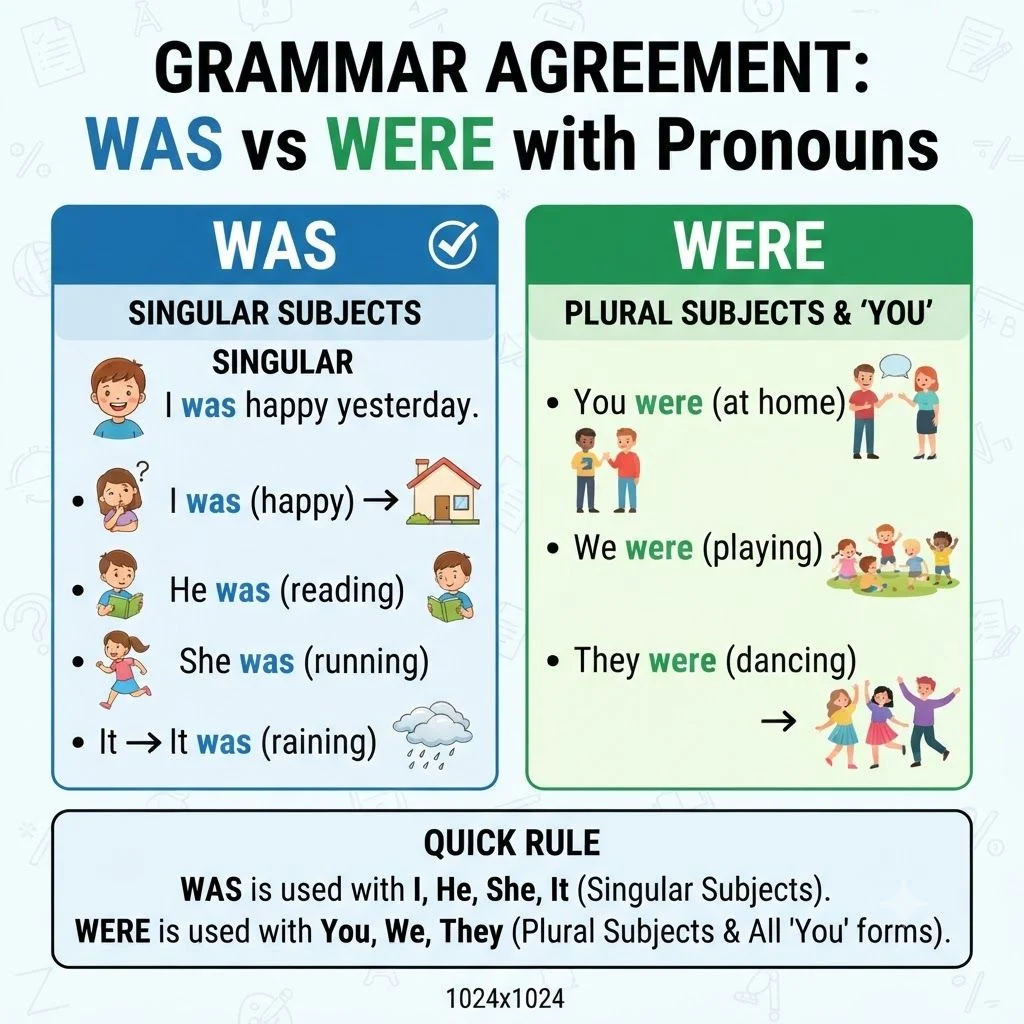
Correct usage of “was” and “were” depends heavily on subject-verb agreement, especially with pronouns and noun types. In English grammar, this agreement ensures that sentences sound natural, logical, and grammatically correct. The confusion around Was There or Were There often comes from not matching the verb correctly with the subject in different contexts.
Understanding how pronouns control verb forms is essential for clear communication in writing, speaking, and formal language use. It also helps prevent common errors in exams, essays, and professional correspondence.
I, He, She, It and “Was”
The pronouns I, he, she, and it always take “was” because they refer to singular subjects in the past tense. This rule is a core part of subject-verb agreement, ensuring that sentences remain grammatically correct and easy to understand. Whether you are describing personal experiences, emotions, or past events, using “was” with singular pronouns helps maintain clarity and accuracy in communication.
This structure is widely used in both spoken and written English, especially when talking about past states or actions of a single person or thing. It is one of the most fundamental grammar patterns learners must master to avoid confusion in basic sentence formation.
Examples:
- I was at the office yesterday.
- He was very busy last night.
- It was a difficult decision to make.
You, We, They and “Were”
The pronouns you, we, and they take “were” because they represent plural subjects in standard grammar usage. This rule applies even when “you” refers to one person, making it a unique exception in English. Using “were” correctly helps maintain consistency in past tense sentences involving multiple people or shared experiences.
This form is essential for describing group actions, past events, and collective situations. It ensures that sentences sound natural and grammatically aligned, especially in conversations, storytelling, and formal writing.
Examples:
- You were late for the meeting.
- We were happy with the results.
- They were playing in the park.
Special Cases with Collective Nouns
Collective nouns like team, family, group, or committee can use either “was” or “were” depending on whether the group is seen as a single unit or as individual members. This flexibility often confuses learners, but the meaning of the sentence usually makes the choice clear.
When the group acts as one whole, “was” is preferred. When focusing on individual actions within the group, “were” is used. This distinction helps express more precise meaning in both formal and informal English contexts.
Examples:
- The team was ready for the final match.
- The family was celebrating the holiday together.
- The committee were divided on the decision.
Read More: Expiry vs Expiration: Which Term Should You Use? 2026
“Was/Were” in Questions and Negative Sentences
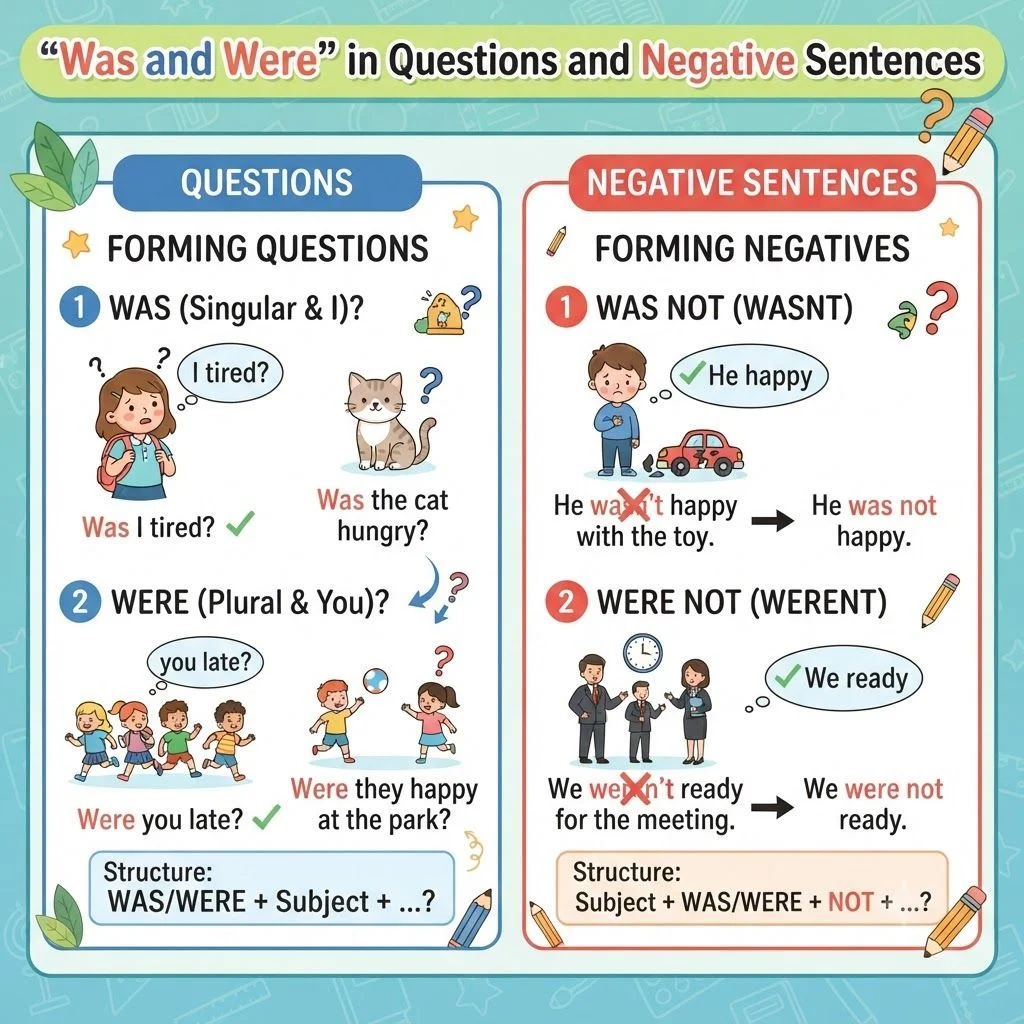
The verbs “was” and “were” are commonly used in questions and negative sentences to talk about past events, states, or situations. In English grammar, these forms follow specific patterns that help maintain clarity and accuracy in communication. Understanding how to structure questions and negatives with Was There or Were There is essential for asking about existence, past conditions, or experiences in a grammatically correct way.
Mastering these forms improves both spoken and written English, especially in interviews, exams, and everyday conversations. It also helps learners avoid common mistakes when shifting between statements, questions, and negative expressions in the past tense.
Forming Questions with “Was”
Questions with “was” are used when referring to singular subjects or singular possibilities in the past. The structure typically places “was” before the subject, making it easy to ask about past states, events, or conditions involving one person or thing.
This form is widely used in everyday communication to gather information about past situations. It helps speakers inquire clearly and directly without changing the meaning of the sentence.
- Was she at the meeting yesterday?
- Was there a problem with the order?
- Was it difficult to complete the task?
Forming Questions with “Were”
Questions using “were” are used when referring to plural subjects or group situations in the past. In this structure, “were” comes before the subject, following standard question formation rules in English grammar.
This form is essential when asking about multiple people, events, or shared experiences. It ensures clarity when discussing past actions involving more than one subject.
- Were they present at the event?
- Were there any mistakes in the report?
- Were you satisfied with the results?
Negative Forms and Their Usage
Negative sentences with “was” and “were” are formed by adding “not” after the verb. These structures are used to express the absence of something, denial of an event, or non-existence in the past.
They are important in both formal and informal English because they help clarify what did not happen or was not true. This is especially useful in explanations, corrections, and factual statements.
- She was not ready for the exam.
- There were not enough seats available.
- I was not aware of the change.
Time Expressions with “Was” and “Were”
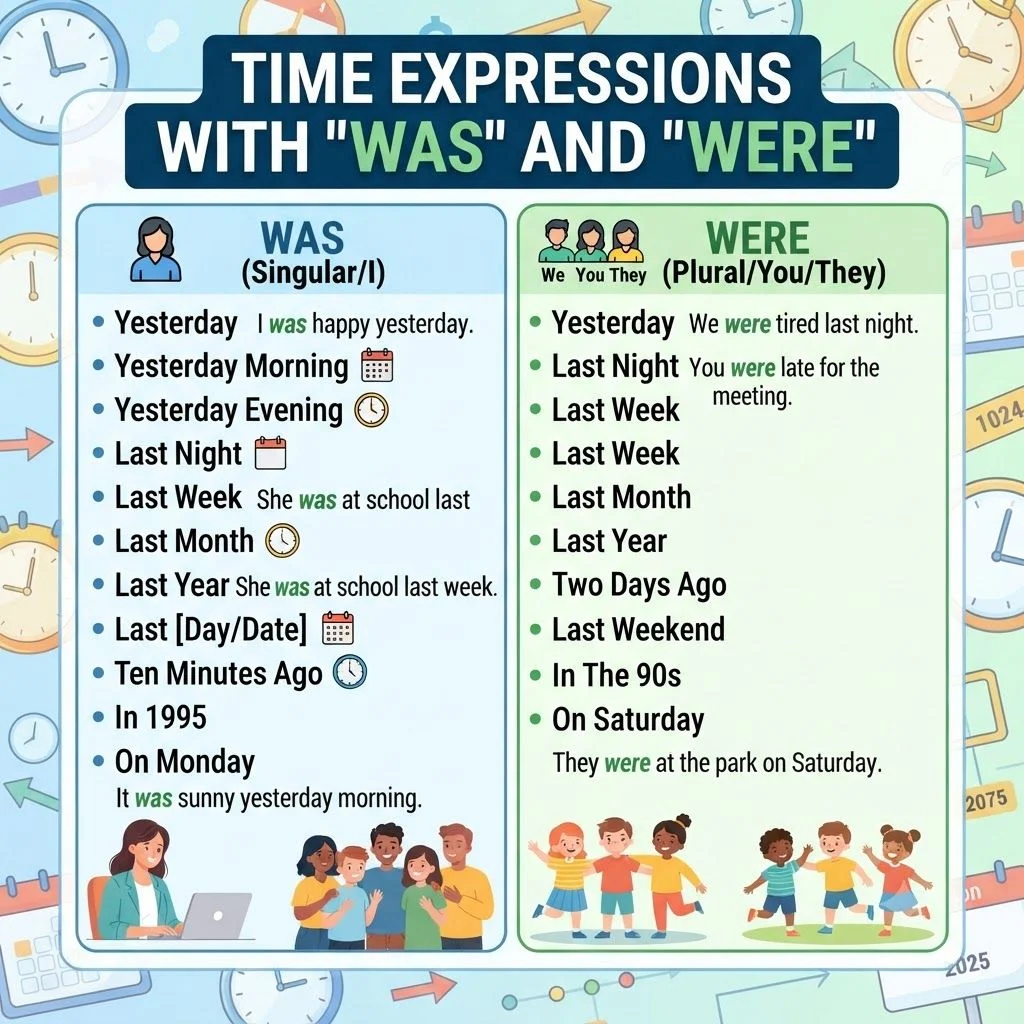
Time expressions play an important role in understanding how “was” and “were” function in past-tense sentences. These verbs often appear alongside time markers that indicate when an action happened, how long it lasted, or whether it was ongoing. In the context of Was There or Were There, time expressions help clarify the exact moment or duration of past events, making communication more precise and meaningful.
Using correct time references improves sentence accuracy and helps listeners or readers understand the timeline of events. It is especially important in storytelling, academic writing, and everyday conversation where clarity about time is essential.
Past Continuous Context
The past continuous tense is often used with “was” and “were” to describe actions that were happening at a specific moment in the past. It emphasizes that something was in progress rather than completed, giving a clearer picture of background events.
This structure is commonly used when setting the scene or describing interrupted actions. It helps create a sense of continuity in past narratives.
- I was studying when the phone rang.
- She was cooking dinner at 7 PM.
- They were watching a movie during the storm.
Specific Time References
Specific time references such as yesterday, last week, at 5 PM, or in 2020 are often used with “was” and “were” to clearly locate an event in time. These expressions help anchor the action in a definite past moment.
They are widely used in both formal and informal communication to provide clarity and avoid ambiguity about when something happened.
- I was at home yesterday.
- He was absent last Monday.
- We were at the airport at 6 AM.
Duration and Ongoing Actions in the Past
When describing how long something lasted or continued in the past, “was” and “were” are often combined with time expressions like for hours, all day, or since morning. These structures help show that an action or situation continued over a period of time.
This usage is important for expressing background conditions or extended activities in storytelling and reports.
- She was working for five hours.
- They were waiting all evening.
- I was feeling unwell for two days.
Visual Comparison of “Was” vs “Were” Usage
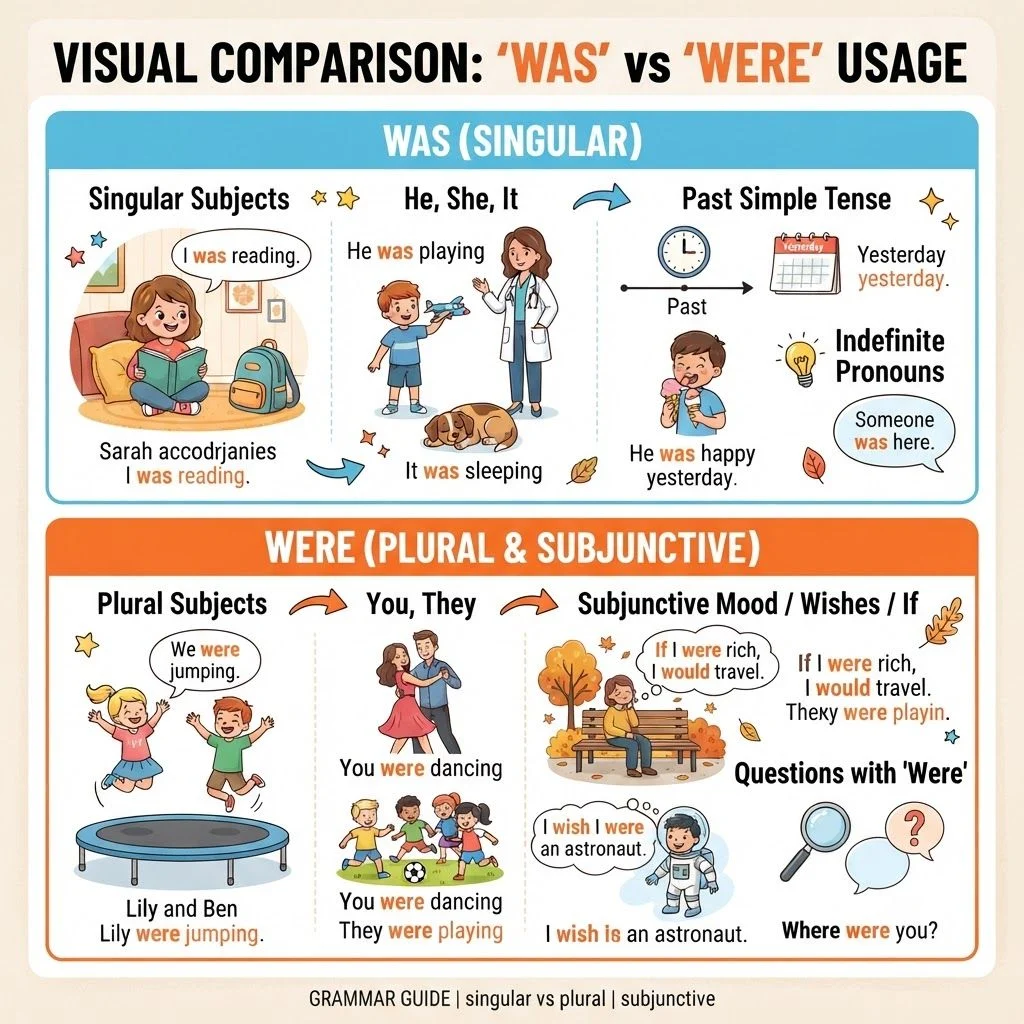
A clear visual understanding of “was” vs “were” usage helps learners quickly identify patterns in subject-verb agreement. Instead of memorizing rules in isolation, comparing structures side by side makes it easier to apply grammar correctly in real sentences, especially when dealing with Was There or Were There constructions.
Simple Rules Chart
A simple rules chart helps break down the core logic behind “was” and “were” usage in a structured way. It visually connects subjects with their correct verb forms, making it easier for learners to remember subject-verb agreement without confusion.
This type of structured comparison is especially useful for beginners who struggle with identifying whether a subject is singular or plural in real sentences. It builds strong grammatical accuracy over time.
- I, He, She, It → was
- You, We, They → were
- Collective nouns → was/were (context-based)
Context-Based Decision Flow
A context-based decision flow helps learners choose between “was” and “were” by analyzing the meaning of the sentence rather than just memorizing rules. This approach is useful in real communication where context determines grammatical accuracy.
By asking simple questions—such as whether the subject is singular, plural, or collective—learners can quickly select the correct form and avoid common mistakes in both writing and speaking.
- Is the subject singular? → Use was
- Is the subject plural? → Use were
- Is the meaning collective or individual-focused? → Choose based on context
Read More: Where vs In Which vs Wherein: The Differences and Usage 2026
How “There” Changes the Sentence Structure
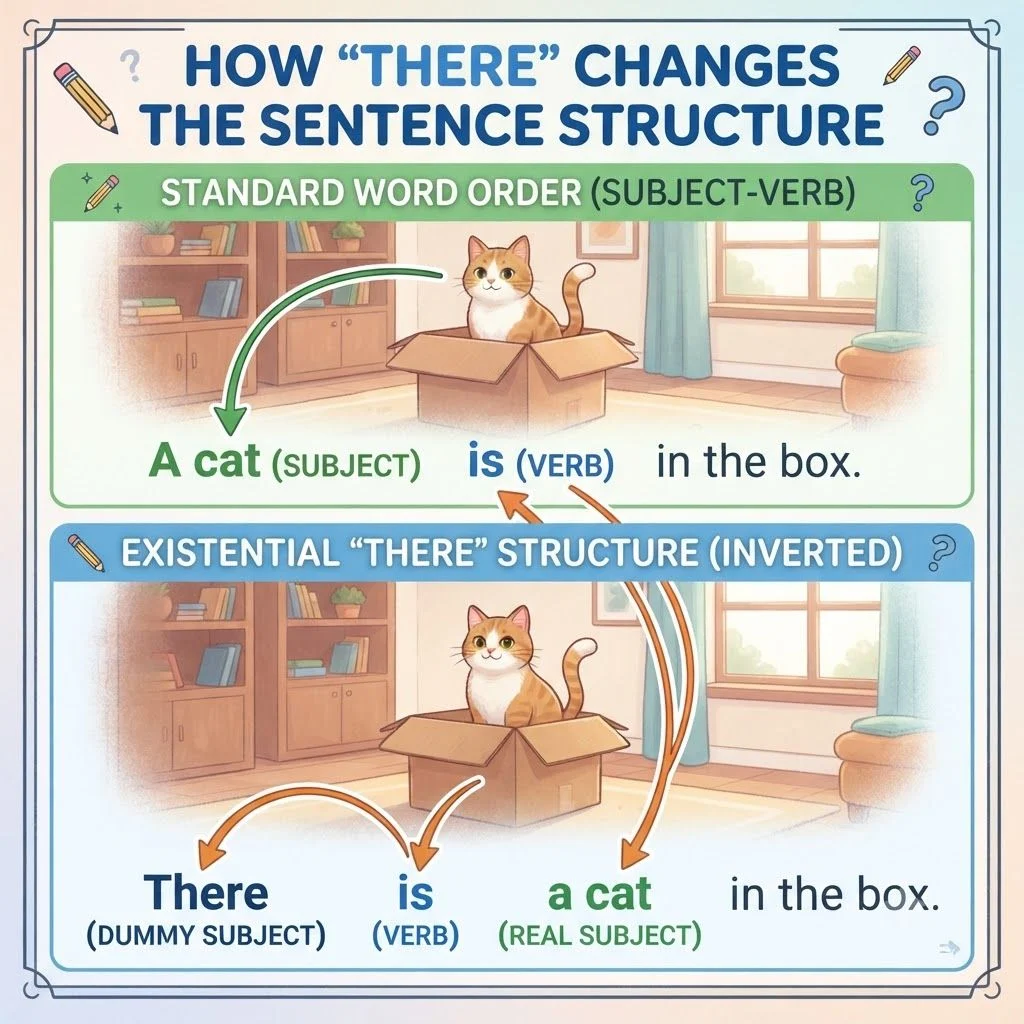
When “there” is used at the beginning of a sentence, it acts as a grammatical placeholder rather than the main subject. The real subject comes after the verb, which is why “was” or “were” must agree with that subject instead of “there” itself.
This structure is commonly used to introduce information about existence or presence in a natural and neutral way.
- There was a problem in the system.
- There were several students in the class.
- There was a mistake in the report.
When to Use “There Was”
Use “there was” when the noun that follows is singular or uncountable. This form is used to describe one item, one event, or a single condition that existed in the past.
It is commonly used in storytelling, reports, and everyday descriptions where only one entity is being referred to.
- There was a book on the table.
- There was an accident on the road.
- There was confusion during the meeting.
When to Use “There Were”
Use “there were” when referring to plural nouns or multiple items in the past. This structure is essential for describing quantity, groups, or repeated occurrences.
It helps clearly communicate that more than one thing existed or happened in a given situation.
- There were many people at the event.
- There were two errors in the document.
- There were several options available.
Table: “Was There” vs “Were There”
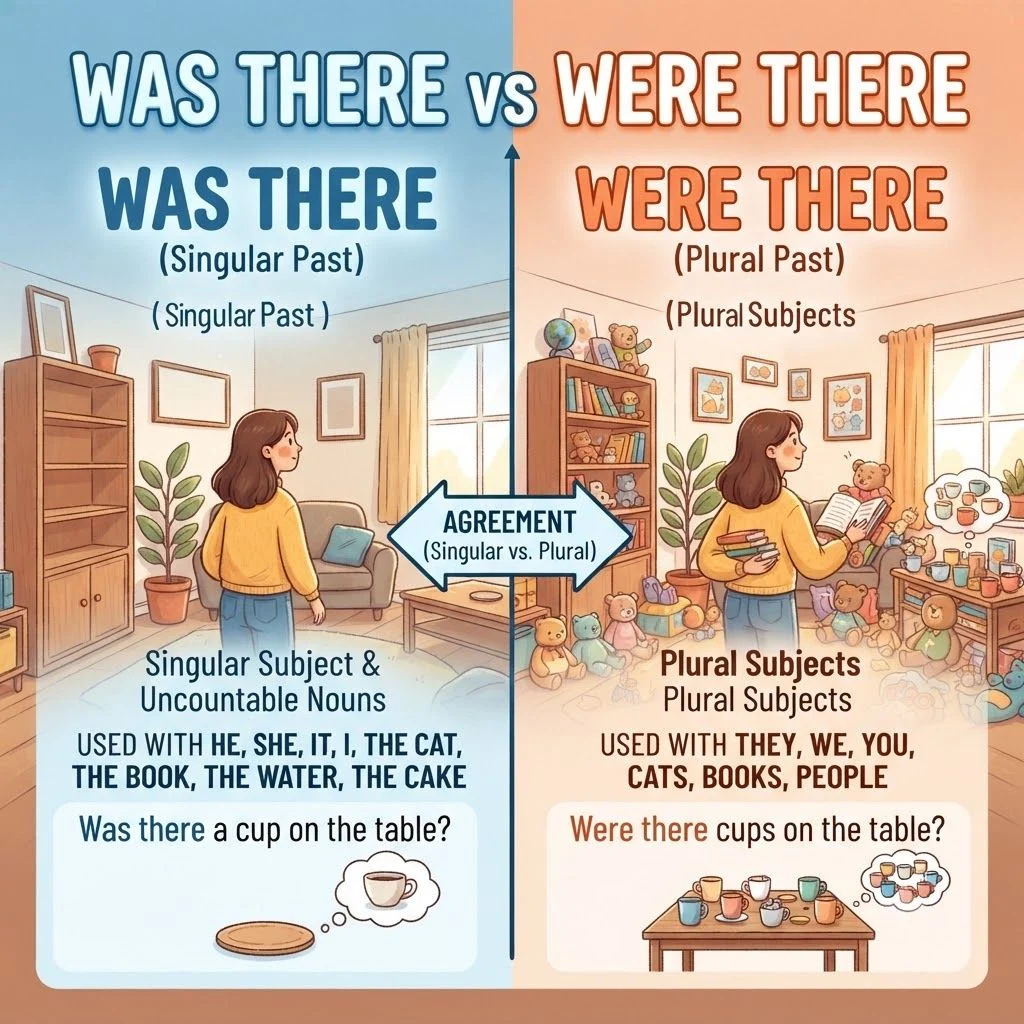
| Feature | Was There | Were There |
| Subject Type | Singular / uncountable noun | Plural noun |
| Meaning | One thing existed | More than one thing existed |
| Example | Was there a mistake? | Were there any mistakes? |
| Usage Context | Single events or items | Multiple events or items |
| Formality | Common in all English types | Common in all English types |
Context Changes Everything
The correct use of “was there” and “were there” often depends on context rather than strict grammar rules alone. Meaning, intention, and reality all influence which form is appropriate. This is why learners must understand not just structure, but also how language reflects real and imagined situations.
Statements About Reality
When talking about real events or actual situations, “was there” and “were there” follow standard grammatical rules based on singular or plural subjects. These statements describe facts that actually happened in the past.
They are commonly used in reports, conversations, and factual descriptions where accuracy is important.
- There was a delay in the flight.
- There were three cars in the parking area.
- Was there any damage in the storm?
Hypothetical or Unreal Situations
In hypothetical or unreal contexts, “were there” can appear even with singular subjects when expressing imagination, wishes, or conditions that are not real. This is part of the subjunctive mood in English grammar.
It helps express ideas that are possible in thought but not in reality.
- If there were more time, I would help.
- I wish there were fewer restrictions.
- If there were a solution, we would use it.
Common Mistakes and How to Fix Them
Many learners misuse “was there” and “were there” due to confusion between singular, plural, and hypothetical contexts. Identifying these errors helps improve grammar accuracy and builds stronger writing skills.
Understanding the root of these mistakes ensures better sentence formation in both formal and informal communication.
Mistake 1: Using “was” in imaginary situations
A common error is using “was” in unreal or hypothetical conditions, where “were” is required. This happens because learners focus on subject form rather than meaning.
- ❌ If there was a solution, I would try it.
- ✔ If there were a solution, I would try it.
- ✔ I wish there were more options.
Mistake 2: Confusing the real subject after “there”
Another mistake is treating “there” as the subject, instead of the noun that follows it. This leads to incorrect verb agreement.
- ❌ There was many problems.
- ✔ There were many problems.
- ✔ There was a problem with the system.
Mistake 3: Treating “you” as singular
Learners sometimes incorrectly use “was” with “you”, forgetting that English treats “you” as plural in verb agreement.
- ❌ You was there yesterday.
- ✔ You were there yesterday.
- ✔ Were you at the meeting?
Read More: Oftentimes vs Often Times: Which One Is Correct? 2026
Memory Hack
A simple memory trick is to always focus on the noun after “there”, not the word “there” itself. This helps quickly decide between was and were in any sentence.
- If one thing → was
- If more than one → were
- If unreal idea → were (subjunctive)
Mini Case Studies
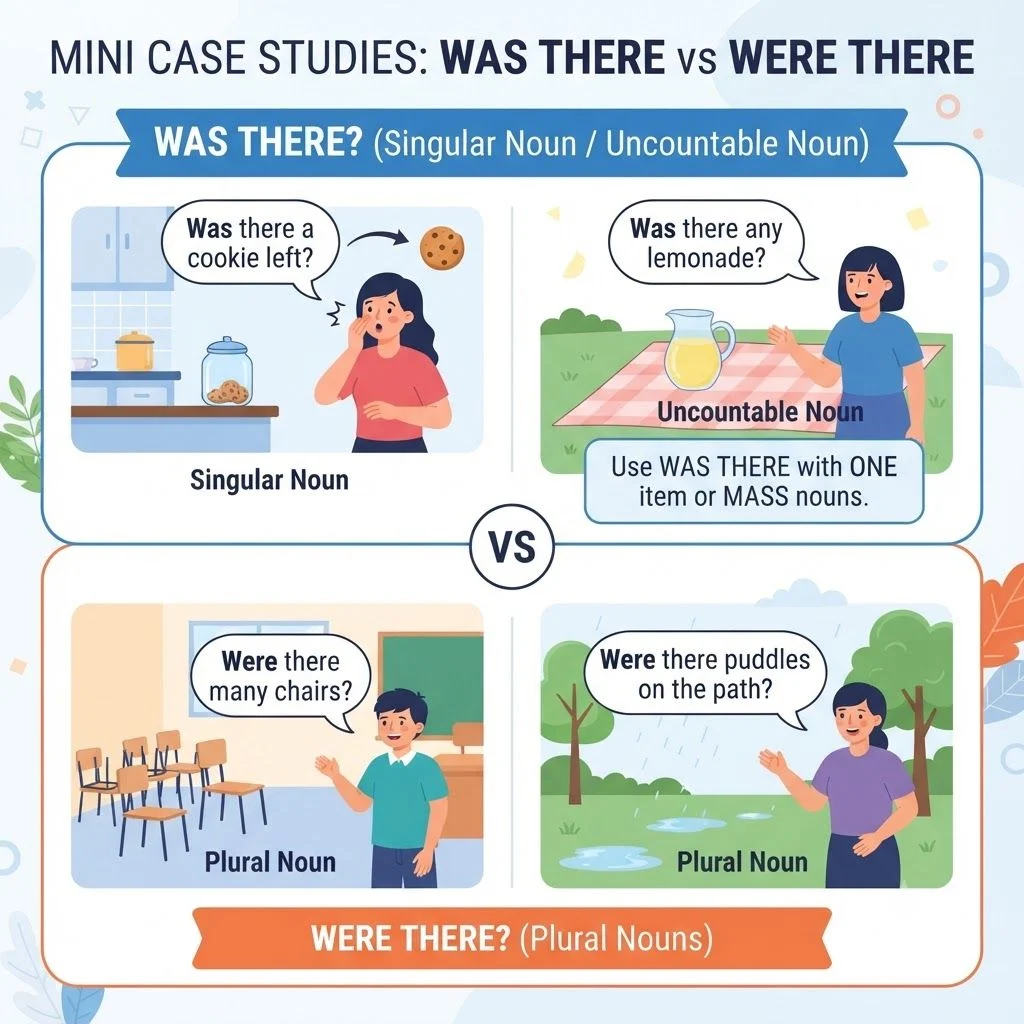
Real-world examples help learners understand how “was there and were there” function in practical communication. These case studies show how grammar changes depending on context, tone, and purpose.
Case Study 1: Customer Service Email
In professional communication, correct grammar improves clarity and trust. Using “was there” or “were there” properly helps ensure accurate reporting of issues.
- There was an issue with your payment processing.
- Were there any delays in receiving the order?
- There were no errors found in the system.
Case Study 2: Everyday Conversation
In daily speech, these structures help people ask and explain past situations naturally. They are commonly used in questions and short responses.
- Was there a call for me?
- Were there many people at the party?
- There was a lot of traffic today.
Case Study 3: Business Report
In formal writing, “was there and were there” are used to present data, observations, and findings in a structured way. Accuracy is essential in these contexts.
- There was a decrease in sales last quarter.
- Were there any changes in customer behavior?
- There were significant improvements in performance.
Quick Reference Summary Table
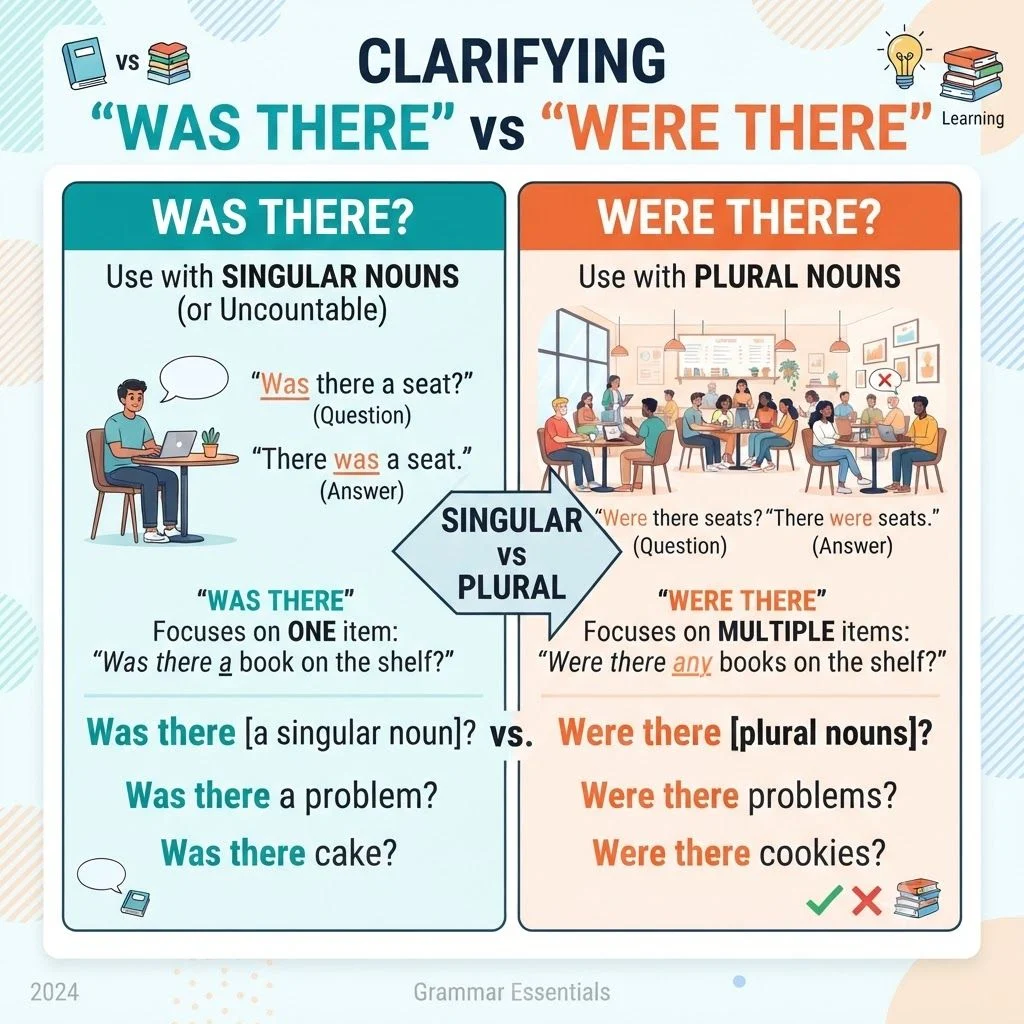
A quick reference summary table provides an easy way to review “was vs were” rules at a glance. It is especially helpful during revision, exams, or quick writing checks when learners need fast decision-making support.
This table combines grammar rules, usage patterns, and examples into one simplified format, making it a powerful tool for improving accuracy and fluency.
- Was → singular subjects, past states, real situations
- Were → plural subjects, group actions, hypothetical cases
- Both → used in questions and negatives depending on subject type
Quotes That Clarify the Concept
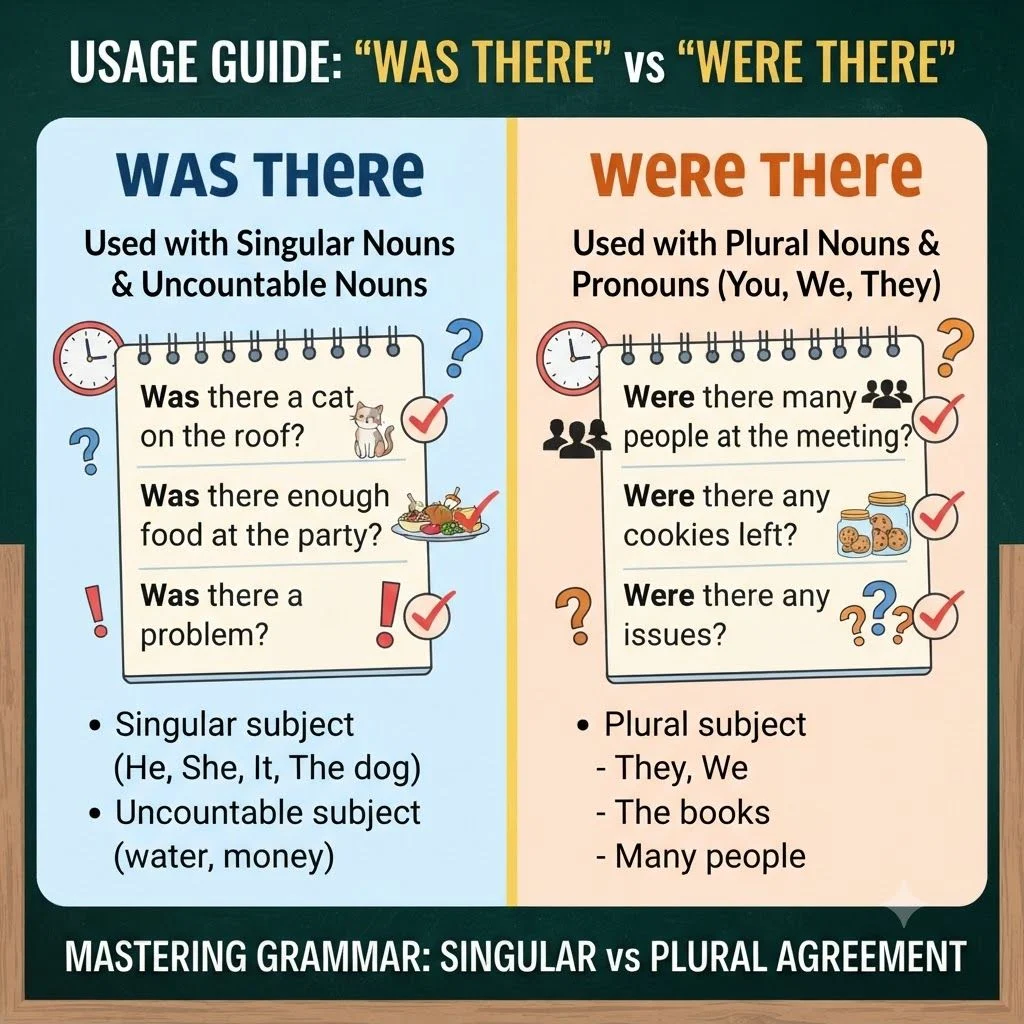
Quotes help simplify complex grammar rules by presenting them in memorable form. They reinforce the idea that correct use of “was there and were there” depends on clarity, number, and context.
- “Correct grammar is not memorization alone; it is understanding how meaning shapes structure.”
- “There was reflects one, but there were reflects many—language follows logic before rules.”
- “In English, clarity begins when the verb agrees with what truly exists in the sentence.”
- “Was there asks about a single presence; were there opens the door to multiples.”
- “Grammar mistakes often come from ignoring context, not from ignoring rules.”
- “Singular thoughts need was; plural realities need were.”
- “The word ‘there’ introduces existence, but the noun decides the verb.”
- “Every sentence has a subject hidden in meaning—find it before choosing was or were.”
- “Hypothetical language bends rules, but it never breaks logic.”
- “Mastering was and were is less about grammar and more about awareness of quantity and reality.”
Frequently Asked Questions
1. What is the basic difference between “was there” and “were there”?
The main difference is based on number agreement. “Was there” is used for singular or uncountable nouns, while “were there” is used for plural nouns. This helps indicate whether one or more things existed in the past.
2. Can “were there” be used with singular subjects?
Yes, but only in hypothetical or unreal situations. In such cases, “were there” follows the subjunctive mood rather than standard grammar rules, especially in conditional or wish statements.
3. Why do we say “was there a problem” and not “were there a problem”?
We use “was there” because “problem” is singular. The verb must agree with the noun that follows “there,” not with the word “there” itself.
4. Is “were there any mistake” correct?
No, it is incorrect. The correct form is “Were there any mistakes?” because “mistakes” is plural, so it requires “were.”
5. What is the role of “there” in these sentences?
In such sentences, “there” is a dummy subject used to introduce existence. The real subject comes after the verb and determines whether “was” or “were” is used.
6. Can we use “was there” in questions?
Yes, “was there” is commonly used in questions when asking about a single thing or situation in the past, such as “Was there a delay?”
7. Why do people get confused between “was there” and “were there”?
Confusion happens because learners mistakenly think “there” is the subject. In reality, the noun after “there” controls the verb form.
8. Is “were there” only used for plural nouns?
Mostly yes, but it is also used in subjunctive or imaginary sentences, where it expresses wishes or hypothetical situations rather than real events.
9. What is a simple rule to remember usage?
A quick rule is: one thing = was there, more than one thing = were there, unreal idea = were there. This helps in fast decision-making.
10. Can “was there” and “were there” be used in formal writing?
Yes, both forms are widely used in formal, academic, and professional writing depending on whether the subject is singular, plural, or hypothetical.
Conclusion
Understanding the difference between “was there” and “were there” is essential for mastering English grammar because it directly affects sentence clarity and correctness. These structures are not just about verb choice—they reflect how we express existence, quantity, and reality in communication. When learners understand the role of singular and plural agreement, they can confidently form accurate sentences in both writing and speech.
In real-world usage, these forms appear in emails, reports, conversations, and academic writing, making them highly practical. Misusing them can lead to confusion, while correct usage strengthens credibility and fluency. With consistent practice and awareness of context, learners can easily avoid common mistakes and improve their overall language precision.

Hi, I am Zadie Smith, the author of Grammargide.com. I write clear, easy-to-understand guides that explain commonly confused words and phrases, helping readers choose the right expression with confidence.