Understanding the difference between Informational vs Informative can improve the way you write, speak, and interpret English. Although these two words look similar and often appear in the same context, they serve different purposes in grammar, vocabulary, and communication. Many learners, students, writers, and professionals search for this comparison because they are unsure which word best fits a sentence. Choosing the correct term helps your writing sound more natural, accurate, and easy to understand in both academic and everyday situations.
The confusion usually comes from the fact that both words relate to information, but their meanings and usage are not identical. Knowing when to use informational instead of informative can strengthen your word choice, improve sentence clarity, and prevent common language mistakes. Whether you’re writing an essay, preparing business content, or improving your English skills, understanding this distinction is an important part of effective communication.
In this guide, you’ll learn the meaning, definition, usage, key differences, common examples, grammar tips, and practical writing advice related to Informational vs Informative. By the end, you’ll know exactly which word to use in different contexts and why the distinction matters. Let’s explore the details.
What Informational vs Informative Really Means
The comparison between Informational vs Informative often confuses English learners because both words come from the noun information. At first glance, they seem interchangeable, but they describe different ideas. The distinction becomes clearer when you look at how each word functions in a sentence.
Informational usually describes something that is created to provide facts, knowledge, or educational material. Informative, on the other hand, describes how useful or valuable that information is to the reader or listener. In simple terms, one focuses on the purpose of the content, while the other focuses on its quality or effectiveness.
For example, a website may publish an informational article, but readers may describe it as informative if it answers their questions clearly. Understanding this difference helps you choose the right adjective in essays, business writing, academic work, and everyday communication.
Informational vs Informative: Core Definitions
Although both words relate to sharing information, they are used differently in English. Learning their core definitions makes it easier to avoid common vocabulary mistakes and write with greater precision.
| Term | Definition | Main Focus |
| Informational | Describes something designed to provide information or facts. | Purpose or function. |
| Informative | Describes something that provides useful, meaningful, or valuable information. | Quality or usefulness. |
A simple way to remember the difference is this:
- Informational = intended to give information.
- Informative = successful at giving useful information.
What “Informational” Means
The adjective informational refers to something whose primary purpose is to share facts, explain concepts, or educate an audience. It describes the type or category of content rather than judging how helpful that content is.
You’ll often see this word used when discussing educational materials, instructional documents, training resources, reference guides, or technical documentation. The word simply tells readers that the material exists to communicate information.
For example:
- An informational brochure explains a company’s services.
- An informational website teaches visitors about a specific topic.
- Schools often provide informational handouts for parents.
In simple words
Think of informational as meaning “made to give information.”
It does not automatically mean the content is interesting, detailed, or helpful. It simply identifies the purpose of the material.
For instance, a pamphlet about recycling is informational because it was created to educate people, even if some readers find it too basic or incomplete.
Where you see informational content
You can find informational content in many everyday situations, including:
- Educational websites.
- School textbooks.
- User manuals.
- Government publications.
- Health awareness brochures.
- Company training materials.
- Research reports.
- Frequently Asked Questions (FAQs).
- Product instruction guides.
- Safety notices.
In each case, the content is intended to inform rather than entertain or persuade.
Example
Here are a few examples of informational used correctly:
- The museum offers informational displays about local history.
- Our company created an informational guide for new employees.
- The website includes informational articles about healthy eating.
- Parents received an informational packet before the school event.
In each sentence, informational describes the type of material being provided.
What “Informative” Means
Unlike informational, the word informative evaluates how well something communicates useful knowledge. If readers or listeners gain valuable insights, they are likely to describe the content as informative.
An informative book, speech, article, or presentation goes beyond simply presenting facts. It explains ideas clearly, answers important questions, and helps the audience understand a topic better. Because of this, informative often expresses a positive opinion about the usefulness of the content.
Examples include:
- The lecture was informative and answered every question.
- I found the article extremely informative.
- Her presentation was short but highly informative.
In simple words
Informative simply means “helpful because it gives useful information.”
It focuses on the reader’s or listener’s experience instead of the purpose of the content itself.
For example, two guides may both be informational, but only one might be considered informative if it explains the topic clearly, includes practical examples, and leaves readers with a better understanding. This subtle difference makes informative the better choice when you want to praise the quality or usefulness of information.
Where you see informative content
You will commonly find informative content anywhere the goal is to help people understand a topic clearly and leave them with useful knowledge. Unlike informational content, which simply exists to provide facts, informative content is valued because it explains ideas in a way that is easy to follow and beneficial to the audience.
Examples of places where you often see informative content include:
- Blog posts that answer common questions in detail.
- Educational videos with clear explanations.
- News articles that provide helpful background and context.
- Classroom lectures that simplify difficult concepts.
- Business presentations that explain strategies effectively.
- Tutorials and how-to guides with step-by-step instructions.
- Product reviews that compare features and offer practical advice.
- Podcasts that teach listeners about a specific subject.
In each case, the content is considered informative because readers or listeners learn something valuable from it.
Example
Here are some examples of informative used correctly in sentences:
- The teacher gave an informative lesson on climate change.
- I found the documentary very informative because it explained the topic with real-life examples.
- Her presentation was both engaging and informative.
- This guide is highly informative for first-time business owners.
- The webinar was short but extremely informative, answering many common questions.
In all of these examples, informative describes the quality and usefulness of the information rather than the type of content itself.
Key Differences Between Informational and Informative
Although informational and informative are closely related, they are not interchangeable. The easiest way to tell them apart is to remember that informational describes the purpose of content, while informative describes its effectiveness. A piece of writing can be informational without being informative if it presents facts but fails to explain them clearly.
| Feature | Informational | Informative |
| Meaning | Intended to provide information. | Provides useful and meaningful information. |
| Focus | Purpose of the content. | Quality and usefulness of the content. |
| Describes | Type of material or resource. | Reader’s or listener’s experience. |
| Tone | Neutral and descriptive. | Often positive and evaluative. |
| Common Use | Brochures, manuals, textbooks, reports. | Articles, presentations, lectures, tutorials. |
| Answers | What is the content designed to do? | How helpful is the content? |
| Example Sentence | The company published an informational guide. | The guide was highly informative and easy to understand. |
A quick memory tip is: Informational describes the content’s purpose, while informative describes the value it delivers.
Informational Texts: Features and Use Cases
An informational text is created to teach, explain, or present factual information about a topic. Its main goal is to increase the reader’s knowledge through accurate, organized, and objective content. These texts are widely used in education, business, healthcare, government, and technical communication because they emphasize facts rather than opinions.
Strong informational texts use logical organization, clear headings, reliable evidence, and straightforward language. They help readers understand subjects without trying to entertain or persuade them. Whether you’re reading a textbook chapter or a product manual, the purpose remains the same—to communicate information effectively.
Core Features of Informational Text
Most informational texts share several important characteristics that make them useful and easy to understand:
- Present accurate and factual information.
- Use a clear and logical structure.
- Include headings and subheadings for easy navigation.
- Explain ideas using examples, definitions, and evidence.
- Maintain an objective and neutral tone.
- Focus on educating rather than persuading.
- Use precise vocabulary appropriate for the audience.
- Support key points with charts, tables, diagrams, or illustrations when needed.
- Answer common questions about a topic clearly.
- Organize information so readers can quickly find what they need.
These features help readers absorb information efficiently while improving comprehension and learning.
Common Formats
You encounter informational texts in many forms throughout daily life. Some of the most common formats include:
- Textbooks and educational materials.
- Encyclopedias and reference books.
- User manuals and instruction guides.
- Research papers and academic articles.
- Government publications and public notices.
- Health and medical information sheets.
- Company policy documents.
- Technical documentation.
- Frequently Asked Questions (FAQs).
- Educational websites and knowledge bases.
Each format serves the same fundamental purpose: to provide clear, accurate, and organized information that helps readers understand a subject or complete a specific task.
Where Informational Texts Fit Best
Informational texts work best when the primary goal is to educate readers with clear, factual, and organized content. They are ideal in situations where people need reliable information instead of opinions, entertainment, or persuasive arguments. Because they focus on accuracy and clarity, they are widely used in educational, professional, and technical settings.
Some of the most common places where informational texts fit best include:
- Schools and universities for textbooks, study guides, and classroom materials.
- Workplaces for employee handbooks, training manuals, and company policies.
- Healthcare for patient guides, medical instructions, and health awareness materials.
- Government agencies for public notices, regulations, and official documents.
- Technical industries for product documentation and user manuals.
- Websites that publish factual articles, FAQs, and educational resources.
In each of these situations, the purpose is to deliver accurate information that helps readers understand a topic or complete a task correctly.
Informative Writing: Purpose, Style, and Characteristics
While informational describes the type of content, informative writing refers to a writing style that helps readers understand a topic clearly and effectively. Good informative writing does more than present facts—it explains ideas, answers questions, and makes complex subjects easier to understand.
Writers achieve this by organizing information logically, using clear language, and providing examples where necessary. The result is content that readers find both useful and easy to follow.
Purpose
The main purpose of informative writing is to educate, explain, and improve understanding. Rather than trying to persuade readers or express personal opinions, informative writing focuses on presenting information in a clear and meaningful way.
Effective informative writing aims to:
- Explain unfamiliar concepts.
- Answer common questions.
- Clarify confusing topics.
- Present facts with context.
- Improve the reader’s knowledge.
- Support learning and informed decision-making.
When readers finish an informative piece, they should feel that they have learned something valuable.
Characteristics of Informative Writing
High-quality informative writing shares several key characteristics that make it effective:
- Uses clear and simple language.
- Presents accurate and well-organized information.
- Maintains an objective and professional tone.
- Includes definitions, examples, and explanations.
- Follows a logical sequence of ideas.
- Avoids unnecessary jargon whenever possible.
- Supports claims with reliable facts or evidence.
- Focuses on reader understanding rather than personal opinion.
- Uses transitions to improve flow between ideas.
- Answers the audience’s most important questions.
These characteristics help readers absorb information quickly and confidently.
Common Formats
You can find informative writing in many forms of communication, including:
- How-to guides.
- Educational blog posts.
- Tutorials.
- News explainers.
- Research summaries.
- Instructional articles.
- Classroom lectures.
- Business reports.
- Training presentations.
- Knowledge-base articles.
Each format is designed to teach, explain, or simplify information so readers can understand the topic more easily.
Read More: Smooth vs Smoothe: Which One Is Correct? 2026
Informational vs Informative in Practice
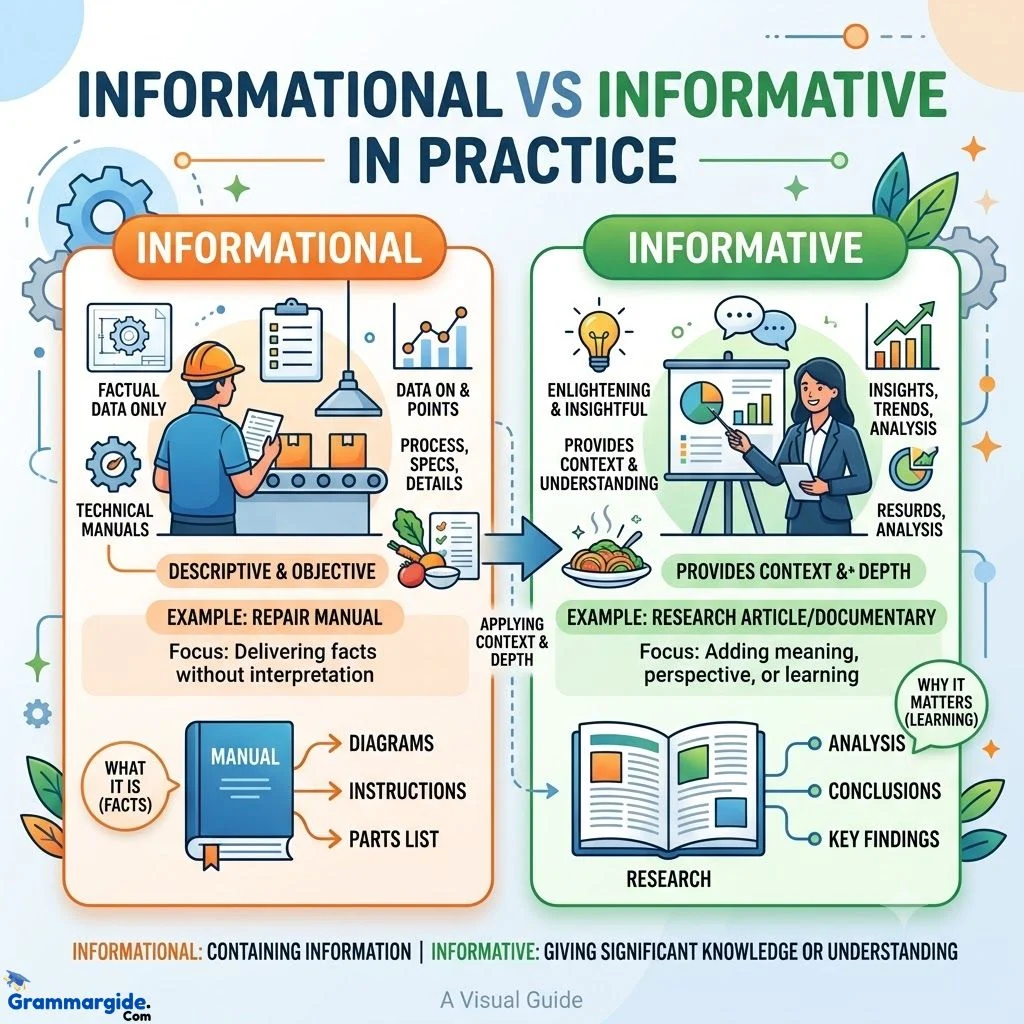
Understanding Informational vs Informative is much easier when you look at how these words are used in everyday situations. Both terms often appear in education, business, marketing, and professional communication, but they describe different aspects of content. Informational identifies content created to provide facts or knowledge, while informative describes content that successfully helps people understand those facts.
In practice, the same piece of content can be both informational and informative. For example, a training manual is informational because its purpose is to teach employees. If employees find it clear, detailed, and easy to follow, they can also describe it as informative.
How Professionals Use Each Type
Professionals choose these words based on what they want to emphasize.
When discussing the purpose of a document, article, or presentation, they usually use informational. When evaluating its quality, usefulness, or clarity, they use informative.
For example:
- “This is an informational report for new employees.”
- “The report was very informative and answered all my questions.”
Using the correct word makes communication more precise and prevents misunderstandings.
Businesses
Businesses regularly create informational materials to educate customers, employees, and partners. These include:
- Employee handbooks.
- Product manuals.
- Company policies.
- Frequently Asked Questions (FAQs).
- Customer support guides.
Customers may describe these resources as informative if they explain products, services, or procedures clearly and help solve problems quickly.
Teachers
Teachers use informational resources such as textbooks, lesson plans, worksheets, and classroom presentations to share knowledge with students.
After a lesson, students often describe the class as informative if the teacher explains concepts clearly, provides useful examples, and helps them understand difficult topics. In this context, informative reflects the effectiveness of the teaching rather than the type of material.
Content Creators
Bloggers, YouTubers, educators, and online publishers often produce informational content to answer common questions and explain specific topics.
Their audience may call the content informative when it:
- Solves a problem.
- Provides practical advice.
- Includes clear explanations.
- Uses real-life examples.
- Answers important questions completely.
Successful content creators aim for their work to be both informational in purpose and informative in value.
Marketers
Marketing teams develop informational content such as buying guides, comparison pages, product descriptions, and educational blog posts to help potential customers make informed decisions.
When this content clearly explains features, benefits, pricing, or usage, readers often consider it informative. This builds trust and improves the overall customer experience before a purchase.
Researchers
Researchers publish informational papers, reports, surveys, and scientific studies to present evidence and share new knowledge.
Fellow researchers, students, and professionals describe these publications as informative when they contain valuable findings, well-supported conclusions, and clear explanations. A research paper may be informational by design, but it earns the label informative only if readers gain meaningful insights from it.
Mistakes Writers Make (and How to Avoid Them)
Even experienced writers sometimes confuse informational and informative writing. The problem usually isn’t grammar—it’s how information is presented. A piece of content may contain accurate facts but still fail to help readers understand the topic. Recognizing these common mistakes can improve your writing, increase clarity, and make your content more useful for your audience.
Mistake 1: Giving only facts when people need explanations
Many writers list facts without explaining what they mean or why they matter. While this creates informational content, it may not be informative because readers are left with unanswered questions.
Instead of presenting facts alone, provide context, definitions, examples, or brief explanations that connect ideas. This approach helps readers understand the information rather than simply reading it.
Less effective:
- Water freezes at 0°C.
More informative:
- Water freezes at 0°C, which is the temperature where it changes from a liquid to a solid under normal atmospheric pressure.
The second example gives readers additional understanding instead of only stating a fact.
Mistake 2: Overexplaining simple facts
Another common mistake is adding unnecessary details to information that readers already understand. Overexplaining can make writing longer without making it more helpful.
Focus on your audience’s knowledge level. Explain unfamiliar concepts thoroughly, but keep well-known facts concise. Good informative writing balances detail with readability.
For example, instead of spending several paragraphs explaining a basic term, move quickly to the information that readers actually need.
Mistake 3: Mixing tones accidentally
A clear tone helps readers understand your message. Writers sometimes switch between an objective, educational style and a personal or persuasive tone without a clear reason. This inconsistency can confuse readers.
If you’re creating informational content, maintain a factual and neutral voice. If you’re writing an informative article, you can still be conversational while remaining accurate and objective. Choose a consistent tone that matches your purpose and audience from beginning to end.
Types of Informative Texts: A Quick Breakdown
Informative writing appears in several different forms, each designed to help readers understand information in a specific way. The following categories are among the most common types used in education, professional writing, journalism, and online content.
Expository
Expository writing explains a topic by presenting facts, definitions, and logical explanations. Its purpose is to educate readers without expressing personal opinions.
Common examples include:
- Encyclopedias.
- Textbooks.
- Educational articles.
- Knowledge-base content.
- Fact sheets.
This type of writing focuses on making complex subjects easier to understand through clear explanations.
Descriptive
Descriptive informative writing explains the characteristics, features, or qualities of a person, object, place, event, or concept. It helps readers build a clear understanding by providing detailed yet factual descriptions.
Examples include:
- Nature guides.
- Product descriptions.
- Museum exhibits.
- Scientific observations.
- Historical descriptions.
The goal is to help readers visualize or understand a subject through accurate details.
Comparative
Comparative writing examines two or more subjects by identifying their similarities and differences. It helps readers evaluate options, understand distinctions, or make informed decisions.
Examples include:
- Product comparisons.
- Grammar comparisons.
- Software reviews.
- Side-by-side feature guides.
- Academic comparison essays.
Articles about Informational vs Informative are a perfect example of comparative informative writing because they explain how two related terms differ.
Procedural
Procedural writing teaches readers how to complete a task by providing step-by-step instructions. It emphasizes clarity, sequence, and practical guidance.
Common examples include:
- User manuals.
- How-to articles.
- Recipe instructions.
- Installation guides.
- Troubleshooting documents.
Good procedural writing uses clear action verbs, logical steps, and simple language so readers can easily follow the process.
Analytical
Analytical writing goes beyond presenting facts by examining evidence, identifying patterns, and explaining relationships between ideas. It encourages readers to understand not just what something is, but why it matters.
Examples include:
- Research analyses.
- Case studies.
- Data interpretation reports.
- Literary analysis.
- Business performance reviews.
Analytical informative writing combines factual information with thoughtful explanation, helping readers develop a deeper understanding of the topic.
Read More: Was There or Were There: Which One Should You Use Correctly?
The Role of Visual Aids in Both Types of Content
Visual aids make both informational and informative content easier to understand. They organize complex ideas, highlight important details, and improve reader engagement. Whether you’re creating educational materials, business documents, or online articles, the right visuals can communicate information faster than text alone.
However, the way visuals are used depends on the purpose of the content. Informational content typically uses visuals to present facts, while informative content uses them to explain ideas and improve understanding.
Visuals for Informational Content
In informational content, visual aids support factual information and make it easier for readers to locate or interpret important details. They help organize content without changing its objective tone.
Common visual aids include:
- Tables.
- Charts and graphs.
- Maps.
- Timelines.
- Flowcharts.
- Diagrams.
- Infographics.
- Labels and illustrations.
For example, an employee handbook may include a flowchart showing the company’s reporting structure, while a science textbook may use diagrams to explain the parts of a plant. These visuals support the content by presenting information in a structured format.
Visuals for Informative Content
In informative content, visuals are used to improve comprehension and make explanations clearer. Instead of simply displaying facts, they help readers understand concepts, relationships, or processes.
Examples include:
- Step-by-step illustrations.
- Before-and-after images.
- Comparison tables.
- Process diagrams.
- Annotated screenshots.
- Educational infographics.
- Concept maps.
For instance, a tutorial explaining how to install software becomes more informative when screenshots guide readers through each step. Likewise, a comparison table can make it easier to understand the differences between Informational vs Informative at a glance.
Why Visual Aids Improve Understanding
Visual aids support learning by presenting information in a clear and organized way. They reduce cognitive effort, improve memory, and help readers understand complex topics more quickly.
Some key benefits include:
- Breaking down difficult concepts into simple visuals.
- Improving information retention.
- Highlighting important details.
- Supporting different learning styles.
- Making long sections of text easier to read.
- Helping readers compare ideas quickly.
- Increasing engagement and comprehension.
When visuals are relevant and well-designed, they strengthen both informational and informative content by making the message clearer and more accessible.
Real-World Examples
Seeing these terms in everyday situations makes the difference between informational and informative much easier to understand. The examples below show how each word is used in real communication.
Informational Examples
The following examples use informational correctly because they describe content created to provide facts or knowledge.
- The hospital distributed an informational brochure about heart health.
- The museum features informational displays beside every exhibit.
- Our company published an informational guide for new employees.
- Students received an informational packet before the field trip.
- The government website provides informational resources about tax regulations.
- The user manual contains informational diagrams for setting up the device.
In each sentence, informational describes the purpose or type of material rather than its quality.
Informative Examples
The following examples use informative correctly because they describe content that readers or listeners found useful and educational.
- The workshop was extremely informative and answered every participant’s questions.
- I found the article very informative because it explained the topic with clear examples.
- Her presentation was both engaging and informative.
- The documentary offered an informative look at marine life.
- The online course was highly informative for beginners.
- Their customer support video was short but surprisingly informative.
In these examples, informative evaluates how helpful and effective the communication was. The focus is not on the type of content, but on the value it provided to the audience.
SEO Angle: Search Intent Behind Both Terms
From an SEO perspective, understanding Informational vs Informative helps you create content that better matches what users and search engines expect. While the two words are closely related in English, they play different roles in search intent, content strategy, and keyword optimization.
Search engines aim to deliver pages that satisfy a user’s question as completely as possible. That means content should not only target the right keyword but also provide the level of explanation users are looking for. Knowing the difference between informational intent and informative content can improve user experience, increase engagement, and support stronger search performance.
How Search Engines Interpret Informational Intent
In SEO, informational intent refers to searches where users want to learn, understand, or find answers rather than buy a product or complete a transaction. Search engines recognize these queries and prioritize pages that provide accurate, trustworthy, and comprehensive information.
Examples of informational search queries include:
- What is informational writing?
- Informational vs Informative.
- How to improve grammar.
- Meaning of informative.
- Difference between informational and educational.
For these searches, Google expects content that:
- Answers the question clearly.
- Explains concepts in simple language.
- Includes examples and definitions.
- Covers related subtopics naturally.
- Demonstrates expertise and accuracy.
Pages that satisfy informational intent are more likely to keep readers engaged and reduce the need for them to continue searching elsewhere.
How Search Engines Interpret Informative Content
While informational intent describes what users are searching for, informative content describes how well a webpage satisfies that need.
Search engines favor content that goes beyond listing facts. An informative page typically:
- Explains ideas clearly.
- Uses logical headings and structure.
- Provides practical examples.
- Answers related questions.
- Covers the topic in sufficient depth.
- Uses clear, reader-friendly language.
- Demonstrates credibility through accurate information.
For example, two articles may target the same keyword. One simply defines the terms, while the other explains their meanings, compares them, includes examples, and answers common questions. The second article is generally more informative because it delivers greater value to readers.
Choosing the Right Keyword Based on Intent
Selecting the right keyword begins with understanding user intent. Every keyword reflects a specific goal, and your content should match that goal as closely as possible.
If users search for “Informational vs Informative,” they are typically looking for:
- A clear comparison.
- Definitions of both words.
- Usage differences.
- Grammar guidance.
- Real-life examples.
- Writing tips.
- Common mistakes.
To meet this intent effectively:
- Use the primary keyword naturally in headings and body content.
- Include related terms such as meaning, difference, usage, examples, grammar, word choice, and English vocabulary.
- Answer common follow-up questions within the article.
- Write for readers first rather than focusing only on keywords.
- Organize information with clear headings, tables, and examples for easy navigation.
When your content aligns with the reader’s search intent and provides genuinely informative explanations, it is more likely to satisfy users, improve engagement, and perform well in search results.
Read More: People Do or People Does: Which One Is Grammatically Correct?
Why People Confuse Informational and Informative
Many people confuse informational and informative because both words come from the noun information and appear in similar contexts. They are also adjectives, which makes them seem interchangeable at first glance. However, they describe different aspects of communication.
The key difference is that informational refers to the purpose of content, while informative refers to its quality or usefulness. A document can be informational simply because it provides facts, but readers will only describe it as informative if those facts are presented clearly and help them understand the topic.
Another reason for the confusion is that both words are commonly used in education, business, journalism, and online content. Learning their distinct meanings helps writers choose the right word with confidence.
Which Term Is More Common in Everyday English?
In everyday conversation, informative is generally more common than informational.
People often use informative when giving opinions about something they have watched, read, or heard. For example:
- “That podcast was really informative.”
- “I found the workshop very informative.”
The word informational appears more often in formal or professional contexts where the focus is on the type or purpose of content.
Examples include:
- Informational brochure.
- Informational website.
- Informational meeting.
- Informational document.
In short:
- Informative is more common in everyday speech.
- Informational is more common in educational, technical, and professional writing.
Informational vs Informative in Academic Writing
Academic writing requires precise vocabulary. Choosing the correct word helps maintain clarity and accuracy.
| Aspect | Informational | Informative |
| Main Purpose | Describes educational or factual material. | Evaluates how useful the material is. |
| Common Usage | Research papers, textbooks, handouts. | Lectures, articles, presentations. |
| Focus | Type of academic resource. | Effectiveness of explanation. |
| Example | An informational textbook on biology. | The textbook was highly informative. |
Informational vs Informative in Business Communication
Businesses use both words regularly, but for different purposes.
| Situation | Informational | Informative |
| Employee handbook | ✔ | |
| Product manual | ✔ | |
| Company policy document | ✔ | |
| Customer feedback | “The manual was very informative.” | |
| Training session | Material is informational. | Session was informative. |
| Business presentation | Presentation contains informational data. | Audience found it informative. |
Informational vs Informative in Digital Marketing
Digital marketers often create content that is informational in purpose while aiming to make it informative for readers.
| Marketing Content | Informational | Informative |
| Blog articles | Provides information. | Explains topics clearly. |
| Buying guides | Educates shoppers. | Helps users make decisions. |
| FAQs | Answers common questions. | Makes answers easy to understand. |
| Product pages | Share product details. | Explain benefits effectively. |
| Tutorials | Teach processes. | Help users complete tasks successfully. |
How to Choose Between Informational and Informative
Choosing the correct word becomes easier if you ask yourself one simple question:
Are you describing the purpose of the content or evaluating its usefulness?
Use informational when discussing the type or function of content.
Use informative when describing how helpful, educational, or valuable the content is.
A quick memory trick:
- Informational = Made to provide information.
- Informative = Successfully provides useful information.
This simple distinction works in almost every writing situation.
When to Use “Informational” Correctly
Use informational when referring to resources, materials, or documents created to communicate facts or knowledge.
Common examples include:
- Informational article.
- Informational brochure.
- Informational website.
- Informational seminar.
- Informational video.
- Informational guide.
- Informational report.
- Informational handout.
In these examples, the word identifies the purpose of the content rather than judging its effectiveness.
When to Use “Informative” Correctly
Use informative when describing content that readers or listeners find useful, educational, or insightful.
Correct examples include:
- The presentation was informative.
- The documentary was very informative.
- I found the article extremely informative.
- Her explanation was clear and informative.
- The workshop provided an informative overview of the topic.
Here, the word evaluates the value the audience received.
Is Informational the Same as Informative?
No. Although the two words are closely related, they are not synonyms.
An informational resource is designed to provide information, but it may not always explain the subject well. An informative resource, however, helps readers understand the topic through clear explanations, useful examples, and logical organization.
Think of it this way:
- Every informative resource shares information.
- Not every informational resource is informative.
This distinction is important for accurate writing and effective communication.
Benefits of Creating Informative Content
Creating informative content benefits both readers and content creators.
Some key advantages include:
- Improves reader understanding.
- Builds trust and credibility.
- Increases audience engagement.
- Encourages longer reading time.
- Answers user questions effectively.
- Demonstrates expertise.
- Supports better learning outcomes.
- Improves user satisfaction.
- Encourages repeat visits to your content.
- Helps establish authority in your subject area.
High-quality informative content focuses on solving problems rather than simply presenting information.
Benefits of Publishing Informational Content
Publishing informational content helps organizations educate their audience and communicate important facts consistently.
Its benefits include:
- Provides accurate information.
- Supports customer education.
- Improves knowledge sharing.
- Reduces confusion.
- Answers frequently asked questions.
- Standardizes communication.
- Supports employee training.
- Creates reliable reference materials.
- Helps readers access factual resources quickly.
- Strengthens educational value.
When well organized, informational content becomes an excellent foundation for informative communication.
How to Make Informational Content More Informative
Simply presenting facts is often not enough. To make informational content more informative, focus on improving understanding rather than increasing word count.
Helpful strategies include:
- Explain why the information matters.
- Add practical examples.
- Define unfamiliar terms.
- Use comparison tables.
- Include diagrams or visuals where appropriate.
- Answer likely follow-up questions.
- Organize content with clear headings.
- Use simple, reader-friendly language.
- Add real-world applications.
- Summarize key takeaways.
These improvements help readers learn more effectively and retain information longer.
Tips for Writing Clear and Informative Content
Clear writing improves communication and makes information easier to understand. Whether you’re writing articles, reports, guides, or educational materials, these best practices can help:
- Know your target audience.
- Use simple and precise language.
- Organize ideas logically.
- Write short, focused paragraphs.
- Explain technical terms when necessary.
- Support ideas with relevant examples.
- Avoid unnecessary repetition.
- Use headings and bullet points for readability.
- Maintain a consistent tone throughout.
- Review and edit for clarity before publishing.
Following these practices will help you create content that is both informational in purpose and genuinely informative for your readers.
Frequently Asked Questions
1. What is the main difference between informational and informative?
The main difference is that informational describes content created to provide facts or knowledge, while informative describes content that successfully helps people understand those facts. In other words, informational refers to the purpose of the content, whereas informative refers to its usefulness.
2. Can something be both informational and informative?
Yes. A piece of content can be both informational and informative. For example, a training guide is informational because it provides information, and it is informative if readers find it clear, helpful, and easy to understand.
3. Which word should I use in academic writing?
Use informational when referring to the type of material, such as an informational report or informational text. Use informative when describing how effective or helpful the material is, such as an informative lecture or informative article.
4. Is informational more formal than informative?
Generally, yes. Informational is more common in academic, technical, educational, and professional writing. Informative appears more frequently in everyday conversation when people describe how useful something was.
5. Are informational and informative synonyms?
No. Although they are closely related, they are not exact synonyms. They have different meanings and should be used according to the context of the sentence.
6. Which word is more common in everyday English?
Informative is more commonly used in daily conversations because people often describe books, videos, presentations, and discussions as informative. Informational is more common when referring to documents or educational resources.
7. How can I remember the difference easily?
A simple trick is:
- Informational = Made to provide information.
- Informative = Provides useful information well.
Remembering this distinction makes choosing the correct word much easier.
8. Can an informational article fail to be informative?
Yes. An article may contain accurate facts and still not be informative if it lacks clear explanations, useful examples, or logical organization. Good informative writing helps readers truly understand the topic.
9. Why does this difference matter in SEO and content writing?
Understanding Informational vs Informative helps writers create content that matches search intent, improves user experience, and answers readers’ questions effectively. Content that is both informational and informative is more likely to satisfy users and perform well in search results.
10. How do I know which word fits my sentence?
Ask yourself what you’re describing. If you’re talking about the purpose of a document or resource, choose informational. If you’re describing how helpful or educational it is, choose informative.
Conclusion
Understanding Informational vs Informative is essential for anyone who wants to communicate clearly and accurately. Although the two words share the same root, they serve different purposes in English. Informational describes content created to provide facts or knowledge, while informative describes content that effectively helps readers or listeners understand those facts.
Using the correct word improves your grammar, vocabulary, and writing skills. Whether you’re creating academic papers, business documents, blog posts, or educational materials, knowing this distinction allows you to choose more precise language and avoid common mistakes. It also helps you produce content that better meets readers’ expectations.
The easiest way to remember the difference is to focus on purpose versus usefulness. If something is designed to share information, it is informational. If it successfully teaches, explains, or adds value, it is informative. Keeping this simple rule in mind will help you write with greater confidence, clarity, and effectiveness in every context.

Hi, I am Zadie Smith, the author of Grammargide.com. I write clear, easy-to-understand guides that explain commonly confused words and phrases, helping readers choose the right expression with confidence.