In everyday writing, choosing the right words helps readers understand your message clearly and avoid confusion. Recurring vs Reoccurring is a common language question because these two terms look and sound similar, but many writers are unsure whether they have the same meaning or when to use each one. Understanding the difference between these words improves accuracy in professional writing, academic communication, and everyday conversations.
While both terms relate to something happening again, their usage can depend on the situation and the meaning a writer wants to express. This article will explain the meaning, differences, correct usage, and examples of recurring and reoccurring to help you choose the right word confidently. You will also learn how these terms function in sentences and how to avoid common word-choice mistakes. Keep reading to discover the simple distinction that makes your writing more precise.
Understanding the Real Difference Between Recurring vs. Reoccurring
The confusion between recurring and reoccurring happens because both words describe something that happens again. They share the same root word, “occur,” which means “to happen,” and both can appear in similar sentences. However, their meanings carry a small but important difference that can affect clarity in writing and communication.
Recurring usually describes something that happens repeatedly, often in a regular pattern or predictable cycle. It suggests that an event, issue, or situation returns again and again over time. For example, a recurring meeting happens on a scheduled basis, while a recurring problem appears repeatedly and may need a long-term solution.
Reoccurring, on the other hand, focuses on something happening again after it has already happened before. It does not always suggest a fixed pattern or regular repetition. An event can be reoccurring without following a clear schedule.
Understanding this distinction helps writers choose the most accurate word for their meaning. In professional documents, academic writing, emails, and everyday conversations, using the right term improves precision and prevents misunderstandings.
Clear Definitions: What Each Word Really Means
Although recurring and reoccurring are often used interchangeably in modern English, their traditional meanings are slightly different. Both words describe repeated events, but the type of repetition they express changes depending on context.
The difference mainly comes from their prefixes. The word recurring comes from “recur,” which means to happen repeatedly or return over time. The word reoccurring comes from “reoccur,” which means to occur again. While these definitions overlap, the idea of repetition is stronger in recurring, whereas reoccurring simply highlights a repeated occurrence.
What “Recurring” Means
Recurring means something that happens repeatedly, especially when it returns regularly or follows a pattern. It often suggests a cycle, routine, or ongoing situation that appears multiple times.
The term comes from the verb “recur,” which has roots in the Latin word recurrere, meaning “to run back” or “return.” Because of this meaning, recurring is commonly used when something comes back repeatedly over a period of time.
Examples of recurring situations include:
- A recurring monthly payment that happens every month.
- A recurring appointment scheduled at regular intervals.
- A recurring theme that appears throughout a book or discussion.
- A recurring issue that keeps creating the same challenge.
In writing, recurring is often the better choice when the repetition is expected, planned, or follows a recognizable pattern. For example:
- Correct: The company reviews its recurring expenses every quarter.
- Correct: She has a recurring meeting with her manager every Monday.
Here, the repeated nature of the event is clear because it happens as part of a regular pattern.
What “Reoccurring” Means
Reoccurring means something happens again after happening once before. It emphasizes the return of an event but does not necessarily suggest a regular schedule or predictable pattern.
The prefix “re-” means “again,” so reoccurring focuses on the idea that something has happened another time. It can describe events that return unexpectedly or without a fixed timeline.
Examples of reoccurring situations include:
- A technical error that appears again after being fixed.
- A memory that comes back from time to time.
- A situation that happens again under similar conditions.
For example:
- Correct: The software issue became a reoccurring problem after the update.
- Correct: The same misunderstanding was reoccurring between the two teams.
In many cases, writers choose reoccurring when they want to emphasize that something happened again rather than highlight a continuous pattern. However, because everyday English often treats the two words as similar, context plays an important role in determining which word sounds more natural.
When choosing between the two, consider the meaning you want to express: use recurring for repeated patterns or cycles, and use reoccurring when you simply mean something happened again.
Root Origins and How These Words Evolved Over Time
Understanding the history behind recurring and reoccurring helps explain why these words have similar meanings but slightly different uses today. Both terms come from the Latin root “currere,” meaning “to run,” and developed through the idea of something coming back or happening again. Their shared history is the main reason many writers confuse them, but their prefixes create a small difference in meaning.
The word parts provide useful clues: “re-” means again, while “cur” in recur relates to returning or coming back repeatedly. Over time, English speakers developed both forms to describe repeated events, situations, and experiences. Learning their origins makes it easier to understand why recurring often suggests a pattern, while reoccurring focuses on something happening again.
Origin of “Recur”
The word “recur” comes from the Latin verb recurrere, which combines “re-” (back or again) with “currere” (to run). The original idea was something that “runs back” or returns.
As the word entered the English language, recur developed the meaning of returning repeatedly. It became commonly used to describe events, thoughts, problems, or situations that appear again and again.
For example:
- A recurring dream returns several times.
- A recurring pattern appears repeatedly in different situations.
- A recurring event follows a repeated schedule.
Because of this history, recurring naturally carries the idea of repetition, continuation, or a cycle. Writers often use it when describing things that happen regularly or appear as part of an ongoing process.
Origin of “Reoccur”
The word “reoccur” developed later by combining the prefix “re-,” meaning again, with the verb “occur,” meaning to happen. Unlike recur, which comes directly from the idea of returning, reoccur simply means that something happens another time.
The word occur comes from the Latin occurrere, meaning “to meet” or “to happen.” When English added the prefix re-, it created reoccur, which emphasizes a repeated occurrence.
Examples include:
- A mistake that happens again after being corrected.
- A situation that appears again unexpectedly.
- An event that returns without a fixed pattern.
Because of its structure, reoccurring does not always suggest regular repetition. It focuses more on the fact that an event happened again rather than showing a predictable cycle.
Why This Matters
Knowing the origins of recurring vs. reoccurring helps writers understand the subtle difference between these commonly confused words. While dictionaries often recognize both terms as valid, choosing the more precise word improves clarity and communication.
Using recurring for repeated patterns and reoccurring for events that simply happen again can make your writing more accurate. This distinction matters in areas like business communication, academic writing, technical documents, and everyday conversations, where small word choices can change how readers interpret meaning.
A strong vocabulary is not only about knowing definitions. It is also about understanding how words developed and how their meanings work in real contexts. By recognizing the history behind these terms, you can make more confident choices when describing repeated events.
The Frequency Distinction: The Key Difference That Changes Everything
The main difference between recurring and reoccurring often comes down to the idea of frequency and repetition patterns. Although both words describe something happening more than once, they do not always express the same type of repetition.
Recurring usually suggests a repeated event that follows a pattern, schedule, or predictable cycle. It often involves something that happens regularly over time. For example, a recurring payment appears every month, and a recurring meeting happens at planned intervals.
Reoccurring, however, focuses on the fact that something happens again. It does not necessarily tell the reader that the event follows a regular pattern. A problem can be reoccurring if it appears multiple times, even when those appearances are unpredictable.
Understanding this frequency difference helps writers select the word that matches their intended meaning. A small change in word choice can affect how readers understand whether something is routine, repeated, unexpected, or simply happening again.
The Big Picture
The easiest way to remember the difference is to focus on the level of repetition being described.
Recurring = repeated in a pattern.
It suggests continuation, regularity, or a cycle. The event returns because it is expected to happen again.
Examples:
- A recurring subscription is charged at regular intervals.
- A recurring appointment happens according to a set schedule.
- A recurring theme appears throughout a story or discussion.
Reoccurring = happening again.
It highlights another occurrence of an event without strongly suggesting a predictable timeline.
Examples:
- A website error that appears again after being fixed is a reoccurring issue.
- A similar situation happening another time may be described as reoccurring.
In many everyday situations, people use these words interchangeably, and the meaning is usually understood from context. However, in professional writing, academic work, and formal communication, choosing the more precise term creates clearer messages.
A simple test can help: ask whether the event follows a pattern. If it happens on a regular basis, recurring is usually the better choice. If you only mean that it happened again, reoccurring may fit better. This frequency-based approach makes the difference between these commonly confused words much easier to understand.
Side-by-Side Usage Comparison
Comparing recurring vs. reoccurring side by side makes their difference easier to understand. Both words describe repeated events, but they focus on different types of repetition. Recurring emphasizes a pattern, routine, or expected return, while reoccurring focuses on something happening again after it occurred before.
| Recurring | Reoccurring |
| Shows repeated events that often follow a pattern. | Shows an event that happens again without requiring a pattern. |
| Often connects with schedules, cycles, or ongoing situations. | Often connects with repeated incidents or unexpected returns. |
| Suggests something is expected to happen again. | Suggests something has happened another time. |
| Common in professional and formal contexts. | Common when describing repeated experiences or situations. |
For example, a recurring monthly report happens according to a planned schedule. However, a reoccurring mistake may happen again after someone fixes it, but it does not necessarily follow a regular timeline.
The best choice depends on the meaning you want to communicate. If the repetition is predictable or organized, recurring usually provides more accuracy. If the focus is simply on another occurrence, reoccurring may be the better fit.
Examples That Show the Difference Clearly
Real-world examples help show how recurring and reoccurring work in different sentences. While both words describe repeated situations, the surrounding context reveals the intended meaning.
Understanding these examples can help writers avoid confusion in emails, reports, articles, conversations, and academic writing. The key is to identify whether the event happens as part of a pattern or simply returns after happening before.
Examples of “Recurring”
Recurring is used when something happens repeatedly, often at predictable times or in a consistent way.
Examples:
- The company tracks its recurring expenses every month.
- She has a recurring appointment with her doctor every Friday.
- The team holds a recurring meeting at the beginning of each week.
- The writer explored a recurring theme throughout the novel.
- The software sends a recurring notification every morning.
- He experiences a recurring problem with the same device.
- The business earns income from recurring customers.
- The manager reviewed the recurring tasks assigned to employees.
In each example, the repetition follows a recognizable pattern. The event does not simply happen again; it returns as part of an ongoing cycle.
Examples of “Reoccurring”
Reoccurring is used when something happens again, especially when the repetition is not clearly scheduled or predictable.
Examples:
- The computer error became a reoccurring issue after the update.
- The same misunderstanding was reoccurring between the two teams.
- A similar problem was reoccurring during the testing process.
- The customer reported a reoccurring complaint about the service.
- The old memory became reoccurring after seeing the photograph.
- The unusual event was reoccurring in different locations.
- The problem was fixed but later became reoccurring.
- The character faced a reoccurring challenge throughout the story.
These examples focus on something returning again rather than following a fixed schedule. The event may happen several times, but the repetition pattern is not the main idea.
When deciding between the two words, consider the message behind the sentence. Use recurring for regular patterns and repeated cycles. Use reoccurring when you simply want to show that something happened again.
Case Studies: Real-World Usage
Understanding recurring vs. reoccurring becomes easier when we see how these words work in real-life situations. Different fields use these terms to describe repeated events, but the intended meaning changes depending on whether the repetition follows a pattern or simply happens again.
In professional communication, choosing the right word can improve accuracy and prevent confusion. A scheduled activity, ongoing process, or predictable cycle usually fits recurring, while an unexpected return of an issue or event may better fit reoccurring.
Case Study 1: Business & Finance
In business and finance, the word recurring is commonly used for predictable financial activities that happen on a regular schedule.
Examples:
- A company tracks its recurring revenue from monthly subscriptions.
- A business reviews recurring expenses such as rent, salaries, and service fees.
- A customer pays a recurring bill every month.
These examples show a clear pattern because the payments or activities happen at expected intervals.
However, reoccurring may describe financial situations that return after appearing earlier but do not follow a fixed schedule.
Example:
- A company experiences a reoccurring financial issue caused by unexpected costs.
The problem happens again, but it does not necessarily occur every month or every quarter.
Case Study 2: Healthcare
In healthcare, both terms can appear when describing symptoms, conditions, or patient experiences.
Recurring is often used when a symptom or condition repeatedly appears in a recognizable pattern.
Examples:
- A patient experiences recurring headaches every few weeks.
- A doctor monitors a recurring condition that requires regular treatment.
- The patient schedules recurring checkups for ongoing care.
Reoccurring may describe symptoms or health-related events that return after improving or disappearing.
Example:
- The patient reported a reoccurring symptom after several months without problems.
The difference depends on whether the focus is on a repeated pattern or simply the return of an earlier issue.
Case Study 3: Technology
In the technology field, these words often describe software problems, updates, tasks, and system behavior.
A recurring issue usually means a problem that appears repeatedly in a predictable way.
Examples:
- The team fixed a recurring server error that happened every night.
- The developer created a solution for a recurring system problem.
- The application sends recurring security updates.
A reoccurring issue refers to a problem that comes back after being resolved.
Example:
- The software bug became a reoccurring problem after the latest update.
Here, the focus is not on a schedule but on the fact that the issue returned.
Case Study 4: Everyday Life
In daily conversations, people often use these words to describe habits, experiences, and personal situations.
Recurring works well for regular activities or repeated experiences.
Examples:
- She has a recurring morning routine.
- He receives recurring reminders on his phone.
- The family has a recurring weekend tradition.
Reoccurring works when something happens again without a clear pattern.
Examples:
- A childhood memory became reoccurring after seeing an old photo.
- The same argument became reoccurring between friends.
- A forgotten task became a reoccurring problem.
These examples show that both words are useful, but the choice depends on the type of repetition. When something follows a cycle, recurring is usually more precise. When something simply happens again, reoccurring may better express the idea.
How Americans Actually Use These Words
In American English, recurring is far more common than reoccurring in everyday writing and professional communication. Many native speakers use recurring as the standard choice when describing something that happens repeatedly, especially when the event involves a pattern, routine, or ongoing situation.
The popularity of recurring comes from its long-established use in areas such as business, healthcare, education, and technology. Americans often use it for scheduled events, repeated challenges, and regular processes because it clearly communicates the idea of something returning over time.
However, reoccurring still appears in American English. It is not considered incorrect, but it carries a slightly different focus. It usually highlights that something has happened again rather than emphasizing a repeated cycle.
Understanding how these words are used in real communication helps writers choose the term that sounds natural while matching the exact meaning they want to express.
Why “Recurring” Dominates
Recurring dominates American usage because it provides a clearer sense of repetition and pattern. It often describes situations that people expect to happen again, making it a natural choice in many formal and informal contexts.
Common examples include:
- Recurring payments for subscriptions or services.
- Recurring meetings that happen on a regular schedule.
- Recurring problems that continue to appear.
- Recurring events that take place every year.
In professional settings, recurring is especially common because organizations often deal with repeated systems and processes. Businesses discuss recurring expenses, recurring customers, and recurring tasks because these activities follow a predictable structure.
The word also appears frequently in writing because it connects well with the idea of consistency. When readers see recurring, they usually understand that the situation is part of a pattern rather than a one-time event.
Does That Make “Reoccurring” Wrong?
No, reoccurring is not wrong. It is a valid English word that means something happens again. The difference is that it usually does not carry the same strong sense of regular repetition as recurring.
For example:
- Recurring: The company has recurring monthly expenses.
(The expenses happen on a predictable schedule.) - Reoccurring: The company faced a reoccurring issue after the system update.
(The issue happened again, but not necessarily on a schedule.)
In many situations, people use these words interchangeably, and the meaning remains clear from context. However, careful writers choose based on the idea they want to express.
Use recurring when describing a pattern, cycle, or regular event. Use reoccurring when focusing on something returning after it happened before. This small distinction can make your writing sound more precise and natural.
When You Should Choose “Recurring”
Choose recurring when you want to describe something that happens repeatedly, especially when it follows a pattern, routine, or expected cycle. This word works best when the repetition is an important part of the meaning.
In professional and everyday communication, recurring often describes planned events, ongoing situations, or repeated experiences that people can predict. It helps readers understand that something returns regularly rather than appearing only once more.
Common situations where recurring is the better choice include:
- Regular payments or financial activities.
- Scheduled meetings or appointments.
- Repeated tasks or responsibilities.
- Ongoing themes, habits, or patterns.
- Problems that continue to appear over time.
For example, a recurring subscription payment tells the reader that the payment happens repeatedly on a set schedule. A recurring issue suggests that the same problem keeps returning and may require a long-term solution.
Examples Where “Recurring” Is Always Right
The following examples show situations where recurring clearly communicates a repeated pattern:
- The company reviews its recurring expenses every month.
- She attends a recurring meeting with her project team every Monday.
- The writer noticed a recurring theme throughout the novel.
- The customer canceled a recurring subscription.
- The doctor monitored the patient’s recurring symptoms.
- The manager created a plan to solve a recurring problem.
- The software performs recurring updates automatically.
- The family enjoys a recurring tradition every holiday season.
In each sentence, the event happens as part of a repeated cycle. The word recurring makes the pattern clear and helps the reader understand the expected repetition.
When “Reoccurring” Is the Correct Fit

Use reoccurring when you want to emphasize that something happens again after it happened before. The focus is on the return of an event, not necessarily on a regular schedule.
Reoccurring is useful when an event, issue, or experience comes back unexpectedly or without a predictable pattern. It often appears when people describe situations that were resolved but later appeared again.
Examples of situations where reoccurring may fit include:
- A technical problem returning after a fix.
- A similar mistake happening again.
- A memory or feeling coming back.
- An unusual event appearing another time.
Although many writers choose recurring in most cases, reoccurring can add a specific meaning when the idea of “happening again” matters more than repetition frequency.
Great Examples
Here are examples where reoccurring fits naturally:
- The software bug became a reoccurring issue after the update.
- The same misunderstanding was reoccurring between the two teams.
- The old memory became reoccurring after seeing the photograph.
- The problem was fixed but became reoccurring a few weeks later.
- The unusual event was reoccurring in different locations.
- The customer reported a reoccurring error during checkout.
- The same challenge became reoccurring throughout the project.
These examples focus on something returning rather than following a fixed pattern. The event happened again, but the timing may be unpredictable.
Read More: Tomatoes or Tomatos: Which Spelling Is Correct?
Quick Memory Trick to Instantly Tell Them Apart
Remembering the difference between recurring and reoccurring becomes easier when you connect each word with a simple idea.
Think about whether the event follows a rhythm, creates a pattern, or appears on a calendar. These clues can help you quickly choose the correct word.
Trick 1: The Rhythm Trick
Think of recurring as having a rhythm.
If something happens again and again in a repeated flow, choose recurring.
Examples:
- A recurring payment.
- A recurring meeting.
- A recurring habit.
The repetition has a steady beat, similar to something that follows a routine.
Trick 2: The Pattern Trick
Ask yourself: “Does this happen in a recognizable pattern?”
If the answer is yes, recurring is usually the right choice.
Examples:
- A recurring problem appears every few weeks.
- A recurring event happens every year.
- A recurring task appears in a regular workflow.
If there is no clear pattern and you only mean “it happened again,” reoccurring may fit better.
Trick 3: The Calendar Trick
Imagine checking a calendar.
If you can mark the event on a calendar because it happens regularly, choose recurring.
Examples:
- Monthly bills are recurring.
- Weekly meetings are recurring.
- Yearly celebrations are recurring.
If the event returns but you cannot predict when it will happen again, reoccurring may be the better choice.
A simple way to remember:
Recurring = returns regularly.
Reoccurring = happens again.
This quick trick helps you choose the right word with confidence in writing and conversation.
Common Phrases Using “Recurring”
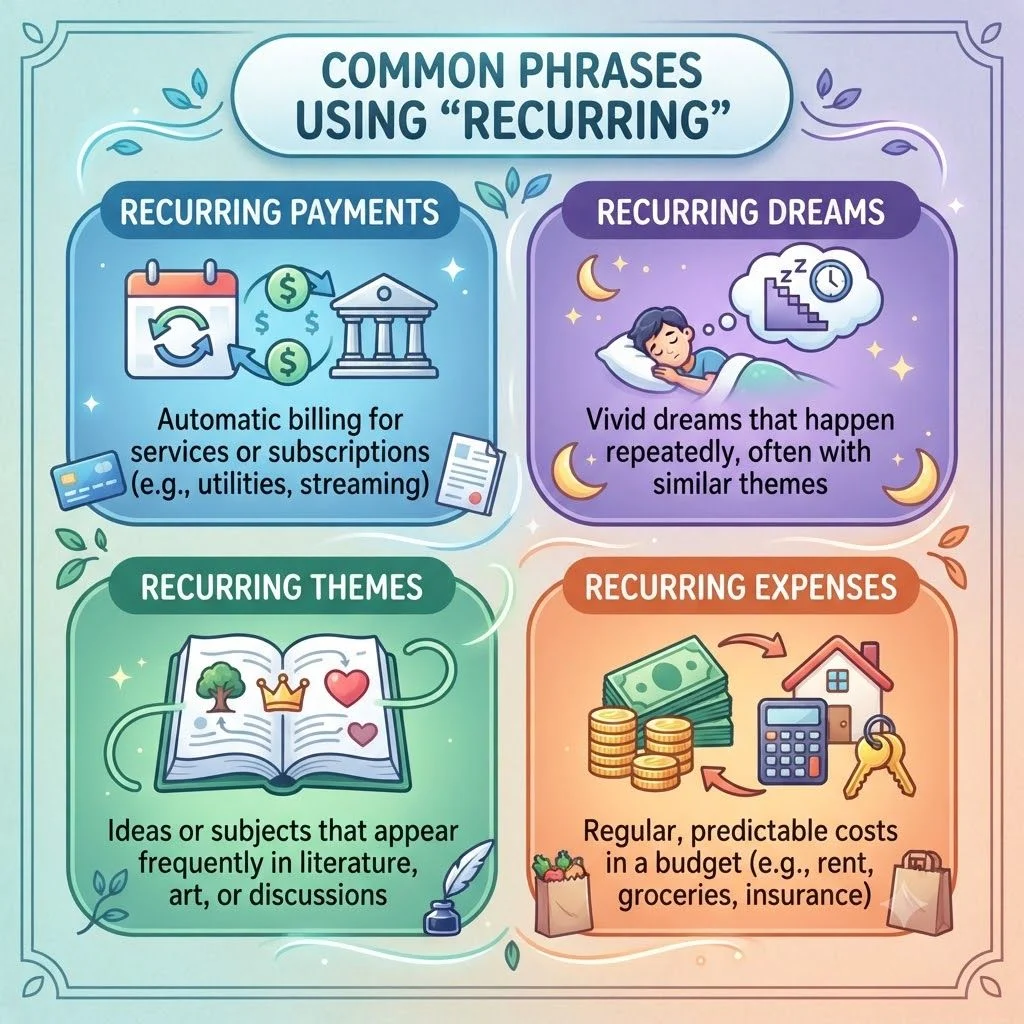
The word recurring appears frequently in English because it describes events, situations, or actions that happen repeatedly in a pattern. It is especially common in business, healthcare, technology, and everyday communication where regular repetition needs to be explained clearly.
Common phrases with recurring include:
- Recurring payment – a payment automatically made at regular intervals, such as a monthly subscription fee.
- Recurring expense – a cost that regularly happens, such as rent, salaries, or service charges.
- Recurring meeting – a meeting scheduled to happen repeatedly at specific times.
- Recurring problem – an issue that keeps appearing and may require a permanent solution.
- Recurring event – an event that takes place repeatedly, such as an annual celebration.
- Recurring theme – an idea or subject that appears multiple times in a story, discussion, or project.
- Recurring customer – a customer who repeatedly purchases products or services.
- Recurring task – a responsibility that needs to be completed regularly.
Examples:
- The company tracks its recurring expenses to manage its budget.
- The team scheduled a recurring meeting every Friday.
- The writer explored a recurring theme throughout the article.
These phrases work well because they describe repeated activities with a clear pattern or expected return.
Common Phrases Using “Reoccurring”
The word reoccurring is less common than recurring, but it still appears when writers want to emphasize that something happened again. It often describes situations, problems, or experiences that return after they were gone.
Common phrases with reoccurring include:
- Reoccurring issue – a problem that appears again after happening before.
- Reoccurring problem – a difficulty that returns but may not follow a fixed schedule.
- Reoccurring error – a mistake or technical issue that happens again.
- Reoccurring event – an event that happens another time.
- Reoccurring symptoms – health signs that return after disappearing.
- Reoccurring pattern – a repeated situation that appears again.
- Reoccurring challenge – a difficulty that comes back over time.
- Reoccurring situation – a circumstance that happens again.
Examples:
- The developer fixed the bug, but it became a reoccurring error.
- The patient experienced reoccurring symptoms after several months.
- The team faced a reoccurring challenge during the project.
While these phrases are grammatically acceptable, many writers prefer recurring when they want to describe repeated patterns or ongoing cycles.
Related Terms: Recurrence vs. Reoccurrence
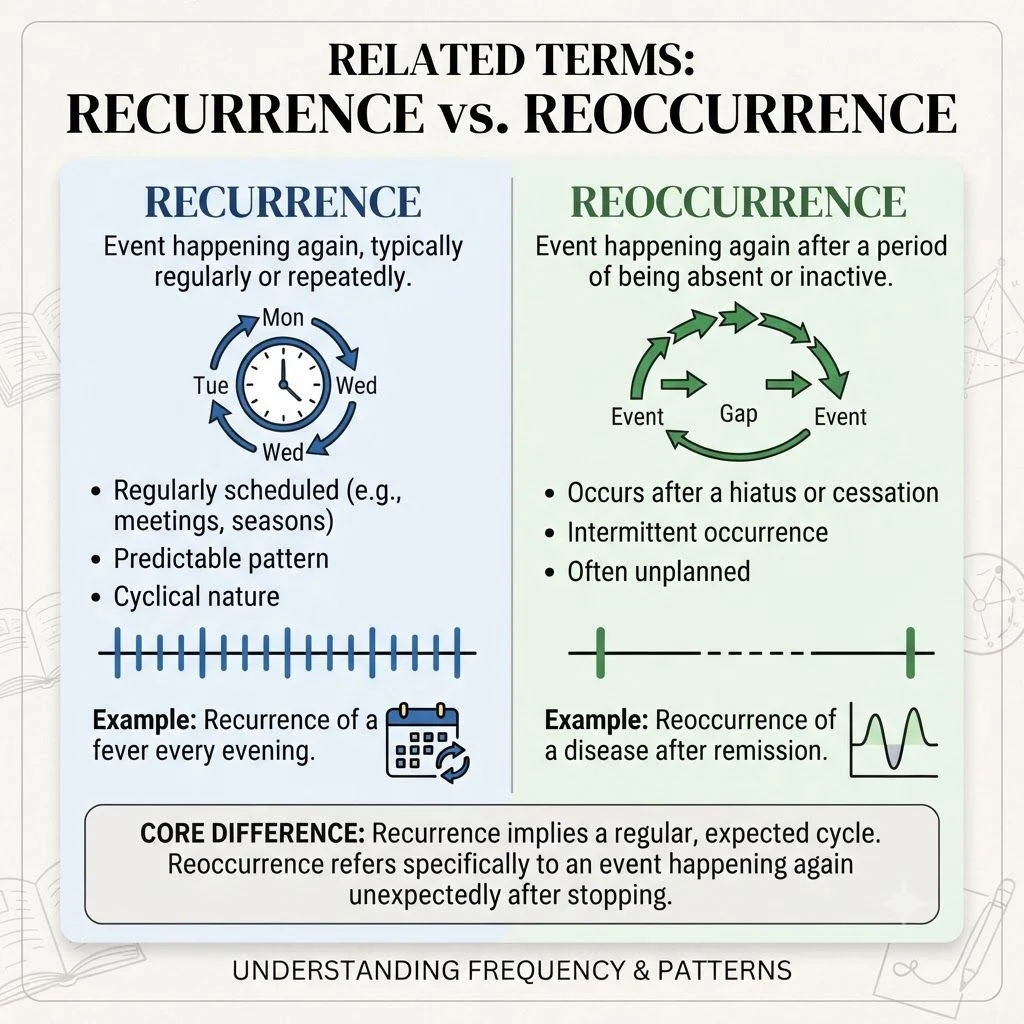
The nouns recurrence and reoccurrence follow the same basic difference as recurring and reoccurring. Both describe something happening again, but they highlight different ideas.
Recurrence focuses on repetition, especially when something returns repeatedly or follows a pattern. Reoccurrence focuses on the fact that something happened again after an earlier occurrence.
Understanding these noun forms can improve vocabulary choices in formal writing, reports, and professional communication.
Recurrence
Recurrence means the repeated appearance or return of something, often with a sense of repetition or continuation. It is commonly used when discussing events, conditions, problems, or ideas that happen more than once.
Examples:
- The doctor monitored the recurrence of the condition.
- The recurrence of the issue suggests a deeper problem.
- The story’s central idea has a strong recurrence throughout the book.
In many contexts, recurrence suggests that something returns as part of a pattern. It is often the preferred term in academic, medical, and technical writing.
Reoccurrence
Reoccurrence means that something occurs again after happening previously. It focuses more on another occurrence rather than a repeated cycle.
Examples:
- The reoccurrence of the error affected the system’s performance.
- The team investigated the reoccurrence of the problem.
- The unexpected reoccurrence of the event surprised everyone.
Although reoccurrence is a valid word, it is used less often than recurrence in many formal contexts.
Comparison Table
| Term | Meaning | Main Focus | Example |
| Recurring | Happening repeatedly over time. | Pattern, routine, or cycle. | The company has recurring monthly expenses. |
| Reoccurring | Happening again after a previous occurrence. | Another appearance or return. | The error became a reoccurring issue. |
| Recurrence | The act of happening repeatedly. | Repeated return or pattern. | The recurrence of the problem required action. |
| Reoccurrence | The act of happening again. | A repeated occurrence. | The reoccurrence of the mistake caused delays. |
The easiest way to remember the difference is that recurrence and recurring usually connect with patterns, while reoccurrence and reoccurring simply highlight something happening again. Choosing the right form helps make your writing clearer and more precise.
Read More: Appreciative Of vs Appreciative For: Which One Is Correct? 2026
Common Misconceptions and Clarifications
The similarity between recurring and reoccurring creates several common misunderstandings among English learners and even experienced writers. Since both words describe something happening again, many people assume they are completely interchangeable. However, the small difference in meaning can affect clarity, especially in formal writing, professional communication, and academic contexts.
Understanding these distinctions helps you choose the word that best matches your intended meaning. While everyday speakers may use both terms casually, knowing the difference between a repeated pattern and a simple return allows for more precise language use.
Can “reoccurring” be used instead of “recurring”?
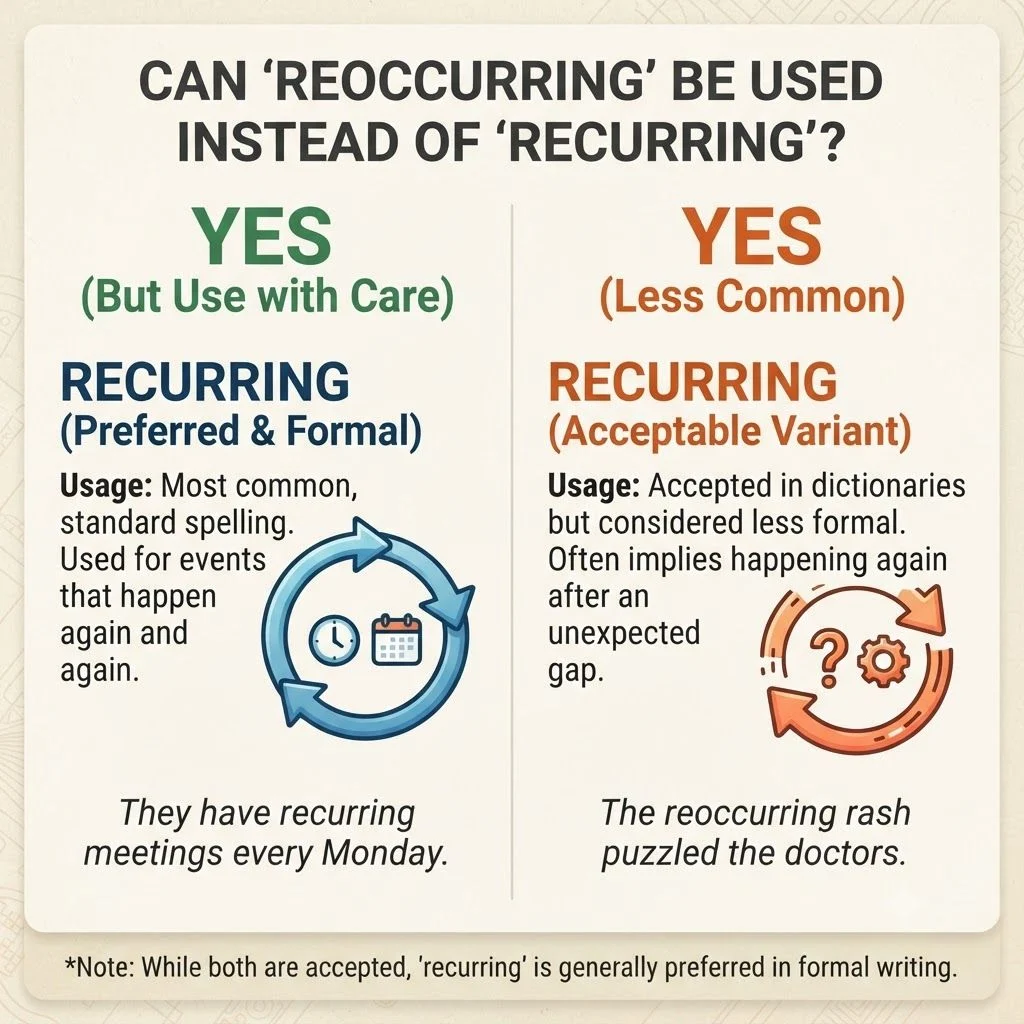
Yes, reoccurring can sometimes be used instead of recurring, but the meaning may slightly change. Both words describe repeated events, and many readers will understand the intended message from context.
However, recurring is usually the better choice when something happens regularly or follows a predictable pattern.
Examples:
- Recurring: The company has a recurring monthly payment system.
(The payment follows a regular schedule.) - Reoccurring: The company experienced a reoccurring payment issue.
(The payment problem happened again.)
Using reoccurring for a scheduled or repeated cycle may sound less natural to many readers. When describing routines, patterns, or ongoing processes, recurring is often the clearer option.
Is “reoccur” a real word?
Yes, reoccur is a real English word. It means to occur again after happening before. The word combines the prefix “re-”, meaning “again,” with “occur,” meaning “to happen.”
Examples:
- The same error may reoccur after a system update.
- The problem continued to reoccur despite several fixes.
- Similar events can reoccur in different situations.
Although reoccur is correct, it is less common than recur in many types of writing. Writers often choose recur when they want to emphasize repetition or a pattern.
Are there British vs. American differences?
There is no major British English vs. American English rule that separates these words. Speakers in both varieties of English use recurring and reoccurring, and both forms are considered understandable and acceptable.
The main difference comes from usage preference, not geography. In both British and American writing, recurring appears more frequently because it naturally describes repeated events, cycles, and regular activities.
For example, writers in both regions commonly use:
- Recurring payment
- Recurring meeting
- Recurring issue
- Recurring theme
The choice depends more on meaning and context than on the type of English being used.
Can something be both Recurring and Reoccurring?
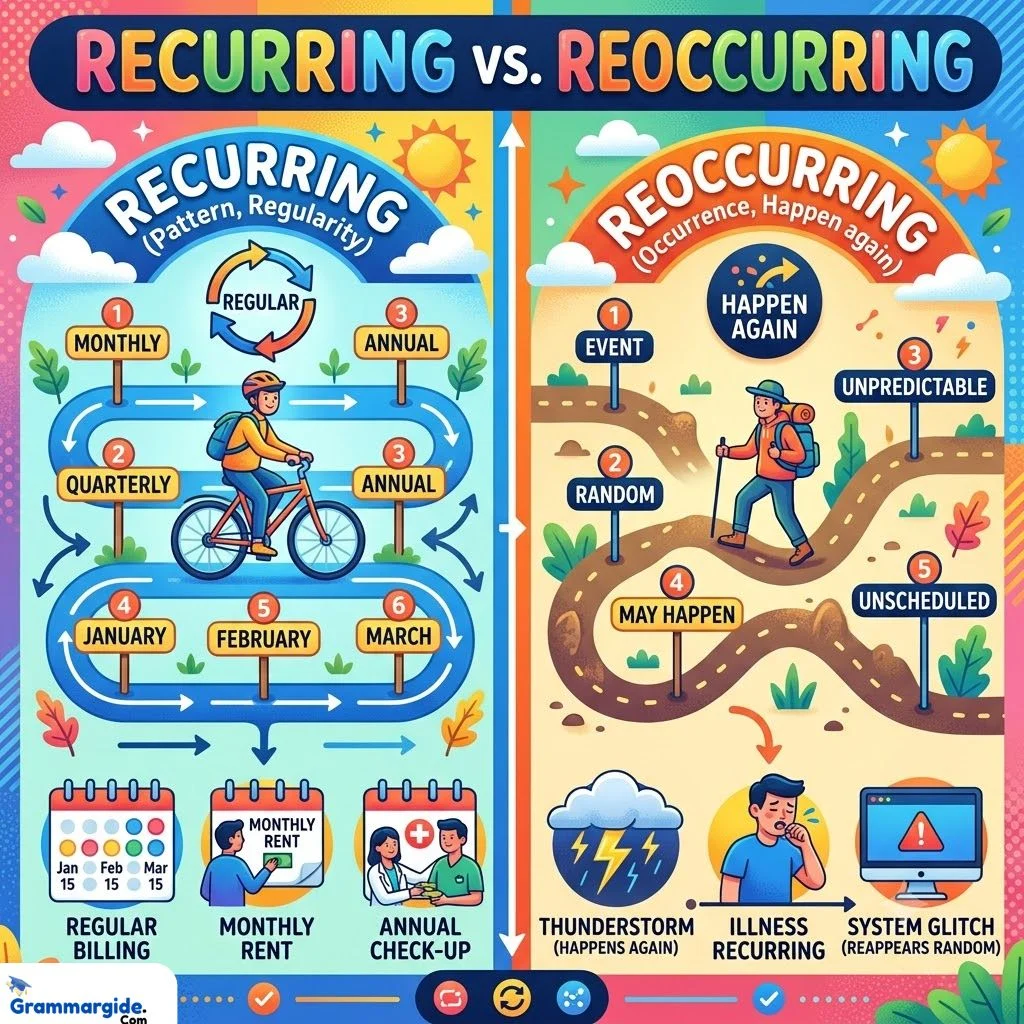
Yes, in some situations, something can be described as both recurring and reoccurring because both words involve repetition. The difference depends on which part of the event you want to emphasize.
For example, a technical problem may be:
- Recurring because it keeps appearing repeatedly over time.
- Reoccurring because it has happened again after being fixed.
However, using both words in the same sentence is usually unnecessary because it can create confusion. Most writers choose the term that best matches their intended meaning.
A helpful way to decide is:
- Use recurring when the focus is on a repeated pattern or regular cycle.
- Use reoccurring when the focus is on something happening again.
Choosing the more precise word makes your writing clearer and helps readers understand exactly what you mean.
The Safer Choice for Most Writing
When you are unsure whether to use recurring or reoccurring, recurring is usually the safer choice for most types of writing. It is more common, widely recognized, and naturally fits situations where something happens repeatedly or follows a pattern.
Writers often choose recurring in professional documents, academic writing, business reports, and everyday communication because it clearly expresses repeated events. Terms like recurring payment, recurring problem, recurring meeting, and recurring event are familiar to most readers.
Examples:
- The company identified a recurring issue in its customer service process.
- She manages several recurring tasks each week.
- The report highlights recurring trends in consumer behavior.
While reoccurring is correct and has a place in English, it may sound less natural in many situations. If you want your writing to be clear and widely accepted, especially in formal contexts, recurring is often the better option.
A simple guideline:
Choose recurring for repeated patterns.
Choose reoccurring when you specifically mean something happened again.
Grammar Rules Behind Recurring and Reoccurring
The difference between recurring and reoccurring comes from how each word is formed and what meaning its structure creates.
Recurring comes from the verb recur, which means “to happen repeatedly” or “to return again and again.” The word usually suggests repetition over time, often with some level of predictability.
Examples:
- The company has a recurring monthly charge.
- The writer noticed a recurring idea throughout the article.
Reoccurring comes from reoccur, which combines “re-” (again) with “occur” (to happen). It means that something happens again after it occurred previously.
Examples:
- The software error became reoccurring after the update.
- The same issue was reoccurring during testing.
From a grammar perspective, both words are acceptable. The main difference is not correctness but meaning and usage. Choosing the right word depends on whether you want to emphasize a repeated pattern or simply another occurrence.
Pronunciation Differences Between Recurring and Reoccurring
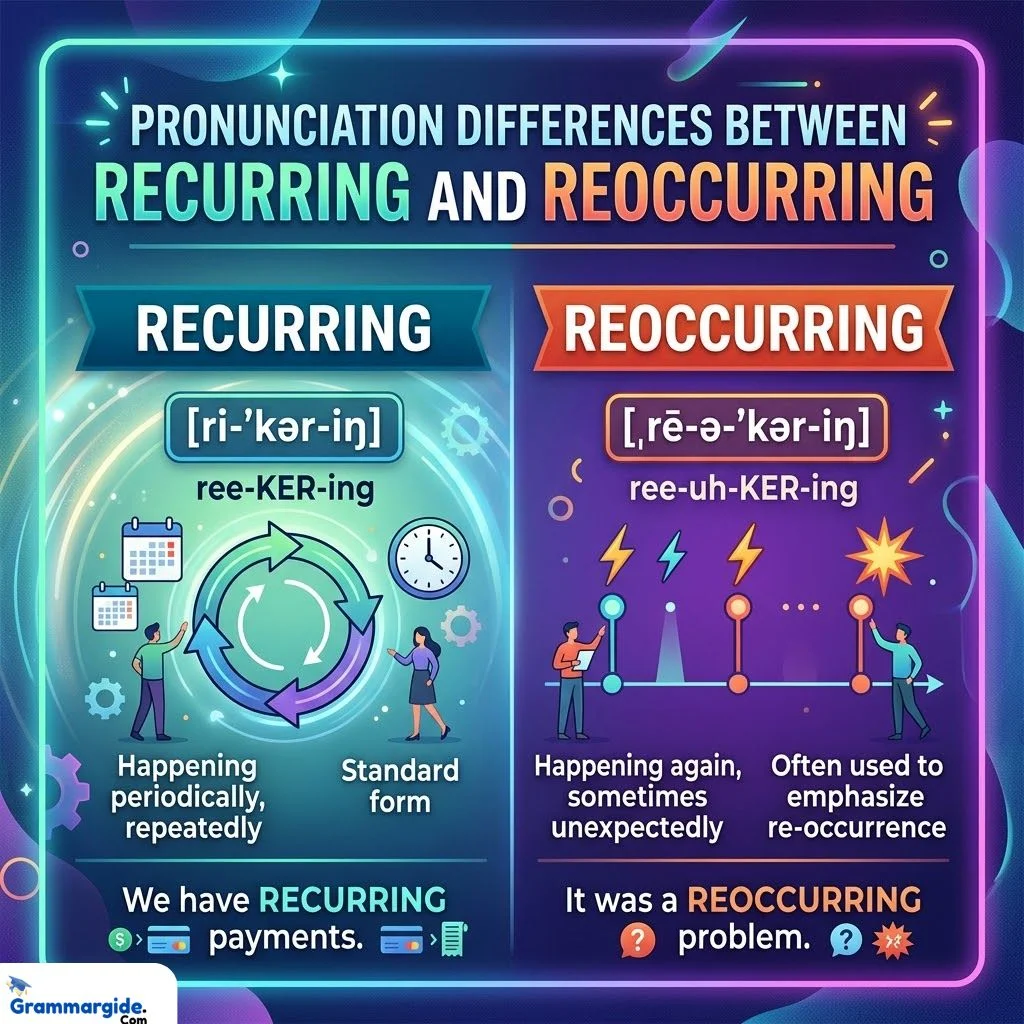
The pronunciation of recurring and reoccurring is similar because both words come from the same root idea of something happening again. However, the number of syllables and stress placement create a noticeable difference.
Recurring has fewer syllables and a smoother rhythm.
Reoccurring has an extra syllable because of the added prefix “re-.”
Knowing the pronunciation difference can help speakers use these words confidently in conversations, presentations, and professional settings.
How to Pronounce “Recurring”
Recurring (ri-KUR-ing)
Recurring is pronounced as ri-KUR-ing.
The stress falls on the second syllable: CUR.
Breakdown:
- Re → sounds like “ri”
- cur → sounds like “kur” and receives the main stress
- ring → sounds like “ing”
Example sentence:
- The company has a recurring meeting every Monday.
The strong middle sound helps distinguish recurring from similar words.
How to Pronounce “Reoccurring”
Reoccurring (ree-uh-KUR-ing)
Reoccurring is pronounced as ree-uh-KUR-ing.
It contains an extra sound because it combines re + occurring.
Breakdown:
- Re → sounds like “ree”
- oc → sounds like “uh”
- cur → sounds like “kur” and receives the main stress
- ring → sounds like “ing”
Example sentence:
- The technical problem became reoccurring after the system change.
The main pronunciation difference is that reoccurring has an extra “uh” sound, while recurring moves more quickly from the opening sound to the stressed syllable.
Read More: Driver’s License vs Drivers License: Which Is Correct? 2026
Recurring and Reoccurring in Professional Writing
In professional writing, choosing between recurring and reoccurring can affect how clearly readers understand repeated events, processes, and issues. Both words are acceptable, but they communicate slightly different ideas.
Professionals often prefer recurring because it clearly describes regular activities, ongoing patterns, and predictable events. It works well in business communication, reports, and formal documents where accuracy and clarity matter.
Reoccurring is useful when a writer wants to highlight that something happened again after appearing before. It often describes repeated problems, unexpected events, or situations that return without a fixed schedule.
Using the right term helps readers quickly understand whether something follows a pattern or simply happened another time.
Emails and Workplace Communication
In workplace emails, word choice needs to be clear and direct. Recurring is commonly used when discussing schedules, responsibilities, payments, and routine activities.
Examples:
- Please review the recurring tasks assigned to your department.
- The team will discuss this issue during the recurring weekly meeting.
- We need to update the list of recurring expenses.
These examples show activities that happen regularly and are expected to continue.
Reoccurring may appear when discussing problems or situations that return after being solved.
Examples:
- The software issue is becoming a reoccurring problem.
- We noticed a reoccurring error in the customer support system.
In workplace communication, using recurring for regular processes and reoccurring for returning issues helps avoid confusion and makes messages more precise.
Reports and Business Documents
Business reports often describe trends, costs, operations, and performance patterns. In these contexts, recurring is usually the preferred choice because many business activities happen in cycles.
Common examples include:
- Recurring revenue from subscriptions or repeat customers.
- Recurring costs such as rent, salaries, and service fees.
- Recurring activities included in operational plans.
Example:
- The financial report analyzes the company’s recurring revenue streams.
This tells readers that the revenue continues regularly over time.
On the other hand, reoccurring may describe issues that appear again during business operations.
Example:
- The company investigated a reoccurring system failure affecting customers.
Here, the focus is on the return of the problem rather than a planned business cycle.
Academic and Formal Writing
In academic and formal writing, precision is especially important because word choice can influence how readers interpret information. Writers often choose recurring when discussing repeated concepts, patterns, research findings, or themes.
Examples:
- The study identified a recurring pattern in participant behavior.
- The author explored a recurring theme throughout the research paper.
- Researchers observed recurring trends across multiple studies.
These examples describe repetition that appears consistently.
Reoccurring can also be used in formal writing when the meaning focuses on something happening again.
Example:
- The researchers examined the reoccurrence of errors during the experiment.
However, many academic writers prefer recurring because it often sounds more natural when describing repeated patterns or findings.
For professional and formal communication, a useful rule is simple: choose recurring for established patterns and repeated cycles, and choose reoccurring when emphasizing that something happened again after an earlier occurrence.
Common Sentence Mistakes With Recurring and Reoccurring
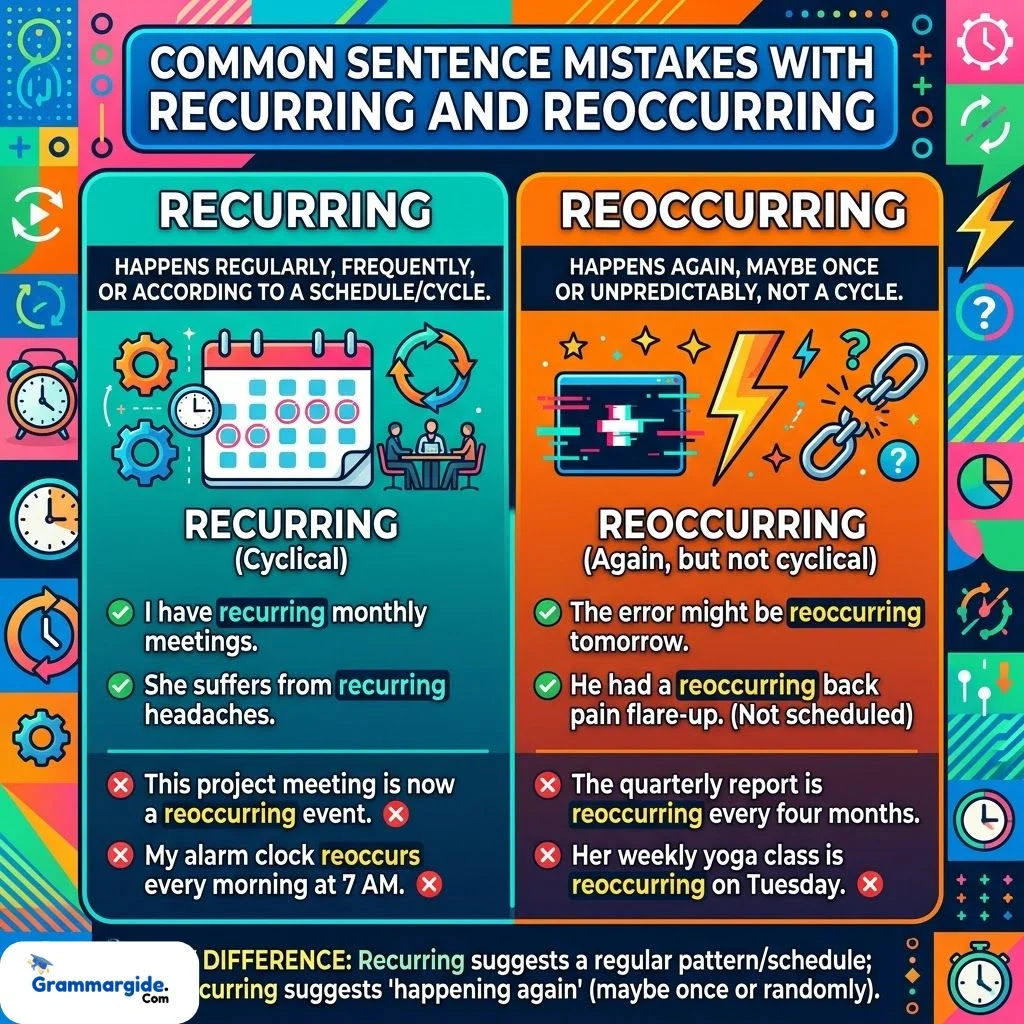
Because recurring and reoccurring look and sound similar, many writers treat them as complete synonyms. While both words relate to something happening again, they do not always express the same idea. The main difference comes from the type of repetition being described.
Understanding common mistakes helps writers make better word choices in emails, articles, reports, academic work, and everyday conversations. The goal is not to avoid one word completely but to understand when each term creates the clearest meaning.
Mistake 1: Using Them as Exact Synonyms
A common mistake is assuming recurring and reoccurring always mean exactly the same thing. Although both words describe repeated events, recurring usually highlights a pattern, while reoccurring focuses on something happening again.
Incorrect approach:
- The company has a reoccurring monthly payment.
While readers may understand the meaning, recurring monthly payment sounds more natural because the payment follows a fixed schedule.
Better:
- The company has a recurring monthly payment.
Another example:
- The team discussed a recurring issue that appeared every week.
Here, recurring works because the issue follows a repeated pattern.
Choosing the word based on meaning rather than similarity makes writing more accurate and professional.
Mistake 2: Ignoring the Idea of Repetition
Another mistake is using these words without considering how the repetition happens. Writers sometimes focus only on the fact that something happens more than once and ignore whether it follows a pattern.
For example:
- The employee reported a recurring error after the update.
This sentence works if the error appears repeatedly as part of an ongoing pattern.
However:
- The employee reported a reoccurring error after the update.
This may be better if the focus is that the error returned after it was fixed.
Before choosing the word, ask:
Does this happen regularly or in a cycle?
→ Use recurring.
Did this simply happen again?
→ Use reoccurring.
Thinking about the type of repetition leads to clearer communication.
Mistake 3: Choosing the Longer Word Automatically
Some writers assume that reoccurring is more accurate because it is longer and includes the prefix “re-,” meaning again. However, a longer word does not always provide a better meaning.
For example:
- The company schedules a reoccurring meeting every Monday.
This sentence is understandable, but recurring meeting is the more natural choice because the meeting follows a regular schedule.
Better:
- The company schedules a recurring meeting every Monday.
The extra letters in reoccurring do not make it more formal or correct. The best word is the one that matches the intended meaning.
A simple reminder:
Recurring = repeated pattern.
Reoccurring = happens again.
Choosing based on meaning instead of word length helps create clearer and more effective writing.
Read More: A MA or An MA: Which Article Is Correct? 2026
Expert Tips for Choosing the Right Word
Choosing between recurring and reoccurring becomes easier when you focus on the meaning behind the repetition. Instead of selecting a word based only on appearance or length, consider what you want your reader to understand.
Both words are correct, but the best choice depends on the situation. Recurring usually describes something that returns in a pattern, while reoccurring highlights something happening again after it happened before.
These simple strategies can help you make the right choice in emails, articles, reports, and everyday conversations.
Think About the Pattern
The first question to ask is: “Does this happen in a predictable pattern?”
If the answer is yes, recurring is usually the better choice. This word works well for events, tasks, payments, and situations that happen regularly.
Examples:
- A recurring payment is charged every month.
- A recurring meeting happens every Monday.
- A recurring issue appears repeatedly during a process.
These examples show a clear cycle or routine.
If the event does not follow a predictable schedule but simply appears again, reoccurring may be more suitable.
Example:
- The software error became reoccurring after the update.
The error returned, but it was not necessarily part of a regular pattern.
Focus on the Meaning
The most important factor is the meaning you want to communicate. Ask yourself whether you are describing a repeated pattern or a returning event.
Use recurring when you mean:
- Something happens regularly.
- Something continues to return over time.
- Something follows a cycle or routine.
Use reoccurring when you mean:
- Something happened again.
- Something returned after disappearing.
- Something repeated without a fixed schedule.
For example:
- The company has a recurring problem with late payments.
(The problem happens repeatedly.) - The company faced a reoccurring problem after changing its system.
(The problem returned again.)
Paying attention to the meaning behind the sentence helps you avoid word-choice mistakes.
Consider Your Audience
Your audience also matters when choosing between recurring and reoccurring. In professional and formal writing, readers often expect clear and familiar wording.
Because recurring is more common, it is usually the safer choice when writing for a broad audience. It appears frequently in:
- Business documents.
- Academic papers.
- Workplace emails.
- Technical reports.
- Marketing content.
For example:
- The company analyzes recurring revenue every quarter.
Most readers immediately understand that this refers to regular income.
Reoccurring can still be appropriate when the meaning requires emphasis on something happening again.
Example:
- The team investigated a reoccurring system failure.
Choosing the right word based on your audience helps your writing sound more natural, accurate, and professional. When in doubt, choose the word that best explains the type of repetition you mean.
Frequently Asked Questions
1. What is the main difference between recurring and reoccurring?
The main difference between recurring and reoccurring is the type of repetition they describe. Recurring usually means something happens repeatedly in a pattern, cycle, or regular schedule. Reoccurring means something happens again after it happened before, but it does not always suggest a predictable pattern.
2. Is recurring more common than reoccurring?
Yes, recurring is much more common in everyday and professional English. Writers often use it for regular events, payments, meetings, problems, and patterns because it clearly communicates repeated activity.
3. Is reoccurring a correct English word?
Yes, reoccurring is a correct English word. It means that something happens again after a previous occurrence. However, it is less commonly used than recurring, especially in formal and professional writing.
4. Can I use recurring and reoccurring interchangeably?
Sometimes you can use them interchangeably because both words relate to repeated events. However, they do not always create the same meaning. Recurring emphasizes a repeated pattern, while reoccurring emphasizes that something happened again.
5. Should I use recurring or reoccurring for a monthly payment?
The correct choice is recurring because a monthly payment follows a regular schedule. Common phrases like recurring payment and recurring charge describe automatic payments that happen at set intervals.
6. Is a recurring problem different from a reoccurring problem?
Yes, there is a slight difference. A recurring problem usually means an issue that repeatedly appears as part of a pattern. A reoccurring problem focuses more on an issue returning after it happened before.
7. Which word should I use in business writing?
In most business writing, recurring is the better choice. It is commonly used for financial terms, schedules, tasks, and ongoing processes because it sounds clear and professional.
8. Do British and American English use recurring and reoccurring differently?
There is no major British and American English difference between these words. Speakers in both forms of English use recurring and reoccurring, but recurring is generally more common in both varieties.
9. How can I remember the difference between recurring and reoccurring?
A simple memory trick is:
Recurring = repeated pattern.
Reoccurring = happens again.
If something follows a cycle or routine, choose recurring. If something simply returns after happening before, reoccurring may fit better.
10. Is recurring always the safer choice?
In most situations, yes. Recurring is widely accepted and works well for repeated events, regular activities, and ongoing patterns. However, reoccurring is still useful when you want to highlight that something happened again without focusing on a predictable cycle.
Conclusion
Understanding the difference between recurring and reoccurring helps you make clearer word choices in writing and conversation. Although both terms describe something happening more than once, they highlight different types of repetition. Recurring focuses on patterns, routines, and predictable cycles, while reoccurring focuses on something happening again after a previous occurrence.
In most professional, academic, and everyday writing situations, recurring is the more common and safer choice. It naturally fits phrases like recurring payments, recurring meetings, recurring issues, and recurring themes. However, reoccurring remains a correct option when the meaning centers on the return of an event rather than a regular pattern.
By focusing on the context and the type of repetition you want to describe, you can confidently choose the right word. A small difference in wording can make your communication more precise, natural, and easier for readers to understand.

Hi, I am Zadie Smith, the author of Grammargide.com. I write clear, easy-to-understand guides that explain commonly confused words and phrases, helping readers choose the right expression with confidence.