Clear communication often depends on choosing the right words, especially when small grammar differences can change how a sentence sounds. Me Too vs Me As Well vs I As Well is a common point of confusion for English learners because these phrases can seem interchangeable, but they do not always work in the same situations. Understanding their correct usage helps you express agreement naturally in conversations, writing, and professional communication.
Many people struggle with knowing when to use “me too,” “me as well,” or “I as well” because the choice depends on sentence structure, tone, and grammatical role. This guide explains the meaning, differences, and proper usage of each expression with clear examples. You will learn how these phrases function in everyday English and how to avoid common mistakes. Continue reading to discover the simple rules that make choosing the correct expression easier.
Understanding “Me Too,” “Me as Well,” and “I as Well”
“Me too,” “Me as well,” and “I as well” are expressions used to show agreement, similarity, or that the speaker shares the same feeling, action, or experience as someone else. Many English learners find these phrases confusing because they all communicate a similar idea: “the same is true for me.” However, their grammar, tone, and placement can differ depending on the situation.
The main difference comes from how each phrase functions in a sentence. “Me too” is the most common expression in everyday conversations, while “me as well” often sounds slightly more formal or complete. On the other hand, “I as well” follows a different grammatical pattern and usually needs to connect with a verb or a larger sentence structure.
Understanding these differences helps you choose the right expression for casual conversations, written communication, workplace discussions, and academic settings. Using the correct phrase makes your English sound more natural and confident.
“Me Too”: Meaning, Usage, and Real-Life Examples
“Me too” is one of the most common ways to express agreement in English. It means “I also feel the same,” “I also do that,” or “the same applies to me.” People use it when they want to quickly respond to a statement and show that they share the same experience, opinion, or situation.
This phrase usually appears as a short response in conversations. It does not require a complete sentence because the meaning is already understood from the previous speaker’s words. For example, if someone says, “I love reading books,” another person can simply reply, “Me too.” The listener understands that the second person also loves reading books.
Although “me too” is grammatically short, it is widely accepted in modern English because language often allows shorter forms in informal communication. It appears frequently in spoken English, text messages, social media conversations, and friendly discussions.
What “Me Too” Really Means
“Me too” means “I do too” or “I am too,” depending on the sentence it responds to. It shows that the speaker has the same feeling, action, opinion, or condition as another person.
The phrase works because the missing words are understood from the conversation. This makes communication faster and more natural. Instead of repeating the entire sentence, speakers use “me too” to show agreement clearly and efficiently.
However, “me too” is mainly used as a response phrase. It usually does not replace a full sentence in formal writing where complete grammatical structures are preferred.
Examples
Here are some everyday examples of “me too” in different situations:
Casual conversation:
- “I enjoy listening to music while working.”
- “Me too.”
Sharing feelings:
- “I’m nervous about the presentation.”
- “Me too.”
Talking about activities:
- “I play basketball on weekends.”
- “Me too.”
Agreeing with an opinion:
- “I think this book is interesting.”
- “Me too.”
Text message example:
- “I miss our old school days.”
- “Me too!”
In each example, the phrase replaces a longer response. Instead of saying “I also enjoy listening to music” or “I also miss our old school days,” the speaker uses the shorter and more natural expression.
Standalone Nature of “Me Too”
One important feature of “me too” is that it can stand alone as a complete response. The phrase does not need additional words because the context provides the missing information.
For example:
- “I love coffee.”
- “Me too.”
The second speaker does not need to repeat “I love coffee.” The listener already understands the connection.
This standalone use makes “me too” especially common in spoken English. It creates a quick and friendly way to participate in conversations. It also works well in informal digital communication, such as chats, comments, and messages.
However, when writing formal emails, reports, or academic content, replacing “me too” with a complete sentence can sound more professional. For example:
- Informal: “I agree with this idea. Me too.”
- Formal: “I agree with this idea as well.”
The choice depends on the audience, purpose, and level of formality.
Read More: Recurring vs Reoccurring Which One Is Correct? 2026
Formality Level of “Me Too”
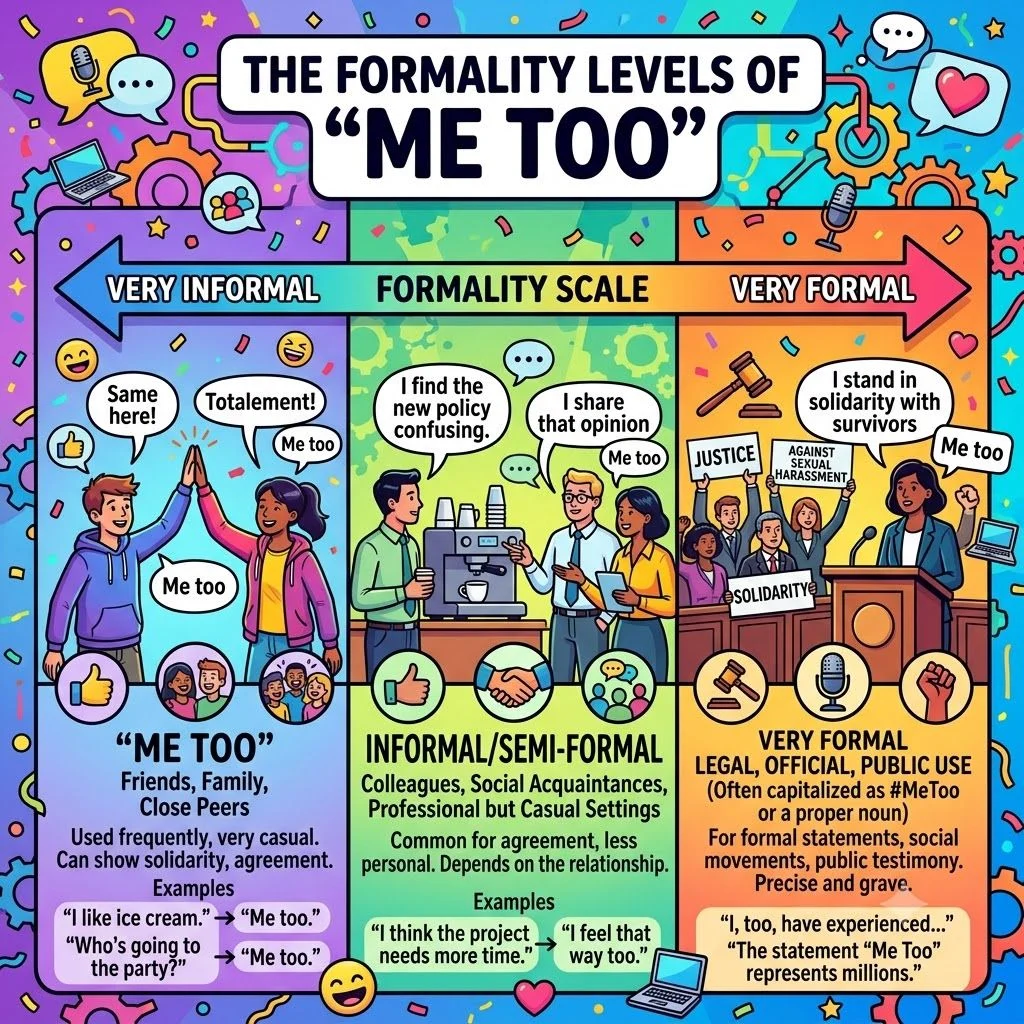
“Me too” is considered an informal expression. It sounds natural in everyday conversations, friendly discussions, and casual messages. Native English speakers commonly use it when talking with friends, family members, or coworkers in relaxed situations.
Examples of suitable situations:
- Conversations with friends.
- Social media replies.
- Casual workplace discussions.
- Personal messages.
However, it may sound too relaxed in highly formal contexts. In professional writing, presentations, or academic communication, alternatives like “I agree as well,” “I also share this view,” or “I have the same opinion” may create a more polished tone.
The phrase itself is not incorrect. It simply carries a conversational style. Understanding the difference between informal and formal language helps you communicate more effectively with different audiences.
“Me as Well”: Correct, Clear, and Slightly More Formal
“Me as well” is another way to express agreement and show that the speaker shares the same action, feeling, or experience as someone else. Like “me too,” it means “I also do that,” “I feel the same,” or “the same applies to me.” The main difference is that “me as well” often sounds a little more complete and slightly more formal.
This phrase commonly appears after a statement when the speaker wants to add themselves to the same situation. It works well in conversations where the tone is polite, professional, or less casual. While “me too” feels quick and conversational, “me as well” can sound more careful and structured.
For example:
- “I would like to join the meeting.”
- “Me as well.”
Here, the second speaker means they would also like to join the meeting.
Although “me as well” is grammatically acceptable, it is less common than “me too” in everyday speech. Many native speakers choose it when they want their response to sound a little more thoughtful or when the conversation has a slightly formal tone.
What “Me as Well” Means
“Me as well” means “I also” or “I too.” It shows that the speaker has the same experience, preference, action, or opinion mentioned by another person.
The word “as well” works as an agreement marker that adds the speaker to the same group or situation. For example:
- Person A: “I am interested in learning Spanish.”
- Person B: “Me as well.”
The meaning is: “I am interested in learning Spanish as well.”
Another example:
- Person A: “I will attend the conference tomorrow.”
- Person B: “Me as well.”
The meaning is: “I will attend the conference tomorrow too.”
In many cases, “me as well” appears as a shortened version of a longer sentence. The complete meaning remains clear because the previous statement provides the context.
Examples
Here are some examples showing how “me as well” works in different situations:
Professional conversation:
- “I think we should review the project again.”
- “Me as well.”
Talking about plans:
- “I’m going to visit the new office.”
- “Me as well.”
Sharing interests:
- “I enjoy watching documentaries.”
- “Me as well.”
Agreeing with an experience:
- “I had trouble understanding that topic.”
- “Me as well.”
Polite conversation:
- “I hope you have a great weekend.”
- “Me as well.”
In each example, “me as well” communicates agreement without repeating the complete sentence. It allows speakers to respond clearly while keeping the conversation smooth.
When Native Speakers Use “Me as Well”

Native speakers use “me as well” less frequently than “me too,” but it still appears in many natural situations. People often choose it when they want a response that feels slightly more polite, deliberate, or formal.
For example, in workplace communication, a person may prefer:
- “I would like to be included in this discussion.”
- “Me as well.”
This can sound more professional than the very casual “me too.”
Native speakers may also use “me as well” when the original sentence already has a formal tone:
- “I appreciate your support.”
- “Me as well.”
However, in everyday friendly conversations, many people naturally choose “me too” because it feels shorter and more common.
The choice between these phrases often depends on tone, audience, and situation. Neither phrase is wrong, but understanding the context helps you sound more natural.
“Me Too” vs “Me as Well”
“Me too” and “me as well” have almost the same meaning, but they differ in tone and frequency. Both expressions show agreement, but “me too” is more common in casual English, while “me as well” can sound slightly more formal or intentional.
| Expression | Meaning | Common Use | Tone |
| Me too | I also do/feel the same | Everyday conversations, chats, informal speech | Casual and friendly |
| Me as well | I also do/feel the same | Polite conversations, workplace situations | Slightly more formal |
Both phrases can be correct depending on the context. The important point is choosing the expression that matches the situation.
For example:
- Casual: “I love this song.” → “Me too.”
- Polite: “I would like to participate.” → “Me as well.”
Using “me too” in a formal situation may sound too relaxed, while using “me as well” in a casual chat may sound slightly more careful than necessary.
Example Comparison
Comparing both expressions side by side makes the difference easier to understand:
Example 1: Sharing an interest
Person A: “I enjoy cooking.”
- Person B: “Me too.”
(Very common and casual.) - Person B: “Me as well.”
(Correct but slightly more formal.)
Example 2: Discussing plans
Person A: “I am attending the workshop tomorrow.”
- Person B: “Me too.”
(Natural in everyday conversation.) - Person B: “Me as well.”
(Polite and clear.)
Example 3: Workplace setting
Person A: “I believe we need more time to complete this task.”
- Person B: “Me too.”
(Acceptable but informal.) - Person B: “Me as well.”
(Sounds more suitable for a professional discussion.)
The meaning stays similar, but the feeling changes. “Me too” creates a relaxed connection, while “me as well” adds a slightly more polished tone. Understanding this small difference helps you communicate more naturally in both personal and professional situations.
“I as Well”: Why It’s Considered Incorrect
“I as well” is a common phrase that English learners use when they want to say they also share the same feeling, action, or experience. However, in most situations, using “I as well” by itself is considered incorrect or unnatural because it does not follow standard English sentence structure.
The confusion happens because learners see phrases like “me too” and “me as well” and assume that replacing “me” with “I” creates another correct option. While “I” is the correct subject pronoun in many sentences, it cannot usually stand alone with “as well” to express agreement.
For example:
- Incorrect: “I as well.”
- Correct: “Me as well.”
- Correct: “I do as well.”
The key difference is that “I” usually needs a verb or a complete sentence structure, while “me” can function naturally in this short response pattern. Understanding this grammar rule helps avoid a common mistake in spoken and written English.
The Core Grammar Problem
The main grammar issue with “I as well” is that “I” is a subject pronoun, not an object pronoun. In English, subject pronouns usually perform an action and need to connect with a verb.
Examples of subject pronouns:
- I like coffee.
- I am excited.
- I will attend the event.
In contrast, “me” is an object pronoun that can appear in short agreement phrases:
- “I like coffee.”
- “Me too.”
- “Me as well.”
When someone says “I as well,” the listener expects more information because the phrase feels incomplete. The word “I” needs a verb to show what the speaker also does, feels, or experiences.
For example:
❌ “I as well.”
✅ “I like coffee as well.”
✅ “I do as well.”
The problem is not the word “as well” itself. The issue is using it with a subject pronoun without completing the sentence.
Read More: A MA or An MA: Which Article Is Correct? 2026
Why Learners Use “I as Well”
Many English learners use “I as well” because they try to apply a simple pattern from other agreement expressions. Since they know that “I” means themselves, they assume it should replace “me” in every situation.
Another reason is that learners often focus on meaning rather than grammatical function. The expressions:
- “Me too.”
- “Me as well.”
- “I as well.”
may seem similar because all three appear to mean “the same applies to me.” However, English grammar does not always allow direct word replacement.
The phrase “I as well” also feels logical because people hear correct sentences like:
- “I also agree.”
- “I as well agree.” (rare and unnatural in modern English)
This can create confusion about where “also” and “as well” should appear. In natural English, “also” usually comes before the main verb, while “as well” often appears at the end of a complete sentence.
Understanding sentence structure makes it easier to choose the correct form.
Correct Alternatives to “I as Well”
Instead of saying “I as well,” choose an expression that includes the necessary grammar structure. The correct alternative depends on the verb used in the original sentence.
If the speaker uses “am”
When the original statement uses “am,” respond with a phrase that includes the same verb.
Example:
Person A: “I am tired.”
Correct responses:
- “I am too.”
- “I am as well.”
Incorrect:
- “I as well.”
Here, “I am” is needed because “am” carries the meaning of the sentence.
If the speaker uses “do”
When the original sentence uses an action verb, “do” can replace the repeated action.
Example:
Person A: “I enjoy reading.”
Correct responses:
- “I do too.”
- “I do as well.”
Incorrect:
- “I as well.”
The word “do” acts as a helping verb that completes the response while avoiding unnecessary repetition.
If the speaker uses “will”
For future actions, include “will” in the response.
Example:
Person A: “I will join the meeting.”
Correct responses:
- “I will too.”
- “I will as well.”
Incorrect:
- “I as well.”
Using “will” keeps the sentence structure complete and clearly shows that the same future action applies to the speaker.
If the speaker uses “can”
When the original sentence expresses ability or possibility with “can,” repeat the modal verb.
Example:
Person A: “I can help you.”
Correct responses:
- “I can too.”
- “I can as well.”
Incorrect:
- “I as well.”
Modal verbs like can need to stay connected with the subject to create a complete grammatical response.
If the speaker uses “have”
When the original statement uses “have,” keep the same structure in the reply.
Example:
Person A: “I have finished my work.”
Correct responses:
- “I have too.”
- “I have as well.”
Incorrect:
- “I as well.”
Using the complete structure makes the meaning clear and follows standard English grammar rules.
Choosing between these alternatives depends on the verb in the original sentence. The easiest way to avoid “I as well” is to remember that “I” usually needs a verb, while “me too” and “me as well” can work as standalone agreement responses.
Popularity Comparison: Me as Well vs I as Well
When comparing “me as well” and “I as well,” the difference is not only about popularity but also about grammatical correctness. “Me as well” is a recognized English expression used to show agreement, while “I as well” usually sounds incomplete and unnatural when used alone.
Native speakers commonly use “me as well” in situations where they want to add themselves to the same action, feeling, or opinion. For example:
- “I enjoyed the movie.”
- “Me as well.”
The phrase works because “me” fits naturally in this short response structure.
On the other hand, “I as well” is rarely used as a standalone phrase because “I” requires a verb or a complete sentence structure. A native speaker would normally say:
- “I do as well.”
- “I agree as well.”
- “I will as well.”
rather than simply saying “I as well.”
| Phrase | Usage | Naturalness | Example |
| Me as well | Shows agreement or shared experience | Natural and acceptable | “I like this idea.” → “Me as well.” |
| I as well | Usually incomplete without a verb | Unnatural as a standalone phrase | “I as well” ❌ |
The key lesson is that “me as well” works as a short agreement response, while “I as well” needs additional words to become grammatically complete.
Case Studies: Real-Life Usage
Understanding how these phrases appear in real situations makes the difference easier to remember. The correct choice often depends on the communication setting, audience, and level of formality.
In everyday English, people usually choose short agreement expressions that sound natural and easy. However, in professional or academic situations, speakers often use complete sentences to maintain clarity and a polished tone.
The following examples show how “me as well” works in different communication environments and why “I as well” often needs correction.
Case Study 1: Workplace Email
In workplace emails, clear and professional language is important. While short expressions like “me too” may appear in casual team messages, a more complete structure often sounds better in formal communication.
Example:
Email message:
“ I will review the updated document before Friday.”
Possible reply:
- “I will as well.” ✅
- “I will do the same.” ✅
- “Me as well.” ⚠️ (acceptable but less formal)
- “I as well.” ❌
In a workplace email, using a complete sentence creates a more professional impression. The phrase “I will as well” works because the verb “will” completes the structure.
Professional writing usually avoids incomplete responses because readers may need clear information without relying heavily on conversational context.
Case Study 2: Casual Conversation
Casual conversations allow shorter and more relaxed expressions. In these situations, “me too” is usually the most common choice, while “me as well” can also work.
Example:
Friend A: “I love watching football.”
Friend B:
- “Me too.” ✅
- “Me as well.” ✅
- “I as well.” ❌
Here, the short response is understood because the previous sentence provides the missing information.
In friendly conversations, people often choose the easiest and quickest expression. This is why “me too” appears more frequently than “me as well” in everyday speech.
Case Study 3: Professional Meeting
Professional meetings require clear communication and appropriate language. Speakers often avoid incomplete phrases and choose responses that sound confident and precise.
Example:
Manager: “I believe we should improve our customer support process.”
Employee:
- “I agree as well.” ✅
- “I think so too.” ✅
- “Me as well.” ⚠️
- “I as well.” ❌
Although “me as well” is understandable, professional settings often benefit from complete statements. Adding a verb creates a stronger and more polished response.
Using the right structure helps speakers communicate ideas effectively and avoid sounding like they are translating directly from another language.
Case Study 4: Social Media Post
Social media communication is usually informal, so shorter expressions are common. Users often respond quickly with phrases that show agreement or shared feelings.
Example:
Post: “I can’t wait for the weekend!”
Comments:
- “Me too!” ✅
- “Same here!” ✅
- “Me as well!” ✅
- “I as well!” ❌
On social platforms, people prefer natural and quick responses. “Me too” fits this environment because it is short, familiar, and widely understood.
Although “me as well” is correct, it may sound slightly more formal than needed for a casual comment.
Case Study 5: Classroom Interaction
In classroom discussions, students need to balance natural conversation with correct grammar. Teachers often encourage learners to use complete sentences when practicing English.
Example:
Teacher: “I think this topic is interesting.”
Student responses:
- “Me too.” ✅
- “I think so too.” ✅
- “I find it interesting as well.” ✅
- “I as well.” ❌
For beginner learners, “me too” is often the easiest correct response. As students develop stronger grammar skills, they can use longer forms such as “I agree as well” or “I feel the same way.”
Learning these differences helps students move from simple agreement phrases to more accurate and natural English communication.
Read More: Driver’s License vs Drivers License: Which Is Correct? 2026
Comparison Table: Me Too vs Me as Well vs I as Well
Understanding the difference between “Me Too,” “Me as Well,” and “I as Well” becomes easier when you compare their meaning, grammar role, and common usage. Although all three expressions relate to agreement, they do not function in the same way.
| Expression | Meaning | Grammar Use | Commonness | Example |
| Me Too | I also feel, do, or experience the same thing | Standalone agreement phrase | Very common in casual English | “I love this movie.” → “Me too.” |
| Me as Well | I also share the same action, feeling, or opinion | Standalone agreement phrase with a slightly formal tone | Less common but correct | “I want to join.” → “Me as well.” |
| I as Well | Attempts to show agreement but usually incomplete alone | Needs a verb or complete sentence structure | Rare and usually incorrect as a standalone phrase | “I as well” ❌ |
The main difference is the role of the pronoun. “Me” can naturally appear in short agreement responses, while “I” usually needs a verb to complete the meaning.
Compare:
- “I am interested in this topic.” → “Me too.” ✅
- “I am interested in this topic.” → “Me as well.” ✅
- “I am interested in this topic.” → “I as well.” ❌
To use “I” correctly, add the missing verb:
- “I am as well.” ✅
- “I do as well.” ✅
- “I agree as well.” ✅
Knowing this difference helps you sound more natural in conversations, writing, and professional communication.
How to Choose the Right Expression
Choosing between “me too,” “me as well,” and “I as well” depends on the sentence structure, communication setting, and level of formality. The easiest way is to look at the original statement and decide whether you need a short agreement phrase or a complete sentence.
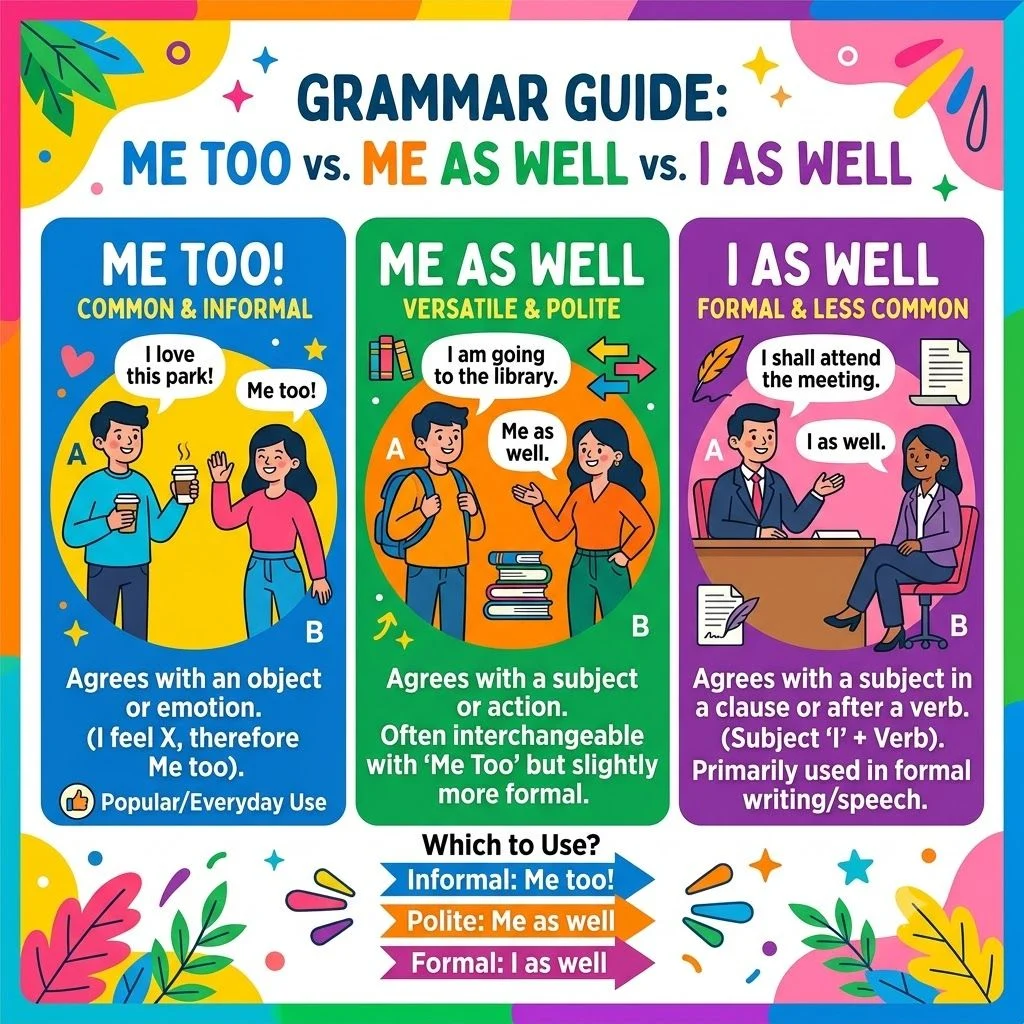
If you are replying quickly in a casual conversation, “me too” is usually the best option. If you want a slightly more polished response, “me as well” can work. However, if you want to use “I,” make sure you include the correct verb.
Use “Me too” when:
Use “me too” when you want a simple, natural, and informal way to show agreement.
It works best in:
- Everyday conversations.
- Text messages.
- Social media replies.
- Friendly discussions.
Examples:
- “I love traveling.”
- “Me too.”
- “I’m excited for the weekend.”
- “Me too.”
“Me too” is popular because it is short, clear, and instantly understood. It allows speakers to avoid repeating the full sentence while keeping the conversation smooth.
Use “Me as Well” when:
Use “me as well” when you want to express the same idea but with a slightly more careful or polite tone.
It can fit in:
- Professional conversations.
- Polite discussions.
- Situations where you want a softer response.
Examples:
- “I would like to attend the event.”
- “Me as well.”
- “I appreciate your help.”
- “Me as well.”
Although it is correct, many native speakers still prefer “me too” in casual situations because it sounds more natural and common.
Avoid “I as Well” unless:
Avoid using “I as well” as a standalone response because it usually sounds incomplete. The pronoun “I” needs a verb or additional words to create a complete grammatical structure.
Incorrect:
- “I as well.” ❌
Better:
- “I do as well.” ✅
- “I agree as well.” ✅
- “I will as well.” ✅
- “I am as well.” ✅
You can use “I” with “as well” when the sentence already contains the necessary verb. The problem is not the word “as well”; the issue is leaving the sentence unfinished.
Quick rule of thumb:
Remember this simple rule:
Use “me too” for quick agreement.
Use “me as well” for a slightly more formal agreement.
Use “I as well” only when a verb completes the sentence.
A quick test can help:
- Can you say only “Me too”? → Yes, it works. ✅
- Can you say only “Me as well”? → Yes, it works. ✅
- Can you say only “I as well”? → Usually no, add a verb. ❌
Following this rule will help you avoid one of the most common mistakes with agreement expressions in English.
Frequently Asked Questions
1. Is “Me Too” grammatically correct?
Yes, “me too” is grammatically correct when used as a short response to show agreement. It means that the speaker shares the same feeling, action, or experience as someone else. Although it is not a complete sentence, English allows this type of shortened expression in conversations.
2. Is “Me As Well” correct in English?
Yes, “me as well” is correct and can be used to show agreement. It has a similar meaning to “me too,” but it often sounds slightly more formal or polite. Native speakers use it in certain conversations, although “me too” remains more common.
3. What is the difference between “Me Too” and “Me As Well”?
The main difference is tone and usage. “Me too” sounds more casual and common, especially in everyday conversations, while “me as well” sounds a little more careful or formal. Both expressions communicate that the speaker shares the same situation.
4. Why is “I As Well” considered incorrect?
“I as well” is usually incorrect when used alone because “I” is a subject pronoun that normally needs a verb. A sentence like “I as well” feels incomplete because it does not explain what the speaker also does or feels.
5. Can I say “I do as well” instead of “I as well”?
Yes, “I do as well” is correct because the verb “do” completes the sentence structure. It clearly shows that the speaker performs the same action mentioned earlier.
Example:
“I enjoy reading.”
“I do as well.”
6. Can “Me Too” be used in formal writing?
Usually, “me too” is better for informal communication rather than formal writing. In professional emails, academic writing, or official documents, a complete sentence like “I agree as well” or “I share the same opinion” may sound more appropriate.
7. Is “Me As Well” more formal than “Me Too”?
Yes, “me as well” can sound slightly more formal than “me too,” but it is still conversational. The difference is not about correctness but about tone, style, and the situation where the phrase is used.
8. Can “Me Too” and “Me As Well” replace each other?
In many situations, yes. Both expressions can replace each other when showing agreement. However, the choice depends on the setting. “Me too” is usually more natural for casual speech, while “me as well” may fit better in polite or professional conversations.
9. What should I say instead of “I As Well”?
Instead of “I as well,” use a complete structure with a verb. Common alternatives include:
- “I do as well.”
- “I agree as well.”
- “I will as well.”
- “I am as well.”
The correct option depends on the verb used in the original sentence.
10. Which expression is most common among native English speakers?
“Me too” is the most common expression among native speakers because it is short, natural, and easy to use. “Me as well” is also correct but appears less often, while “I as well” is rarely used without additional words.
Conclusion
Understanding the difference between “Me Too,” “Me As Well,” and “I As Well” helps you communicate more naturally in English. Although these phrases share a similar meaning, their grammar and usage are different. “Me too” works best for quick, everyday agreement, while “me as well” provides a slightly more polished alternative.
The biggest mistake learners make is using “I as well” as a standalone response. Since “I” usually requires a verb, it needs extra words to create a complete sentence. Choosing the correct structure makes your conversations and writing clearer.
By learning when to use each expression, you can avoid common grammar mistakes and sound more confident in different situations. Whether you are chatting with friends, writing messages, or communicating professionally, the right agreement phrase helps you express your thoughts smoothly.

Hi, I am Zadie Smith, the author of Grammargide.com. I write clear, easy-to-understand guides that explain commonly confused words and phrases, helping readers choose the right expression with confidence.