
Colon vs. semicolon is a common punctuation question for students, writers, and anyone who wants to make their sentences clearer. These two marks may look similar in purpose, but they follow different grammar rules and create different relationships between ideas.
A colon (:) often signals that something important is about to follow. It can introduce a list, explanation, example, or clarification, making it useful when the second part of a sentence directly develops the first.
A semicolon (;) works differently by connecting closely related independent clauses. It can show a strong connection between complete thoughts without relying on a coordinating conjunction such as and, but, or so.
Knowing the difference between a colon and a semicolon helps you avoid punctuation mistakes and build stronger sentence structure. It also makes academic writing, professional communication, and everyday writing easier to read.
In this guide, you will learn when to use a colon, when to use a semicolon, how they differ, and which common mistakes to avoid. Continue reading to understand these punctuation marks with clear rules and practical examples.
Read More: English Grammar Advance Guide From Basic to Advanced Rules
Colon vs Semicolon – Quick Answer
A colon (:) and a semicolon (;) both help organize ideas, but they perform different grammatical jobs. A colon usually tells the reader that more information is coming, while a semicolon connects two closely related complete thoughts.
Use a colon before a list, explanation, example, or clarification when the words before the colon create a natural introduction to what follows. For example: She packed three things: a notebook, a pen, and a charger. The colon prepares the reader for the list.
Use a semicolon between two closely related independent clauses when you want to show a strong connection without separating them into two sentences. For example: The meeting ended early; everyone had finished the discussion.
| Punctuation | Main Function | Example |
| Colon (:) | Introduces related information | He had one goal: success. |
| Semicolon (;) | Links closely related independent clauses | He worked hard; he achieved his goal. |
The easiest way to remember the difference is this: a colon points forward to an explanation or detail, while a semicolon connects two complete thoughts. Neither punctuation mark should be chosen simply because a sentence feels like it needs a pause; the grammatical relationship between the ideas determines the correct mark.
What Is a Colon? and Its Uses
A colon (:) is a punctuation mark used to introduce information that explains, expands, or gives more detail about the words before it. It often tells the reader that something important is coming next.
Uses of a Colon
- Introducing a list: She bought three things: bread, milk, and eggs.
- Introducing an explanation: He had one goal: to finish the project.
- Introducing an example: Remember this rule: always check your work.
- Introducing a quotation: She gave one clear message: “Never give up.”
- Showing emphasis: There was only one choice: leave immediately.
- Introducing subtitles or titles: Grammar Guide: Common Punctuation Rules.
What Is a Semicolon? and Its Uses
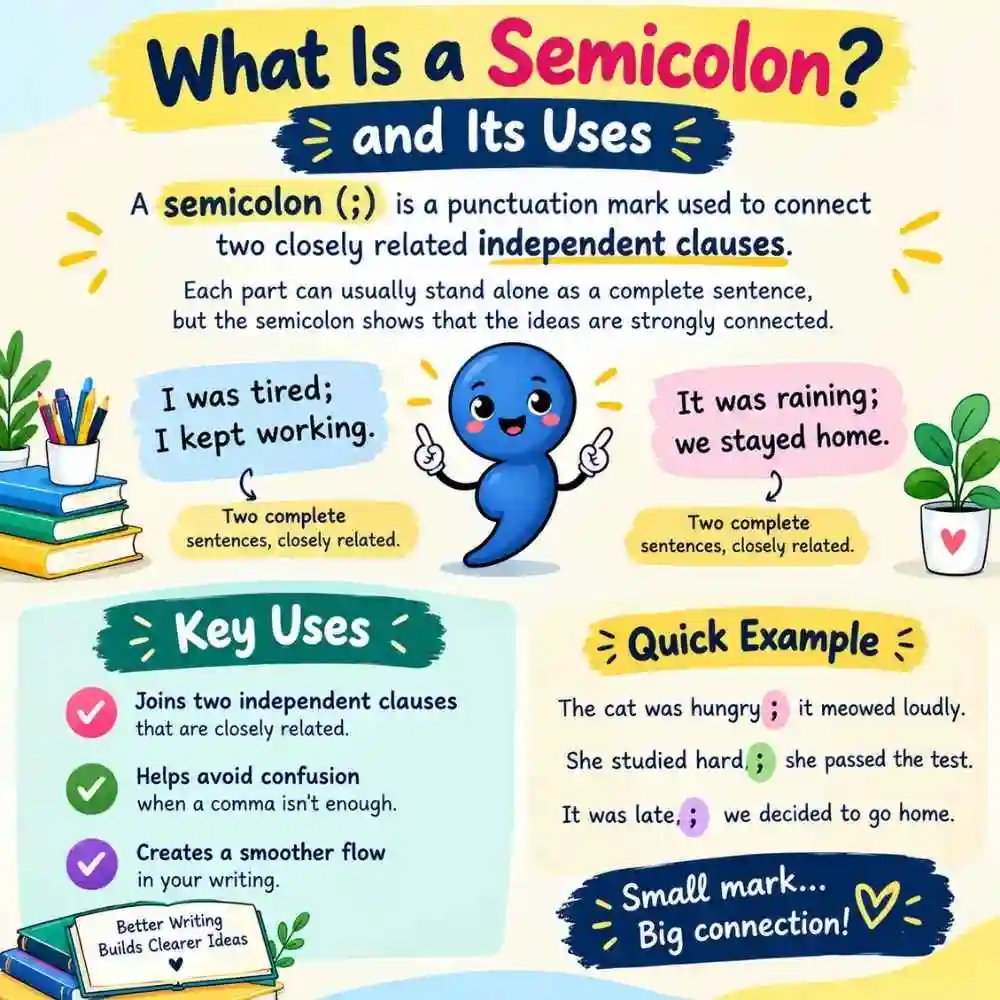
A semicolon (;) is a punctuation mark used to connect two closely related independent clauses. Each part can usually stand alone as a complete sentence, but the semicolon shows that the ideas are strongly connected.
Uses of a Semicolon
- Connecting related complete sentences: I was tired; I finished my work.
- Showing a close relationship: She loves reading; her brother prefers writing.
- Joining sentences without a conjunction: The weather was cold; we stayed indoors.
- Separating complex list items: We visited Paris, France; Rome, Italy; and Madrid, Spain.
- Connecting clauses with transitional words: I wanted to go; however, I was too busy.
- Avoiding short, disconnected sentences: The test was difficult; everyone remained focused.
The Origin of Colon vs Semicolon
The colon and semicolon have long histories in written language, developing as punctuation became more systematic. Ancient writers used various marks to organize text, but punctuation gradually took on more consistent grammatical functions as written English evolved.
Their modern roles are connected to the broader development of punctuation in European writing. As authors needed clearer ways to separate, connect, and organize ideas, different marks became associated with different levels of separation within a sentence.
Origin of Colon
The word colon comes from the Greek kōlon, meaning a limb, part, or member. In early writing traditions, the term was associated with a meaningful section or part of a sentence rather than the exact punctuation mark used today.
The colon gradually developed into a punctuation mark used to signal a relationship between what comes before and what comes after it. Its function became especially useful for introducing lists, explanations, examples, and elaborations.
Today, the colon remains an important part of standard written English. Although its appearance is simple, its grammatical role is specific: the material after the colon should normally have a clear connection to the preceding statement.
Origin of Semicolon
The semicolon developed later as writers needed a punctuation mark that could show a stronger connection than a comma but a weaker separation than a full stop. Its name reflects its form: it combines the functions suggested by a semi-colon, creating an intermediate level of separation.
The modern semicolon became established in European printing and writing as punctuation practices became more standardized. It proved useful for separating closely connected thoughts while keeping them within the same sentence.
In modern English, its clearest grammatical function is to join independent clauses that are closely related in meaning. It can also help separate complicated items in a series when those items already contain commas.
British English vs American English Spelling
There is no major spelling difference between British English and American English for colon or semicolon. Both varieties use the same words and the same punctuation symbols: colon (:) and semicolon (;).
British English Style
British English uses the colon and semicolon according to the same basic grammatical principles as other standard forms of English. A colon can introduce an explanation, list, or example, while a semicolon can connect closely related independent clauses.
British writing may follow the punctuation preferences of a particular publication, institution, or style guide. This can affect details such as capitalization after a colon in certain contexts, especially in headings, lists, and formal documents.
For example, a British English writer may use a colon to introduce a list: The course covers three areas: grammar, vocabulary, and punctuation. The semicolon can then connect complete ideas: The course was challenging; the students enjoyed it.
The important point is that British English does not change the fundamental purpose of the colon or semicolon. Context and the grammatical structure of the sentence remain the deciding factors.
| Feature | British English Style |
| Colon (:) | Used to introduce a list, explanation, example, or clarification. |
| Semicolon (;) | Used to connect closely related independent clauses. |
| Colon before a list | Common when the preceding words introduce the information that follows. |
| Semicolon with conjunctions | Can connect closely related independent clauses without a coordinating conjunction. |
| Capitalization after a colon | Often follows the context and the relevant British style guide. |
| Spelling | colon and semicolon are spelled the same as in American English. |
| Main principle | Correct punctuation depends on sentence structure, meaning, and the relationship between clauses. |
American English Style
American English follows the same core distinction between the colon and semicolon. A colon introduces material that explains, illustrates, or expands on what comes before it, whereas a semicolon normally connects two related independent clauses.
American style guides may have specific preferences about capitalization after a colon, particularly when the material that follows is a complete sentence or consists of multiple sentences. These are style choices, not a change in the basic meaning of the colon.
For example, an American English sentence can use a colon before a direct explanation: She knew the answer: she had studied carefully. A semicolon can connect two independent clauses: She studied carefully; she felt prepared for the exam.
Therefore, writers using American English should learn the grammatical function first and then apply the capitalization and formatting rules required by their chosen style guide.
| Feature | American English Style |
| Colon (:) | Used to introduce a list, explanation, example, or clarification. |
| Semicolon (;) | Used to connect closely related independent clauses. |
| Colon before a list | Common when the words before the colon form a complete thought. |
| Semicolon with conjunctions | Usually used without a coordinating conjunction when linking independent clauses. |
| Capitalization after a colon | Depends on the sentence and the style guide; a complete sentence may be capitalized in some contexts. |
| Spelling | colon and semicolon are spelled the same as in British English. |
| Main principle | Choose punctuation based on the grammatical relationship between ideas, not simply the desired pause. |
Which Spelling Should You Use?
There is no different British or American spelling to choose between colon and semicolon. Both words are spelled the same in standard British and American English. The real choice is about selecting the correct punctuation mark for the relationship between ideas in your sentence.
A colon and a semicolon may both appear in formal writing, but they are not interchangeable. Choose the mark based on what you want the reader to understand: whether the following text explains, introduces, or expands on the previous text, or whether it presents a separate but closely connected complete thought.
Use a Colon If You Want To:

Use a colon (:) when the material that follows provides a direct explanation, example, list, or clarification of what comes before it.
- Introduce a list: She brought three items: a notebook, a pen, and a folder.
- Introduce an explanation: He had one concern: the deadline was approaching.
- Introduce an example: She followed one simple rule: always check her work.
- Emphasize information that directly develops the preceding statement.
A colon works best when the first part of the sentence naturally sets up or points toward the information that follows.
Use a Semicolon If You Want To:
Use a semicolon (;) when you want to connect two closely related independent clauses without making them separate sentences.
- Connect related thoughts: The weather improved; we continued the trip.
- Show a close relationship between two complete ideas: She studied carefully; she felt ready for the test.
- Separate complicated items in a series when those items already contain commas.
The key test is simple: both sides of a semicolon should normally be capable of standing as complete sentences on their own.
Best Choice by Audience
The correct choice does not usually depend on whether your audience uses British English or American English. The basic functions of the colon and semicolon are shared across both varieties.
| Audience | Best Approach |
| Students | Follow the punctuation rules taught by your school or course. |
| Academic readers | Follow the required academic style guide consistently. |
| Professional readers | Use clear sentence structure and consistent punctuation. |
| British English readers | Apply standard British punctuation conventions and the relevant style guide. |
| American English readers | Apply standard American punctuation conventions and the relevant style guide. |
| General readers | Choose the mark that most clearly shows the relationship between ideas. |
Professional Advice
For professional writing, focus on clarity, grammar, consistency, and readability rather than trying to make your writing sound more formal by using semicolons or colons unnecessarily.
Before using a colon, check that the words before it create a natural introduction to what follows. Before using a semicolon, check that both sides contain independent clauses and that the ideas are closely connected.
When a simpler sentence communicates the same idea more clearly, a full stop may be better. Good punctuation should help the reader understand your message—not make the sentence harder to follow.
Can a semicolon replace a period?
Yes, a semicolon can sometimes replace a period when you have two closely related independent clauses. Both parts must be complete sentences on their own.
Example:
- With a period: The rain stopped. We went outside.
- With a semicolon: The rain stopped; we went outside.
A semicolon creates a stronger connection between the two ideas than a period. However, it should not be used simply because two sentences are next to each other.
Can a colon introduce a list?
Yes, a colon can introduce a list when the words before the colon form a complete thought that naturally leads to the list.
Example:
I need three items: a notebook, a pen, and a ruler.
Do not place a colon directly after a verb or preposition when the sentence already flows naturally into the list.
Incorrect: I need: a notebook, a pen, and a ruler.
Correct: I need three items: a notebook, a pen, and a ruler.
Read More: International Girl’s Day vs. International Girls’ Day
Is a semicolon stronger than a comma?
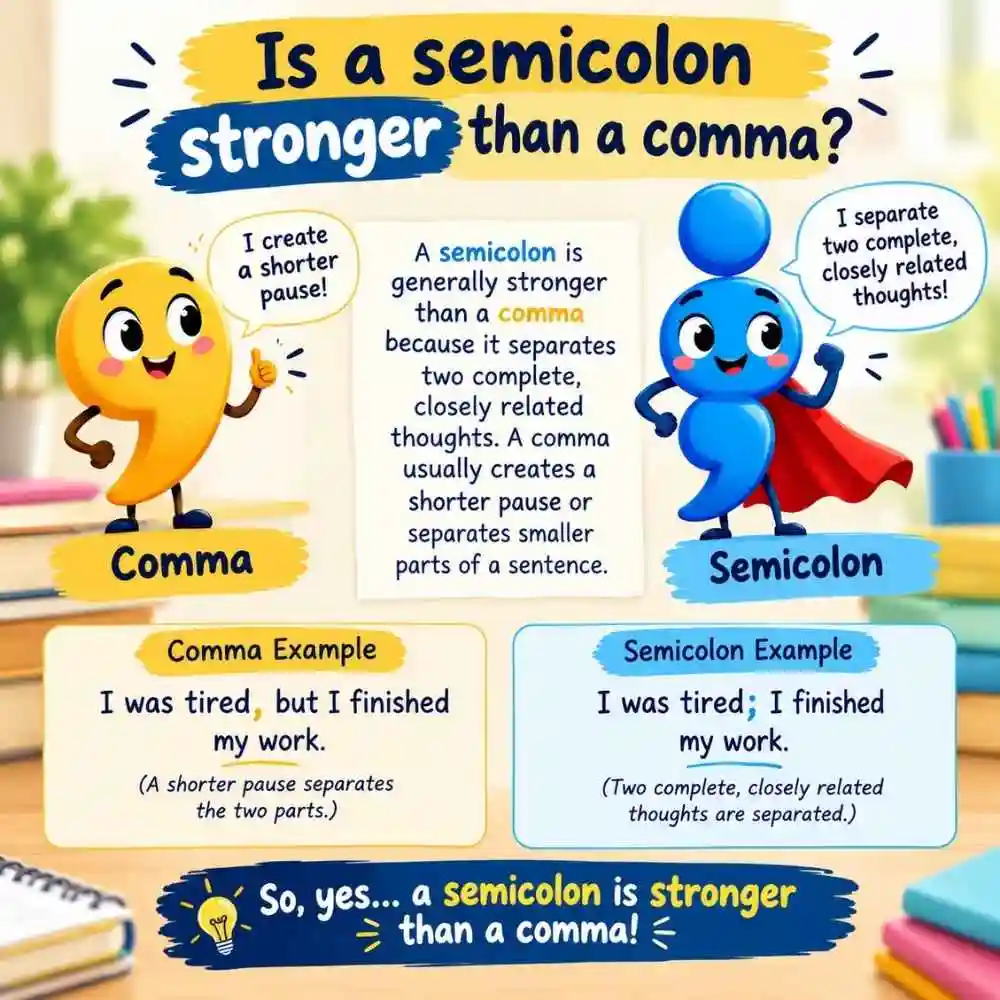
A semicolon is generally stronger than a comma because it separates two complete, closely related thoughts. A comma usually creates a shorter pause or separates smaller parts of a sentence.
Example with a comma:
After dinner, we went for a walk.
Example with a semicolon:
We finished dinner; we went for a walk.
A semicolon can also separate items in a complicated list when the items already contain commas.
Should I use semicolons in casual writing?
Yes, you can use semicolons in casual writing, but they are not always necessary. In texts, social media posts, and quick messages, writers often prefer periods because they make sentences shorter and easier to scan.
For example:
- I wanted to call you; I got busy.
In casual writing, you could simply write:
- I wanted to call you. I got busy.
Use a semicolon when the connection between the two complete thoughts is important or when it makes the sentence flow better.
Are colon and semicolon rules the same in British and American English?
The basic rules for colons and semicolons are the same in British and American English. A colon can introduce a list, explanation, or example, while a semicolon can connect closely related independent clauses.
There can be small differences in style-guide preferences, especially around capitalization after a colon and punctuation in formal writing. These differences do not change the main function of either punctuation mark.
For most writers, the safest approach is to follow the style guide required by their school, workplace, publisher, or publication.
Which punctuation mark is more formal?
Neither a colon nor a semicolon is automatically more formal. Both are appropriate in academic, professional, and formal writing when used correctly.
A colon often sounds more structured because it introduces an explanation, list, or important point. A semicolon can make formal writing more connected by joining closely related complete thoughts.
The best choice depends on the relationship between your ideas, not how formal you want the sentence to sound. Use the punctuation mark that clearly shows what you mean.
Colon vs Semicolon in Everyday Examples
The difference between a colon and semicolon becomes easier to understand when you see how each punctuation mark works in real writing. The colon often introduces information, while the semicolon connects closely related complete thoughts. Their use can change slightly depending on the type of writing and the reader.
In Emails
In emails, a colon is useful when introducing a list, explanation, or important detail. It can make instructions and information easier to scan.
Example:
Please bring the following items: your ID, notebook, and completed form.
A semicolon can connect two closely related complete thoughts without creating two separate sentences.
Example:
The meeting has been moved to Friday; please update your calendar.
For everyday emails, use these marks only when they improve clarity and sentence flow.
In News Writing
News writing often values concise and direct sentences. A colon can introduce a statement, list, explanation, or key detail that follows an introductory phrase.
Example:
The investigation revealed one major issue: several records were missing.
A semicolon can connect two closely related independent clauses, particularly when the relationship between the facts is clear.
Example:
Officials released the report Tuesday; further details are expected later.
Because news writing emphasizes readability, journalists generally avoid punctuation that makes a sentence unnecessarily complicated.
In Social Media
Social media writing is usually more flexible, but correct punctuation can still make a message easier to understand. A colon can introduce a short list, announcement, or explanation.
Example:
Today’s goal: finish the project.
A semicolon can join two short, closely related thoughts.
Example:
The work was challenging; the result was worth it.
On social platforms, writers may intentionally use fragments or informal punctuation for style. However, when clarity matters, the standard grammatical functions of the colon and semicolon still provide a useful guide.
In Formal Writing
Formal writing requires careful punctuation because sentences often contain detailed information and complex ideas. A colon can introduce an explanation, example, or list that directly follows a complete introductory statement.
Example:
The report identified three priorities: accuracy, consistency, and transparency.
A semicolon is useful when two independent clauses are closely connected.
Example:
The proposal requires further review; the committee will meet next week.
Using each mark for its proper function helps formal writing remain precise, organized, and professional.
In Academic Writing
Academic writing often contains long explanations, comparisons, and evidence, so punctuation needs to show relationships between ideas clearly. A colon can introduce an explanation, example, or series of related points.
Example:
The study focused on three factors: motivation, practice, and feedback.
A semicolon can connect two independent clauses that are strongly related.
Example:
The results were consistent across the groups; the researchers therefore repeated the experiment.
Academic writers should also follow the specific style guide required by their institution or publication.
In Business Reports
Business reports frequently use colons to introduce findings, recommendations, lists, and key details.
Example:
The review identified two priorities: reducing costs and improving service.
Semicolons can connect related statements when keeping them in one sentence makes the relationship clearer.
Example:
Sales increased during the final quarter; customer complaints also declined.
The goal is to communicate information quickly and accurately, so punctuation should support easy reading.
In Presentations and Slides
A colon can work well in presentations because it introduces information that readers can quickly scan.
Example:
Project goals: improve quality, reduce delays, and increase efficiency.
Semicolons are less common on short slides, but they can be useful when a slide contains two closely connected complete thoughts.
Example:
The first phase is complete; the testing phase begins Monday.
For slides, keep punctuation simple and purposeful rather than adding marks only to make the text appear formal.
In Creative Writing
Creative writers may use colons and semicolons to control sentence rhythm, emphasis, and the relationship between ideas.
- A colon can create anticipation before an important detail:
- She knew one thing: the journey was only beginning.
- A semicolon can keep two connected thoughts together:
- The road was difficult; she continued anyway.
Creative writing allows more stylistic freedom, but understanding the standard grammatical function of each mark helps writers use that freedom deliberately.
Read More: How-To vs. How-Tos: Which Form Is Correct?
When Should You Use a Colon Instead of a Semicolon?
Choose a colon instead of a semicolon when the second part of a sentence introduces, explains, illustrates, or emphasizes information from the first part. A colon creates a clear “look ahead” relationship, while a semicolon mainly connects two closely related complete thoughts.
Colon for Introducing Information
Use a colon when the first part of the sentence prepares the reader for specific information that follows. The information after the colon can be an explanation, detail, quotation, or other material that develops the first idea.
Example:
She had one important message: stay calm.
The words before the colon create an introduction, and the words after it provide the message.
Colon for Lists and Examples
A colon is useful when you want to introduce a list of items or examples. The words before the colon should normally form a complete thought.
Example:
Bring these items: a notebook, a pen, and a folder.
You can also use a colon before examples:
There is one simple solution: start early.
Colon for Emphasis
A colon can create emphasis by making the information after it stand out. This is useful when the second part gives the most important detail in the sentence.
Example:
He wanted only one thing: success.
The colon creates a pause that draws attention to the word or phrase that follows.
Colon for Explanations
Use a colon when the second part explains or clarifies the first part. This structure is especially useful when the reader needs more information to understand the statement.
Example:
The decision was easy: everyone agreed with the plan.
The second part explains why the decision was easy.
Colon vs Semicolon in Sentence Structure
The main structural difference is simple: a colon introduces or develops information, while a semicolon connects closely related independent clauses. Understanding the parts of a sentence helps you choose the correct mark.
Independent and Dependent Clauses
An independent clause contains a subject and a verb and can stand alone as a complete sentence. A dependent clause cannot stand alone.
A semicolon normally joins two independent clauses:
- The class ended; the students left.
- A colon can follow a complete introductory clause when the next part explains or expands on it:
- The students had one plan: finish the project today.
Complete Sentences
When using a semicolon between two clauses, both sides should be able to work as complete sentences.
Correct:
The store was closed; we went home.
Incorrect:
Because the store was closed; we went home.
The first part of the incorrect example is dependent, so a semicolon does not work there.
Sentence Connections
A semicolon shows that two complete ideas have a close logical connection without using a coordinating conjunction.
Example:
Maria studied all night; she wanted to pass the exam.
The two clauses are separate thoughts, but their meanings are closely connected.
A colon creates a different relationship:
- Maria had one goal: she wanted to pass the exam.
- Here, the second part develops the idea introduced in the first part.
Punctuation Placement
Place a colon or semicolon directly after the preceding word, with no space before the punctuation mark.
Colon: I need three things: paper, pens, and folders.
Semicolon: I finished my work; then I went home.
In standard English writing, both marks are followed by a single space. The important point is to choose the mark based on the sentence structure and relationship between ideas, not simply on the length of the pause.
Colon vs Semicolon Before a Complete Sentence
A colon and semicolon can both appear before a complete sentence, but they create different relationships. A colon usually tells the reader that the next sentence or clause will explain, clarify, or expand on what came before. A semicolon directly joins two closely related independent clauses.
Rules for Colons
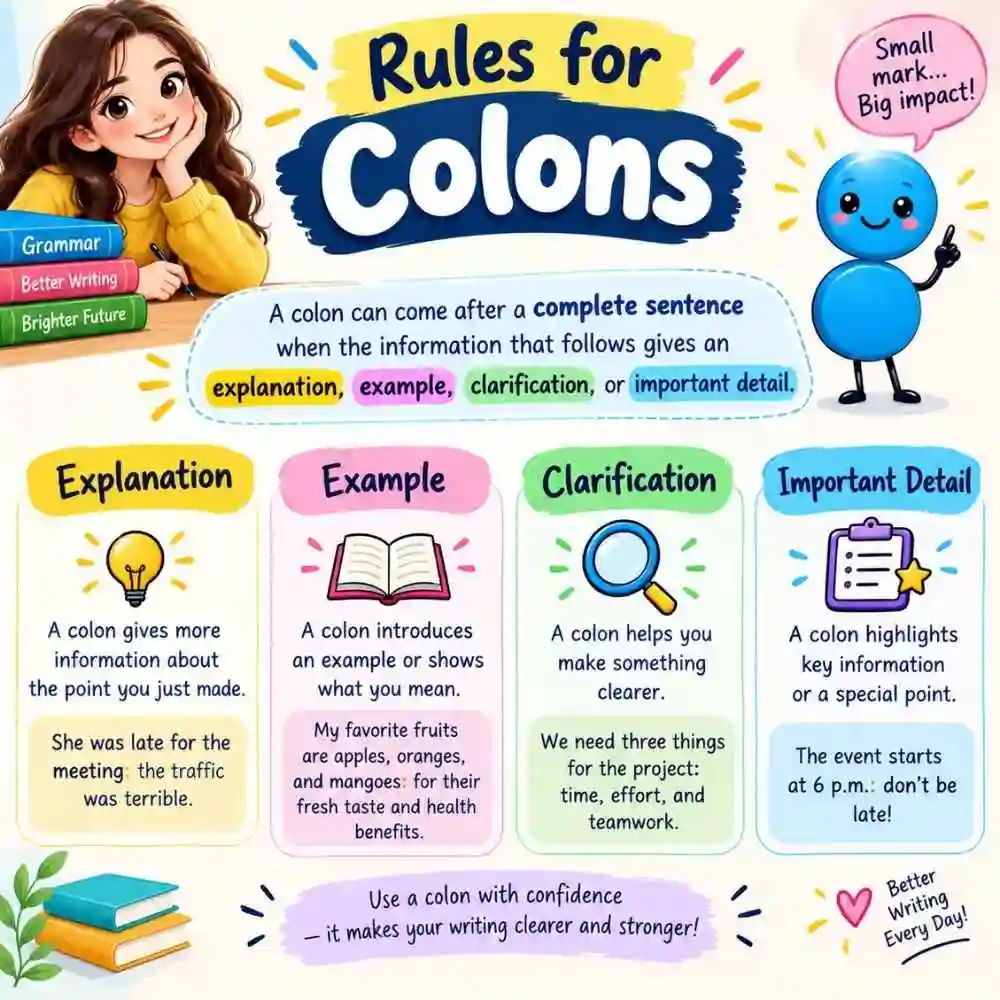
A colon can come after a complete sentence when the information that follows gives an explanation, example, clarification, or important detail.
- Example:
She made an important decision: she would start over.
The first part is complete, and the second part explains the decision.
A colon can also introduce a quotation or a longer explanation:
- He gave us one clear instruction: “Arrive before noon.”
The colon should not be used simply because the next part is a complete sentence. There should be a clear explanatory or introductory relationship between the two parts.
Rules for Semicolons
A semicolon can join two complete, closely related sentences without using a coordinating conjunction.
Example:
The meeting ended; everyone left the room.
Both sides can stand alone:
- The meeting ended.
- Everyone left the room.
A semicolon is especially useful when the writer wants to show that the two thoughts belong closely together. Do not use a semicolon between an independent clause and a dependent clause.
Correct and Incorrect Examples
| Type | Example | Why |
| Correct colon | She knew the truth: he had lied. | The second part explains the first. |
| Correct semicolon | She knew the truth; he had lied. | Both sides are independent clauses. |
| Correct colon | He had one request: please stay. | The second part gives the request. |
| Correct semicolon | He wanted to stay; he had to leave. | Two closely related complete thoughts are connected. |
| Incorrect semicolon | Because he was tired; he went home. | The first part is dependent. |
| Incorrect colon | She bought: a book and a pen. | The words before the colon do not form a suitable complete introduction. |
The easiest way to remember the difference is this: use a colon when the second part explains or introduces something, and use a semicolon when two complete thoughts are closely connected.
Read More: Presume vs Assume: What’s the Difference and When to Use Each?
How to Remember Colon vs Semicolon Rules
Learning the difference between a colon (:) and a semicolon (;) becomes easier when you focus on what each mark does. A colon usually points forward to more information, while a semicolon connects two closely related complete thoughts.
The Colon Rule
Remember this simple rule: A colon introduces what comes next.
Use a colon before a list, explanation, example, quotation, or important detail when the first part naturally leads to the information after it.
Example:
She brought everything she needed: a laptop, a charger, and a notebook.
Think of the colon as saying, “Here is what I mean.”
The Semicolon Rule
Remember this rule: A semicolon connects two complete, related thoughts.
Both sides of the semicolon should normally be able to stand alone as complete sentences.
Example:
The store was closed; we went home.
You could replace the semicolon with a period, but the semicolon shows that the two thoughts are closely connected.
Easy Memory Trick
Use this quick trick:
Colon = “Here comes more.”
Semicolon = “These belong together.”
You can also remember the symbols visually. The colon has two dots, like an introduction that opens the door to more information. The semicolon looks like a comma with a dot above it, making it a stronger separator than a comma.
Quick Practice Examples
| Sentence | Correct Mark | Why? |
| I need three things___ a pen, paper, and a folder. | Colon (:) | Introduces a list. |
| She had one goal___ to win the competition. | Colon (:) | Introduces an explanation. |
| The sun was setting___ we headed home. | Semicolon (;) | Connects two related complete thoughts. |
| He studied hard___ he wanted to pass. | Semicolon (;) | Joins two independent clauses. |
| There was only one problem___ we had no time. | Colon (:) | The second part explains the problem. |
| The road was blocked___ we took another route. | Semicolon (;) | Connects two closely related sentences. |
The easiest final check is: If you are introducing something, think colon. If you are joining two complete related thoughts, think semicolon.
Read More: Coach vs Couch: Which Word Should You Use?
Common Mistakes with Colon vs Semicolon
Understanding the difference between a colon (:) and a semicolon (;) is easier when you know the mistakes writers commonly make. Most errors happen when the punctuation mark does not match the grammatical structure or relationship between the ideas.
Mistake 1: Using a Colon After a Verb
A common mistake is placing a colon directly after a verb when the sentence does not need one. A colon should not separate a verb from its object or the information that naturally completes it.
Incorrect:
She likes: reading, writing, and painting.
Correct:
She likes reading, writing, and painting.
The colon is unnecessary because reading, writing, and painting directly complete the verb likes. However, a colon can be used when the wording before it forms a complete introduction.
Correct:
She has three favorite hobbies: reading, writing, and painting.
Mistake 2: Using a Semicolon Instead of a Colon
A semicolon should not replace a colon when the second part introduces or explains the first part.
Incorrect:
He brought everything he needed; a notebook, a pen, and a charger.
Correct:
He brought everything he needed: a notebook, a pen, and a charger.
The second part is a list introduced by the first part, so a colon is the appropriate choice. A semicolon is better suited to connecting two closely related independent clauses.
Mistake 3: Joining Incomplete Sentences with Semicolons
A semicolon normally connects two independent clauses. If one side is only a phrase or dependent clause, a semicolon is usually incorrect.
Incorrect:
Because she was tired; she went home early.
Correct:
Because she was tired, she went home early.
Here, because she was tired cannot stand alone as a complete sentence. Therefore, a semicolon cannot properly separate it from the main clause.
A useful test is to check both sides of the semicolon. If each side can function as a complete sentence, the semicolon may be appropriate.
Mistake 4: Overusing Semicolons
Using too many semicolons can make writing feel heavy, crowded, or unnecessarily complicated. A semicolon is useful when two ideas have a strong connection, but it should not replace every comma, conjunction, or full stop.
Overused:
She arrived early; she found a seat; she opened her notebook; she reviewed her notes.
Clearer:
She arrived early. She found a seat, opened her notebook, and reviewed her notes.
Good punctuation should support readability. If several short sentences do not need to remain connected, separating them with full stops may create a cleaner flow.
Mistake 5: Forgetting Capitalization Rules
Writers sometimes assume that a colon or semicolon automatically determines whether the next word should begin with a capital letter. In most ordinary sentences, the word after a semicolon is not capitalized unless it is a proper noun.
Correct:
The task was difficult; everyone needed more time.
After a colon, capitalization depends on the sentence structure and style guide. A single word, phrase, or ordinary list item usually does not require a capital letter simply because it follows a colon.
Example:
She needed three things: patience, practice, and time.
When a colon introduces a complete sentence or multiple sentences, capitalization may vary according to the relevant style guide. For formal writing, always follow the capitalization convention required by your chosen academic, professional, or editorial style guide.
Mistake 6: Using a Semicolon Before a Simple List
A semicolon should not normally be used to introduce a basic list. When the words before the list create a complete introduction, a colon is usually the better choice.
Incorrect:
I need three things; a pen, paper, and a notebook.
Correct:
I need three things: a pen, paper, and a notebook.
The colon clearly signals that the list is coming next, while the semicolon does not serve that function.
Mistake 7: Using a Colon Between Two Complete Sentences Without a Clear Relationship
A colon should not be placed between two complete sentences simply because the writer wants a stronger pause. The second part should explain, illustrate, or expand on the first part.
Incorrect:
The meeting starts at nine: I arrived early.
Better:
The meeting starts at nine; I arrived early.
Here, the two ideas are related, but the second does not explain or introduce the first. A semicolon is more suitable because it connects two closely related independent clauses.
Read More: Lets or Let’s: How to Use Each Word Correctly? 2026
Colon vs Semicolon – Google Trends & Usage Data
Searches for colon vs semicolon mainly come from people who want a quick and reliable way to understand the difference between these two punctuation marks. Google Trends can help show relative search interest, but it does not provide exact monthly search volume. The data is normalized on a scale from 0 to 100 for the selected time and location.
Countries with High Search Interest
For this section, a table works best because readers can quickly compare countries and understand relative search interest.
| Country/Region | Relative Interest | Common Search Intent |
| United States | High | Grammar rules and writing help |
| United Kingdom | High | British English and punctuation |
| Canada | Moderate–High | Academic and professional writing |
| Australia | Moderate–High | English grammar and usage |
| India | Moderate–High | English learning and education |
| Philippines | Moderate | Grammar and language learning |
Important: Google Trends values change according to the selected date range, location, language, and search term, so this table should be treated as a general presentation rather than fixed search-volume data.
Why People Search This Keyword
This section is best with a short paragraph followed by points, because the search intent can be divided into several common questions.
People commonly search colon vs semicolon because they know both punctuation marks separate or organize ideas but are unsure which one belongs in a particular sentence.
Common reasons include:
- Understanding the difference between a colon and semicolon.
- Learning when to use a colon in a sentence.
- Learning when to use a semicolon.
- Checking whether one punctuation mark can replace the other.
- Finding correct sentence examples.
- Avoiding common punctuation mistakes.
- Improving grammar for school, work, or academic writing.
Usage Trends
A table suits this section best because it shows how the two punctuation marks are commonly used across different types of writing.
| Writing Context | Colon Usage | Semicolon Usage |
| Academic writing | Lists, explanations, and examples | Closely related independent clauses |
| Professional writing | Introductions, details, and lists | Connected complete thoughts |
| Emails | Lists and explanations | Related complete sentences |
| News writing | Introductions and explanations | Closely connected facts |
| Social media | Short introductions and lists | Less common but still grammatically useful |
| Creative writing | Emphasis and explanation | Rhythm and connected ideas |
The main usage pattern is simple: colons introduce related information, while semicolons connect closely related independent clauses.
Modern Writing Trend
Modern writing increasingly values clarity, readability, and shorter sentences, especially online. This affects how writers use punctuation, but it does not make either the colon or semicolon outdated.
A few noticeable patterns include:
- Short digital content often favors full stops over semicolons.
- Academic writing continues to use semicolons for complex sentence structures.
- Professional writing uses colons frequently for lists, explanations, and headings.
- Online content tends to prefer punctuation that makes information easy to scan.
- Experienced writers choose punctuation based on sentence structure rather than using a mark simply for stylistic effect.
Overall, the modern trend is not about choosing one punctuation mark over the other. It is about using the colon and semicolon purposefully so the relationship between ideas remains clear to the reader.
Colon vs Semicolon Comparison Table
| Feature | Colon (:) | Semicolon (;) |
| Main purpose | Introduces related information | Connects closely related ideas |
| Used before a list | Yes | Usually no |
| Used before an explanation | Yes | No |
| Connects independent clauses | Sometimes, when the second clause explains the first | Yes |
| Can replace a period? | In some structures | Yes, between closely related independent clauses |
| Can introduce an example? | Yes | No |
| Can separate complex list items? | Sometimes | Yes |
| Relationship between ideas | The second part develops or explains the first | Both parts are closely connected and relatively independent |
| Example | She had one goal: to succeed. | She studied hard; she passed the exam. |
| Common mistake | Putting it after an incomplete introduction | Using it between incomplete clauses |
| Basic rule | Think “Here is more information.” | Think “These two complete thoughts are connected.” |
Quick tip: Use a colon (:) when the second part introduces, explains, or expands on the first. Use a semicolon (;) when you want to connect two closely related independent clauses.
Frequently Asked Questions About Colon vs. Semicolon
1. What is the main difference between a colon and a semicolon?
A colon (:) usually introduces information that follows, such as a list, explanation, or example. A semicolon (;) connects two closely related independent clauses or separates complex list items.
2. Can a colon connect two complete sentences?
Yes, a colon can connect two complete thoughts when the second part explains, expands, or illustrates the first. However, the relationship should be clear.
Example: She knew what she wanted: she wanted a fresh start.
3. Can a semicolon introduce a list?
A semicolon is not normally used to introduce a list. A colon is usually the better choice for introducing a list.
Example: I packed four things: clothes, shoes, toiletries, and books.
4. Can I use a semicolon before “and”?
Usually, you do not need a semicolon before and when joining two simple independent clauses. A comma and coordinating conjunction are normally enough.
Example: I finished my work, and I went home.
A semicolon may be useful when the sentence contains complicated clauses or internal punctuation.
5. What comes after a colon?
A colon can be followed by a list, explanation, example, quotation, or related information. Whether the next word is capitalized depends on the sentence and the style guide being followed.
6. What comes after a semicolon?
A semicolon is normally followed by a lowercase letter, unless the next word is a proper noun or another word that normally requires capitalization.
Example: The store was closed; we went somewhere else.
7. Can I use a colon and semicolon in the same sentence?
Yes. A sentence can contain both punctuation marks when each one has a different grammatical purpose.
Example: We visited three cities: Paris, France; Rome, Italy; and Madrid, Spain.
Here, the colon introduces the list, while semicolons separate the complex items.
8. Is a semicolon the same as a comma?
No. A semicolon is stronger than a comma and can separate two closely related independent clauses. A comma alone usually cannot join two independent clauses without creating a comma splice.
Example: The weather changed; we stayed inside.
9. Are colons and semicolons used in formal writing?
Yes. Both marks are common in academic, professional, and formal writing. The key is to use each one according to its grammatical function rather than adding punctuation simply to make writing sound formal.
10. How can I remember when to use a colon or semicolon?
Think of a colon as “here comes more information” and a semicolon as “these two complete thoughts belong together.” Use a colon for lists, explanations, and examples, and use a semicolon to connect closely related independent clauses.
Conclusion
Understanding colon vs. semicolon becomes easier when you focus on the relationship between the ideas in a sentence. A colon points forward to information that explains, introduces, or expands on what came before it, while a semicolon links closely related complete thoughts.
The best way to avoid mistakes is to check the structure before choosing the punctuation mark. If you are introducing a list, example, or explanation, a colon may be the right choice. If you are connecting two independent clauses that belong closely together, a semicolon is usually more suitable.
With regular practice, these punctuation marks become much easier to recognize and use. When you choose punctuation based on meaning, sentence structure, and clarity, your writing becomes smoother, more precise, and easier for readers to understand.

I’m Jane Austen, the admin of GrammarGuide.com, where words come to life in smarter, sharper, and more creative ways. I focus on simplifying grammar, exploring powerful synonyms, and sharing fun, engaging expressions that make everyday communication more effective. My goal is to help readers write with clarity, confidence, and a touch of personality, whether it’s for professional use or just for fun.



