
Choosing the correct spelling matters in clear English, especially when a small spelling difference can change whether your writing looks polished or contains a common spelling error. The question of Greatful or Grateful is a frequent spelling confusion, because “greatful” may seem logical at first glance. However, grateful is the correct spelling in standard English, while “greatful” is a common mistake. Understanding the difference between greatful and grateful, the meaning of grateful, and its proper usage can help you avoid unnecessary errors in everyday communication.
This guide explains the word origin, British spelling, and American spelling, along with the correct form and the reason behind this spelling pattern. You will also learn about everyday writing, formal writing, emails, social media posts, and writing professionally with confidence. We will cover correct usage, how to use grateful, grateful examples, and grateful in a sentence, while also addressing common mistakes, English spelling, and how accurate wording supports credible writing. Continue reading to understand this commonly confused word clearly.
Greatful or Grateful: Quick Answer
Grateful is the correct spelling. Greatful is a common spelling mistake and is not the standard English form. The confusion often happens because grateful looks closely related to the word great, so it can feel natural to add “great” when spelling it.
The word grateful is an adjective used when someone feels or shows thankfulness and appreciation. For example, you can say, “I am grateful for your help” or “She was grateful to her parents.” If you are writing an email, school assignment, social media post, or professional message, use grateful, not “greatful.”
- Correct: I am grateful for everything you have done.
- Incorrect: I am greatful for everything you have done.
A simple way to remember the spelling is to focus on grate + ful, not great + ful. The correct word contains grate followed by -ful.
What Does Grateful Mean?
Grateful means feeling or expressing thanks, appreciation, or recognition for something positive received. It can describe appreciation for a person’s help, kindness, support, opportunity, gift, advice, or experience.
The word usually appears when someone wants to acknowledge something that has benefited them. For example, if a friend helps you with an important task, you might say, “I am grateful for your support.” In this sentence, grateful communicates more than simply noticing the help; it expresses genuine appreciation.
Here are some common ways to use grateful:
- Grateful for something: I am grateful for your kindness.
- Grateful to someone: She is grateful to her teacher.
- Grateful that something happened: We are grateful that everyone arrived safely.
- Grateful to someone for something: He is grateful to his parents for their support.
The adjective can work in both everyday and formal communication. You might use it in a conversation with a friend, a thank-you note, a workplace email, or a formal speech. The exact tone depends on the surrounding words.
For example:
- I am grateful for your advice.
- We are grateful to everyone who supported the project.
- She felt grateful for the opportunity to learn something new.
These examples show that grateful is closely connected with appreciation and thankfulness. It is often used when the speaker wants to clearly recognize the value of another person’s action, support, or contribution.
Read More: Capital or Capitol: Understanding the Difference in 2026
Why Is “Greatful” Incorrect?
Greatful is incorrect because it is not the standard spelling of the English adjective meaning thankful or appreciative. The correct form is grateful.
One reason people make this mistake is the visual similarity between great and grate. Since “great” is a familiar English word, writers may naturally assume that adding -ful produces “greatful.” However, the standard spelling comes from grateful, with grate rather than great.
The pronunciation can also contribute to the confusion. In normal speech, the difference between the spelling patterns may not be obvious enough to help someone remember every letter. As a result, a person may know exactly what the word means but still spell it incorrectly.
Compare the two forms:
| Spelling | Status | Meaning |
|---|---|---|
| Grateful | Correct | Feeling or showing appreciation |
| Greatful | Incorrect | Nonstandard misspelling of grateful |
It is also useful to avoid thinking of grateful as meaning “full of greatness.” The -ful ending can sometimes encourage this kind of word-building, but English spelling does not always work by simply attaching an ending to a familiar word.
When proofreading, look specifically for greatful because spell-checking tools may catch it, but relying entirely on automatic correction is not ideal. Learning the correct word pattern makes it easier to recognize the mistake yourself.
How Do You Spell Grateful Correctly?
The correct spelling is grateful:
G-R-A-T-E-F-U-L
A useful way to remember it is to divide the word into:
grate + ful = grateful
The spelling contains grate, not great.
You can also connect the word with the related noun gratitude. Both words express the idea of appreciation or thankfulness:
- grateful: an adjective
- gratitude: a noun
- gratefully: an adverb
For example:
- I am grateful for your help.
- I feel deep gratitude for your kindness.
- She gratefully accepted the offer.
Another useful spelling habit is to check the letters after gra. If you are deciding between “greatful” and “grateful,” remember that the correct form contains “te”, giving you grate.
Correct and Incorrect Examples
- Correct: I am grateful for your support.
Incorrect: I am greatful for your support. - Correct: We are grateful to our teachers.
Incorrect: We are greatful to our teachers. - Correct: She felt grateful for the opportunity.
Incorrect: She felt greatful for the opportunity.
Using the correct spelling is especially important in formal writing, academic work, professional emails, applications, and public communication, where spelling errors can distract readers from your message.
The Origin of Greatful or Grateful
The history of grateful helps explain why its spelling does not come from the modern word great. The word is connected with the older family of terms associated with gratitude, thankfulness, and appreciation.
English grateful developed through French and ultimately traces back to the Latin gratus, meaning pleasing, thankful, or agreeable. The same Latin root is connected with words such as gratitude and gratify.
This history explains the relationship between grateful and gratitude. They belong to the same broader word family and both express appreciation.
The modern spelling therefore should not be interpreted as:
- great + ful
Instead, it is written:
- grate + ful → grateful
Understanding this distinction can make the spelling easier to remember. Even though greatful may look logical at first glance, it does not reflect the historical development or standard spelling of the word.
Knowing a little about word origin can be useful when learning English because many spelling patterns become easier to remember once you understand how related words are connected.
Read More: Linchpin vs. Lynchpin: Which One Should You Use?2026
Grateful vs. Thankful: What’s the Difference?
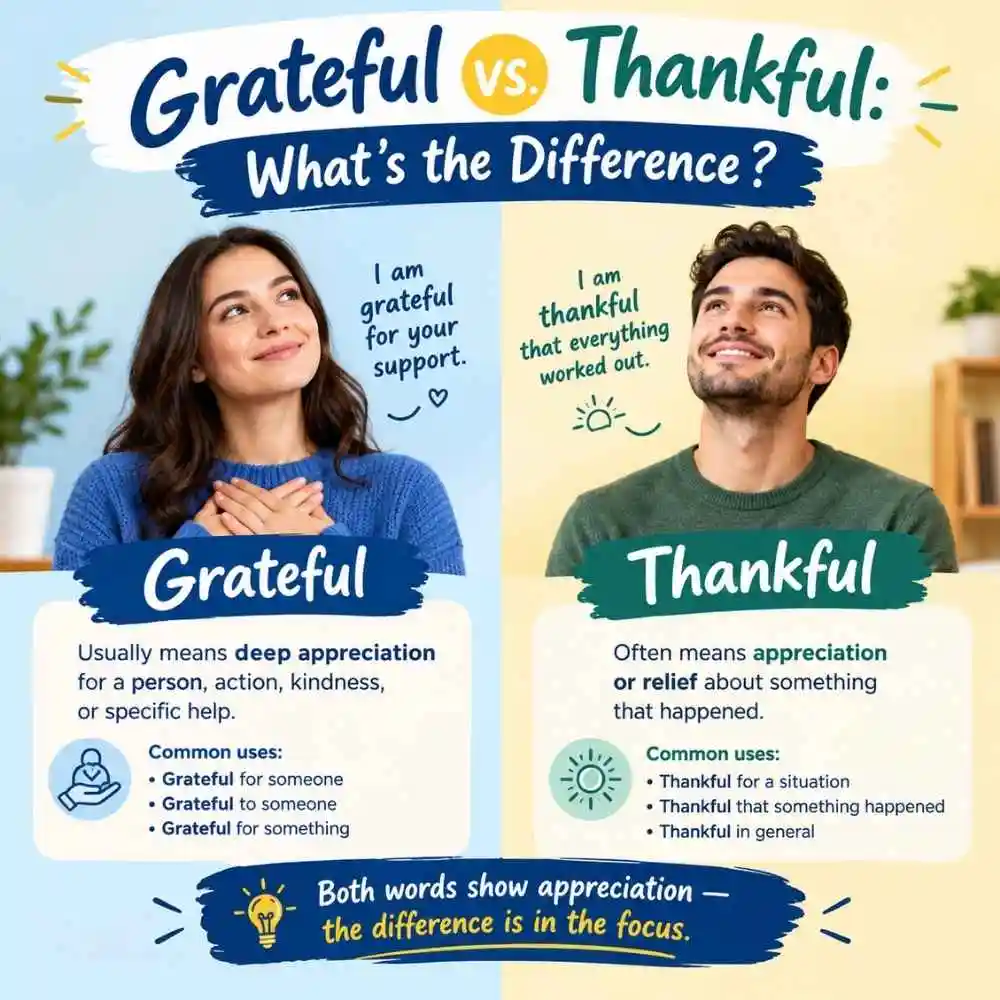
Grateful and thankful are closely related words, and they can often be used interchangeably. Both describe a feeling of appreciation, but they can carry slightly different shades of meaning depending on the context.
Thankful often emphasizes appreciation or relief about something that happened. For example, someone might say, “I am thankful that the weather improved.” Here, the speaker is expressing appreciation or relief about a situation.
Grateful often places stronger emphasis on appreciation for a person, action, kindness, opportunity, or benefit. For example, “I am grateful for your support” directly recognizes the value of someone’s help.
| Word | Main idea | Example |
|---|---|---|
| Grateful | Deep appreciation or recognition | I am grateful for your support. |
| Thankful | Appreciation or relief | I am thankful that you arrived safely. |
The distinction is not absolute. Native speakers may use either word in many of the same situations.
For example:
- I am grateful for your help.
- I am thankful for your help.
Both sentences are grammatically correct and communicate appreciation. The choice depends partly on tone and context.
In professional or heartfelt writing, grateful can sound especially appropriate when you want to emphasize sincere appreciation:
- We are grateful for your continued support.
In everyday conversation, thankful may feel more natural when discussing relief:
- I am thankful that everything worked out.
The key point is that grateful and thankful are both correct words, while greatful is not the standard spelling. If your main question is which spelling to use, choose grateful whenever you mean appreciative or thankful.
British English vs. American English Spelling
There is no spelling difference between British English and American English for this word. Both varieties of English use grateful as the standard spelling. The incorrect form greatful is not an accepted British or American spelling.
| Feature | British English | American English |
|---|---|---|
| Correct spelling | Grateful | Grateful |
| Incorrect form | Greatful | Greatful |
| Part of speech | Adjective | Adjective |
| Meaning | Thankful or appreciative | Thankful or appreciative |
| Related noun | Gratitude | Gratitude |
| Example | I am grateful for your help. | I am grateful for your help. |
This is different from words such as colour/color or centre/center, where British and American English use different spellings. With grateful, you do not need to change the spelling based on the variety of English you are using.
Examples in Both Varieties
- British English: She was grateful for the opportunity.
- American English: She was grateful for the opportunity.
- British English: We are grateful to everyone who helped.
- American English: We are grateful to everyone who helped.
The spelling remains grateful in both cases.
Which Spelling Should You Use?
Use grateful whenever you mean thankful, appreciative, or pleased about something received or experienced. You do not need to choose between British and American spellings because both use the same standard form.
Keep these points in mind:
- Use grateful in school assignments and academic writing.
- Use grateful in professional emails and workplace communication.
- Use grateful in thank-you messages and personal notes.
- Use grateful in social media captions when expressing appreciation.
- Avoid greatful, even though it may look like a logical spelling.
Quick Memory Tip
Remember:
grateful = grate + ful
Not:
greatful = great + ful
For example:
- Correct: I am grateful for your kindness.
- Incorrect: I am greatful for your kindness.
If you frequently confuse these spellings, pause before writing the word and check whether you have used “grate” rather than “great.” This small spelling check can prevent one of the most common errors associated with the word.
Read More: In Process vs In Progress: Which One Should You Use? 2026
Common Mistakes With Greatful or Grateful
The most common mistake is replacing grate with great. Because “great” is a familiar word, greatful can look correct at first glance. However, the standard spelling is always grateful.
Here are some mistakes to watch for:
- Mistake: greatful
- Correct: grateful
- Example: I am grateful for your advice.
- Mistake: greatfully
- Correct: gratefully
- Example: She gratefully accepted the gift.
- Mistake: gratefull
- Correct: grateful
- Example: We are grateful for your support.
- Mistake: gratefulness when gratitude is intended
- Gratefulness is a real word, but gratitude is often the more natural noun when referring to appreciation.
- Example: She expressed her gratitude to the team.
Common Sentence Errors
- ❌ I am greatful for your help.
- ✅ I am grateful for your help.
- ❌ He was greatful to his parents.
- ✅ He was grateful to his parents.
- ❌ We are greatfully accepting your offer.
- ✅ We are gratefully accepting your offer.
- ❌ She feels greatful about the opportunity.
- ✅ She feels grateful about the opportunity.
A good proofreading habit is to search your document for “greatful” before publishing or submitting it. If you find it, replace it with “grateful.”
How to Use Grateful in a Sentence
Grateful is an adjective, so it describes someone who feels or expresses appreciation. It commonly appears with for when you are identifying what you appreciate and with to when identifying the person you appreciate.
Use “grateful for” when naming the thing or situation
- I am grateful for your support.
- She is grateful for the opportunity.
- We are grateful for your kindness.
- He felt grateful for the extra time.
Use “grateful to” when naming the person
- I am grateful to my parents.
- She is grateful to her teacher.
- We are grateful to everyone who helped.
- He was grateful to his friend.
Use “grateful to someone for something”
This structure combines both ideas and gives a more complete sentence:
- I am grateful to you for your help.
- She is grateful to her parents for their support.
- We are grateful to the team for their hard work.
- He was grateful to his teacher for the valuable advice.
Everyday Examples
- Conversation: I’m really grateful for everything you did.
- Text message: I’m grateful for your help today.
- Professional email: We are grateful for your continued support.
- Academic writing: The researchers were grateful for the participants’ cooperation.
- Thank-you note: I am truly grateful for your thoughtful gift.
- Social media: Feeling grateful for the people who make life special.
The important point is simple: when you want to express appreciation, use grateful with the correct spelling. Whether you are writing casually or formally, grateful is the standard choice.
Grateful in Formal and Professional Writing

Grateful is appropriate in formal, academic, workplace, and professional communication when you want to express appreciation. It can make a statement sound sincere and respectful without being overly casual.
Common professional uses include:
- Thanking a colleague: I am grateful for your assistance with the project.
- Acknowledging support: We are grateful for your continued support.
- Recognizing an opportunity: I am grateful for the opportunity to contribute to this research.
- Thanking a client: We are grateful for your trust and cooperation.
- Acknowledging someone’s time: I am grateful for your time and consideration.
Examples in Professional Writing
- Job application: I am grateful for the opportunity to discuss my qualifications.
- Business communication: We are grateful for your continued partnership.
- Academic writing: The researchers are grateful to all participants for their cooperation.
- Formal statement: We remain deeply grateful to everyone who contributed to the project.
- Thank-you letter: I am truly grateful for your thoughtful assistance.
When writing professionally, avoid misspellings such as greatful or gratefull. The standard spelling is grateful, and it is the same in American and British English.
Grateful in Emails and Social Media Posts
The word grateful works in both professional emails and casual social media posts. The main difference is the tone and surrounding language, not the spelling.
In Professional Emails
Use grateful when thanking someone for their time, help, response, advice, or cooperation.
- Thank you for your assistance. I am grateful for your support.
- I am grateful for your time and look forward to hearing from you.
- We are grateful for your patience while we resolve this issue.
- I would be grateful if you could provide the requested information.
In Personal Emails
- I’m really grateful for everything you did.
- I’m so grateful for your kindness.
- I’m truly grateful that you were there when I needed help.
In Social Media Posts
Social media often uses shorter and more emotional expressions:
- Feeling grateful for today. ❤️
- So grateful for my family.
- Forever grateful for these memories.
- Grateful for the little things.
- Simply grateful for this beautiful moment.
- Grateful for the people who always support me.
The spelling does not change because the writing is informal. Even in a short caption or text message, grateful is the standard form.
Read More: A MA or An MA: Which Article Is Correct? 2026
Greatful or Grateful in Everyday Examples
In everyday English, use grateful when you want to express thanks or appreciation. The incorrect spelling greatful should be replaced with grateful in both casual and formal writing.
Here are practical examples from common situations:
- After receiving help:
- ✅ I’m grateful for your help.
- ❌ I’m greatful for your help.
- After receiving a gift:
- ✅ I’m grateful for this thoughtful gift.
- ❌ I’m greatful for this thoughtful gift.
- Talking about family:
- ✅ She is grateful for her family.
- ❌ She is greatful for her family.
- Talking about an opportunity:
- ✅ He is grateful for the opportunity.
- ❌ He is greatful for the opportunity.
- Thanking a teacher:
- ✅ We are grateful to our teacher.
- ❌ We are greatful to our teacher.
- Thanking a friend:
- ✅ I’m grateful to you for being there.
- ❌ I’m greatful to you for being there.
- Expressing relief:
- ✅ I’m grateful that everyone is safe.
- ❌ I’m greatful that everyone is safe.
A useful pattern to remember is:
grateful for + thing/situation
I am grateful for your kindness.
grateful to + person
I am grateful to my parents.
grateful to + person + for + thing
I am grateful to you for your support.
Grateful Synonyms and Related Words
Several words are closely related to grateful, but they are not always interchangeable in every sentence. Choosing the right word depends on the situation and the tone you want.
| Word | Meaning | Example |
|---|---|---|
| Thankful | Feeling or expressing thanks | I am thankful for your help. |
| Appreciative | Recognizing the value of something | She was appreciative of his advice. |
| Gratitude | The feeling of being grateful | He expressed his gratitude. |
| Gratefully | In a grateful manner | She gratefully accepted the gift. |
| Gratefulness | The state of being grateful | His gratefulness was clear. |
| Indebted | Feeling that you owe someone for their help | I am deeply indebted to you. |
| Obliged | Grateful because of a favor or service | I am much obliged for your assistance. |
Related Word Forms
- Grateful: adjective
- I am grateful for your support.
- Gratefully: adverb
- She gratefully accepted the invitation.
- Gratefulness: noun
- His gratefulness was evident.
- Gratitude: noun
- She expressed her gratitude to the team.
The most common noun used to express the idea is gratitude. The spelling connection can also help you remember why grateful, rather than greatful, is correct.
Greatful or Grateful: Google Trends & Usage Data
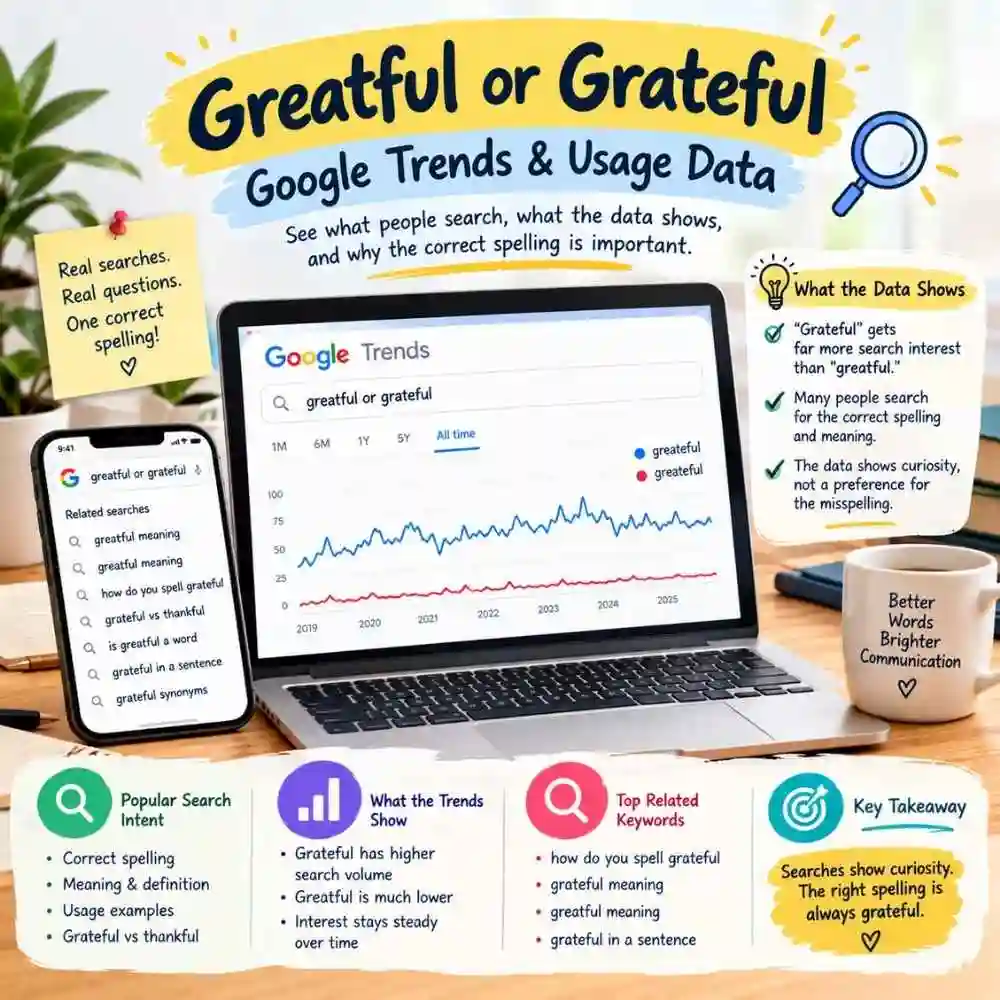
Search interest around “greatful or grateful” reflects a spelling question rather than a genuine choice between two standard English variants. Dictionary references identify grateful as the standard word meaning thankful or appreciative, while greatful is a common misspelling.
When analyzing search data for this keyword, it is important to distinguish between search volume for a spelling mistake and actual standard usage. Someone searching for “greatful or grateful” may already be unsure about the spelling and is looking for confirmation.
A useful interpretation of the search intent is:
- “greatful or grateful”: The user wants to know which spelling is correct.
- “is grateful a word”: The user wants confirmation and meaning.
- “how do you spell grateful”: The user needs the correct spelling.
- “greatful meaning”: The user may have encountered the misspelling and wants clarification.
- “grateful meaning”: The user wants the definition and usage.
- “grateful vs thankful”: The user wants to understand the difference between related words.
For accurate keyword research, tools such as Google Trends can show relative search interest over a selected period, but trend data should not be treated as dictionary evidence or proof that a spelling is grammatically correct. Dictionary sources establish the standard spelling, while search data helps reveal what people are searching for.
Greatful or Grateful: Keyword Variations Comparison Table
Different searches can express the same underlying question. Understanding these variations helps identify the specific information a reader expects.
| Keyword variation | Likely search intent | Content to provide |
|---|---|---|
| Greatful or grateful | Spelling comparison | Explain that grateful is correct |
| Grateful or greatful | Correct spelling | Give the correct form and examples |
| Is it grateful or greatful? | Quick answer | State the correct spelling clearly |
| How do you spell grateful? | Spelling help | Show G-R-A-T-E-F-U-L |
| Greatful meaning | Word meaning | Explain the correct term and note the misspelling |
| Grateful meaning | Definition | Define grateful with examples |
| Grateful vs thankful | Word comparison | Explain similarities and differences |
| Grateful spelling | Spelling confirmation | Show the standard spelling |
| Greatfully or gratefully | Related spelling | Explain that gratefully is correct |
| Gratefull or grateful | Extra-letter mistake | Explain that grateful has one final L |
| Grateful in a sentence | Usage | Provide natural sentence examples |
| Synonym for grateful | Vocabulary | Give relevant synonyms such as thankful and appreciative |
These variations are related, but they do not all have exactly the same intent. A reader searching “how do you spell grateful?” needs a quick spelling answer, while someone searching “grateful vs thankful” expects a comparison. Addressing these differences makes the content more useful without repeating the same explanation.
Frequently Asked Questions About Greatful or Grateful
1. Is “grateful” or “greatful” correct?
Grateful is the correct spelling when you mean thankful or appreciative. Greatful is a common misspelling.
2. Why do people spell grateful as greatful?
The mistake often happens because grateful looks and sounds similar to great, making “greatful” seem logical. However, the standard spelling is grateful.
3. How do you spell grateful?
The correct spelling is G-R-A-T-E-F-U-L.
A useful memory aid is:
grate + ful = grateful
4. Is greatful a word?
Greatful is not the standard spelling of the adjective meaning thankful or appreciative. Use grateful instead.
5. Is grateful used in British English?
Yes. Grateful is the standard spelling in British English.
6. Is grateful used in American English?
Yes. Grateful is also the standard spelling in American English. There is no American-versus-British spelling difference for this word.
7. What does grateful mean?
Grateful means feeling or expressing thanks, appreciation, or recognition for a benefit received.
Example:
I am grateful for your help.
8. What is the difference between grateful and thankful?
Both words can mean appreciative or thankful. Grateful often emphasizes appreciation for someone’s kindness or help, while thankful can also express relief about a positive outcome.
9. What is the noun form of grateful?
The related nouns are gratitude and gratefulness. Gratitude is commonly used when referring to the feeling or expression of being grateful.
10. What is a synonym for grateful?
Common synonyms include thankful, appreciative, obliged, and indebted, although their meanings and appropriate contexts can differ.
Conclusion
When choosing between greatful or grateful, the correct spelling is always grateful. It means feeling or showing appreciation, thanks, or recognition for something positive. Although “greatful” may look natural because of the familiar word great, it is a common spelling mistake rather than a standard English form.
Using grateful correctly becomes easier when you remember its connection with gratitude and the spelling pattern grate + ful. You can use it in everyday conversations, emails, professional writing, academic work, thank-you messages, and social media posts. Remember to use grateful for when talking about something you appreciate and grateful to when referring to the person you appreciate.
If you were unsure about greatful or grateful, you now have a simple rule to follow: choose grateful. Checking this spelling before submitting an assignment, sending an email, or publishing content can help keep your writing clear and accurate. Whether you use British or American English, the spelling remains the same.

I’m Jane Austen, the admin of GrammarGuide.com, where words come to life in smarter, sharper, and more creative ways. I focus on simplifying grammar, exploring powerful synonyms, and sharing fun, engaging expressions that make everyday communication more effective. My goal is to help readers write with clarity, confidence, and a touch of personality, whether it’s for professional use or just for fun.



