
Clear word choice can make everyday English easier to understand, especially when a small change in verb form changes the time of an action. Choose or chose is a common grammar confusion for students, writers, and English learners.
Although choose and chose come from the same verb, they are not interchangeable. Choose refers to a present or current decision, while chose describes a choice made in the past.
Knowing this difference helps you write grammatically correct sentences and avoid common tense mistakes. It also makes your English clearer in conversations, schoolwork, emails, and professional communication.
In this guide, you will learn the meaning, tense, and usage of choose and chose. We will also explain the past participle “chosen,” compare the three forms, and look at their correct use in everyday English.
Once you understand how these verb forms work, choosing the right word becomes much easier. Let’s explore choose, chose, and chosen and see exactly when each form belongs in a sentence.
Read More: English Grammar Advance Guide From Basic to Advanced Rules
Choose or Chose – Quick Answer
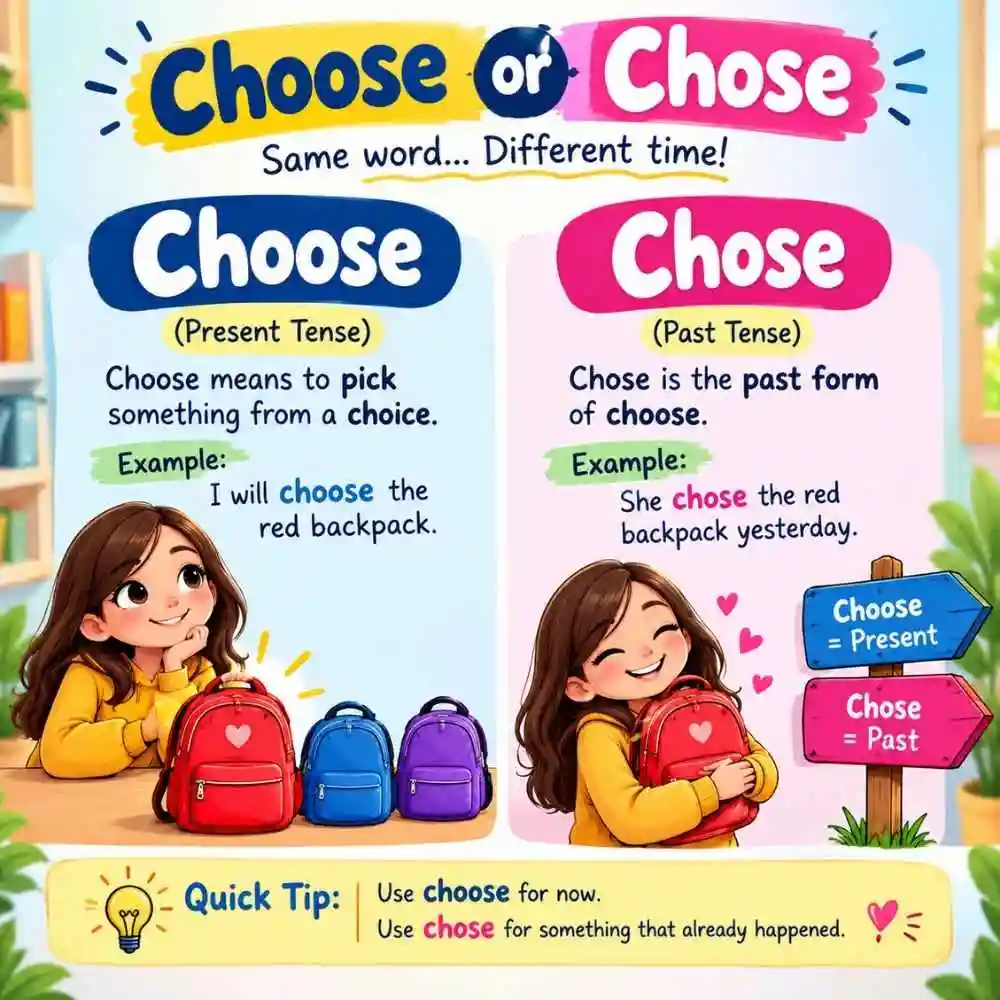
Choose and chose are two forms of the same verb, but they are used for different times. Choose is the present-tense form, while chose is the simple past form. The choice between them depends on when the action happens.
| Word | Verb form | When to use it | Example |
| Choose | Present tense | A current, regular, or future choice | I choose the blue shirt. |
| Chose | Simple past | A choice already made | I chose the blue shirt yesterday. |
A useful way to remember the difference is to connect choose with a choice happening now and chose with a choice that happened before. The past participle is chosen, which is used with helping verbs such as have, has, and had.
For example: “I choose tea every morning,” describes a regular choice, while “I chose tea yesterday,” describes a completed choice in the past.
The Origin of Choose or Chose
The words choose and chose have a long history in the English language. They developed from older Germanic forms and are related to similar words found in other Germanic languages. Over time, English developed different forms of the verb to show changes in tense.
Choose comes from an Old English verb related to the idea of selecting or deciding between possibilities. Its past form developed separately as chose, reflecting the irregular pattern that remains in modern English.
This makes choose an irregular verb. Unlike regular verbs, it does not form its past tense simply by adding -ed. For comparison, walk becomes walked, but choose changes to chose.
The verb also has a third important form: chosen. The basic pattern is:
Choose → Chose → Chosen
Understanding this historical and grammatical development explains why chose cannot be treated as a spelling variation of choose. Each form has a specific role in English grammar.
What is Choose?
Choose is the present-tense form of the verb meaning to select one person, thing, action, or possibility from two or more options. It can describe a choice being made now, a repeated decision, or, in some contexts, a future decision.
For example:
- I choose the healthier option.
- We usually choose this restaurant.
- You can choose any seat you like.
- I will choose my course tomorrow.
The word can also appear with modal verbs and other helping structures. In these cases, choose remains in its base form:
- You should choose carefully.
- She may choose another option.
- They will choose a new leader.
One important point is that choose does not always mean the decision is happening at this exact second. It can describe a habitual choice, a general preference, or a choice that someone is expected to make.
What is Chose ?
Chose is the simple past tense of choose. It is used when someone selected or decided on something at a completed point in the past.
For example:
- I chose the red dress yesterday.
- She chose the earlier train.
- We chose a different route last night.
- They chose John for the position.
The key idea is that the choice has already happened. Words such as yesterday, last week, earlier, ago, and in 2025 can often provide a clear past-time context, although they are not always necessary.
Chose should not normally be used for a present decision. For example, if you are deciding between two options right now, you would say, “I choose this one,” rather than “I chose this one.”
Remember that chose is different from chosen. Chose works as the simple past on its own, while chosen is the past participle and normally appears with a helping verb, as in “I have chosen this one.”
Read More: International Girl’s Day vs. International Girls’ Day
What Is the Difference Between Choose and Chose?
The main difference between choose and chose is verb tense. Choose is used for a present or general choice, while chose describes a choice that was completed in the past.
Consider these examples:
- Present: I choose the blue option.
- Past: I chose the blue option yesterday.
The subject does not determine whether you use choose or chose. The time and grammatical structure of the sentence do. With I, you, we, or they, the distinction remains the same when describing the base form and simple past.
A quick comparison makes the rule easier to remember:
| Feature | Choose | Chose |
| Meaning | Select or decide | Selected or decided |
| Tense | Present/base form | Simple past |
| Time | Now, regularly, or future with a helper | Completed past action |
| Example | I choose carefully. | I chose carefully. |
| Common context | Current or repeated choices | Previous decisions |
A common mistake is using chose when talking about a current decision or using choose when describing a completed past action. Always look at the time of the action before selecting the verb form.
The complete verb pattern is choose → chose → chosen. Once you connect each form with its grammatical role, the difference becomes straightforward: choose for the present or base form, chose for the simple past, and chosen for the past participle.
What Is the Past Tense of Choose?
The past tense of choose is “chose.” It is used when someone made a selection or decision at a completed time in the past. Because choose is an irregular verb, its past form does not follow the usual -ed pattern.
For example:
- I chose the blue notebook yesterday.
- She chose the earlier flight.
- We chose a quiet place for dinner.
- They chose the best option available.
The key point is that chose describes a choice that has already happened. If the choice is happening now or describes a regular action, use choose instead.
Choose → Chose is the basic present-to-past change. However, chose should not be confused with chosen, which has a different grammatical function.
What Is the Past Participle of Choose?
The past participle of choose is “chosen.” Unlike chose, chosen is not normally used by itself as the simple past tense. It usually appears with a helping verb such as have, has, or had.
Examples include:
- I have chosen the blue option.
- She has chosen her university.
- They had chosen a different route.
- We have chosen the final design.
The form chosen can also appear in passive constructions:
- She was chosen for the position.
- He was chosen as the team leader.
A simple way to remember the three main forms is:
Choose → Chose → Chosen
Here, choose is the base/present form, chose is the simple past, and chosen is the past participle.
Read More: How-To vs. How-Tos: Which Form Is Correct?
Choose vs. Chose vs. Chosen: What Is the Difference?
Although choose, chose, and chosen all come from the same verb, they have different grammatical roles. The correct form depends on the tense and sentence structure.
| Word | Grammatical form | Main use | Example |
| Choose | Base/present form | Present choices, habits, or after modal/helping verbs | I choose tea every morning. |
| Chose | Simple past | A completed choice in the past | I chose tea yesterday. |
| Chosen | Past participle | With have, has, had or in passive constructions | I have chosen tea. |
The easiest distinction is time versus sentence structure. Use chose when the selection happened in the past without a perfect helping verb. Use chosen when the sentence requires a past participle.
For example, “I chose this book” tells us about a completed past decision. In contrast, “I have chosen this book” uses the present perfect and emphasizes the connection between the past choice and the present situation.
British English vs American English Spelling
There is no spelling difference between British English and American English for choose, chose, or chosen. Both varieties use the same spellings and the same basic verb forms.
| Form | British English | American English | Difference |
| Base form | choose | choose | No difference |
| Simple past | chose | chose | No difference |
| Past participle | chosen | chosen | No difference |
| Present example | I choose this option. | I choose this option. | Same |
| Past example | I chose this option. | I chose this option. | Same |
| Perfect example | I have chosen this option. | I have chosen this option. | Same |
Unlike some English words that have different British and American spellings, choose, chose, and chosen remain identical in both varieties. The grammatical rules are also essentially the same, so writers do not need to change these forms based on whether they are writing for a British or American audience.
The important distinction is therefore not British vs. American spelling, but knowing when to use each form according to tense and sentence structure.
Which Spelling Should You Use?
The correct spelling depends on the time of the action. Use choose for the present or for a choice that is generally true. Use chose when talking about a completed choice in the past. Chosen is the past participle and usually appears with has, have, or had.
| Word | When to Use | Example |
| Choose | Present or general choice | I choose tea every morning. |
| Chose | Completed past choice | I chose tea yesterday. |
| Chosen | Past participle | I have chosen tea. |
When Should You Use Choose?
Use choose when the action happens now, happens regularly, or describes a choice you are about to make. It is also used after modal verbs such as will, can, should, and may.
Examples:
- I choose the blue shirt.
- We usually choose a quiet restaurant.
- You can choose any seat.
- She will choose her favorite book later.
- Always choose the option that works best for you.
When Should You Use Chose?
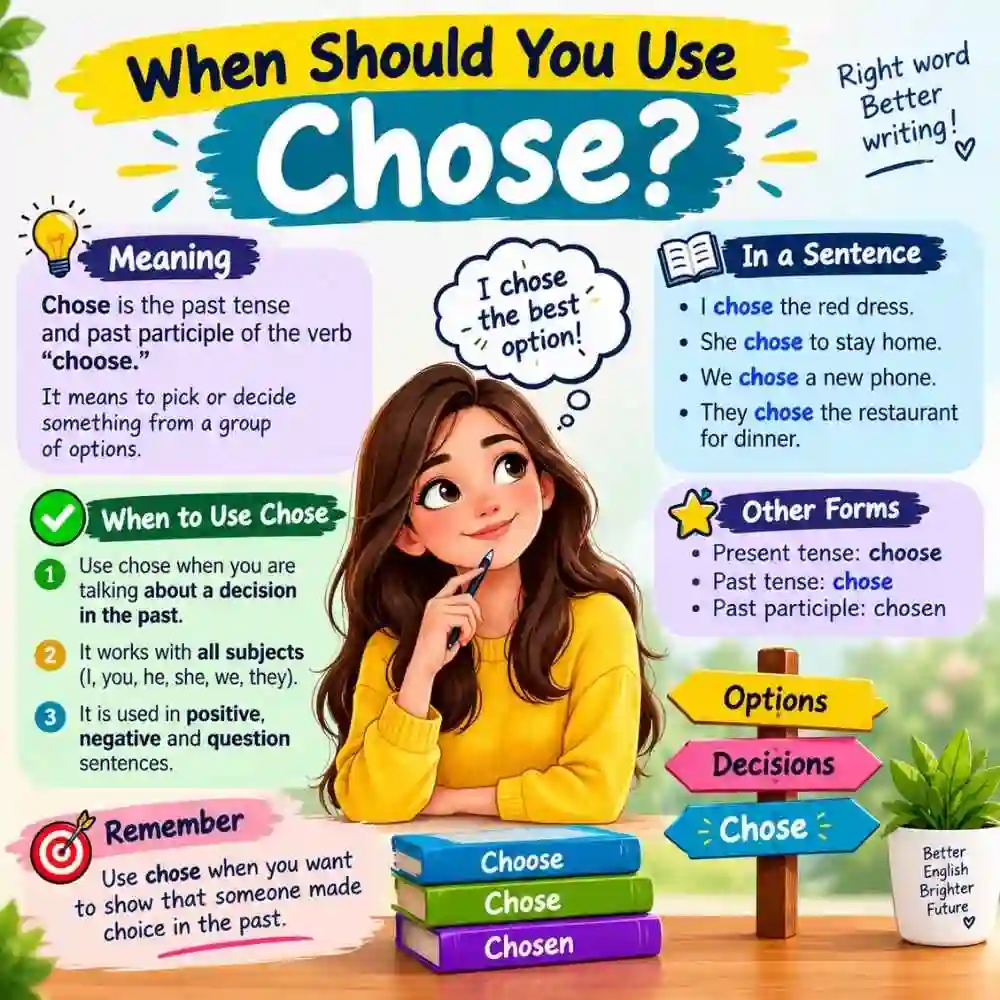
Use chose when someone made a choice that was completed in the past. It is the simple past form of choose.
Examples:
- I chose the red dress yesterday.
- She chose the first option.
- They chose a different route last night.
- He chose to study English in college.
- We chose the smaller table for our group.
A useful clue is a past-time expression such as yesterday, last week, last year, or an hour ago.
Is Choose a Regular or Irregular Verb?
Choose is an irregular verb because its past form does not end in -ed. Instead, its forms change from choose to chose and then chosen.
The three main forms are:
Choose → Chose → Chosen
For example:
- Present: I choose my clothes carefully.
- Past: I chose this jacket yesterday.
- Past participle: I have chosen this jacket.
Read More: Teacher’s Day vs Teachers’ Day: Which Is Correct and Why? 2026
What Are the Three Forms of Choose?
The three forms of choose are choose, chose, and chosen. Each form has a different grammatical role.
| Form | Grammar | Example |
| Choose | Base/present form | I choose healthy food. |
| Chose | Simple past | I chose healthy food yesterday. |
| Chosen | Past participle | I have chosen healthy food. |
Remembering choose → chose → chosen makes it easier to use the verb correctly in both speaking and writing.
Choose or Chose in Questions
In questions, use choose when asking about a present, future, or general choice. Use chose when asking about a choice that happened in the past.
Examples:
- Which color did you choose?
- What did you choose for dinner?
- Which option will you choose?
- Why did she choose that book?
- How do you choose the right answer?
Remember that did is followed by the base form choose, not chose.
Choose or Chose in Negative Sentences
Use choose after do, does, did, will, can, and other helping or modal verbs. The helping verb shows the tense, so the main verb stays in its base form.
Examples:
- I do not choose that option.
- She does not choose expensive products.
- We did not choose the blue one.
- They will not choose that restaurant.
- He cannot choose between the two options.
A common mistake is writing “did not chose.” The correct form is “did not choose.”
Choose or Chose in Conditional Sentences
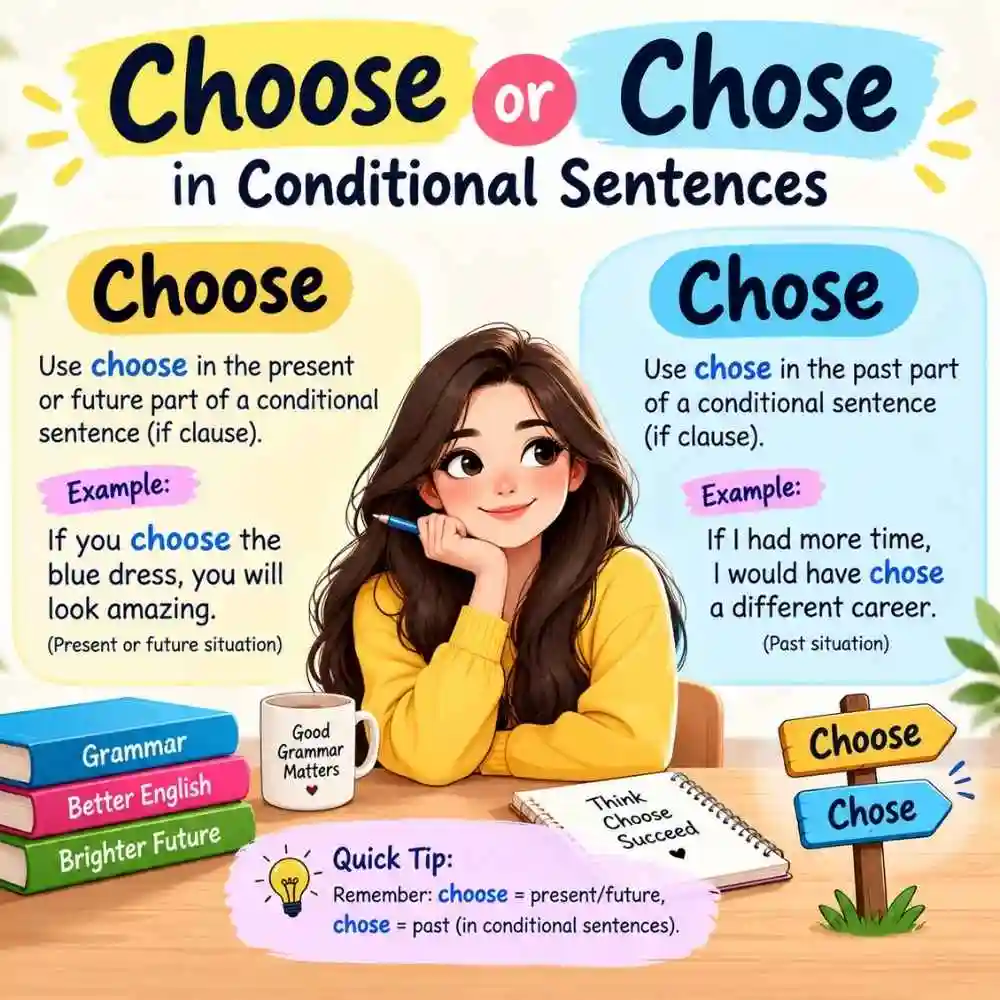
The correct form depends on the type of conditional sentence. Choose commonly appears in present or future conditions, while chose can describe a past choice when the sentence refers to an earlier situation.
Examples:
- If you choose this option, you will save time.
- If she chooses carefully, she may find a better option.
- If I could choose, I would take the earlier flight.
- If he had chosen differently, the result might have changed.
Notice that chosen, rather than chose, is used after had in a past perfect conditional.
Common Mistakes with Choose or Chose
Several mistakes happen because choose and chose sound and look similar.
| Incorrect | Correct | Why |
| I chose this every day. | I choose this every day. | General present habit |
| I did not chose it. | I did not choose it. | Did takes the base form |
| She will chose later. | She will choose later. | Will takes the base form |
| He has chose the winner. | He has chosen the winner. | Has takes the past participle |
| They had chose another route. | They had chosen another route. | Had takes the past participle |
The easiest way to avoid these errors is to check the helping verb before selecting the form.
Choose or Chose in Everyday Examples
Both words appear often in everyday conversations, but they describe different times.
- I choose coffee every morning.
- She chose the window seat yesterday.
- Did you choose a movie?
- We chose pizza for dinner last night.
- You can choose any color.
- He chose the black jacket at the store.
- I usually choose simple designs.
- They chose a different hotel on their trip.
- Which one will you choose?
- She chose the first answer on the test.
Read More: Per Se or Per Say: Which Spelling Is Correct? 2026
Choose and Chose Pronunciation: Is There a Difference?
Yes. Choose and chose have different vowel sounds.
Choose has the long oo sound, while chose has the long o sound. The final sound is also different: choose ends with a /z/ sound, while chose ends with a /z/ sound as well.
How to Remember the Difference Between Choose and Chose
A simple memory trick is to connect choose with the present and chose with the past.
Think of the pattern:
Choose → Chose → Chosen
You can also remember these examples:
- Today: I choose.
- Yesterday: I chose.
- Already decided: I have chosen.
Another useful clue is that chose contains the letter o, which can remind you of an old/past choice. This is only a memory trick, but it can help you quickly select the right form.
Choose or Chose – Google Trends & Usage Data
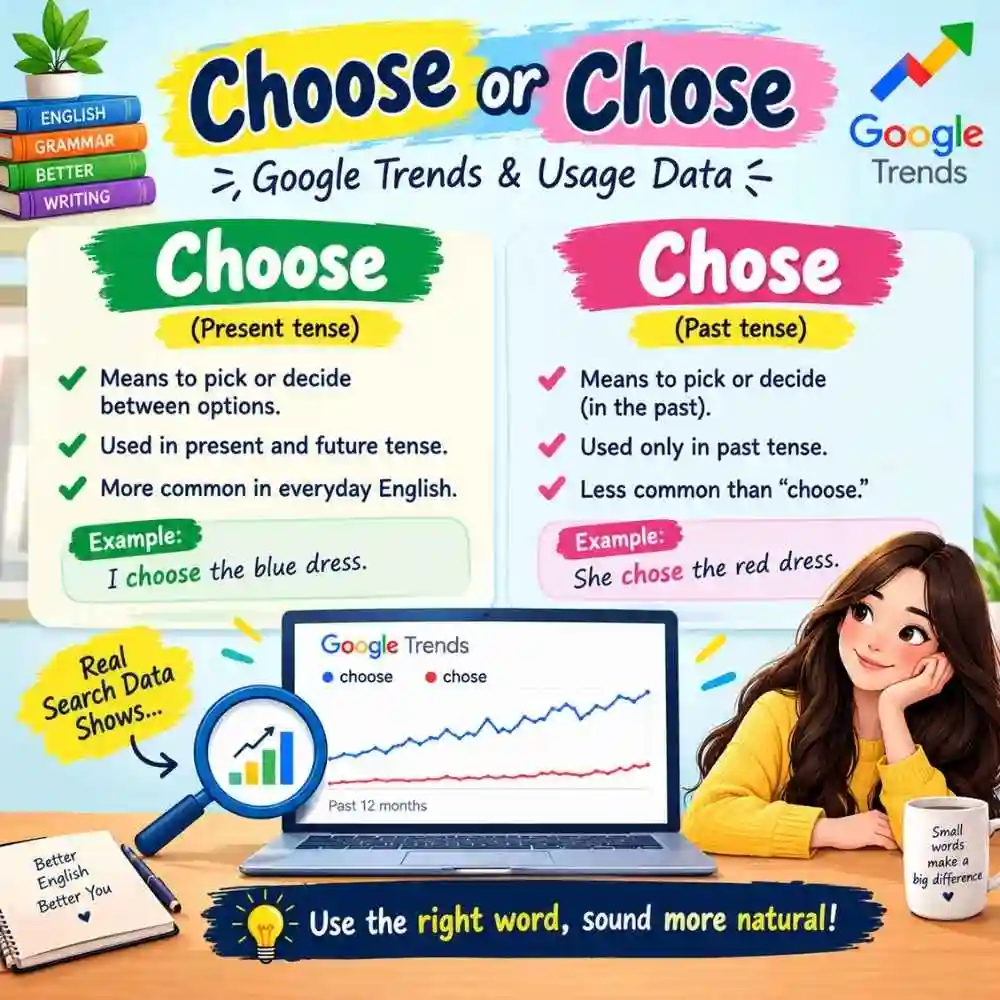
Search interest for choose and chose can vary over time because they serve different grammatical purposes. Choose is the base form, while chose is the simple past form, so comparing the two as if they were interchangeable spellings can be misleading.
For content and search research, it is more useful to examine related queries separately, such as choose or chose, chose vs choose, past tense of choose, and past participle of choose. These searches reflect different user questions and should be treated as separate keyword intents rather than repeating the same explanation.
Keyword Variations Comparison Table
| Keyword Variation | Main Search Intent |
| choose or chose | Basic spelling and grammar difference |
| choose vs chose | Direct comparison |
| chose vs choose | Reverse comparison of the same forms |
| past tense of choose | Find the correct past form |
| past participle of choose | Learn the form chosen |
| choose chose chosen | Learn all three verb forms |
| is chose a word | Confirm whether chose is correct |
| is choose a word | Understand the base verb |
| choose in a sentence | See practical usage |
| chose in a sentence | See past-tense examples |
| choose or chose in a sentence | Compare usage in context |
| choose vs chose vs chosen | Understand all three forms |
Frequently Asked Questions About Choose or Chose
1. What is the difference between choose and chose?
Choose is the present or base form, while chose is the simple past form. For example, “I choose tea every morning” describes a regular choice, while “I chose tea yesterday” describes a completed past choice.
2. Is chose the past tense of choose?
Yes. Chose is the simple past tense of choose. The three main forms are choose, chose, chosen.
3. What is the past participle of choose?
The past participle is chosen. It is normally used with helping verbs such as have, has, and had. For example, “She has chosen the blue dress.”
4. Is choose a regular or irregular verb?
Choose is an irregular verb because its past form is chose, not “choosed.” Its three forms are choose → chose → chosen.
5. Should I say “I choose” or “I chose”?
Use I choose for a present or regular choice. Use I chose when referring to a choice you made in the past. For example, “I choose coffee every morning” and “I chose coffee yesterday.”
6. Is “Did you chose?” grammatically correct?
No. The correct sentence is “Did you choose?” After did, the main verb must use its base form. Therefore, use choose, not chose.
7. Is “I have chose” correct?
No. The correct form is “I have chosen.” After have or has, use the past participle chosen, not the simple past chose.
8. Do choose and chose have different pronunciations?
Yes. Choose and chose have different vowel sounds. Choose has the long “oo” sound, while chose has the long “o” sound.
9. Is there a British or American spelling difference between choose and chose?
No. Choose, chose, and chosen are spelled the same in British English and American English. The difference is grammatical, not regional.
10. How can I easily remember choose, chose, and chosen?
Remember the simple pattern: choose = present, chose = past, and chosen = past participle. A quick memory line is: Today I choose, yesterday I chose, and I have chosen already.
Conclusion
Understanding choose vs. chose becomes easy when you connect each word with its time and grammatical form. Use choose for the present, regular choices, or after helping verbs such as will, can, and did. Use chose for a completed action in the past.
The third form, chosen, is equally important because it works as the past participle. You will usually see it with have, has, or had, as in “I have chosen the best option.” Remembering choose → chose → chosen gives you a simple way to use all three forms correctly.
Whether you are writing an email, answering a question, or creating everyday sentences, choosing the correct form makes your English clear and grammatically accurate. Keep the basic rule in mind: choose for present, chose for past, and chosen after have, has, or had.

I’m Jane Austen, the admin of GrammarGuide.com, where words come to life in smarter, sharper, and more creative ways. I focus on simplifying grammar, exploring powerful synonyms, and sharing fun, engaging expressions that make everyday communication more effective. My goal is to help readers write with clarity, confidence, and a touch of personality, whether it’s for professional use or just for fun.



