Clear writing often depends on choosing the right words, especially when two phrases look similar but carry different meanings. “In Process” vs “In Progress” is a common point of confusion because both expressions describe something that has started, yet they are not always used in the same situations. Many writers and speakers use them interchangeably without understanding the subtle difference in meaning, grammar, and context.
Understanding the distinction between in process and in progress helps improve accuracy in professional communication, academic writing, workplace updates, and everyday conversations. This guide explains the meaning, usage, and differences between these two phrases, including when each expression fits naturally in a sentence. You will also learn how context affects their use and how to avoid common mistakes. Keep reading to discover the correct way to use “in process” and “in progress” with confidence.
What “In Process” vs “In Progress” Really Mean
“In Process” and “In Progress” look almost identical, which is why many writers use them as if they have the same meaning. Both phrases describe something that has started but has not reached completion. However, they focus on different ideas and appear in different contexts.
The phrase “in progress” usually emphasizes that an activity, task, or event is actively happening and moving forward. For example, a project, meeting, repair, or assignment can be in progress because the work is currently underway.
On the other hand, “in process” often refers to something that is going through a particular procedure, system, or series of steps. It highlights the method or stage of development rather than the active movement of the work itself.
Understanding this difference improves clarity in professional writing, workplace communication, academic documents, and everyday conversations. Choosing the correct phrase helps readers understand whether something is actively happening or simply moving through an established process.
Meaning of “In Process”
“In process” means that something is currently going through a defined procedure, system, or set of steps. It focuses on the process or method involved, rather than the action happening at that exact moment.
This phrase often appears in formal, technical, or organizational contexts where a task follows specific guidelines or stages. It suggests that an outcome is being developed, reviewed, handled, or completed according to a structured process.
For example:
- “Your application is in process and will be reviewed soon.”
- “The documents are in process with the approval department.”
- “The payment request is in process.”
In these examples, the focus is not on the speed or activity of the task. Instead, the emphasis is on the fact that the task has entered a system and is moving through required steps.
However, “in process” is less common in casual conversation than “in progress.” Many native speakers prefer alternatives such as “being processed,” “under review,” or “currently being handled” depending on the situation.
The phrase can also describe personal or developmental changes. For example:
- “Learning a new skill is an in-process journey.”
Here, the idea is that growth happens through different stages over time.
Meaning of “In Progress”
“In progress” means that something has started and is currently happening or continuing toward completion. It highlights an ongoing activity, event, or task.
This phrase is widely used in everyday speech, workplace updates, education, and project management because it clearly shows that work is actively underway.
Examples include:
- “The construction work is in progress.”
- “My assignment is still in progress.”
- “The meeting is in progress, so please wait.”
When people say something is in progress, they usually mean that the action has not finished yet. It may be paused temporarily or actively continuing, but the task remains incomplete.
The phrase is especially common in status updates. Businesses often use terms like “work in progress,” “project in progress,” or “application progress” to communicate current situations.
A helpful way to remember the difference is:
- In progress = something is happening or moving forward.
- In process = something is going through a procedure or system.
For most everyday situations, “in progress” sounds more natural and is the preferred choice when describing ongoing activities.
Where These Words Come From (And Why It Matters)
Understanding the origins of “process” and “progress” helps explain why these two phrases developed different meanings. Although both words describe movement or change, their roots point to different ideas.
Process is connected with the idea of a path, method, or sequence of actions. It focuses on the steps needed to achieve a result.
Progress is connected with moving forward or advancing. It focuses on development, improvement, and forward movement.
This difference in meaning explains why we use these words differently in modern English. A process describes how something happens, while progress describes how something advances.
Learning the background of these terms can help writers make better vocabulary choices and avoid confusing similar expressions. Understanding word origins, also known as etymology, often provides useful clues about correct usage.
Origin of “Process”
The word “process” comes from the Latin word “processus,” meaning “a going forward” or “a course of action.” It later entered Old French and Middle English, where it developed the meaning of a series of actions or steps used to complete something.
Today, process refers to an organized method, procedure, or system. It appears in many fields, including business, science, technology, education, and everyday communication.
Examples of modern uses include:
- Manufacturing process — the steps used to create a product.
- Learning process — the stages involved in gaining knowledge.
- Approval process — the steps required before acceptance.
Because the word focuses on structure and sequence, “in process” naturally connects with situations where something moves through a planned system.
For example:
- “The visa application is in process.”
This suggests that the application is following an official procedure rather than simply happening at the moment.
Origin of “Progress”
The word “progress” comes from the Latin word “progressus,” meaning “an advance” or “a forward movement.” It combines ideas related to moving ahead and developing over time.
In modern English, progress describes improvement, growth, or movement toward a goal. It is commonly used when discussing achievements, projects, personal development, and ongoing activities.
Examples include:
- “She is making progress in her studies.”
- “The team has made good progress on the project.”
- “The research is progressing well.”
Because progress focuses on forward movement, the phrase “in progress” describes something that is currently continuing or developing.
This historical connection explains why “in progress” feels natural for active tasks, while “in process” works better when the focus is on a structured procedure or system. Understanding this distinction makes word choice easier and improves overall communication accuracy.
Why “In Progress” Is More Common Today
“In progress” has become the more common phrase in modern English because it communicates an idea that most speakers and writers want to express: something is currently happening and moving toward completion. It sounds natural in everyday conversations, workplace updates, education, and digital communication.
While “in process” is still correct in certain situations, it often feels more formal, technical, or connected to a specific procedure. In contrast, “in progress” provides a quick and clear update about the current status of an activity.
The popularity of “in progress” also comes from its flexibility. People use it to describe tasks, events, projects, changes, and personal development. From a simple conversation to professional reports, the phrase fits many communication settings.
1. It’s clearer
“In progress” gives readers and listeners an immediate understanding that something is actively happening. The phrase clearly signals an unfinished task, activity, or event.
For example:
- “The website redesign is in progress.”
- “The repairs are in progress.”
These sentences quickly tell the audience that work has started but has not finished yet.
Because modern communication often values quick and direct information, in progress works well for status updates, notifications, and announcements.
2. It feels more active
The phrase “in progress” creates a stronger sense of movement and development. It suggests that something is advancing toward a goal.
For example:
- “The investigation is in progress.”
This tells readers that the investigation is currently continuing.
By comparison, “in process” focuses more on the procedure involved. It may describe a situation where something is moving through official steps but does not always create the same feeling of active movement.
This active quality makes “in progress” a preferred choice when writers want to show ongoing action.
3. It’s used in project management
In project management, “in progress” is one of the most common status labels used to describe ongoing work. Teams use it in task boards, reports, software tools, and workplace communication.
Common project statuses include:
- Not started
- In progress
- Completed
- On hold
For example:
- “The marketing campaign is currently in progress.”
- “The development team has three tasks in progress.”
The phrase works well because it gives teams a simple way to show that work has begun and requires further action before completion.
4. It works in more contexts
One major reason “in progress” is more common is its wide range of uses. It can describe physical activities, professional tasks, creative work, learning, and personal growth.
Examples:
- “The construction project is in progress.”
- “The exam is in progress.”
- “My training is still in progress.”
- “The discussion is in progress.”
This flexibility makes it useful across many situations. “In process” has a narrower meaning because it usually connects to procedures, systems, or formal steps.
When to Use “In Progress” vs. “In Process” (Context-Based Guide)
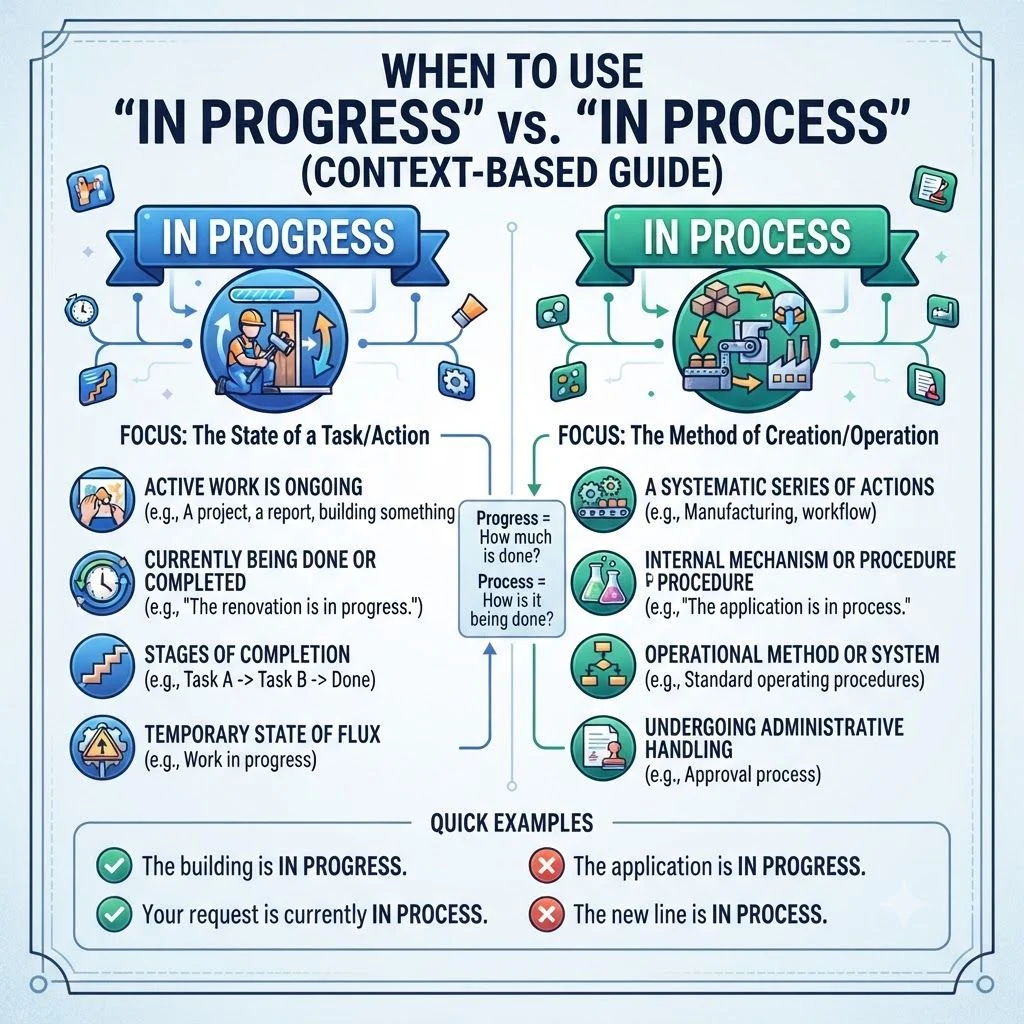
Choosing between “in progress” and “in process” depends on what you want to emphasize. The key difference is whether you are describing an ongoing activity or a structured procedure.
Use “in progress” when the main idea is that something is happening, continuing, or moving toward completion.
Use “in process” when the main idea is that something is passing through a specific system, method, or series of steps.
A simple way to decide:
- Ask: “Is the action happening right now?” → Use in progress.
- Ask: “Is something going through an official procedure?” → Use in process.
Understanding this context-based difference helps avoid awkward wording and improves accuracy in both formal and casual writing.
Use “In Progress” when:
Use “in progress” when you want to describe an activity, event, task, or project that has started but has not finished.
Common situations include:
1. Ongoing work
- “The report is in progress.”
- “The repairs are in progress.”
2. Projects and assignments
- “The research project is in progress.”
- “My final paper is still in progress.”
3. Events happening at the moment
- “The meeting is in progress.”
- “The game is in progress.”
4. Personal development
- “Her recovery is a work in progress.”
- “Learning a language is an ongoing process and always in progress.”
In these examples, the focus stays on continuation, activity, and movement toward an outcome.
Use “In Process” when:
Use “in process” when you want to emphasize that something is going through a defined procedure, review system, or formal sequence.
Common situations include:
1. Administrative procedures
- “The application is in process.”
- “The request is in process with the department.”
2. Official reviews or approvals
- “The approval is in process.”
- “The documents are in process for verification.”
3. Structured systems
- “The order is in process at the warehouse.”
In many cases, modern speakers may choose alternatives such as “being processed” or “under review” because they sound more natural.
For example:
- Less natural: “Your payment is in process.”
- More common: “Your payment is being processed.”
The phrase “in process” is not incorrect, but it usually appears in specific contexts where a procedure or system matters.
Side-By-Side Comparison: “In Process” vs “In Progress”
| Feature | In Process | In Progress |
| Main meaning | Going through a procedure or system | Currently happening or continuing |
| Focus | Steps, method, or process | Activity, movement, or development |
| Common usage | Formal, administrative, technical contexts | Everyday, professional, and general communication |
| Frequency | Less common | More common |
| Example | “The application is in process.” | “The application review is in progress.” |
| Natural alternatives | Being processed, under review | Ongoing, underway |
| Best used for | Procedures and official stages | Tasks, events, projects, and activities |
Both phrases can describe something unfinished, but they highlight different aspects. “In progress” focuses on the action itself, while “in process” focuses on the system or steps involved. Choosing the right phrase depends on the context and the message you want to communicate.
Read More: Newfound vs New-Found: What’s The Difference 2026
Comparison Examples (To Make It Crystal Clear)
The difference between “in process” and “in progress” becomes easier to understand when you see how each phrase works in real sentences. Both expressions describe unfinished situations, but the focus changes depending on the context.
Example 1
In Progress:
- “The construction of the new office building is in progress.”
This sentence means that construction work has started and workers are actively continuing the project.
In Process:
- “The building permit application is in process.”
This means the application is moving through an official approval procedure.
The construction itself is an activity, so in progress fits better. The permit follows a system, so in process works naturally.
Example 2
In Progress:
- “The teacher’s training program is in progress.”
This shows that the training sessions are currently happening and have not ended.
In Process:
- “The teacher certification review is in process.”
This focuses on the official evaluation steps required for certification.
The training involves active learning, while the certification involves a formal procedure.
Example 3
In Progress:
- “The website redesign project is in progress.”
This tells readers that designers and developers are currently working on the project.
In Process:
- “The website approval process is in process.”
This means the website is going through a review or approval system.
A project moves forward through action, while approval follows specific steps.
Is “In Process” Grammatically Correct?
Yes, “in process” is grammatically correct, but its use is more limited than “in progress.” The phrase works when you want to describe something that is moving through a defined procedure, system, or series of steps.
For example:
- “Your application is in process.”
- “The documents are in process for approval.”
In these sentences, the focus is on an organized procedure rather than an activity happening in real time.
However, many native English speakers prefer alternatives such as “being processed,” “under review,” or “in progress” depending on the situation. This is why “in process” can sometimes sound less natural in casual conversations.
The phrase is more common in business, administration, customer service, and technical environments where processes and workflows are clearly defined.
The key point is that “in process” is not wrong. It simply carries a more specific meaning than “in progress.”
“In Process” vs “In Progress” in American English
| Feature | In Process | In Progress |
| Main meaning | Going through a procedure or system | Currently happening or developing |
| Common usage | Formal, administrative, technical situations | Everyday and professional communication |
| Frequency | Less common | Very common |
| Focus | Steps and procedures | Activity and movement |
| Example | “Your application is in process.” | “The project is in progress.” |
| Natural alternatives | Being processed, under review | Ongoing, underway |
| Typical contexts | Applications, approvals, requests | Tasks, meetings, projects, events |
In American English, “in progress” is generally the more common expression. People use it frequently for work updates, projects, events, and activities.
“In process” appears more often in official or procedural contexts, especially when something follows a specific workflow.
Examples:
- “The refund request is in process.”
- “The software update is in progress.”
American speakers often choose clearer alternatives such as “being processed” when talking about customer service or administrative tasks.
“In Process” vs “In Progress” in British English
| Feature | In Process | In Progress |
| Main meaning | Passing through a formal process | Continuing activity or development |
| Common usage | Less frequent, usually formal | More natural and widely used |
| Focus | Procedure and stages | Ongoing action |
| Example | “The application is in process.” | “The repairs are in progress.” |
| Common alternative | Being processed | Underway |
| Everyday preference | Limited use | Preferred choice |
In British English, “in progress” is also the more natural and widely used phrase for ongoing activities.
British speakers commonly use terms like “work in progress” and “underway” when describing something that has started but is not complete.
“In process” can still appear in formal contexts, but many speakers may prefer clearer wording.
Example:
Less natural:
- “Your request is in process.”
More natural:
- “Your request is being processed.”
Can “In Process” and “In Progress” Be Used Interchangeably?
No, “in process” and “in progress” are not completely interchangeable. Although both describe unfinished situations, they emphasize different ideas.
In progress focuses on an activity that is happening:
- “The construction work is in progress.”
This means workers are actively continuing the construction.
In process focuses on a procedure or system:
- “The construction permit is in process.”
This means the permit is moving through an approval process.
Using one phrase instead of the other may change the meaning of a sentence. Choosing the correct expression helps readers understand whether something is actively happening or simply being handled through a procedure.
Is “in process” outdated?
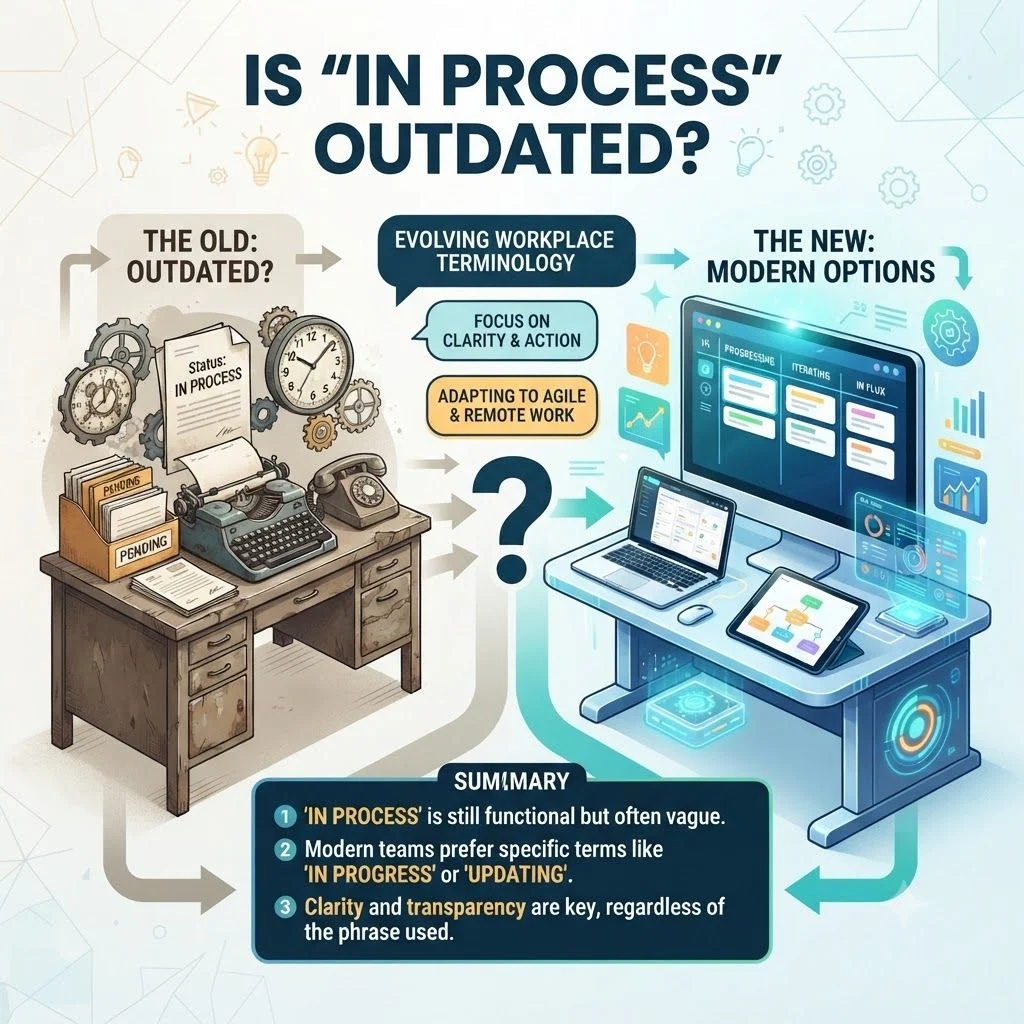
No, “in process” is not outdated, but it is less common than “in progress.” The phrase is still used in professional, technical, and administrative settings.
For example:
- “The application is in process.”
- “The approval request is in process.”
However, in many everyday situations, modern English speakers prefer more natural alternatives:
- “The application is being processed.”
- “The request is under review.”
The phrase has not disappeared, but its usage has become more specialized.
Is “in progress” more natural in English?
Yes, “in progress” is usually more natural in modern English, especially when describing ongoing activities.
People commonly use it for:
- Projects
- Meetings
- Repairs
- Learning
- Research
- Creative work
- Events
Examples:
- “The project is in progress.”
- “The meeting is in progress.”
- “The artwork is still in progress.”
Because it clearly communicates that something is happening now, it works well in both casual conversations and professional communication.
Do companies use “in process” differently?
Yes, many companies use “in process” as an internal status label to describe items moving through a workflow.
For example, a company may label:
- Customer requests as In Process
- Applications as In Process
- Orders as In Process
In these cases, the phrase refers to a company’s internal system rather than everyday speech.
However, companies may define these terms differently. One organization may use “In Process” to mean “being reviewed,” while another may use it to mean “work has started.”
For clear communication, businesses often create specific status definitions, such as:
- In Progress → Someone is actively working on the task.
- In Process → The task is moving through a required workflow.
This distinction helps teams, customers, and stakeholders understand the exact stage of work.
Read More: Family and Friends or Friends and Family: Which Is Correct?
How Different Industries Use “In Process” vs “In Progress”
Different industries use these phrases based on whether they are describing an ongoing activity or a structured procedure. Understanding industry-specific usage helps professionals communicate more accurately.
“In progress” commonly appears in project updates, workflow tracking, and active tasks. “In process” often appears in systems where something must pass through specific stages, checks, or approvals.
Technology & Agile Workflows
In technology and Agile project management, “in progress” is the more common phrase. Development teams use it to describe tasks that engineers, designers, or testers are actively working on.
Examples:
- “The software update is in progress.”
- “The bug fix is currently in progress.”
- “The feature development task is in progress.”
Project management platforms often use In Progress as a task status between “To Do” and “Completed.”
However, “in process” may appear when technology teams discuss a defined workflow or system.
Example:
- “The data migration process is in process.”
In this case, the focus is on the stages involved in completing the migration.
Business & Operations
Businesses use both phrases, but they serve different purposes.
In progress describes active business activities:
- “The sales campaign is in progress.”
- “The company expansion plan is in progress.”
In process often relates to internal procedures:
- “The employee onboarding request is in process.”
- “The contract review is in process.”
When managers provide updates, in progress usually sounds clearer because it tells teams that work is actively moving forward.
Customer Service
Customer service teams often use language related to processing requests, which makes “in process” appear more frequently.
Examples:
- “Your refund request is in process.”
- “Your replacement order is being processed.”
However, when describing an activity happening at the moment, customer service may use in progress:
- “Your chat support session is in progress.”
The difference depends on whether the focus is on a service procedure or an active interaction.
Manufacturing & Supply Chain
Manufacturing uses both expressions because production involves activities and processes.
In progress:
- “The product assembly is in progress.”
- “The quality testing is in progress.”
These examples describe actions currently taking place.
In process:
- “The order is in process at the production facility.”
This suggests that the order has entered a production system and is moving through required stages.
Academia & Research
In education and research, in progress is widely used for ongoing work.
Examples:
- “The research study is in progress.”
- “The thesis project is still in progress.”
Researchers often describe unfinished studies, experiments, and writing projects this way.
In process may appear when discussing research methods or formal procedures:
- “The data review is in process.”
However, many writers prefer clearer alternatives such as “under review” or “being analyzed.”
Creative Industries (Art, Design, Writing)
Creative fields usually favor “in progress” because creative work develops over time.
Examples:
- “The novel is in progress.”
- “The artwork is still in progress.”
- “The design concept is in progress.”
The phrase “work in progress” is especially common in creative industries. It shows that a project is incomplete but actively developing.
In process is less common because creative work usually emphasizes growth and development rather than a fixed procedure.
Read More: Hola or Ola: What’s the Difference and Which One Should You Use?
Grammar Rules: How to Use Each Phrase Correctly
The correct use of “in process” and “in progress” depends on meaning, context, and sentence structure.
Both phrases function as adjective phrases because they describe the current state of something. They usually appear after linking verbs such as is, are, was, or were.
Examples:
- “The project is in progress.”
- “The application is in process.”
The main grammar rule is simple:
- Use in progress for ongoing activities.
- Use in process for things moving through a procedure.
Choosing the correct phrase improves clarity and prevents confusion for readers.
Sentence Construction
Both phrases commonly follow a subject + linking verb structure.
Structure:
Subject + be verb + in progress/in process
Examples:
- “The repairs are in progress.”
- “The approval request is in process.”
They can also appear before nouns when used as modifiers.
Examples:
- “An in-progress project requires regular updates.”
- “An in-process application needs further review.”
When used before a noun, the phrases usually take a hyphen.
Correct placements
Correct placement helps the sentence sound natural.
✅ Correct:
- “The investigation is in progress.”
- “The payment request is in process.”
- “The project currently in progress will finish next month.”
❌ Incorrect:
- “The progress is in project.”
- “The process is in application.”
The phrase should describe the status of a task, activity, or procedure.
Verb Combinations
Certain verbs naturally work better with each phrase. Choosing the right combination improves sentence flow and meaning.
Pairs with “In Progress”:
Common combinations include:
- Work in progress
- Project in progress
- Task in progress
- Meeting in progress
- Development in progress
- Research in progress
- Construction in progress
- Changes in progress
Examples:
- “The website development is in progress.”
- “The meeting is in progress.”
These combinations emphasize ongoing action and movement.
Pairs with “In Process”:
Common combinations include:
- Application in process
- Approval in process
- Request in process
- Review in process
- Procedure in process
- Verification in process
Examples:
- “Your application is in process.”
- “The document review is in process.”
These combinations highlight systems, procedures, and formal steps.
Understanding these common pairings helps writers choose the phrase that matches the intended meaning.
Capitalization Notes
The capitalization of “in process” and “in progress” depends on where and how you use them. In normal sentences, both phrases are usually written in lowercase because they are common expressions, not proper nouns.
Examples:
- “The project is in progress.”
- “The application is in process.”
However, capitalization may change when these phrases appear in titles, headings, labels, or official documents.
Examples:
- Project In Progress
- Application In Process
- Work in Progress Report
Different style guides may use different title capitalization rules, but the phrases themselves do not require capital letters unless they appear in a title or a specific naming format.
When writing professional documents, consistency matters more than capitalization choice. Use the same style throughout your report, presentation, or website content.
Quick Memory Tricks (Easy to Remember)
Remembering the difference between “in process” and “in progress” becomes easier when you connect each phrase with its main idea.
Mnemonic 1:
Progress = Going Forward
Think of the word progress as movement toward a goal.
- A project moves forward.
- A task moves forward.
- A person develops skills.
So, if something is actively moving ahead, use in progress.
Example:
- “The project is in progress.”
Mnemonic 2:
Process = Steps
Think of process as a series of steps or a system.
- Applications follow procedures.
- Requests go through reviews.
- Documents follow approval stages.
If something moves through an organized method, use in process.
Example:
- “The application is in process.”
Mnemonic 3:
P in Progress = Present Action
The letter P in progress can remind you of present activity.
Ask yourself:
“Is this happening right now?”
If yes, in progress is usually the better choice.
Quick Test:
Ask one simple question:
“Is it an activity or a procedure?”
- Activity → In Progress
- Procedure → In Process
Examples:
- “The painting is ___.” → In progress
- “The visa application is ___.” → In process
This quick test helps you choose the right phrase in everyday writing.
Read More: Violet vs Indigo vs Purple: What’s the Real Difference? 2026
Common Mistakes (Avoid These)
Although “in process” and “in progress” have related meanings, using them incorrectly can create confusion. Understanding common mistakes helps improve grammar accuracy and communication.
Mistake 1: Using “in process” for tasks
Many people use “in process” when they simply mean that a task is happening. In most everyday situations, “in progress” sounds more natural.
Incorrect:
- “The homework is in process.”
Better:
- “The homework is in progress.”
A homework assignment is an ongoing activity, not a formal procedure.
Mistake 2: Using “in progress” for system steps
Using “in progress” for official procedures can sometimes make the meaning less precise.
Less clear:
- “Your application is in progress.”
Better in formal contexts:
- “Your application is in process.”
- “Your application is being processed.”
The second version highlights that the application is moving through a system.
Mistake 3: Mixing them in documentation
Professional documents should use consistent language. Switching between these phrases without a clear reason can confuse readers.
For example, a company should avoid writing:
- “Order A is in progress.”
- “Order B is in process.”
- “Order C is being processed.”
If all orders follow the same workflow, choose one clear term and use it consistently.
Mistake 4: Over-formalizing everyday language
Some writers choose “in process” because it sounds more professional. However, formal wording does not always mean better wording.
Example:
- “The meeting is in process.”
This sounds unnatural in most conversations.
Better:
- “The meeting is in progress.”
Clear and simple language usually communicates better than unnecessary formality.
Real Case Study: A Technical Team Miscommunication
A software development team created a project dashboard with two status labels: “In Process” and “In Progress.” Team members used both terms for active coding tasks, which caused confusion.
Some developers believed “in process” meant a task was waiting for approval, while others used it to mean active development. As a result, managers could not accurately understand which tasks needed attention.
The team later simplified the system by using:
- In Progress → For coding, testing, and active development work.
- Under Review / Processing → For approval and workflow stages.
This small language change improved communication because each status clearly represented a different situation.
Another Case Study: Manufacturing Confusion
A manufacturing company used the phrase “order in progress” and “order in process” interchangeably in customer updates.
Customers became unsure whether their orders were actively being produced or simply waiting inside the company’s system.
The company clarified its communication:
- Order in progress → Production has started.
- Order being processed → The order is moving through internal procedures.
By separating these meanings, customers received clearer updates and employees had a better understanding of order status.
Helpful Quotes to Remember
These simple reminders can help you remember the difference:
- “Progress shows movement; process shows method.”
- “In progress means something is happening. In process means something is going through steps.”
- “Activities make progress; procedures follow processes.”
- “If it is moving forward, think progress. If it is moving through a system, think process.”
These short rules make choosing between the two phrases much easier.
FAQs About “In Process” vs “In Progress”
What is the main difference between “in process” and “in progress”?
“In progress” describes something that is currently happening or developing. “In process” describes something moving through a specific procedure, system, or series of steps.
Is “in progress” more common than “in process”?
Yes. “In progress” is much more common in everyday English because people frequently use it for tasks, projects, events, and activities.
Is “in process” grammatically correct?
Yes, “in process” can be correct, especially in formal or procedural contexts. However, some situations sound more natural with alternatives like “being processed” or “under review.”
Can I use “in progress” for an application?
Yes, but the meaning may depend on context. If you mean the application is actively being reviewed, “in process” or “being processed” may be more precise.
Is “work in progress” the same as “in progress”?
They are related but used differently. “Work in progress” is a noun phrase describing something unfinished, while “in progress” describes an ongoing state.
Example:
- “The painting is in progress.”
- “The painting is a work in progress.”
Which phrase should I use in professional emails?
Use “in progress” for ongoing tasks and projects. Use “in process” only when referring to a formal procedure or workflow.
Conclusion
Understanding the difference between “in process” vs “in progress” helps you communicate ideas with greater accuracy. Although both phrases describe something unfinished, they focus on different meanings.
“In progress” is the better choice for activities, projects, events, and tasks that are actively happening. “In process” works best when something is moving through a structured system, procedure, or set of steps.
Using the correct phrase improves clarity in emails, reports, academic writing, workplace communication, and everyday conversations. When you remember that progress means movement and process means steps, choosing the right expression becomes simple.

Hi, I am Zadie Smith, the author of Grammargide.com. I write clear, easy-to-understand guides that explain commonly confused words and phrases, helping readers choose the right expression with confidence.