
Every girl deserves a voice, equal opportunities, and the freedom to shape her own future. That message lies at the heart of the International Day of the Girl Child, observed every year on October 11.
However, some people become confused when they see phrases such as International Girl’s Day vs. International Girls’ Day. The words look almost the same, but the placement of the apostrophe creates an important difference in grammar and meaning.
The United Nations General Assembly established the observance through Resolution 66/170 in December 2011 to promote girls’ rights, girls’ empowerment, and gender equality. The day raises global awareness about gender inequality, limited access to education, child marriage, the need for legal protection, and barriers to freedom and opportunity.
It also encourages girls’ voices and greater investment in girls. The 2026 Theme, “End child marriage and invest in girls’ rights!”, further highlights these concerns and supports women’s and girls’ rights.
In this guide, you’ll learn why the day is celebrated, what October 11 represents, and whether “girl’s” or “girls’” is the correct possessive form. Understanding this distinction can help you write about the occasion clearly and accurately.
Read More: English Grammar Advance Guide From Basic to Advanced Rules
What Is International Day of the Girl Child?
International Day of the Girl Child is a global observance that recognizes the rights, needs, and potential of girls around the world. It focuses on creating a future where every girl can learn, grow, speak up, and make choices about her life.
The day also draws attention to challenges that affect girls, including gender inequality, child marriage, limited education, and lack of legal protection. These issues can prevent girls from enjoying the same freedom and opportunities as others.
The observance encourages governments, organizations, families, schools, and communities to support girls’ rights and girls’ empowerment. It also gives greater importance to girls’ voices when discussing decisions that affect their lives.
Some people confuse the official name with phrases such as International Girl’s Day or International Girls’ Day. However, the official United Nations name is International Day of the Girl Child, so neither possessive phrase is the official title.
Key focus areas include:
- Girls’ rights
- Education and learning
- Gender equality
- Protection from child marriage
- Legal protection
- Girls’ empowerment
- Freedom and opportunity
When Is International Day of the Girl Child Celebrated?
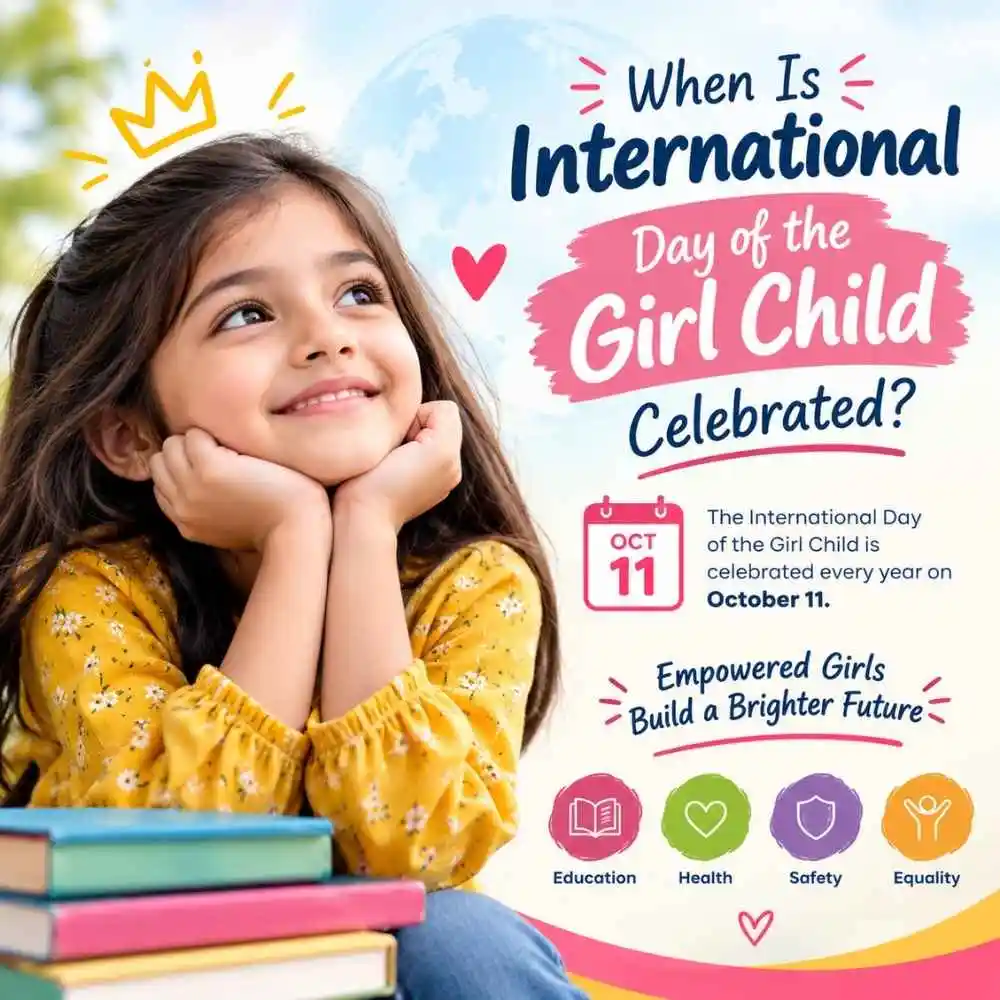
International Day of the Girl Child is celebrated every year on October 11. The date remains the same each year, making it easy for schools, organizations, and communities to plan awareness activities.
October 11 is more than a date on the calendar. It provides an opportunity to discuss the challenges girls face and to encourage practical action that supports their rights, safety, education, and future opportunities.
The observance is marked in many ways, including educational programs, awareness campaigns, community events, discussions, and social media posts. These activities can help bring greater attention to issues affecting girls.
If you are writing about the occasion, October 11 is the correct date to mention. However, the date does not change the official wording: the recognized name remains International Day of the Girl Child.
| Detail | Information |
| Observance | International Day of the Girl Child |
| Date | October 11 |
| Frequency | Every year |
| Focus | Girls’ rights and empowerment |
| Official name | International Day of the Girl Child |
Read More: Teacher’s Day vs Teachers’ Day: Which Is Correct and Why? 2026
Why Is International Day of the Girl Child the Official Name?
The wording International Day of the Girl Child describes the observance in a clear and specific way. It refers to a day focused on the rights, needs, experiences, and opportunities of girls during childhood and adolescence.
This is different from International Girl’s Day, where girl’s is a singular possessive form. It would grammatically suggest that something belongs to one girl, which does not accurately describe a global observance centered on girls as a group.
International Girls’ Day uses the plural possessive form girls’, which grammatically means something belongs to or relates to multiple girls. Although this wording may appear in informal writing, it is not the official United Nations title.
The distinction can be understood more easily by looking at the grammar:
| Phrase | Grammar | Meaning | Official name? |
| Girl’s | Singular possessive | Belonging to one girl | No |
| Girls’ | Plural possessive | Belonging to multiple girls | No |
| Girl Child | Noun phrase | A girl who is a child | Yes, as part of the official title |
| International Day of the Girl Child | Official title | Global observance for girls’ rights | Yes |
Therefore, when referring to the United Nations observance, International Day of the Girl Child is the most accurate name to use.
What Is the History of International Day of the Girl Child?
The history of International Day of the Girl Child is connected to growing international attention toward the challenges faced by girls. Advocacy for girls’ rights highlighted the need for a dedicated day to recognize these issues globally.
In December 2011, the United Nations General Assembly adopted Resolution 66/170. Through this resolution, the United Nations designated October 11 as the International Day of the Girl Child.
The first official observance followed in 2012. Since then, October 11 has provided an annual opportunity to highlight girls’ rights, empowerment, education, equality, and protection from harmful practices.
The history also explains why the official wording matters. The United Nations established the observance as International Day of the Girl Child, rather than International Girl’s Day or International Girls’ Day.
Important historical points:
- December 2011: The United Nations General Assembly adopted Resolution 66/170.
- October 11: The designated date for the observance.
- 2012: The first official International Day of the Girl Child was observed.
- Main purpose: Promote awareness of girls’ rights and challenges.
- Long-term focus: Support equality, empowerment, education, protection, and opportunity.
Why Is International Day of the Girl Child Celebrated?
International Day of the Girl Child is celebrated to recognize girls’ rights and encourage equal opportunities. It reminds communities that girls should have access to education, protection, healthcare, freedom, and opportunities to participate in decisions that affect their lives.
Another important purpose is to increase global awareness of problems such as gender inequality and child marriage. Bringing these issues into public discussion can encourage stronger protection and support for girls.
The day also promotes girls’ empowerment by emphasizing the importance of education, confidence, participation, and the freedom to shape the future. Supporting girls today can help create more equal opportunities for women and girls in the future.
Each year, the observance can also draw attention to specific concerns. For 2026, the focus highlighted in your article is “End child marriage and invest in girls’ rights!”, connecting the day with efforts to protect girls and increase investment in girls.
The celebration highlights:
- Girls’ rights and dignity
- Equal opportunities in education and life
- Protection from child marriage
- Stronger legal protection
- Greater access to education
- Girls’ voices and participation
- Gender equality and reduced inequality
- Greater investment in girls’ futures
What Is the Purpose of International Day of the Girl Child?
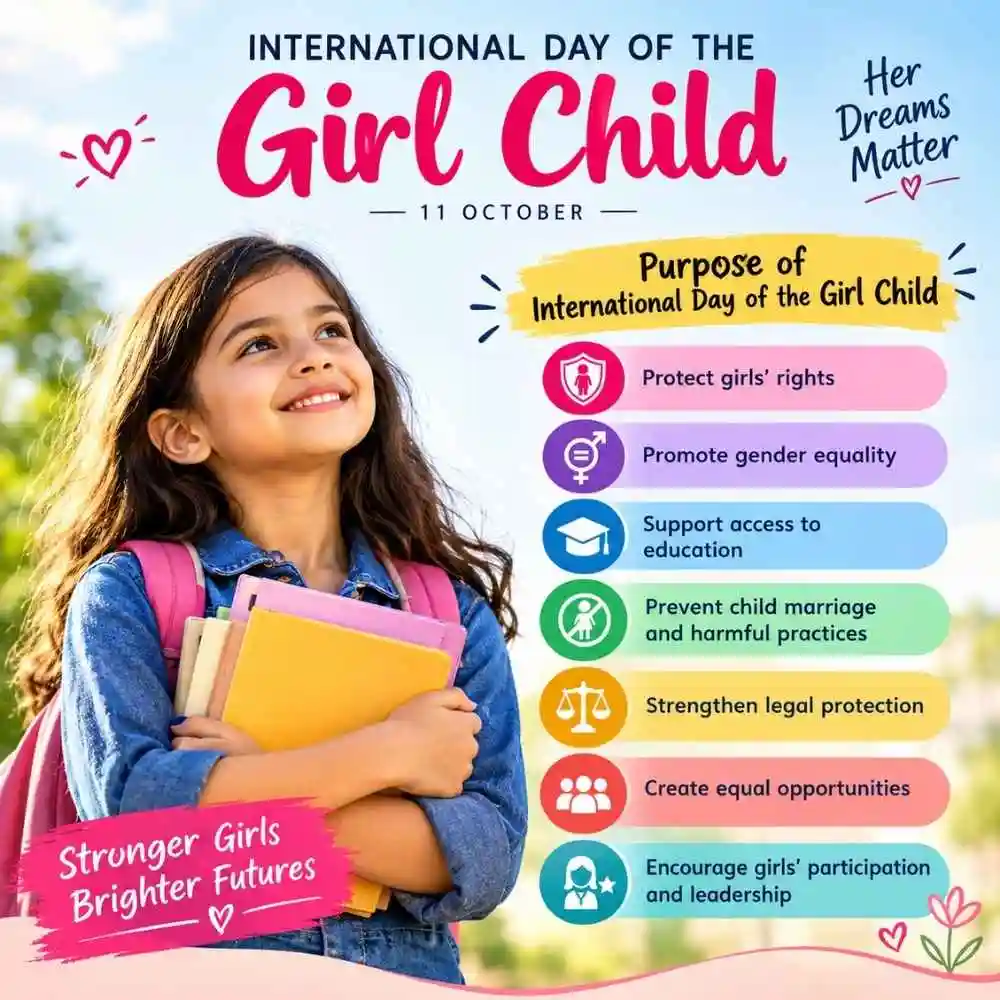
The main purpose of International Day of the Girl Child is to recognize the rights, needs, and potential of girls around the world. It encourages greater attention to the challenges that can limit a girl’s education, safety, freedom, and future opportunities.
The day also helps raise global awareness about issues that affect girls, including gender inequality, child marriage, discrimination, and limited access to education. These concerns can prevent girls from enjoying the same opportunities as others.
Another purpose is to encourage girls’ empowerment and give greater importance to girls’ voices. Governments, organizations, schools, and communities are encouraged to support actions that help girls participate, learn, and make informed choices.
The purpose can therefore be understood through several key areas:
- Protect girls’ rights
- Promote gender equality
- Support access to education
- Prevent child marriage and harmful practices
- Strengthen legal protection
- Create equal opportunities
- Encourage girls’ participation and leadership
How Is International Day of the Girl Child Celebrated Around the World?
International Day of the Girl Child is marked through activities that promote awareness, education, equality, and girls’ rights. The exact activities differ from one country or community to another, depending on local needs and priorities.
Schools may organize classroom discussions, presentations, writing activities, or awareness programs about girls’ education and equality. Community organizations can also arrange workshops and events that give girls opportunities to share their experiences and ideas.
Governments and international organizations may use the day to highlight important issues affecting girls. Social media campaigns, public discussions, educational resources, and advocacy activities can help bring these topics to a wider audience.
Common ways to mark the day include:
- School awareness programs
- Educational workshops
- Community discussions
- Girls’ empowerment activities
- Social media awareness campaigns
- Youth events and presentations
- Programs supporting girls’ education
- Advocacy for girls’ rights
Are “International Girls’ Day” and “International Day of the Girl Child” the Same?
International Girls’ Day and International Day of the Girl Child may sound similar because both phrases refer to girls and their rights. However, they should not automatically be treated as the same name.
International Day of the Girl Child is the established name of the United Nations observance held on October 11. It specifically refers to the international day created to promote awareness of girls’ rights and the challenges girls face.
International Girls’ Day is a different wording. People may use it informally when talking about a day related to girls, but using a similar phrase does not make it the official name of the United Nations observance.
This distinction is especially useful when writing articles, school assignments, social media posts, or educational material. If you mean the UN observance, use the official wording International Day of the Girl Child.
| Term | Meaning/Use | Official UN name? |
| International Day of the Girl Child | Established international observance for girls’ rights | Yes |
| International Girls’ Day | Informal or alternative wording | No |
| International Girl’s Day | Grammatically singular possessive wording | No |
Is “International Girls’ Day” an Official International Observance?
International Girls’ Day is not the official name of the United Nations observance celebrated on October 11. The official name is International Day of the Girl Child, which was designated by the United Nations General Assembly.
The difference is important because similar wording can make two expressions appear interchangeable. While girls’ is grammatically a plural possessive form, the official observance uses the noun phrase girl child rather than a possessive construction.
When discussing the UN observance, using the official name avoids confusion and makes your writing more precise. This is especially important in formal articles, educational content, reports, and references to United Nations activities.
For accurate usage, keep this simple distinction in mind:
- Official observance: International Day of the Girl Child
- Official date: October 11
- Official organization: United Nations
- International Girls’ Day: Not the official UN title
- International Girl’s Day: Not the official UN title
Read More: Coach vs Couch: Which Word Should You Use?
Difference Between International Girl’s Day and International Girls’ Day
The main difference between International Girl’s Day and International Girls’ Day is the use of the apostrophe. Girl’s is singular possessive, while girls’ is plural possessive.
Girl’s means something belongs to or is connected with one girl. For example, “the girl’s book” means the book belongs to one girl. In contrast, girls’ refers to something connected with more than one girl, as in “girls’ education.”
This grammatical difference explains why International Girl’s Day and International Girls’ Day do not have exactly the same meaning. However, neither expression is the official United Nations name for the October 11 observance.
| Phrase | Grammatical form | Basic meaning | Example |
| Girl’s | Singular possessive | Belonging to one girl | The girl’s bag |
| Girls’ | Plural possessive | Belonging to several girls | Girls’ education |
| International Girl’s Day | Singular possessive phrase | A day associated with one girl | Not the official UN name |
| International Girls’ Day | Plural possessive phrase | A day associated with multiple girls | Not the official UN name |
| International Day of the Girl Child | Official noun phrase | Global observance focused on girls | Official UN name |
So, if your goal is to write about the United Nations observance on October 11, the clearest and most accurate choice is International Day of the Girl Child rather than either possessive phrase.
Is “International Girl’s Day” or “International Girls’ Day” Correct?
Neither “International Girl’s Day” nor “International Girls’ Day” is the official name of the United Nations observance. The recognized name is International Day of the Girl Child, observed on October 11.
From a grammar perspective, however, girl’s and girls’ are both valid possessive forms. The correct choice depends on whether you are referring to one girl or multiple girls.
Girl’s is the singular possessive form, while girls’ is the plural possessive form. Therefore, if you mean something connected with several girls, girls’ is grammatically appropriate.
| Phrase | Grammar | Meaning |
| Girl’s | Singular possessive | Belonging to one girl |
| Girls’ | Plural possessive | Belonging to multiple girls |
| International Girl’s Day | Singular possessive | A day associated with one girl |
| International Girls’ Day | Plural possessive | A day associated with multiple girls |
| International Day of the Girl Child | Official name | The UN observance |
Why Do People Confuse “International Girl’s Day” and “International Girls’ Day”?
People often confuse these phrases because the difference is only one small punctuation mark. At first glance, girl’s and girls’ look almost identical, especially when they appear inside a longer title.
The confusion also comes from the fact that both phrases seem to describe a day connected with girls. Many writers know that a possessive apostrophe is needed but are unsure whether it should come before or after the s.
Another reason is that everyday writing sometimes uses informal names for observances. When people see different versions online, they may assume that International Girl’s Day and International Girls’ Day are simply alternative spellings of the same official title.
The easiest way to remember the difference is:
- girl’s = one girl
- girls’ = two or more girls
- girls = plural, not possessive
- International Day of the Girl Child = official UN observance
Why Do People Write “International Girl’s Day”?
People write “International Girl’s Day” because they may think the apostrophe should come before the s whenever a word shows possession. This is a common grammar mistake when the writer is referring to a group rather than one person.
The form girl’s is actually correct when the noun is singular and possessive. For example, “the girl’s notebook” means that one girl has the notebook.
The problem occurs when the intended meaning is about girls as a group. In that situation, girls’ is the appropriate plural possessive form, because girls already represents more than one girl.
However, when discussing the October 11 UN observance, neither form should be used as the official title. The safest wording is International Day of the Girl Child.
Does “Girl’s Day” Mean a Day for One Girl?
Grammatically, “Girl’s Day” uses a singular possessive form. The word girl’s suggests that the day is connected to, belongs to, or is associated with one girl.
For example, “the girl’s birthday” means the birthday of one girl. The apostrophe comes before the s because the noun girl is singular.
That does not necessarily mean that every informal use of Girl’s Day literally celebrates one specific girl. Names can be used loosely in everyday language, but the grammar itself gives girl’s a singular possessive meaning.
For the international observance on October 11, Girl’s Day is therefore not the appropriate official name. Use International Day of the Girl Child when referring to the United Nations observance.
Read More: Vender or Vendor: Which One Is Correct in 2026?
Does “Girls’ Day” Mean a Day for All Girls?
The phrase “Girls’ Day” uses the plural possessive form. In grammar, girls’ indicates that something is connected with or belongs to multiple girls, rather than just one.
For example, “girls’ education” refers to education for girls as a group. Likewise, “girls’ rights” refers to the rights of girls collectively.
Therefore, if someone uses “Girls’ Day” to describe a day for girls as a group, the apostrophe placement is grammatically consistent with that meaning. The apostrophe comes after the s because girls is already plural.
Still, grammatical correctness does not make it the official United Nations title. For the October 11 observance, the correct official name remains International Day of the Girl Child.
Why Does “Girls’” Have an Apostrophe After the S?
Girls’ has an apostrophe after the s because girls is already a plural noun. When a regular plural noun ends in s, its possessive form is usually made by adding only an apostrophe.
The basic pattern is simple: girl → girls → girls’. First, girl becomes plural by adding s. Then the apostrophe is placed after the s to show possession or association.
Compare this with the singular form: girl → girl’s. Here, the noun does not already end in s, so an apostrophe followed by s is used.
| Form | Type | Example |
| girl | Singular | One girl |
| girl’s | Singular possessive | The girl’s book |
| girls | Plural | Several girls |
| girls’ | Plural possessive | The girls’ books |
This is why girls’ rights, girls’ education, and girls’ voices all place the apostrophe after the s.
Is “Girls Day” Correct Without an Apostrophe?
“Girls Day” can appear in informal writing, but it is not the standard possessive form if the intended meaning is a day associated with girls. In that meaning, Girls’ Day uses the apostrophe to show the relationship.
The difference is similar to teachers’ day and teachers day. If the phrase is intended as a possessive construction, the apostrophe provides important grammatical information.
However, names and titles can sometimes be written as fixed names without following ordinary possessive patterns. That means context matters when judging a particular event or brand name.
For the October 11 United Nations observance, there is an even clearer option: use International Day of the Girl Child. This avoids the possessive confusion completely and matches the official name.
What Is the Difference Between Girl’s, Girls, and Girls’?
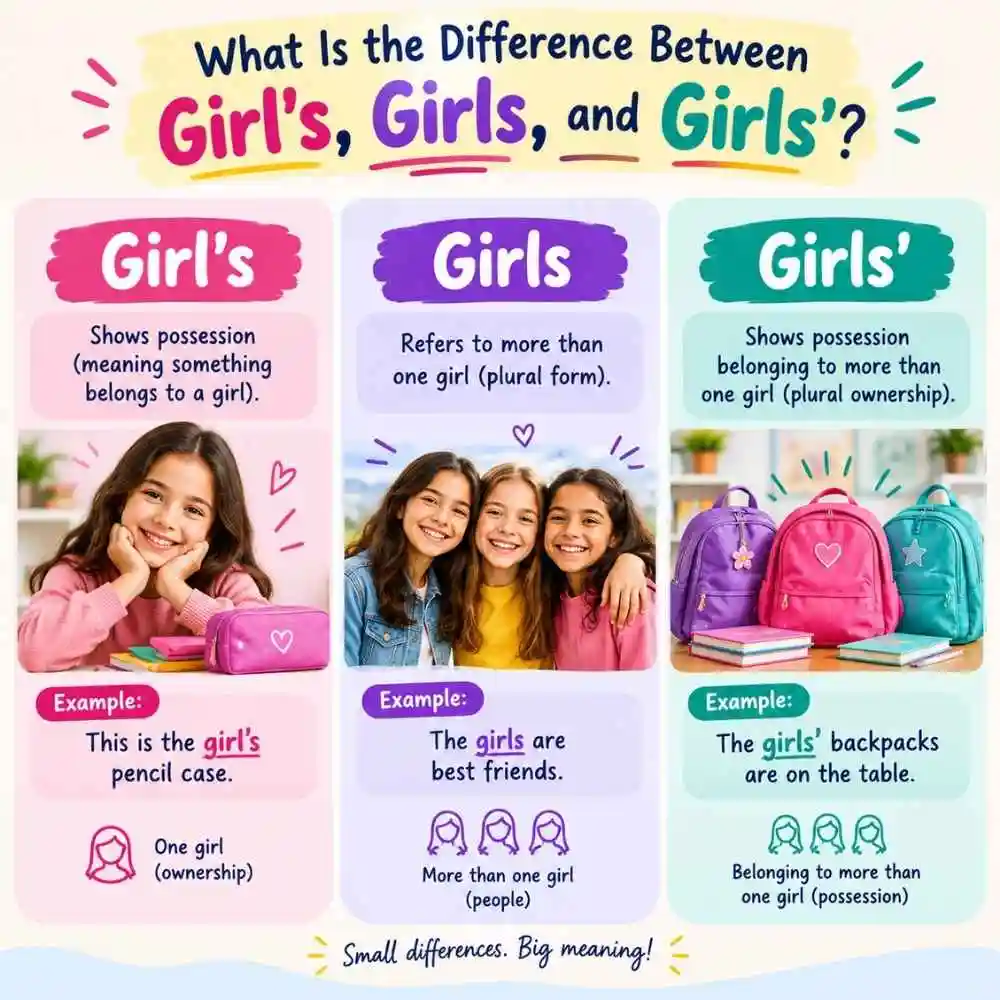
The words girl’s, girls, and girls’ look similar, but they perform different grammatical jobs. Understanding whether a word is singular, plural, or possessive makes it much easier to choose the correct form.
Girl’s is the singular possessive form of girl. It shows that something belongs to or is connected with one girl, such as “the girl’s notebook.”
Girls is simply the plural form of girl. It refers to two or more girls without showing possession, as in “The girls are studying.”
Girls’ is the plural possessive form. It shows that something belongs to or is connected with multiple girls, such as “the girls’ classroom.”
| Word | Grammar | Meaning | Example |
| Girl | Singular | One girl | The girl is reading. |
| Girl’s | Singular possessive | Belonging to one girl | The girl’s bag is blue. |
| Girls | Plural | More than one girl | The girls are reading. |
| Girls’ | Plural possessive | Belonging to multiple girls | The girls’ bags are blue. |
Is “International Girls’ Day” Grammatically Correct?
Yes, “International Girls’ Day” can be grammatically understandable when girls’ is intended as a plural possessive form. It suggests a day associated with or dedicated to girls as a group.
The apostrophe comes after the s because girls is already plural. This follows the standard rule for regular plural nouns ending in s, such as students’ work or teachers’ lounge.
However, grammatical correctness is different from being an official name. International Girls’ Day is not the official United Nations title for the October 11 observance.
For the UN observance, the correct formal name is International Day of the Girl Child. This wording avoids the possessive construction and clearly identifies the established international observance.
Should I Write “Girl’s Day” or “Girls’ Day”?
If you are choosing between the two forms based only on grammar, Girls’ Day is the better choice when you mean a day connected with girls as a group. The plural possessive girls’ indicates that the day relates to multiple girls.
Girl’s Day, by contrast, uses the singular possessive form. It grammatically suggests a connection with one girl, although an event may use this wording as a particular name regardless of the ordinary grammatical meaning.
For the United Nations observance on October 11, neither phrase should replace the official title. The appropriate formal wording is International Day of the Girl Child.
A simple rule can help:
- One girl: girl’s
- More than one girl: girls’
- More than one girl, no possession: girls
- UN October 11 observance: International Day of the Girl Child
International Girl’s Day vs. International Girls’ Day vs. International Day of the Girl Child
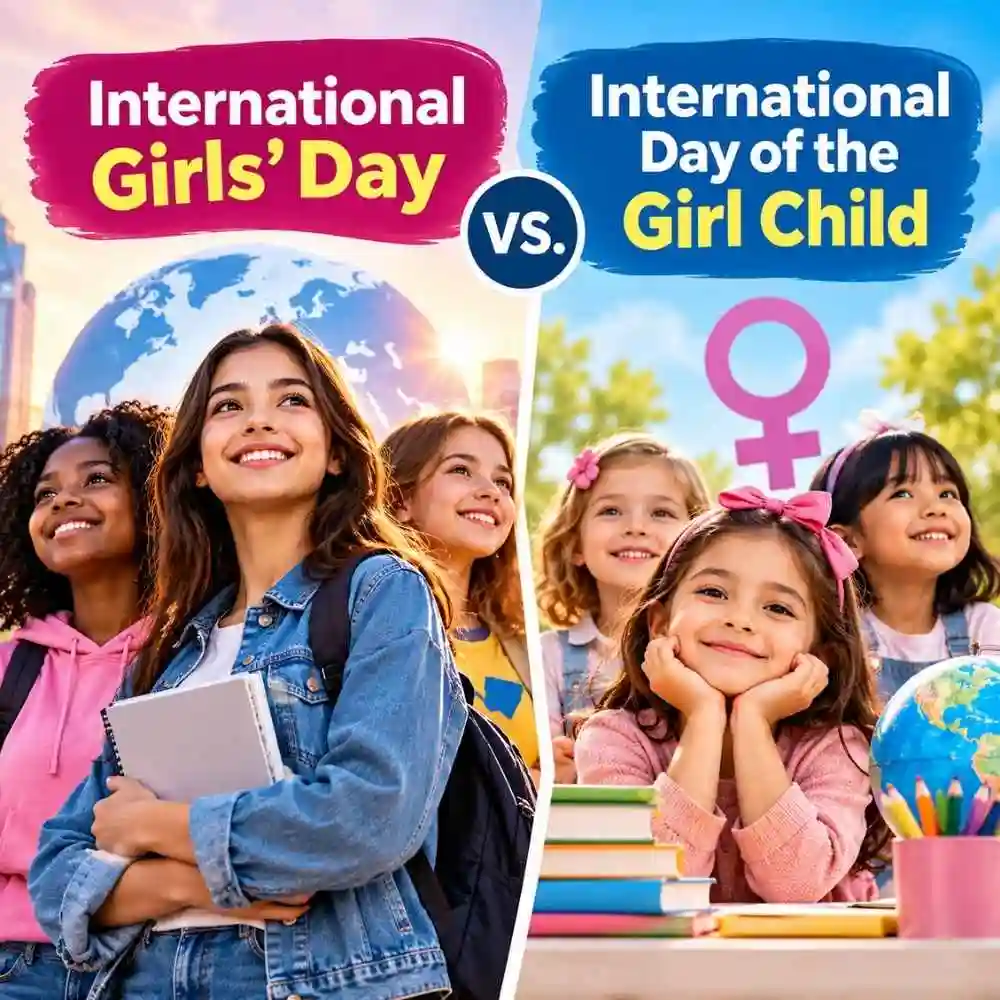
These three expressions differ in both grammar and official usage. The first two use possessive constructions, while International Day of the Girl Child uses a noun phrase that identifies the official observance.
Girl’s Day contains the singular possessive girl’s, which grammatically points to one girl. This Girls’ Day contains the plural possessive girls’, which refers to girls collectively.
International Day of the Girl Child does not use either possessive form. It is the established name of the United Nations observance held on October 11.
| Term | Grammar | General meaning | Use for UN observance? |
| International Girl’s Day | Singular possessive | Day connected with one girl | No |
| International Girls’ Day | Plural possessive | Day connected with girls | No |
| International Day of the Girl Child | Noun phrase | International observance focused on girls | Yes |
Therefore, if your article is specifically about the UN observance, International Day of the Girl Child is the clearest choice.
Examples of “Girl’s,” “Girls,” and “Girls’” in Sentences
Seeing these forms in complete sentences makes their differences easier to understand. The key is to check whether you mean one girl, multiple girls, or something belonging to multiple girls.
We Use girl’s when one girl owns something or has a specific connection to something. And Use girls when you are simply referring to more than one girl.
Use girls’ when something belongs to or relates to several girls. The apostrophe comes after the s because the noun is already plural.
Examples:
- Girl’s: The girl’s backpack is on the desk.
- Girl’s: I read the girl’s story.
- Girls: The girls are playing outside.
- Girls: Several girls joined the program.
- Girls’: The girls’ classroom was decorated.
- Girls’: The school supports girls’ education.
- Girls’: We discussed girls’ rights during the lesson.
Which Name Should You Use in Formal Writing?
In formal writing, the safest and most accurate name for the October 11 United Nations observance is International Day of the Girl Child. This wording matches the established name rather than an informal possessive variation.
Using the official name is especially useful when writing about the observance in an academic, professional, educational, or informational context. It prevents readers from wondering whether Girl’s Day or Girls’ Day refers to a different event.
The possessive forms still have grammatical value when discussing other subjects. For example, girls’ rights, girls’ education, and girls’ voices are standard expressions because they describe things connected with girls as a group.
A useful distinction is:
- Official observance: International Day of the Girl Child
- Singular possessive: girl’s
- Plural: girls
- Plural possessive: girls’
Which Term Should You Use in an Article, School Assignment, or Formal Document?
For an article, school assignment, or formal document about the October 11 observance, use International Day of the Girl Child. It is clear, precise, and appropriate for formal contexts.
If you are explaining the grammar behind the alternative phrases, you can mention International Girl’s Day and International Girls’ Day as examples. Explain that the apostrophe changes the grammatical meaning of the phrase.
In an article focused on grammar, it is also helpful to explain why girls’ differs from girl’s. This gives readers the information they need without presenting an unofficial phrase as the official observance name.
For example, you could write:
International Day of the Girl Child is the official observance name, while girl’s and girls’ are possessive forms with different grammatical meanings.
This approach keeps formal writing accurate while still addressing the wording people commonly search for.
Common Mistakes When Writing International Girl’s Day
One common mistake is using girl’s when the writer actually means girls as a group. Because girl’s is singular possessive, it does not normally express a connection with multiple girls.
Another mistake is assuming that International Girls’ Day is the official United Nations name simply because girls’ is grammatically appropriate for a group. Grammar and official naming are two different issues.
Some writers also remove the apostrophe completely and write International Girls Day. While girls is the correct plural form, removing the apostrophe changes the grammatical structure if the intended phrase is possessive.
Common mistakes include:
- ❌ Treating girl’s as the plural form.
- ❌ Using girls’ as though it were simply plural.
- ❌ Writing Girls Day when a possessive meaning is intended.
- ❌ Calling International Girls’ Day the official UN title.
- ❌ Using International Girl’s Day for the October 11 observance.
- ✅ Using International Day of the Girl Child for the official observance.
Quick Answer: International Girl’s Day, International Girls’ Day, or International Day of the Girl Child?
If you are referring to the United Nations observance on October 11, use International Day of the Girl Child. This is the established official name and is the best choice for formal and informational writing.
If you are asking about grammar, girl’s is singular possessive, while girls’ is plural possessive. Therefore, International Girls’ Day is grammatically more suitable than International Girl’s Day if the intended meaning is a day associated with girls as a group.
However, grammatical suitability does not make International Girls’ Day the official name of the UN observance. The official wording should remain International Day of the Girl Child.
Quick Reference
| Phrase | Correct grammatical form? | Official UN observance name? |
| International Girl’s Day | Grammatically possible, but singular possessive | ❌ No |
| International Girls’ Day | Grammatically possible, plural possessive | ❌ No |
| International Girls Day | Plural without possessive apostrophe | ❌ No |
| International Day of the Girl Child | Official wording | ✅ Yes |
Frequently Asked Questions
1. Is International Girl’s Day the correct name?
No. International Girl’s Day is not the official name of the United Nations observance. The official name is International Day of the Girl Child, celebrated on October 11.
2. Is International Girls’ Day grammatically correct?
International Girls’ Day can be grammatically understood as a plural possessive phrase because girls’ refers to multiple girls. However, it is not the official name of the UN observance.
3. What is the official name of the October 11 observance?
The official name is International Day of the Girl Child. The United Nations established October 11 as the date for this international observance.
4. What is the difference between girl’s and girls’?
Girl’s is singular possessive and refers to one girl, while girls’ is plural possessive and refers to multiple girls. For example, the girl’s book belongs to one girl, while the girls’ books belong to several girls.
5. Does girls mean the same as girls’?
No. Girls is simply the plural form of girl, while girls’ is the plural possessive form. The apostrophe in girls’ shows possession or a relationship with multiple girls.
6. Why is the apostrophe in girls’ placed after the s?
The apostrophe comes after the s because girls is already a regular plural noun ending in s. To make it possessive, an apostrophe is added after the existing s, creating girls’.
7. Can I use International Girls’ Day in an article?
You can mention International Girls’ Day when discussing the phrase itself or explaining its grammar. However, if your article refers to the official October 11 United Nations observance, use International Day of the Girl Child.
8. Is Girls Day correct without an apostrophe?
Girls Day can appear as an informal title or name, but it does not show the same possessive relationship as Girls’ Day. For the October 11 UN observance, International Day of the Girl Child is the appropriate formal name.
9. Should I write Girl’s Day or Girls’ Day?
If you mean a day associated with girls as a group, Girls’ Day is grammatically more suitable because girls’ is plural possessive. However, neither phrase is the official name of the United Nations observance.
10. What should I use in a school assignment?
For a school assignment about the October 11 observance, use International Day of the Girl Child. This is clearer and more accurate than using International Girl’s Day or International Girls’ Day.
Conclusion
Understanding International Girl’s Day vs. International Girls’ Day becomes easier when you separate grammar from official naming. Girl’s is singular possessive, girls is plural, and girls’ is plural possessive. These small differences can change the meaning of a phrase.
If you are referring to the United Nations observance held on October 11, the correct formal name is International Day of the Girl Child. Although International Girls’ Day may appear grammatically understandable in some contexts, it should not be presented as the official UN title.
Choosing the right wording helps make your article, school assignment, or formal document clear and accurate. When discussing the observance, use International Day of the Girl Child, and reserve girl’s, girls, and girls’ for situations where their specific grammatical meanings are intended.

I’m Jane Austen, the admin of GrammarGuide.com, where words come to life in smarter, sharper, and more creative ways. I focus on simplifying grammar, exploring powerful synonyms, and sharing fun, engaging expressions that make everyday communication more effective. My goal is to help readers write with clarity, confidence, and a touch of personality, whether it’s for professional use or just for fun.



