Every October, spooky decorations, creative costumes, carved pumpkins, and festive celebrations bring the spirit of Halloween to life. But when writing about this beloved autumn holiday, one small spelling question often causes confusion: Halloween vs. Holloween. These two spellings may appear similar, yet understanding which one is correct helps you avoid mistakes in schoolwork, online articles, social media captions, and everyday communication.
The word Halloween is the correct English spelling for the annual celebration, while Holloween is a common misspelling rather than an accepted alternative. This distinction is especially useful for students, bloggers, content writers, and anyone creating Halloween-themed content who wants to communicate clearly and professionally.
In this article, you will learn which spelling is correct, explore the meaning and origin of Halloween, understand why people write Holloween by mistake, and review clear sentence examples. By the end, you will know how to spell and use the word correctly in different writing situations.
Halloween vs. Holloween: Which Spelling Is Correct?
Halloween is the correct spelling of the holiday celebrated on October 31. Holloween is a common misspelling and is not the standard English name for the celebration. Although the two spellings look similar, only Halloween should be used in formal writing, school assignments, articles, invitations, and social media captions.
The correct spelling contains the letters H-A-L-L-O-W-E-E-N. Remembering this letter pattern can help you avoid confusion when writing about Halloween parties, costumes, pumpkin carving, or trick-or-treating. For example, “We decorated our house for Halloween” is correct, while “We decorated our house for Holloween” contains a spelling error.
Understanding this difference helps you write more accurately and makes your content easier for readers to understand.
1What Does Halloween Mean?
Halloween is a holiday celebrated every year on October 31, traditionally associated with costumes, spooky decorations, carved pumpkins, haunted houses, and trick-or-treating. Children and adults may dress as witches, ghosts, superheroes, or other characters, while families and communities take part in themed parties and seasonal activities.
The word Halloween comes from “All Hallows’ Eve,” meaning the evening before All Hallows’ Day, also known as All Saints’ Day on November 1. Over time, the expression developed into the modern spelling and form used in English.
Halloween is a proper name for a recognized holiday, so it is normally written with a capital H when referring to the celebration. Here are a few examples:
- Correct: The children are excited about Halloween.
- Correct: We bought pumpkins and costumes for Halloween.
- Correct: Our school is hosting a Halloween party.
- Incorrect: We are planning a Holloween celebration.
Whether you are writing a holiday greeting, a blog post, a school essay, or a social media caption, Halloween is the spelling to use.
What Does Holloween Mean?
Holloween is generally a misspelling of Halloween rather than a separate, standard English word for the holiday. People may type it accidentally because they remember the general sound of the word but not its exact letter sequence.
The spelling can also appear in online searches, informal messages, usernames, or user-generated content. However, its appearance in these places does not make it an accepted alternative spelling of the holiday’s name.
For example:
- Incorrect: We are going trick-or-treating on Holloween.
- Correct: We are going trick-or-treating on Halloween.
- Incorrect: Happy Holloween to everyone!
- Correct: Happy Halloween to everyone!
If you encounter the word Holloween while reading or searching online, the intended meaning is usually clear from the context. Nevertheless, writers should use Halloween in edited content, educational work, professional communication, and published articles.
The key point is simple: Holloween does not have an established, separate holiday meaning in standard English usage. Unless it is intentionally used as a proper name, brand, or creative spelling, it should be corrected to Halloween when referring to the October 31 celebration.
Why Is Holloween a Common Spelling Mistake?
The confusion between Halloween and Holloween mainly comes from their similar appearance and the way people remember familiar words. Both spellings share several letters, including the opening H and the ending sequence “ween.” This similarity can make the incorrect version seem believable at first glance.
Here are some common reasons for this spelling mistake:
1. Confusion About Vowel Patterns
The correct spelling contains “Hallo” at the beginning, not “Hollo.” When people type quickly or rely on memory, they may substitute one vowel for another. This small change produces the incorrect spelling Holloween.
2. Writing From Memory
People often write familiar holiday names without checking their spelling. If someone has seen the incorrect version online, they may remember it and repeat the same mistake later.
3. Typing Too Quickly
Fast typing, autocorrect suggestions, and missed proofreading can lead to spelling errors. A writer may intend to type Halloween but overlook the extra or substituted vowel in the final text.
4. Repeated Exposure to Online Misspellings
Search queries, comments, and informal social media posts sometimes contain spelling mistakes. Seeing Holloween repeatedly may make it look familiar, but familiarity does not establish correctness.
5. Limited Proofreading
Writers may focus on the message rather than individual letters, especially when preparing captions, invitations, or short posts. Reading the final text carefully can help catch this error before publishing.
To remember the correct spelling, associate Halloween with the familiar holiday words hall, hallow, and All Hallows’ Eve. Most importantly, practice writing the complete word rather than relying only on how it looks or sounds.
Halloween vs. Holloween: Key Differences
The main difference between Halloween and Holloween is spelling accuracy. Halloween is the accepted English name for the holiday, while Holloween is generally an incorrect spelling of that name. The two forms should not be treated as interchangeable in standard writing.
| Feature | Halloween | Holloween |
| Spelling status | Correct standard spelling | Common misspelling |
| Meaning | The holiday celebrated on October 31 | Usually intended to mean Halloween |
| Dictionary usage | Recognized name of the holiday | Not a standard alternative spelling |
| First vowel pattern | “Hallo” | “Hollo” |
| Formal writing | Appropriate | Should be corrected |
| School assignments | Correct choice | Spelling error |
| Social media captions | Recommended | Avoid unless intentionally used as a name |
| Example | Happy Halloween! | Happy Holloween! |
Examples in everyday writing:
- Holiday invitation: “Join us for a Halloween party on October 31.”
- School assignment: “Halloween is associated with costumes and trick-or-treating.”
- Blog content: “Discover creative Halloween costume ideas for the whole family.”
- Social media caption: “Wishing everyone a spooky and happy Halloween!”
In each example, Halloween is the appropriate spelling because it refers to the recognized holiday. Using the correct form consistently improves spelling accuracy and helps maintain a polished, professional writing style.
Quick rule to remember: Whenever you mean the October 31 holiday, write Halloween, not Holloween.
Halloween vs. Holloween: American English Spelling
In American English, Halloween is the correct spelling of the holiday celebrated on October 31. Holloween is a common spelling mistake, not an accepted American English variation. Writers should use Halloween in school assignments, blog posts, holiday invitations, social media captions, and professional content.
American English generally follows the same spelling for this holiday as British English. Although pronunciation can vary slightly between speakers, the standard written form remains Halloween.
For example:
- Correct: We are preparing for Halloween.
- Incorrect: We are preparing for Holloween.
- Correct: Halloween decorations make the house look festive.
Remember that Halloween is also capitalized because it refers to a specific holiday.
Read More: Travelling or Traveling: Is One Spelling Better?
Halloween vs. Holloween: Correct Pronunciation
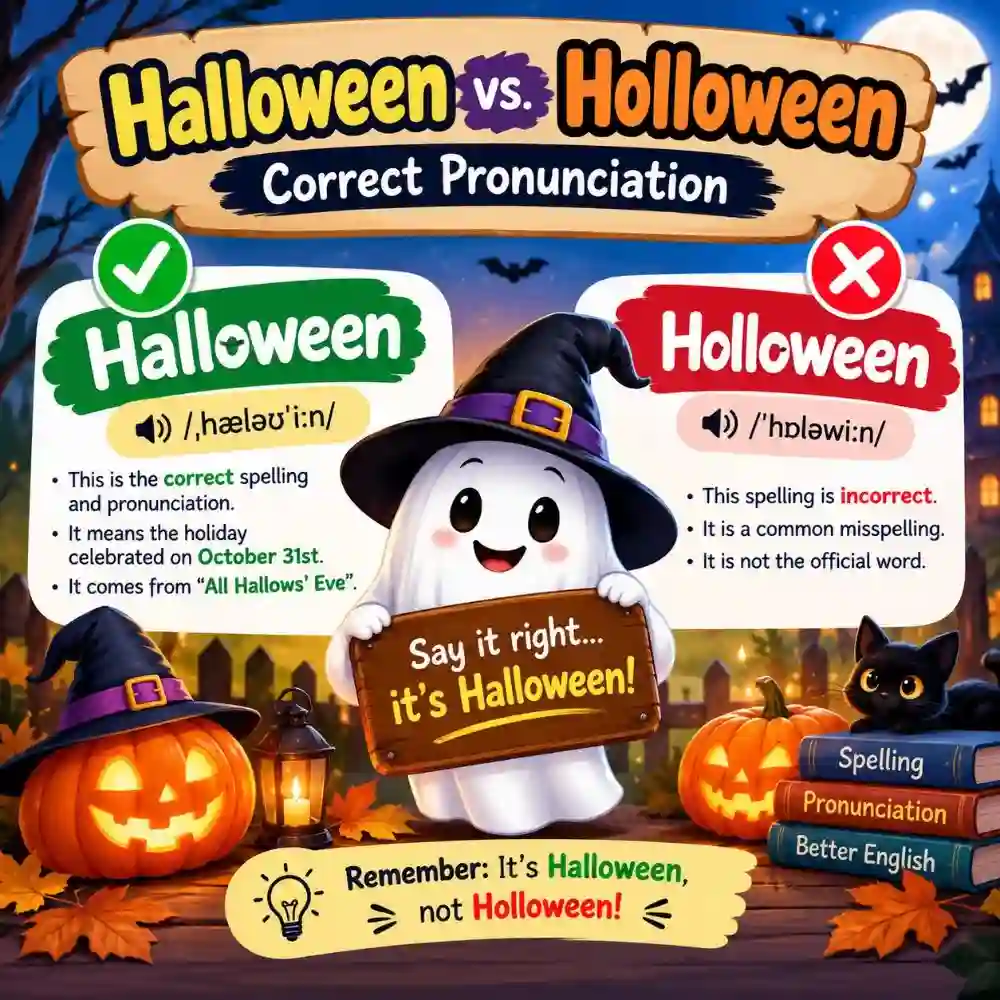
The word Halloween is commonly pronounced with three syllables, with the strongest stress on the final syllable. American speakers may pronounce the first vowel slightly differently depending on their accent, but these differences do not affect the correct spelling.
The pronunciation can be represented as hal-oh-EEN. The important point is to distinguish how a word sounds from how it is conventionally written. A person might hear the first syllable differently and mistakenly write Holloween, but the accepted spelling remains Halloween.
| Feature | Halloween | Holloween |
| Standard spelling | Correct | Incorrect for the holiday |
| Pronunciation | Commonly hal-oh-EEN | Not a separate standard pronunciation |
| Syllables | Three | Intended to represent the same word |
| Usage | Standard English writing | Usually a spelling mistake |
Example: “The children are excited about Halloween.” Even if speakers pronounce the word differently because of regional accents, they should use the standard spelling in written English.
Halloween vs. Holloween: Word Origin and History
The word Halloween has historical roots in the Christian observance known as All Hallows’ Day, also called All Saints’ Day. The name developed from the older expression All Hallows’ Even, which referred to the evening before that religious observance.
Over time, the expression became shorter. The traditional spelling Hallowe’en reflects this shortening through an apostrophe, while Halloween is the modern standard form.
The word’s history helps explain its spelling:
- Hallow: An older word associated with a holy person or saint.
- Even: An older form of evening.
- Hallowe’en: A traditional shortened spelling.
- Halloween: The modern, widely accepted spelling.
The spelling Holloween does not follow this historical development. It likely results from confusion between similar-looking vowel patterns rather than from the word’s established origin.
Is Holloween a Real Word?
Holloween is not the standard spelling of the Halloween holiday. In everyday English, it is generally understood as a misspelling of Halloween rather than a separate word with an established meaning related to the celebration.
However, a person could intentionally use Holloween as a fictional name, a brand name, a username, or a creative title. In such cases, it may function as a proper name, but that does not make it an accepted alternative spelling of the holiday.
Consider these examples:
- Standard usage: We are celebrating Halloween on October 31.
- Spelling mistake: We are celebrating Holloween on October 31.
- Creative name: A fictional event organizer might deliberately call an event “Holloween Night.”
The context determines whether the spelling is intentional. When referring to the traditional holiday, Halloween is the correct choice for formal and informal writing.
Why Do People Spell Halloween as Holloween?
People commonly write Holloween because the two spellings look similar and share many of the same letters. When someone relies on memory instead of checking the word, the first vowel can easily be changed from a to o.
Several factors can contribute to this mistake:
- Vowel confusion: Writers may remember the general shape of the word but substitute the wrong vowel.
- Typing quickly: A small typing error can go unnoticed in a message or caption.
- Online exposure: Seeing misspellings in comments or search queries can make them seem familiar.
- Unfamiliar word history: People who do not know the connection to All Hallows’ Eve may find the correct spelling harder to remember.
- Limited proofreading: Writers may overlook a single incorrect letter while focusing on the meaning of a sentence.
To avoid the mistake, remember that the correct spelling begins with Hallo-, not Hollo-. You can also save the word in your spell-check dictionary or proofread holiday-related content before publishing it.
Read More: Desert or Dessert: Which Spelling Is Correct?
How Did the Word Halloween Originate?
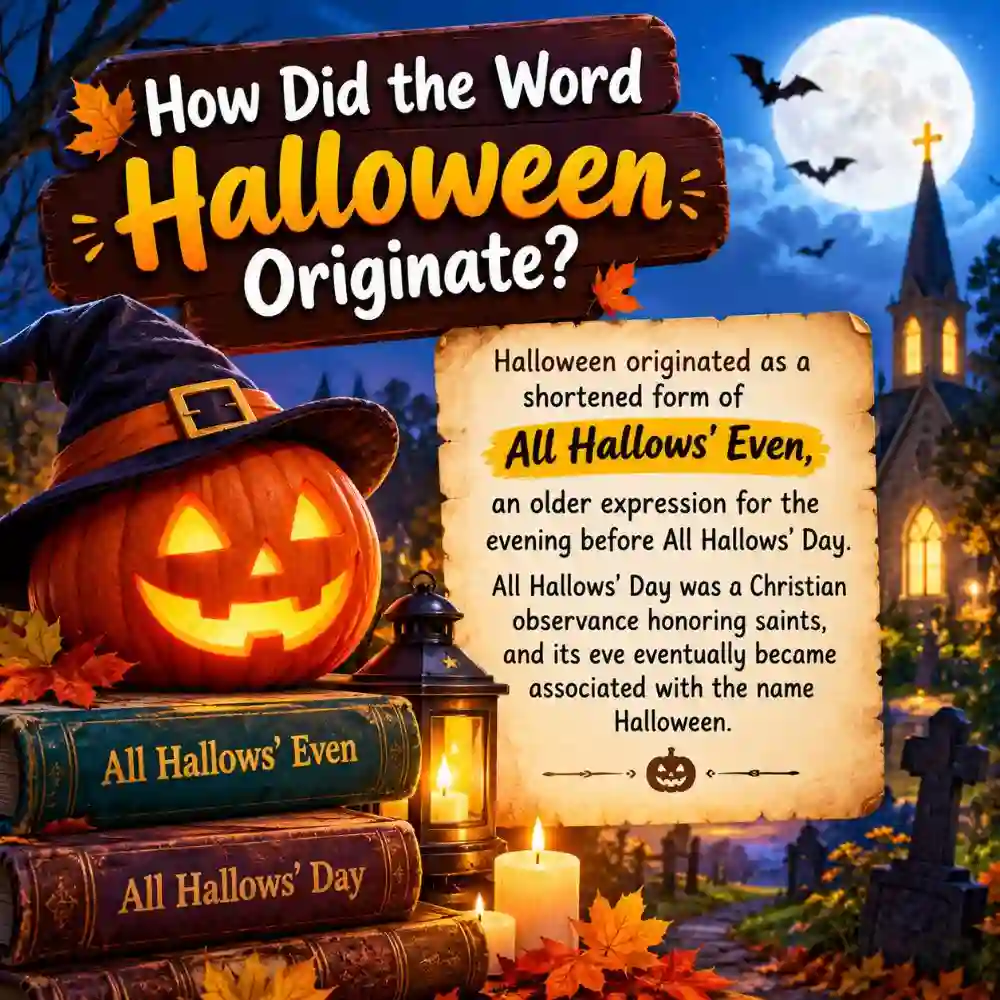
Halloween originated as a shortened form of All Hallows’ Even, an older expression for the evening before All Hallows’ Day. All Hallows’ Day was a Christian observance honoring saints, and its eve eventually became associated with the name Halloween.
The word changed gradually as people shortened and adapted the expression in everyday speech and writing. The traditional spelling Hallowe’en preserves a visible sign of that shortening, while the modern spelling Halloween no longer needs an apostrophe.
Today, Halloween is widely associated with costumes, pumpkins, trick-or-treating, spooky decorations, and themed celebrations. These modern customs developed over time and reflect a range of cultural traditions.
Understanding the origin offers a useful way to remember the spelling: Halloween is historically connected to “hallow,” not “hollow.” That distinction explains why Halloween is the standard form and Holloween is generally considered incorrect when referring to the holiday.
Is Halloween Ever Spelled Holloween?
In standard English writing, Halloween is not spelled Holloween. The latter form is usually an accidental misspelling, although it may be used intentionally as a creative name, title, or brand.
The traditional form Hallowe’en is different from Holloween. Hallowe’en is a historical spelling variant formed by shortening All Hallows’ Even. Holloween, by contrast, changes the vowel pattern and is not a standard alternative.
| Spelling | Status | When to use it |
| Halloween | Modern standard spelling | General, academic, and professional writing |
| Hallowe’en | Traditional spelling variant | Historical or stylistic contexts |
| Holloween | Usually a misspelling | Only when intentionally used as a name or creative spelling |
For everyday writing, choose Halloween in sentences such as “Happy Halloween,” “Halloween party ideas,” and “Halloween costume inspiration.” Use Hallowe’en only when the traditional spelling suits the context, and avoid Holloween when you intend to refer to the holiday.
Easy Tricks to Remember the Spelling of Halloween
The easiest way to remember Halloween is to break it into smaller parts: Hal-low-een. Say each part slowly, then put the word back together. The correct spelling begins with H-A-L-L and ends with -OWEEN.
Try these simple tricks:
- Remember the double L: Halloween has two Ls after the first H.
- Focus on the ending: The correct word ends in -ween, not -ween with an extra O after the H.
- Write it three times: Practice writing Halloween while saying each letter aloud.
- Use a memory sentence: “Halloween has two Ls and one special night.”
- Check before publishing: Review the spelling in schoolwork, captions, invitations, and blog posts.
Read More: Then or Than: Which Word Is Correct?
Words Commonly Misspelled Like Halloween
Some English words are tricky because their sounds do not always make their spelling obvious. Halloween is one example, but other familiar words can also cause spelling mistakes.
| Correct spelling | Common misspelling |
| Halloween | Holloween |
| February | Febuary |
| Definitely | Definately |
| Separate | Seperate |
| Beautiful | Beautifull |
| Tomorrow | Tommorow |
| Receive | Recieve |
| Believe | Beleive |
Tip: Do not rely only on how a word sounds. Check its spelling when writing something important.
Read More: Bougie or Boujee: Which One Should You Use?
Halloween Search Terms and Common Spelling Variations
People may type different versions of Halloween into search engines when looking for holiday ideas, costumes, decorations, or spelling help. Some variations are intentional, while others are typing mistakes.
Common search terms include:
- Halloween spelling.
- Halloween vs. Holloween.
- How to spell Halloween.
- Halloween meaning and origin.
- Halloween vs. Hallowe’en.
- Halloween party ideas.
- Halloween costume ideas.
- Halloween decorations.
Halloween is the standard modern spelling. Hallowe’en is a historical contraction that is still recognized, while Holloween is generally a misspelling. When creating content, use the standard spelling in headings and body text, and mention alternative spellings only when they are relevant to the topic.
Halloween vs. Hallowe’en: Are Both Spellings Correct?
Yes, Halloween and Hallowe’en are both recognized spellings, but they are not equally common today.
Halloween is the standard spelling used in modern American English and in most everyday writing. It is the best choice for school assignments, websites, social media posts, and holiday invitations.
Hallowe’en is an older form that uses an apostrophe to show omitted letters. The name developed from the phrase All Hallows’ Eve, meaning the evening before All Hallows’ Day. The apostrophe reflects the shortened form of the historical name.
| Spelling | Usage |
| Halloween | Standard modern spelling |
| Hallowe’en | Historical variant |
| Holloween | Generally considered a misspelling |
For most writing, choose Halloween unless you are discussing historical spelling or quoting a source that uses Hallowe’en.
Halloween vs. Holy Evening: What Is the Connection?
The word Halloween is connected to the Christian observance of All Hallows’ Eve, the evening before All Hallows’ Day, also known as All Saints’ Day. The word hallow means a holy person or saint, and even is an older word for evening.
Over time, All Hallows’ Eve was shortened into forms such as Hallowe’en and eventually the familiar modern spelling Halloween.
Although the phrase “holy evening” can help explain the religious background, it is not the modern dictionary spelling or a direct replacement for Halloween. The historical connection comes from the name of the evening before All Saints’ Day.
Halloween Spelling in British and American English
| Spelling | American English | British English |
| Halloween | Standard spelling | Standard spelling |
| Hallowe’en | Recognized historical variant | Recognized historical variant |
| Holloween | Generally incorrect | Generally incorrect |
Key takeaway: Both British and American English use Halloween as the standard modern spelling. The spelling does not change between the two varieties of English. Hallowe’en is an older variant, while Holloween is generally a misspelling.
Read More: Grey or Gray: Which Spelling Is Correct?
Halloween Spelling Mistakes to Avoid
When writing about Halloween, a few small errors can make your text look less polished. Remember these common points:
- Avoid “Holloween”: Use Halloween for the standard modern spelling.
- Do not add extra letters: The word has two Ls and one W.
- Use the apostrophe correctly: Hallowe’en is a recognized historical variant, not a spelling that needs to replace Halloween.
- Check titles and headings: A misspelling in a title can be especially noticeable.
- Proofread hashtags and captions: Check words such as #Halloween before posting.
- Keep your spelling consistent: Use Halloween throughout an article unless you are specifically discussing variants.
A quick spell-check can catch many errors, but it is still useful to understand why the correct form is Halloween.
How to Teach Children to Spell Halloween
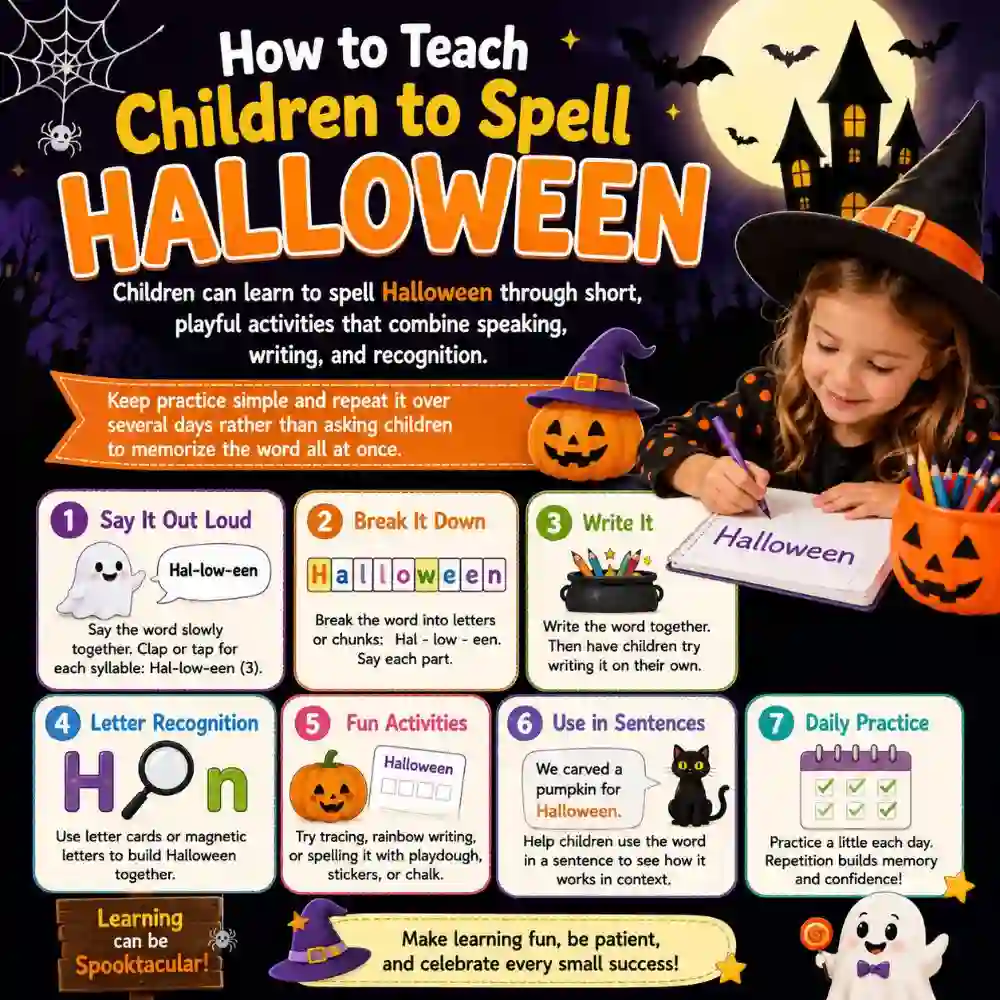
Children can learn to spell Halloween through short, playful activities that combine speaking, writing, and recognition. Keep practice simple and repeat it over several days rather than asking children to memorize the word all at once.
Try these activities:
- Say the word slowly: Let children hear each part of Halloween.
- Spell it aloud: Practice H-A-L-L-O-W-E-E-N together.
- Write and trace: Have children trace the word before writing it independently.
- Use letter cards: Arrange individual letters to build Halloween.
- Make a themed sentence: For example, “We decorated pumpkins for Halloween.”
- Play a correction game: Show Halloween and Holloween, then ask which spelling is correct.
- Practice from memory: Cover the word and let children write it without looking.
Praise their effort and gently correct mistakes. Short, positive practice sessions can make spelling easier to remember.
Frequently Confused Halloween Words
Halloween-related writing includes several words that may look or sound similar but have different meanings. Learning these differences can help you write accurate captions, stories, invitations, and school assignments.
| Word | Meaning |
| Halloween | The holiday observed on October 31 |
| Hallowe’en | A historical spelling variant of Halloween |
| Hollow | Empty inside |
| Hallowed | Holy or sacred |
| Haunt | To visit or appear in a place repeatedly, often in a spooky story |
| Haunted | Said to be visited by ghosts or spirits |
| Hallows | Holy people or sacred things; also part of the historical name All Hallows’ Eve |
| Eve | The evening or day before an event |
The most important distinction is between Halloween and Holloween. Halloween is the correct standard spelling, while Holloween is generally an error. Words such as hollow, hallowed, and hallows are real English words, but they have different meanings and should not be used as substitutes for the holiday’s name.
Halloween vs. Halloween Movies
Halloween can refer to the October 31 holiday, while Halloween movies describes films associated with the holiday or films in the Halloween horror franchise. The meaning depends on context.
| Term | Meaning | Example |
| Halloween | The October 31 holiday | We celebrate Halloween with costumes. |
| Halloween movies | Films watched during the season or related to the holiday | We watched Halloween movies together. |
| Halloween | The title of a horror film franchise and individual films | I watched Halloween (1978). |
Capitalize Halloween when naming the holiday or writing an official film title. In general writing, use lowercase for ordinary words unless they begin a sentence or form part of a proper name.
Read More: Complement or Compliment: What’s the Difference?
All Halloween Movies Names in Release Order
The Halloween franchise has 13 movies released between 1978 and 2022. Here are their names in release order.
- Halloween (1978).
- Halloween II (1981).
- Halloween III: Season of the Witch (1982).
- Halloween 4: The Return of Michael Myers (1988).
- Halloween 5: The Revenge of Michael Myers (1989).
- Halloween: The Curse of Michael Myers (1995).
- Halloween H20: 20 Years Later (1998).
- Halloween: Resurrection (2002).
- Halloween (2007).
- Halloween II (2009).
- Halloween (2018).
- Halloween Kills (2021).
- Halloween Ends (2022).
Note: The movies follow different story timelines. Halloween III: Season of the Witch is a standalone story that does not feature Michael Myers as its main villain.
Read More: Too or To: What’s the Difference and How to Use Them?
Halloween (2018)
Halloween (2018) is an American slasher horror film directed by David Gordon Green. It serves as a direct sequel to the original Halloween (1978), ignoring most of the sequels released in between. The story takes place 40 years after Michael Myers attacked Laurie Strode on Halloween night.
The film follows Laurie as she prepares for Michael’s possible return. When he escapes from custody, he returns to Haddonfield, forcing Laurie and her family to face him once again.
Key Facts About Halloween (2018)
- Release Year: 2018.
- Director: David Gordon Green.
- Main Cast: Jamie Lee Curtis, Judy Greer, and Andi Matichak.
- Genre: Slasher, horror, thriller.
- Main Villain: Michael Myers.
- Connection: Direct sequel to Halloween (1978).
| Detail | Information |
| Release Date | October 19, 2018 |
| Director | David Gordon Green |
| Laurie Strode | Jamie Lee Curtis |
| Michael Myers | James Jude Courtney and Nick Castle |
| Story Setting | Haddonfield, Illinois |
Halloween (1978)
Halloween (1978) is the original film in the Halloween horror franchise, directed by John Carpenter. It introduced audiences to Michael Myers, a masked killer who escapes from a mental institution and returns to his hometown on Halloween night.
The story follows Laurie Strode, a teenager who becomes one of Michael’s targets while babysitting. As the night progresses, Michael stalks Laurie and other young people, creating the suspense that made the film a landmark in slasher cinema.
Key Facts About Halloween (1978)
- Release Year: 1978.
- Director: John Carpenter.
- Main Cast: Jamie Lee Curtis, Donald Pleasence, and P. J. Soles.
- Genre: Slasher, horror, thriller.
- Main Villain: Michael Myers.
- Significance: The film launched one of the best-known horror franchises.
| Detail | Information |
| Release Date | October 25, 1978, in the United States |
| Director | John Carpenter |
| Laurie Strode | Jamie Lee Curtis |
| Dr. Sam Loomis | Donald Pleasence |
| Story Setting | Haddonfield, Illinois |
| Original Music | John Carpenter and collaborators |
Halloween (2007)
Halloween (2007) is a horror film written and directed by Rob Zombie. It reimagines John Carpenter’s original 1978 movie, offering a different look at Michael Myers’ childhood and the events that lead him to become a killer.
The film explores Michael’s early life before following his escape from a psychiatric institution and return to Haddonfield. There, he targets Laurie Strode and others on Halloween night. Unlike the original, this version gives more attention to Michael’s background and uses a darker, more graphic style.
Key Facts About Halloween (2007)
- Release Year: 2007.
- Director: Rob Zombie.
- Main Cast: Scout Taylor-Compton, Malcolm McDowell, and Tyler Mane.
- Genre: Slasher, horror, thriller.
- Main Villain: Michael Myers.
- Connection: A reimagining of the original Halloween (1978).
| Detail | Information |
| Release Date | August 31, 2007, in the United States |
| Director | Rob Zombie |
| Laurie Strode | Scout Taylor-Compton |
| Dr. Samuel Loomis | Malcolm McDowell |
| Michael Myers | Tyler Mane |
| Story Setting | Haddonfield, Illinois |
Halloween Kills (2021)
Halloween Kills (2021) is an American slasher horror film directed by David Gordon Green. It is a direct sequel to Halloween (2018) and continues the story of Michael Myers and Laurie Strode on the same Halloween night. The film focuses on Michael’s return to Haddonfield and the town’s desperate attempt to stop him. <Cite refs={[“turn404603search0″,”turn404603search6”]}/>
After Michael escapes from Laurie’s burning house, Laurie is taken to the hospital with serious injuries. Meanwhile, her daughter Karen, granddaughter Allyson, and other Haddonfield residents join forces to hunt down the masked killer. As fear spreads throughout the town, the survivors struggle to stop Michael’s violent rampage.
Key Facts About Halloween Kills (2021)
- Release Year: 2021.
- Director: David Gordon Green.
- Main Cast: Jamie Lee Curtis, Judy Greer, Andi Matichak, and Will Patton.
- Genre: Slasher, horror, thriller.
- Main Villain: Michael Myers.
- Connection: Direct sequel to Halloween (2018).
| Detail | Information |
| Release Date | October 15, 2021, in the United States |
| Director | David Gordon Green |
| Laurie Strode | Jamie Lee Curtis |
| Karen Nelson | Judy Greer |
| Allyson Nelson | Andi Matichak |
| Michael Myers | James Jude Courtney |
| Story Setting | Haddonfield, Illinois |
| Runtime | Approximately 105 minutes |
Frequently Asked Questions
1. Is Halloween or Holloween the correct spelling?
Halloween is the correct standard spelling. Holloween is generally considered a misspelling and should be avoided in formal writing, school assignments, articles, and social media posts.
2. Why do people spell Halloween as Holloween?
People may write Holloween because they confuse the sounds in the word or type it incorrectly. The correct spelling is Halloween, with two Ls and the letter combination “oween” at the end.
3. Is Halloween spelled the same in British and American English?
Yes, Halloween is the standard spelling in both British and American English. Unlike words such as color and colour, Halloween does not have separate standard spellings for these varieties.
4. Is Hallowe’en also a correct spelling?
Yes, Hallowe’en is a recognized historical variant of Halloween. The apostrophe represents omitted letters in the older expression All Hallows’ Eve. Halloween is more common in modern writing.
5. What does the word Halloween mean?
Halloween is the holiday observed on October 31. Its name comes from All Hallows’ Eve, the evening before All Hallows’ Day, also known as All Saints’ Day.
6. How do you pronounce Halloween?
Halloween is commonly pronounced hal-oh-EEN, with the final syllable receiving the main stress. Pronunciation can vary slightly by accent, but the standard spelling remains the same.
7. What is the easiest way to remember Halloween’s spelling?
Break the word into smaller parts and practice writing it: Hal-low-een. Remember that Halloween begins with H, contains two Ls, and ends with “ween.” Repeating the word aloud can also help.
8. Is Holloween a real English word?
Holloween is not the standard spelling of the holiday’s name and is generally treated as a spelling mistake. The word hollow is real and means empty inside, but it has a different meaning.
9. How did the word Halloween originate?
Halloween developed from All Hallows’ Eve, the evening before All Hallows’ Day. Over time, the expression was shortened, and forms such as Hallowe’en appeared before Halloween became the familiar modern spelling.
10. Which spelling should I use in an article or social media post?
Use Halloween for modern articles, blog posts, schoolwork, invitations, captions, and hashtags. Use Hallowe’en only when discussing historical spelling or reproducing a source that uses that form.
Conclusion
Choosing between Halloween and Holloween is simple once you know the correct spelling. Halloween is the standard form used in both British and American English, while Holloween is generally a misspelling. Remembering the double L and practicing the word a few times can help you avoid this common spelling mistake.
The historical spelling Hallowe’en is also worth knowing because it reflects the word’s connection to All Hallows’ Eve. However, Halloween is the better choice for everyday writing, school assignments, blog content, holiday invitations, and social media captions. Keeping the standard spelling consistent makes your writing clearer and more professional.
Whether you are writing about Halloween traditions, costumes, decorations, trick-or-treating, or spooky celebrations, take a moment to check your spelling before publishing. With a little practice, you can confidently use Halloween every time and avoid confusion with Holloween.

I’m Jane Austen, the admin of GrammarGuide.com, where words come to life in smarter, sharper, and more creative ways. I focus on simplifying grammar, exploring powerful synonyms, and sharing fun, engaging expressions that make everyday communication more effective. My goal is to help readers write with clarity, confidence, and a touch of personality, whether it’s for professional use or just for fun.