
Mastering English grammar is not only about memorizing rules; it is about understanding how words, phrases, and sentences work together to communicate ideas clearly. The English Grammar Advance Guide helps learners build a deeper understanding of advanced grammar rules, sentence structure, and correct language usage for everyday communication, academic writing, and professional situations.
Advanced English grammar can be challenging because several rules often work together within a single sentence. Understanding clauses, phrases, verb forms, tenses, subject-verb agreement, modifiers, conjunctions, punctuation, conditionals, passive voice, reported speech, and complex sentence structures can help you write and speak with greater accuracy. This guide focuses on the meaning, function, and practical use of important grammar concepts rather than simply presenting rules to memorize.
Throughout this guide, you will learn how advanced grammar works, how to recognize common errors, how to construct stronger sentences, and how to apply grammar naturally in speaking and writing. Continue reading to strengthen your grammar knowledge and develop greater confidence in using English correctly.
What Is English?
English is a natural language used to communicate information, ideas, feelings, opinions, and experiences through speaking and writing. It is one of the world’s most widely used languages and plays an important role in education, business, technology, travel, media, and everyday communication.
English is made up of several connected elements, including vocabulary, grammar, pronunciation, spelling, sentence structure, and meaning. Grammar provides the patterns that help speakers and writers arrange words into meaningful sentences. Vocabulary supplies the words needed to express those ideas, while pronunciation and listening help people communicate effectively through speech.
English can be used differently depending on the situation, audience, and purpose. A person may use informal English when talking with friends but choose more formal language for an academic assignment, business email, or professional presentation.
Some important features of English include:
- Spoken and written communication: English can be communicated through speech, writing, and digital formats.
- Flexible vocabulary: New words and expressions continue to enter the language.
- Grammar structure: Rules help organize words and communicate precise meaning.
- Different varieties: English has regional varieties such as American English and British English.
- Multiple communication purposes: It can be used for education, work, entertainment, research, and social interaction.
Understanding these basic characteristics provides a useful foundation for learning English grammar and effective communication.
Definition of the English Language

The English language is a human language used to communicate thoughts, information, questions, instructions, emotions, and opinions. It has a structured system of grammar, vocabulary, pronunciation, spelling, and sentence formation that allows people to create and understand meaning.
English grammar explains how words function and combine within sentences. For example, nouns can identify people, places, objects, or ideas, while verbs commonly express actions or states. Adjectives can provide additional information about nouns, and adverbs can modify verbs, adjectives, or other parts of a sentence.
English also changes according to context and audience. Formal English is often appropriate for academic and professional situations, while informal English is common in casual conversations and personal messages.
| Language Element | Main Function |
| Grammar | Organizes words and sentences according to established patterns |
| Vocabulary | Provides words used to express different meanings and ideas |
| Pronunciation | Determines how spoken words are produced and understood |
| Spelling | Represents words accurately in written English |
| Sentence Structure | Shows how words and clauses are arranged |
| Context | Helps determine the intended meaning and appropriate usage |
English also exists in several recognized varieties. American English, British English, Australian English, Canadian English, and other varieties may have differences in spelling, pronunciation, vocabulary, or usage while remaining part of the broader English language.
Read More: Whoever or Whomever: Understanding the Difference 2026
History and Origin of English
The history of English developed through centuries of migration, cultural contact, political change, trade, literature, and communication. English belongs to the West Germanic branch of the Indo-European language family.
Early English developed in Britain after Germanic-speaking groups, including the Angles, Saxons, and Jutes, settled there. Their languages contributed to what is now called Old English. This early form of English was considerably different from the language used today.
Later historical events introduced vocabulary and linguistic influences from other languages. Old Norse influenced English through Viking settlement, while the Norman Conquest of 1066 brought substantial French influence, particularly in areas connected with government, law, administration, and culture.
The development can be understood through this simplified timeline:
| Period | Approximate Development | Key Characteristics |
| Old English | c. 450–1100 | Strong Germanic foundation |
| Middle English | c. 1100–1500 | Significant French and Norse influence |
| Early Modern English | c. 1500–1700 | Major vocabulary and grammatical changes |
| Modern English | c. 1700–present | Global expansion and continued development |
The invention and growth of printing helped establish more consistent written forms of English. Later, literature, education, science, trade, colonization, migration, and technological development contributed to the language’s international spread.
Modern English continues to change. New vocabulary emerges from technology, science, popular culture, business, and digital communication, showing that language remains an evolving system rather than something permanently fixed.
Why Is English Important?
English is important because it supports communication across many areas of modern life. It is widely used in education, professional communication, international business, science, technology, tourism, entertainment, and online communication.
For students, English can provide access to textbooks, research papers, educational websites, academic resources, and international publications. Strong language skills can also help learners communicate their ideas more clearly in assignments, examinations, presentations, and discussions.
In professional environments, English is commonly used for emails, meetings, reports, presentations, interviews, instructions, and business documents. Knowing how to select appropriate vocabulary and construct clear sentences can make professional communication easier to understand.
English also helps people communicate across language backgrounds. Travelers, international students, researchers, employees, and online users may use English when they do not share the same first language.
Key areas where English plays an important role include:
- Education: Helps learners access academic materials and participate in educational settings.
- Career: Supports workplace communication, interviews, reports, and professional correspondence.
- Technology: Commonly appears in software, technical documentation, digital platforms, and online resources.
- Science and research: Widely used for sharing research and academic information internationally.
- Travel: Can help travelers communicate in airports, hotels, restaurants, and other international settings.
- Business: Supports communication between companies, customers, employees, and international partners.
- Internet communication: English is widely represented across websites, digital media, and online communities.
Learning English, therefore, involves more than memorizing vocabulary. Effective communication also requires grammar, sentence structure, listening, pronunciation, writing, and awareness of context.
Where Is English Spoken?
English is spoken across many parts of the world. In some countries, it is a primary or native language, while in others it serves as an official language, additional language, educational language, or common language for international communication.
Countries and regions use English in different ways, so learners may encounter variations in spelling, pronunciation, vocabulary, and expressions.
| Country or Region | Common Role of English |
| United States | Major native language |
| United Kingdom | Major native language |
| Canada | One of the official languages |
| Australia | Major native language |
| New Zealand | Major native language |
| Ireland | One of the official languages |
| India | Widely used in education, government, business, and communication |
| Singapore | One of the official languages |
| Philippines | Widely used in education and public communication |
There is no single form of English used by every speaker. American English and British English, for example, can differ in spelling and vocabulary. Similar differences appear among other regional varieties.
For English learners, these variations are useful to understand because the same idea may sometimes be expressed differently depending on the country, audience, situation, and communication style. Learning standard grammar while becoming familiar with the variety relevant to your needs can help you communicate more effectively.
How to learn English?

Learning English effectively requires regular practice across several connected skills. Instead of focusing only on vocabulary or grammar rules, learners should develop reading, writing, listening, speaking, pronunciation, vocabulary, and grammar together.
A practical learning process can be divided into these steps:
1. Build Your Basic Vocabulary
Begin with common words and expressions used in everyday communication. Learn words in context rather than memorizing long lists without examples. Understanding how a word functions in a sentence makes it easier to remember and use correctly.
2. Learn Sentence Structure
Study how English sentences are formed. Understanding the relationship between subjects, verbs, objects, phrases, and clauses helps you create clearer sentences.
3. Study English Grammar
Learn grammar progressively rather than trying to memorize every rule at once. Start with fundamental concepts and gradually move toward more advanced areas. Apply each rule by creating your own sentences.
4. Read English Regularly
Reading exposes you to natural vocabulary, sentence patterns, grammar, and writing styles. Choose material that matches your current level and gradually increase the difficulty.
5. Practice Listening
Listen to English regularly through conversations, educational content, interviews, podcasts, or other reliable materials. Focus on understanding the meaning, pronunciation, sentence patterns, and context.
6. Practice Speaking
Use English aloud every day. Describe your routine, explain an idea, summarize something you read, or have a conversation with another learner. Speaking regularly helps turn passive knowledge into active communication.
7. Improve Your Writing
Start with simple sentences and gradually write paragraphs, emails, descriptions, and longer pieces. After writing, check grammar, spelling, punctuation, vocabulary, and sentence clarity.
8. Review Your Mistakes
Keep track of recurring errors. Instead of simply correcting a mistake, understand why the original form was incorrect and create another sentence using the correct structure.
A simple daily routine can help maintain consistency:
| Skill | Suggested Practice |
| Reading | Read an English article or short passage |
| Listening | Listen to natural English for 15–20 minutes |
| Vocabulary | Learn and use several words in sentences |
| Grammar | Study one focused grammar concept |
| Writing | Write a short paragraph or journal entry |
| Speaking | Speak aloud about an everyday topic |
The goal is not to learn everything at once. Consistent practice, active use, regular review, and attention to mistakes can gradually improve your command of English and make communication more natural and accurate.
Read More: Theater or Theatre: Which Spelling Is Correct?
English Speaking
English speaking is the ability to communicate ideas, feelings, questions, and information using spoken English. Good speaking skills require more than grammar. Learners also need vocabulary, pronunciation, listening skills, sentence formation, and regular practice.
Why Is English Speaking Important?
English speaking skills can help you communicate in everyday, academic, and professional situations. Strong speaking skills make it easier to introduce yourself, ask questions, share opinions, explain ideas, and participate in conversations.
How to Improve English Speaking
Regular practice is one of the most useful ways to develop spoken English. Start with simple sentences and familiar topics, then gradually move toward longer conversations.
Try these activities:
- Speak every day: Talk about your routine, hobbies, studies, or plans.
- Read aloud: Read short English passages to practice pronunciation and sentence flow.
- Listen and repeat: Listen to natural English and repeat useful sentences.
- Learn phrases: Study common expressions instead of memorizing isolated words.
- Practice conversations: Speak with friends, classmates, teachers, or language partners.
- Record yourself: Listen to your recordings and identify areas to improve.
- Think in English: Try forming simple thoughts directly in English instead of translating every sentence.
Basic English Speaking Practice
| Situation | Useful Sentence |
| Introduction | My name is Sarah. |
| Asking for information | Could you help me? |
| Sharing an opinion | I think this is a good idea. |
| Daily routine | I usually wake up at seven. |
| Making a request | Could you please repeat that? |
| Talking about plans | I will visit my friend tomorrow. |
| Expressing uncertainty | I’m not sure about that. |
| Ending a conversation | It was nice talking to you. |
The key to better English speaking is consistent practice. You do not need to speak perfectly from the beginning. Start with simple sentences, learn from your mistakes, and gradually increase the amount of English you use in real conversations.
Definition of English Grammar
English grammar is the system of rules and patterns that explains how words are formed, arranged, and used to create meaningful sentences. It helps speakers and writers communicate ideas in a way that other people can understand clearly.
Grammar covers many parts of language, including parts of speech, verb forms, tenses, sentence structure, articles, pronouns, prepositions, conjunctions, modifiers, and subject-verb agreement. These elements work together to show relationships between words and express meaning accurately.
For example, changing the arrangement or form of words can change the meaning or clarity of a sentence. Grammar therefore provides a framework for constructing sentences rather than simply serving as a list of rules to memorize.
English grammar is useful in both spoken and written communication. Learners use it when creating everyday sentences, writing academic assignments, preparing professional emails, having conversations, and expressing complex ideas.
Why Is Grammar Important?
Grammar is important because it helps people communicate clearly, accurately, and effectively. Without an understanding of basic grammatical patterns, a sentence may become difficult to understand or may communicate a different meaning from what the writer intended.
Good grammar can help you:
- Express ideas clearly: Correct sentence structure makes your meaning easier to follow.
- Avoid misunderstandings: Accurate grammar can make relationships between ideas more obvious.
- Write professionally: Grammar is important in emails, reports, applications, and workplace documents.
- Improve academic writing: Students need accurate sentence construction for assignments and examinations.
- Speak more confidently: Understanding grammar makes it easier to form sentences while speaking.
- Develop advanced English skills: Strong basic grammar provides a foundation for complex sentence structures and precise language use.
Grammar is not only useful for formal writing. It also supports everyday conversations by helping speakers organize thoughts and communicate information naturally.
English Basic Grammar
English basic grammar includes the essential rules that help learners form correct sentences and communicate clearly. It covers parts of speech, sentence structure, nouns, pronouns, verbs, tenses, articles, prepositions, conjunctions, and punctuation. Beginners should learn these foundations before moving to more advanced grammar topics.
| Basic Grammar Topic | What You Learn | Example |
| Nouns | Names of people, places, things, or ideas | Ali reads a book. |
| Pronouns | Words that replace nouns | She is my friend. |
| Verbs | Actions or states | They play football. |
| Adjectives | Words that describe nouns | She has a beautiful dress. |
| Adverbs | Words that describe verbs or other words | He runs quickly. |
| Articles | Use of a, an, and the | I saw a bird. |
| Prepositions | Show relationships of place, time, or direction | The book is on the table. |
| Conjunctions | Connect words or ideas | I stayed home because it rained. |
| Tenses | Show when an action happens | She worked yesterday. |
| Punctuation | Makes written sentences clear | Where are you**?** |
Basic English Grammar Rules
Beginners can start with these important rules:
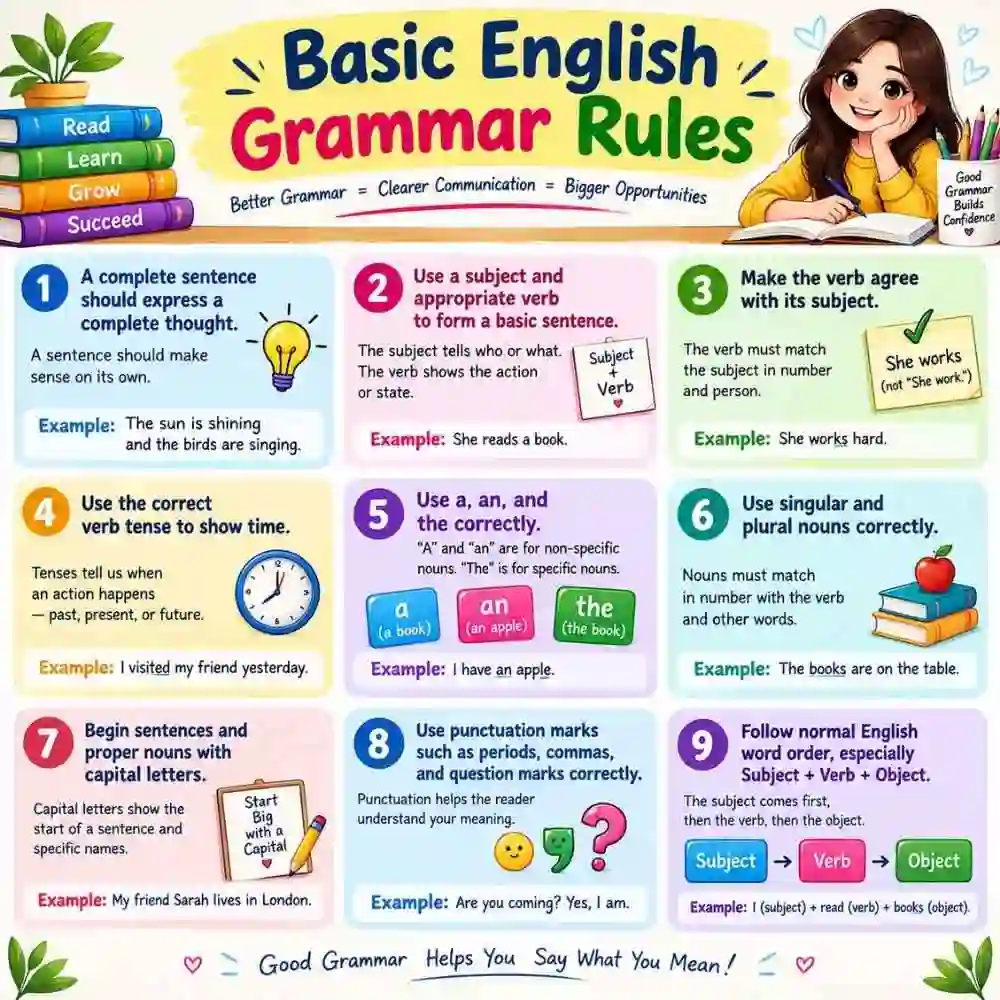
- A complete sentence should express a complete thought.
- Use a subject and appropriate verb to form a basic sentence.
- Make the verb agree with its subject: She works, not “She work.”
- Use the correct verb tense to show time.
- Use a, an, and the correctly.
- Use singular and plural nouns correctly.
- Begin sentences and proper nouns with capital letters.
- Use punctuation marks such as periods, commas, and question marks correctly.
- Follow normal English word order, especially Subject + Verb + Object.
For example, “Sarah reads a book” follows a basic English sentence pattern: Sarah is the subject, reads is the verb, and a book is the object.
Learning these basic grammar rules gives you a strong foundation for English speaking, writing, reading, and advanced grammar.
| Grammar Rule | Explanation | Example |
| Subject-Verb Agreement | The verb should agree with the subject in number and person. | She works every day. |
| Sentence Structure | Words should be arranged in a meaningful grammatical pattern. | They play football. |
| Verb Tense | Verb forms show when an action or situation occurs. | I visited London last year. |
| Articles | Articles such as a, an, and the help identify nouns. | She bought a book. |
| Pronouns | Pronouns can replace nouns to avoid unnecessary repetition. | Maria arrived, and she sat down. |
| Prepositions | Prepositions show relationships involving time, place, direction, or other connections. | The keys are on the table. |
| Capitalization | Certain words, including sentence beginnings and proper nouns, require capital letters. | John lives in Canada. |
| Punctuation | Punctuation marks help organize written sentences and clarify meaning. | What time is it**?** |
These rules are a starting point rather than the entire grammar system. As learners progress, they can study clauses, conditionals, passive constructions, reported speech, modifiers, relative clauses, and complex sentence patterns.
Read More: Laid Off or Layed Off: Which One Should You Use?
Grammar in Everyday Communication
Grammar is used whenever people communicate in English, even when they are not consciously thinking about grammar rules. In a conversation, speakers use verb forms, word order, pronouns, questions, negatives, and sentence patterns to express what they mean.
For example, when talking about a routine, a speaker may use a present-tense structure. When describing something that happened yesterday, a past-tense form helps identify the time of the event. Questions use different word arrangements to distinguish them from statements.
Grammar also changes according to context, audience, and purpose. A casual message to a friend may use shorter and less formal structures, while a job application or academic assignment generally requires more careful grammar and sentence construction.
In everyday communication, grammar helps people:
- Explain what happened and when it happened.
- Ask questions and give answers.
- Describe people, places, and situations.
- Give instructions and advice.
- Express opinions and preferences.
- Connect several ideas in one conversation.
- Communicate clearly in professional and academic settings.
The most effective way to understand grammar is to notice how it works in real sentences and conversations. Applying grammar while reading, writing, listening, and speaking makes the rules easier to understand and use naturally.
Parts of Speech in English
The eight parts of speech are the basic categories used to understand how words function within English sentences. Each category has a different grammatical role, helping learners understand sentence structure, word usage, and meaning.
| Part of Speech | What It Does | Common Examples | Example Sentence |
| Nouns | Name a person, place, thing, or idea. | teacher, city, book, happiness | The teacher opened the book. |
| Pronouns | Replace nouns to avoid repetition. | he, she, it, they, we | She is studying English. |
| Verbs | Show an action, event, or state. | run, write, learn, is | They learn English every day. |
| Adjectives | Describe or give information about nouns or pronouns. | beautiful, smart, difficult, large | She is a smart student. |
| Adverbs | Modify verbs, adjectives, or other adverbs. | quickly, very, carefully, yesterday | He writes carefully. |
| Prepositions | Show relationships involving place, time, direction, or connection. | in, on, under, before, with | The book is on the table. |
| Conjunctions | Connect words, phrases, or clauses. | and, but, because, although | I studied because I had a test. |
| Interjections | Express sudden feelings, emotions, or reactions. | wow, oh, ouch, hurray | Wow! That was amazing. |
Understanding these categories makes it easier to identify the grammatical function of each word and construct clear, accurate English sentences.
English Sentence Structure
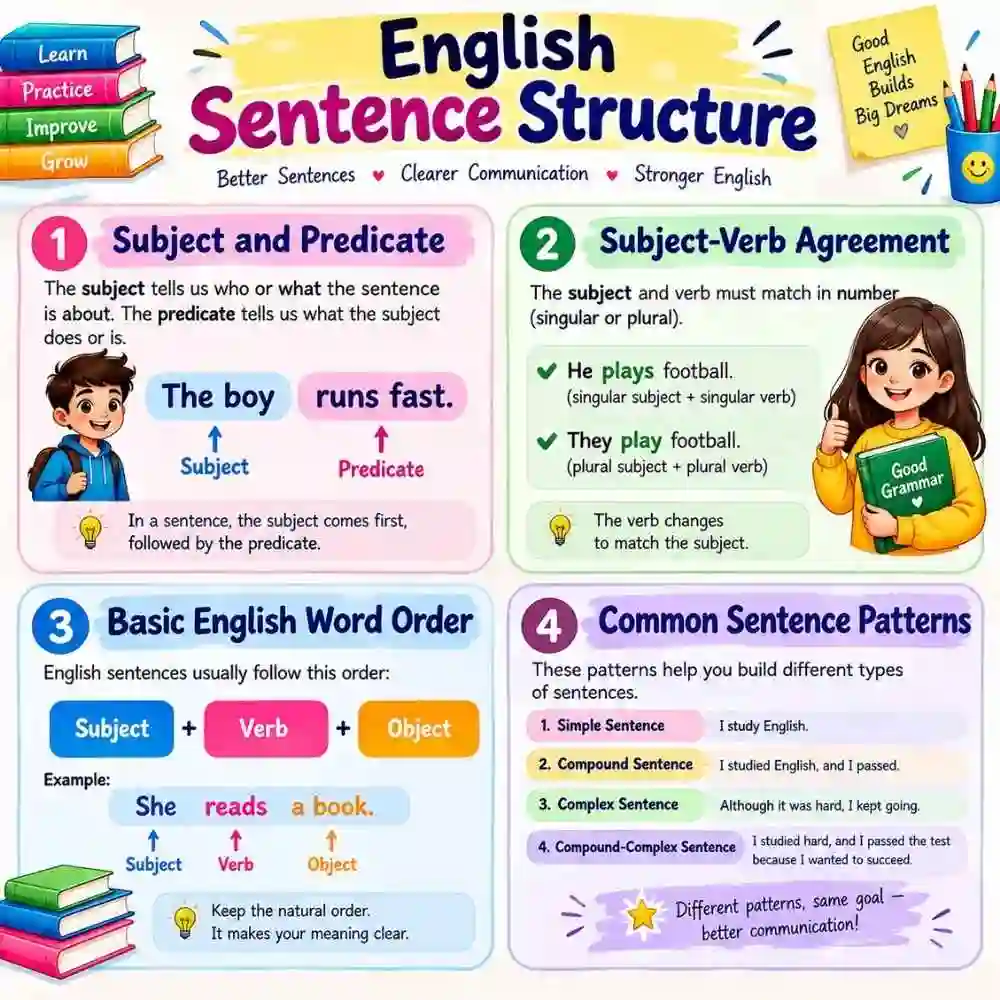
English sentence structure explains how words are arranged to create clear and meaningful sentences. Understanding sentence structure helps learners speak and write more accurately. A complete sentence usually contains a subject and a verb, while additional words can provide information about objects, time, place, reason, and manner.
What Is a Sentence?
A sentence is a group of words that expresses a complete thought. It normally begins with a capital letter and ends with punctuation such as a period, question mark, or exclamation mark.
For example:
- She reads books.
- They are playing football.
- Where do you live?
- What a beautiful day!
A sentence can be short or long, but it should communicate a complete idea. Sentences may also contain multiple clauses when expressing more complex thoughts.
Subject and Predicate
The subject tells us who or what the sentence is about. The predicate tells us what the subject does, is, or experiences.
| Part | Function | Example |
| Subject | Tells who or what the sentence is about. | Ali |
| Predicate | Tells what the subject does or is. | plays cricket. |
| Complete Sentence | Combines both parts. | Ali plays cricket. |
In the sentence “The young girl opened the door,” the subject is “The young girl,” while “opened the door” is the predicate.
Subject-Verb Agreement
Subject-verb agreement means that the verb should match the subject in number and person. A singular subject generally takes a singular verb, while a plural subject usually takes a plural verb.
| Subject | Correct Verb | Example |
| He | works | He works every day. |
| She | likes | She likes coffee. |
| It | looks | It looks beautiful. |
| They | work | They work every day. |
| We | like | We like coffee. |
| You | look | You look happy. |
For example, “She writes every morning” is correct, while “She write every morning” is incorrect. Learning subject-verb agreement helps prevent common grammar mistakes in both speaking and writing.
Basic English Word Order
English generally follows a Subject + Verb + Object (SVO) word order. This means the subject usually comes first, followed by the verb and then the object.
Example:
Maria + reads + a book.
| Sentence Part | Example | Function |
| Subject | Maria | Performs the action |
| Verb | reads | Shows the action |
| Object | a book | Receives the action |
Other information can be added to explain when, where, how, or why something happens.
Example:
“Maria reads a book in the library every afternoon.”
English word order is important because changing the position of words can change the meaning or make a sentence difficult to understand.
Common Sentence Patterns
English uses several common sentence patterns to organize words and ideas. Learning these patterns gives learners a useful foundation for building correct sentences.
| Pattern | Structure | Example |
| SV | Subject + Verb | Birds fly. |
| SVO | Subject + Verb + Object | She reads books. |
| SVC | Subject + Verb + Complement | He is happy. |
| SVOO | Subject + Verb + Object + Object | She gave me a gift. |
| SVOC | Subject + Verb + Object + Complement | They elected him president. |
| SVA | Subject + Verb + Adverbial | The children are outside. |
These patterns can be combined with phrases and clauses to create compound and complex sentences. Once learners understand basic patterns, they can gradually build longer and more detailed sentences without losing grammatical clarity.
English Nouns
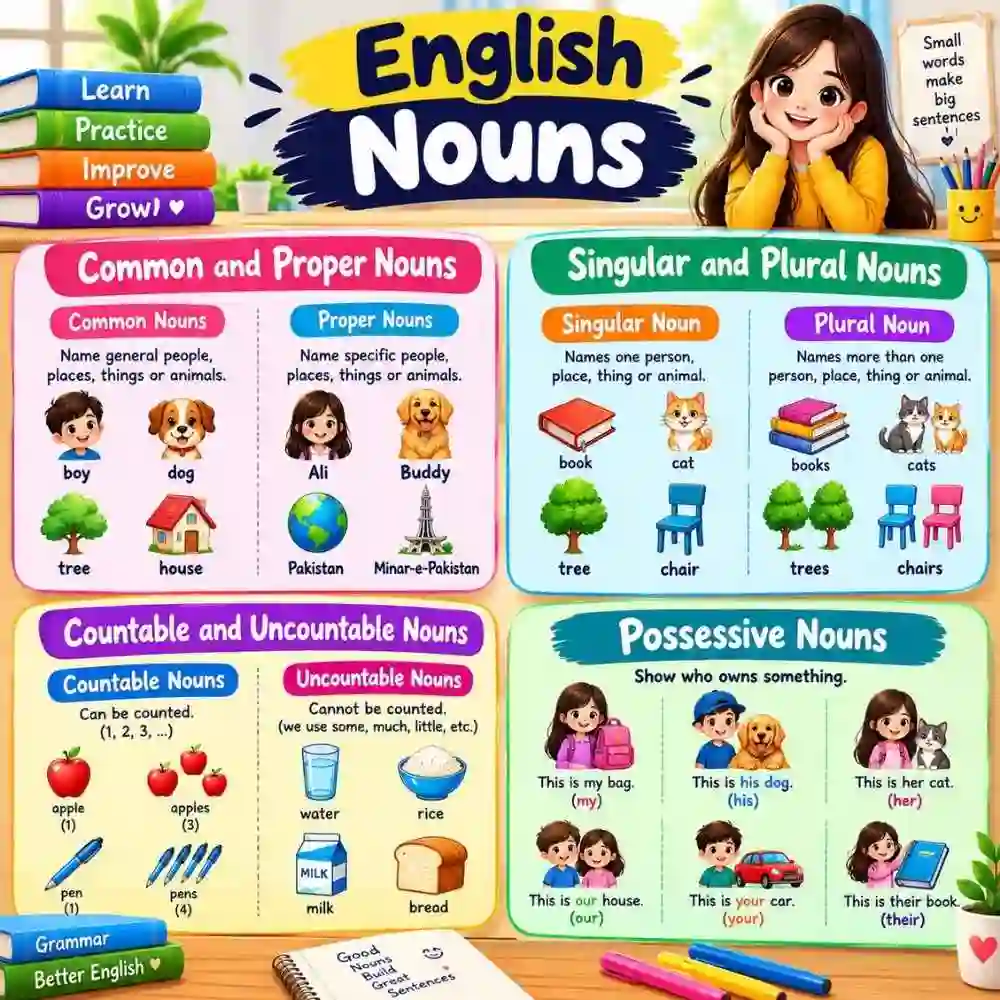
Nouns are words used to name people, places, animals, objects, ideas, feelings, and other things. They are one of the most important parts of English grammar because they often work as the subject or object of a sentence. Understanding different types of nouns helps learners choose the correct forms when speaking and writing.
Common and Proper Nouns
Common nouns refer to general people, places, animals, things, or ideas. Proper nouns identify specific people, places, organizations, or other unique names. Proper nouns usually begin with a capital letter.
| Type | Meaning | Examples | Sentence |
| Common Noun | General name | city, teacher, country | The teacher entered the room. |
| Proper Noun | Specific name | Sarah, London, Pakistan | Sarah visited London. |
For example, “city” is a common noun, while “Lahore” is a proper noun. Similarly, “river” is common, while “Indus River” is a proper noun.
Singular and Plural Nouns
Singular nouns refer to one person, place, animal, object, or idea. Plural nouns refer to more than one. Most regular nouns form their plural by adding -s or -es, but some nouns have irregular plural forms.
| Singular | Plural | Example |
| book | books | I bought two books. |
| class | classes | The classes start at nine. |
| child | children | The children are playing. |
| man | men | Three men entered the room. |
| city | cities | Many cities are crowded. |
| mouse | mice | The mice ran away. |
Learners should pay attention to irregular plural nouns because they do not always follow the usual spelling rules.
Countable and Uncountable Nouns
Countable nouns are things that can be counted individually. They have singular and plural forms and can be used with numbers. Uncountable nouns usually refer to substances, materials, concepts, or things that are not normally counted as separate units.
| Type | Examples | Common Usage |
| Countable | apple, chair, student, car | one apple, three chairs |
| Uncountable | water, rice, information, advice | some water, useful information |
We can say “three apples” because apples can be counted individually. However, we normally say “some rice” rather than “three rices.” When counting uncountable nouns, we often use a suitable unit, such as “three glasses of water” or “two pieces of advice.”
Possessive Nouns
Possessive nouns show ownership, belonging, or a relationship between people or things. For most singular nouns, possession is shown by adding an apostrophe + s (‘s).
| Form | Example | Meaning |
| Singular possessive | John’s car | The car belongs to John. |
| Singular possessive | The girl’s bag | The bag belongs to the girl. |
| Plural ending in -s | The students’ books | The books belong to the students. |
| Irregular plural | The children’s toys | The toys belong to the children. |
For example, “This is Sarah’s phone” means that the phone belongs to Sarah. With plural nouns that already end in -s, an apostrophe is generally added after the s, as in “the teachers’ room.”
Understanding possessive nouns helps writers clearly show ownership and relationships without making sentences unnecessarily long.
Read More: Emasculate vs Demasculate: Which One Is Correct? 2026
English Verbs
Verbs are words that show an action, state, condition, or occurrence. They are essential to English sentences because they tell us what the subject does, experiences, or is. Verbs can be divided into several types based on how they function in a sentence.
Action and Linking Verbs
Action verbs describe physical or mental actions performed by a subject. Examples include run, write, think, eat, study, and laugh.
Linking verbs do not usually show an action. Instead, they connect the subject to a word or phrase that describes or identifies it.
| Type | Function | Examples | Sentence |
| Action Verb | Shows an action | run, write, jump, think | She writes every day. |
| Linking Verb | Connects the subject to information about it | is, am, are, seem, become | She is happy. |
| Action Verb | Shows a mental action | know, believe, understand | I understand the lesson. |
| Linking Verb | Describes a condition or state | feel, look, remain | The soup looks delicious. |
Helping Verbs
Helping verbs, also called auxiliary verbs, work with main verbs to express tense, possibility, questions, negatives, or other grammatical meanings.
Common helping verbs include be, have, and do. Modal verbs such as can, should, and might can also work as auxiliary verbs.
| Helping Verb | Example | Function |
| am | I am studying. | Forms a continuous tense |
| is | She is working. | Forms a continuous tense |
| have | They have finished. | Forms a perfect tense |
| has | He has completed the task. | Forms a perfect tense |
| do | Do you understand? | Forms questions |
| did | She did not call. | Forms past negatives |
The helping verb and main verb work together to create the complete meaning of the verb phrase.
Regular and Irregular Verbs
Regular verbs form their past tense and past participle by following a common pattern, usually by adding -ed. Irregular verbs do not follow this standard pattern and may change completely.
| Type | Base Form | Past Form | Past Participle |
| Regular | work | worked | worked |
| Regular | play | played | played |
| Regular | clean | cleaned | cleaned |
| Irregular | go | went | gone |
| Irregular | eat | ate | eaten |
| Irregular | write | wrote | written |
| Irregular | see | saw | seen |
For example, “walk” becomes “walked,” but “go” becomes “went.” Learning common irregular verbs is important because their forms must usually be memorized.
Transitive and Intransitive Verbs
Transitive verbs need a direct object to complete their meaning. Intransitive verbs do not require a direct object.
| Type | Meaning | Example |
| Transitive | Takes a direct object | She opened the door. |
| Transitive | Takes a direct object | He bought a car. |
| Intransitive | Does not take a direct object | The baby cried. |
| Intransitive | Does not require a direct object | They laughed. |
In “She opened the door,” the verb opened has the direct object the door. In “The baby cried,” the verb cried expresses a complete action without needing an object.
Some verbs can be both transitive and intransitive depending on how they are used.
Modal Verbs
Modal verbs are auxiliary verbs that express ideas such as ability, possibility, permission, advice, necessity, or obligation. They are followed by the base form of the main verb.
Common modal verbs include can, could, may, might, must, shall, should, will, and would.
| Modal Verb | Common Use | Example |
| can | Ability or permission | She can swim. |
| could | Past ability or possibility | He could help us. |
| may | Permission or possibility | You may leave now. |
| might | Possibility | It might rain today. |
| must | Necessity or strong obligation | You must follow the rules. |
| should | Advice or expectation | You should study regularly. |
| will | Future intention or prediction | I will call you later. |
| would | Polite requests or hypothetical situations | Would you help me? |
Modal verbs do not normally take -s with third-person singular subjects. For example, we say “She can drive,” not “She cans drive.” They help speakers express more precise meanings beyond the basic action or state of a verb.
English Articles
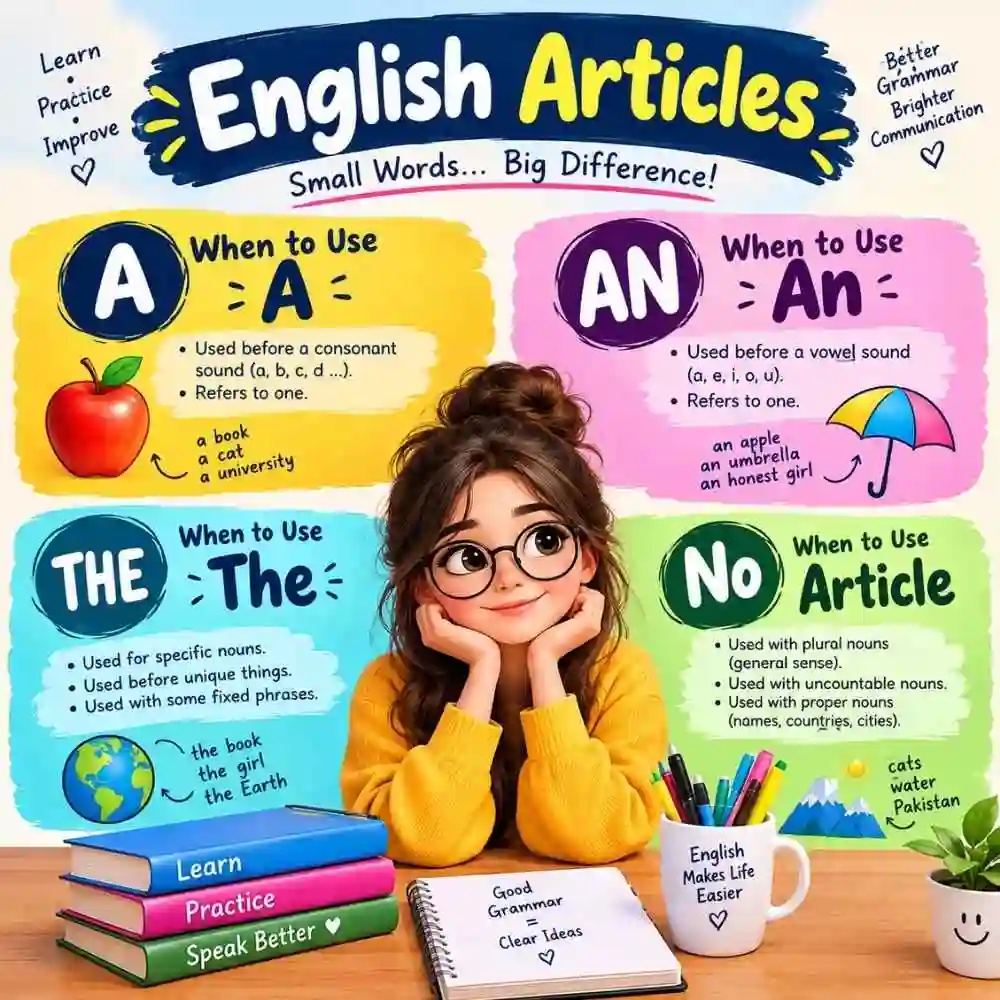
Articles are small words placed before nouns to show whether we are talking about something general, specific, known, or not identified. English has three main articles: a, an, and the. In some situations, we use no article before a noun.
What Are Articles?
The articles a and an are called indefinite articles because they usually refer to one non-specific person, place, thing, or idea. The is called the definite article because it usually refers to a specific or known noun.
| Article | Type | General Use | Example |
| A | Indefinite | One non-specific singular noun | I saw a dog. |
| An | Indefinite | One non-specific singular noun before a vowel sound | She ate an apple. |
| The | Definite | A specific or known noun | The dog was friendly. |
| No article | Zero article | General plural or uncountable nouns in many contexts | Dogs are loyal. |
When to Use A
Use a before a singular countable noun when you are talking about one non-specific thing and the next word begins with a consonant sound.
Examples:
- I saw a bird in the garden.
- She wants to buy a car.
- He is a teacher.
- We need a new computer.
The choice between a and an depends on the sound, not simply the first letter. For example, we say a university because “university” begins with a /y/ sound.
When to Use An
Use an before a singular countable noun when the following word begins with a vowel sound.
Examples:
- She ate an apple.
- He waited for an hour.
- I need an umbrella.
- She is an engineer.
Notice “an hour”. Although hour begins with the letter h, the h is silent, so the word starts with a vowel sound.
Similarly, we use a before words that begin with a consonant sound, even if the spelling starts with a vowel, such as a university and a European country.
When to Use The
Use the when the noun is specific, already known, previously mentioned, or clearly identified by the context.
Examples:
- I bought a book yesterday. The book is interesting.
- Please close the door.
- The sun is shining.
- We visited the museum near our hotel.
The can be used with singular, plural, and uncountable nouns when the meaning is specific.
For example, “I like music” refers to music in general, while “I like the music in this movie” refers to specific music.
When to Use No Article
Sometimes English does not require an article before a noun. This is often called the zero article. It is commonly used when talking about plural countable nouns or uncountable nouns in a general sense.
Examples:
- Dogs make good pets.
- Books can provide useful information.
- Water is essential for life.
- Honesty is an important quality.
- She studies English at school.
Compare:
- Books are useful. → Books in general.
- The books are useful. → Specific books.
- Water is important. → Water in general.
- The water in this bottle is cold. → Specific water.
Using a, an, the, or no article correctly makes sentences clearer and more natural. The key is to consider whether the noun is specific or general, whether it is countable, and what sound begins the following word.
Read More: Linchpin vs. Lynchpin: Which One Should You Use?2026
How to Learn English Grammar Step by Step
Learning English grammar step by step is easier when you build one skill before moving to a more advanced one. Instead of trying to memorize every grammar rule at once, focus on understanding basic concepts, using them in real sentences, and practicing them regularly. A simple routine can gradually improve your English speaking, writing, reading, and overall accuracy.
Start With Basic Grammar
Begin with the basic building blocks of English grammar. Learn the parts of speech, including nouns, pronouns, verbs, adjectives, adverbs, prepositions, conjunctions, and interjections.
Then study simple concepts such as articles, singular and plural nouns, subject-verb agreement, and basic punctuation.
A useful starting order is:
- Learn the parts of speech.
- Understand nouns and pronouns.
- Learn common verbs.
- Study adjectives and adverbs.
- Understand prepositions and conjunctions.
- Practice articles and basic grammar rules.
Do not move too quickly. Make simple sentences using each rule until you can use it naturally.
Learn Sentence Structure
After learning basic grammar, focus on English sentence structure. Start by identifying the subject, verb, and object in simple sentences.
For example:
Sarah reads books.
- Sarah = Subject
- reads = Verb
- books = Object
Practice common patterns such as Subject + Verb, Subject + Verb + Object, and Subject + Verb + Complement. Once simple sentences become easy, begin practicing compound and complex sentences.
Master English Tenses
Tenses help you show when an action happens. Start with the three main time periods: present, past, and future. Then learn the different forms used within each period.
| Tense | Example | Main Use |
| Simple Present | She works here. | Habits and facts |
| Simple Past | She worked yesterday. | Completed past actions |
| Simple Future | She will work tomorrow. | Future actions |
| Present Continuous | She is working now. | Actions happening now |
| Present Perfect | She has worked here for years. | Past actions connected to the present |
Practice one tense at a time. Create your own positive, negative, and question sentences before moving to another tense.
Build Your Vocabulary
Grammar becomes more useful when you have enough English vocabulary to express your ideas. Learn new words in context instead of memorizing long lists without examples.
For each new word, try to learn:
- Its meaning.
- Its part of speech.
- Its common forms.
- A few related words.
- One or two example sentences.
For example, when learning “carefully,” also recognize “careful” and understand how the words function differently in a sentence.
Reading short articles, stories, conversations, and other English content can help you see vocabulary and grammar working together.
Practice Speaking
Regular English speaking practice helps turn grammar knowledge into an active skill. Start with simple sentences about familiar topics such as your daily routine, family, studies, work, hobbies, or plans.
You can practice by:
- Describing what you are doing.
- Talking about your daily routine.
- Reading sentences aloud.
- Answering simple questions in English.
- Having short conversations with a partner.
- Recording yourself and listening for mistakes.
Do not wait until your grammar is perfect before speaking. Making mistakes is a normal part of learning, and correcting repeated mistakes can gradually improve accuracy.
Practice Writing
Writing gives you time to apply grammar carefully. Begin with short sentences and gradually move to paragraphs, emails, descriptions, and longer pieces of writing.
A simple writing routine can include:
| Practice | Example |
| Sentence writing | Write five sentences using a new tense. |
| Daily journal | Describe what you did today. |
| Short paragraph | Write about your favorite activity. |
| Grammar exercise | Practice one grammar rule. |
| Self-editing | Check verbs, articles, punctuation, and word order. |
After writing, read your work again and look for repeated errors. Try rewriting incorrect sentences rather than simply deleting them.
Review and Correct Your Mistakes
Regular review helps turn grammar rules into long-term knowledge. Keep a grammar mistake list where you record errors that you often make.
For example:
| Mistake | Correction | Rule |
| She go to school. | She goes to school. | Subject-verb agreement |
| He is a engineer. | He is an engineer. | Use an before a vowel sound |
| I have went there. | I have gone there. | Correct past participle |
| They was happy. | They were happy. | Subject-verb agreement |
Review your mistakes every few days and create new sentences using the corrected forms. This approach helps you understand why a sentence is incorrect instead of simply memorizing the right answer.
The most effective approach is to combine learning, practice, correction, and review. With consistent practice, grammar rules become easier to recognize and use in everyday English.
How to Improve English Grammar
Improving English grammar takes regular practice rather than memorizing rules once and forgetting them. The goal is to understand how grammar works and then use it naturally in reading, writing, speaking, and everyday conversations. A consistent routine can help you recognize common patterns, reduce repeated mistakes, and communicate your ideas more clearly.
Read English Regularly
Reading English regularly exposes you to correct sentence structure, vocabulary, verb forms, punctuation, and grammar patterns. Choose material that matches your current level, such as short stories, news articles, blogs, or simple books.
While reading, pay attention to how writers:
- Build sentences.
- Use different verb tenses.
- Place adjectives and adverbs.
- Use articles such as a, an, and the.
- Connect ideas with conjunctions.
- Use punctuation marks.
Instead of checking every word, focus on understanding how complete sentences are constructed.
Write in English Every Day
Daily writing gives you an opportunity to actively apply grammar rules. Start with a few sentences and gradually increase the length as your confidence improves.
You can write about:
- Your daily routine.
- Your studies or work.
- Your hobbies.
- A recent experience.
- Your plans for tomorrow.
- A topic you recently read about.
After writing, check your verb forms, subject-verb agreement, articles, prepositions, word order, spelling, and punctuation. Rewriting incorrect sentences can help you remember the correct structure.
Practice Grammar Exercises
Grammar exercises help you test whether you understand a particular rule. Begin with one topic at a time instead of practicing many unrelated rules together.
| Grammar Topic | Practice Example |
| Articles | Choose a, an, or the. |
| Tenses | Complete sentences using the correct verb form. |
| Prepositions | Choose in, on, at, or another suitable preposition. |
| Subject-Verb Agreement | Select the correct singular or plural verb. |
| Pronouns | Replace repeated nouns with suitable pronouns. |
| Sentence Structure | Arrange words into a correct sentence. |
Once you finish an exercise, check your answers and identify why an answer is correct or incorrect. This makes practice more useful than simply counting correct answers.
Learn From Your Mistakes
Mistakes can show you which grammar areas need more attention. Instead of ignoring an error, write down the incorrect sentence, its correction, and the rule involved.
For example:
Incorrect: She don’t like coffee.
Correct: She doesn’t like coffee.
Rule: Use doesn’t with a singular third-person subject.
Keep a small list of your common mistakes and review it regularly. When you notice the same error several times, create new sentences using the correct pattern.
Use Grammar in Real Conversations
Using grammar during real conversations helps turn passive knowledge into an active skill. Try to use the grammar you have recently learned when speaking with friends, classmates, teachers, language partners, or other English speakers.
You can practice by:
- Describing your day in English.
- Asking and answering questions.
- Discussing familiar topics.
- Retelling a short story.
- Explaining your opinion about a simple subject.
- Recording yourself and reviewing your sentences.
Do not focus on speaking perfectly from the beginning. Pay attention to one or two grammar areas at a time and gradually improve your accuracy. Combining reading, writing, exercises, mistake correction, and conversation practice creates a balanced way to improve English grammar.
What Are the Basic Rules of English Grammar?
The basic rules of English grammar help you build sentences that are clear, accurate, and easy to understand. These rules cover areas such as word order, subject-verb agreement, verb tenses, articles, pronouns, prepositions, capitalization, and punctuation.
| Basic Rule | Explanation | Example |
| Subject-Verb Agreement | The verb should agree with the subject. | She works here. |
| Correct Word Order | Words should follow a logical sentence pattern. | They play football. |
| Verb Tenses | Use the correct verb form to show time. | He went home yesterday. |
| Articles | Use a, an, or the correctly. | She bought a book. |
| Pronouns | Use pronouns correctly to replace nouns. | He is my friend. |
| Prepositions | Use suitable words to show relationships. | The keys are on the table. |
| Capitalization | Begin sentences and proper nouns with capital letters. | Maria lives in Canada. |
| Punctuation | Use punctuation to make meaning clear. | Where are you**?** |
| Singular and Plural Forms | Use the correct noun form. | One child, two children. |
Learning these rules gives you a strong foundation before moving into more advanced grammar topics.
What Are the 8 Parts of Speech?
The 8 parts of speech classify words according to the jobs they perform in a sentence. They include nouns, pronouns, verbs, adjectives, adverbs, prepositions, conjunctions, and interjections.
| Part of Speech | Function | Example |
| Noun | Names a person, place, thing, or idea. | Sarah reads a book. |
| Pronoun | Replaces a noun. | She reads a book. |
| Verb | Shows an action or state. | Sarah reads a book. |
| Adjective | Describes a noun or pronoun. | She reads an interesting book. |
| Adverb | Modifies a verb, adjective, or adverb. | She reads quickly. |
| Preposition | Shows a relationship between words. | The book is on the table. |
| Conjunction | Connects words, phrases, or clauses. | I studied because I had a test. |
| Interjection | Expresses emotion or reaction. | Wow! That is amazing. |
Knowing the parts of speech makes it easier to understand how words function and how sentences are constructed.
What Are the 12 Tenses in English?
The 12 English tenses show when an action or state happens and how it relates to a particular time. They are formed from three main time periods: present, past, and future, with four common forms for each.
| Time | Tense | Example |
| Present | Simple Present | She works every day. |
| Present | Present Continuous | She is working now. |
| Present | Present Perfect | She has worked here before. |
| Present | Present Perfect Continuous | She has been working for two hours. |
| Past | Simple Past | She worked yesterday. |
| Past | Past Continuous | She was working at noon. |
| Past | Past Perfect | She had worked before lunch. |
| Past | Past Perfect Continuous | She had been working for two hours. |
| Future | Simple Future | She will work tomorrow. |
| Future | Future Continuous | She will be working at noon. |
| Future | Future Perfect | She will have worked by Friday. |
| Future | Future Perfect Continuous | She will have been working for two hours. |
A useful way to study the 12 tenses is to learn them in groups. First understand the simple forms, then the continuous forms, followed by the perfect and perfect continuous forms. Practice each tense with positive sentences, negative sentences, and questions to understand how it works in real communication.
How Can I Learn English Grammar?
You can learn English grammar by studying one topic at a time and using each rule in your own sentences. Start with basic concepts such as parts of speech, sentence structure, nouns, verbs, articles, prepositions, and subject-verb agreement. After that, move to more advanced topics such as tenses, clauses, conditionals, passive voice, and reported speech.
A simple learning routine can include:
- Learn one grammar rule.
- Read several examples.
- Write your own sentences.
- Practice with grammar exercises.
- Check and correct your mistakes.
- Review the rule regularly.
Reading English and listening to natural conversations can also help you notice how grammar is used in real communication.
How Can I Improve My English Speaking?
Improving English speaking skills requires regular practice. Start by speaking about familiar topics instead of trying to use difficult vocabulary or complicated sentences. Describe your routine, talk about your interests, answer questions, or explain something you already know.
Try these speaking activities:
- Read short English passages aloud.
- Repeat useful phrases after hearing them.
- Practice conversations with a partner.
- Record yourself speaking for a few minutes.
- Learn common expressions used in daily conversations.
- Focus on clear pronunciation and sentence structure.
- Review mistakes and try the same sentences again.
The goal is to become comfortable expressing ideas in English while gradually improving grammar, vocabulary, pronunciation, and accuracy.
How Can I Speak English Fluently?
English fluency develops through regular exposure and active use. Fluency does not mean knowing every English word or never making a grammar mistake. It means being able to express your thoughts with reasonable speed, clarity, and confidence.
To develop fluency, create an English practice routine that includes listening, speaking, reading, and writing. Speak every day, even if you only have a few minutes. Try thinking about simple activities in English rather than translating every sentence from your first language.
You can also improve fluency by:
- Learning useful phrases instead of isolated words.
- Practicing common conversation topics.
- Listening to English conversations regularly.
- Retelling stories in your own words.
- Speaking without stopping to correct every small mistake.
- Learning from repeated grammar and pronunciation errors.
- Gradually increasing the difficulty of your conversations.
With consistent practice, you can become more comfortable forming sentences directly in English and responding more naturally during conversations.
English Grammar Tenses
English grammar tenses show when an action or event happens. The main time categories are present, past, and future, and each has four common forms: simple, continuous, perfect, and perfect continuous.
| Tense | Example | Main Use |
| Simple Present | She works every day. | Habits and facts |
| Present Continuous | She is working now. | Actions happening now |
| Present Perfect | She has finished her work. | Completed actions connected to the present |
| Present Perfect Continuous | She has been working for two hours. | Actions continuing over a period |
| Simple Past | She worked yesterday. | Completed past actions |
| Past Continuous | She was working at noon. | An action in progress in the past |
| Past Perfect | She had finished before lunch. | An earlier past action |
| Past Perfect Continuous | She had been working for two hours. | A continuing action before another past event |
| Simple Future | She will work tomorrow. | Future actions |
| Future Continuous | She will be working at noon. | An action in progress in the future |
| Future Perfect | She will have finished by Friday. | An action completed before a future time |
| Future Perfect Continuous | She will have been working for two hours. | An action continuing until a future point |
English Grammar App
An English grammar app can provide a convenient way to study grammar on a phone or tablet. A useful grammar app may include lessons, examples, quizzes, exercises, progress tracking, and explanations of common mistakes.
When choosing a grammar learning app, look for features such as:
- Grammar lessons organized by difficulty.
- Interactive exercises for regular practice.
- Tense practice with examples.
- Vocabulary activities to support grammar learning.
- Instant feedback on answers.
- Progress tracking to monitor improvement.
- Speaking and listening practice for practical English use.
Using an app regularly can supplement other learning methods such as reading, writing, conversation practice, and traditional grammar exercises.
English Grammar PDF
An English grammar PDF can be useful as a portable reference for studying grammar without needing to search for individual topics each time. A well-organized PDF can include grammar rules, examples, tables, exercises, and answer keys in one place.
A useful English grammar PDF may cover:
- Parts of speech.
- Sentence structure.
- Nouns and pronouns.
- Verbs and helping verbs.
- Articles.
- Prepositions and conjunctions.
- Subject-verb agreement.
- The 12 English tenses.
- Active and passive voice.
- Direct and indirect speech.
- Conditionals.
- Common grammar mistakes.
For effective study, use a grammar PDF as a reference and practice resource, then apply the rules by writing sentences and using English in real conversations.
Frequently Asked Questions About English Grammar
1. What Is the Difference Between Grammar and Vocabulary?
Grammar explains how words are arranged and used in sentences, while vocabulary refers to the words you know and understand. Both are important for clear English communication.
2. How Long Does It Take to Learn English Grammar?
The time varies from person to person. Regular learners can understand basic grammar in a relatively short period, while advanced grammar requires continued study and practice. Consistency is more important than learning everything quickly.
3. Can I Learn English Grammar Without a Teacher?
Yes, you can learn many grammar concepts independently using reliable books, lessons, exercises, and practice resources. A teacher or language partner can provide additional feedback when you need help identifying mistakes.
4. How Can I Remember English Grammar Rules Easily?
Connect each rule with examples and practical sentences instead of trying to memorize definitions alone. Reviewing the same concept at different times and using it in your own writing can also make it easier to remember.
5. Should I Learn Grammar Before Speaking English?
You do not need to master grammar before you start speaking. It is useful to learn basic rules while practicing speaking at the same time. This allows you to develop grammar knowledge and communication skills together.
6. Why Do I Understand English but Struggle to Speak It?
Understanding English and producing English are different skills. You may recognize words and sentences while listening or reading but need more active practice to form your own responses. Regular speaking practice can help bridge this gap.
7. How Can I Stop Making the Same Grammar Mistakes?
First, identify the mistakes you repeat most often. Write down the incorrect and corrected forms, learn the related rule, and create several new sentences using the correct structure. Regular review can help reduce repeated errors.
8. Is It Important to Learn English Pronunciation?
Yes. Pronunciation helps listeners understand your spoken English more easily. You can improve it by listening carefully to English speakers, repeating words and phrases, and practicing difficult sounds.
9. Can Watching English Videos Improve My English?
Watching English videos can expose you to natural vocabulary, pronunciation, sentence patterns, and everyday expressions. For better results, listen actively and repeat useful phrases rather than only watching passively.
10. What Is the Best Way to Practice English Every Day?
Create a balanced routine that includes reading, listening, speaking, and writing. Even a short daily session can be useful when you practice consistently and review the mistakes you make.
Conclusion
Learning English grammar gives you the foundation needed to build clear and accurate sentences. From basic parts of speech and sentence structure to nouns, verbs, articles, tenses, and other grammar concepts, each topic contributes to better communication. Understanding these rules can make both written and spoken English easier to use.
Grammar knowledge becomes more useful when you apply it regularly. Read English, write your own sentences, practice speaking, complete grammar exercises, and pay attention to the mistakes you make. Instead of trying to learn every rule at once, focus on one concept at a time and gradually increase the difficulty.
Improving English is a continuous process that requires practice, patience, and consistency. Whether your goal is better grammar, stronger writing, or more confident speaking, regular use of English can help you make steady progress. Use this guide as a foundation, review important concepts regularly, and keep applying what you learn in real communication.

I’m Jane Austen, the admin of GrammarGuide.com, where words come to life in smarter, sharper, and more creative ways. I focus on simplifying grammar, exploring powerful synonyms, and sharing fun, engaging expressions that make everyday communication more effective. My goal is to help readers write with clarity, confidence, and a touch of personality, whether it’s for professional use or just for fun.



