Nighttime vs. night time is a common spelling question because both forms appear in books, websites, and everyday conversations. Many writers wonder whether they should use the one-word form or the two-word version. The confusion grows because English often combines separate words into compound words over time, and nighttime is one of those examples. Knowing which version fits modern English helps you write with greater confidence and consistency.
In today’s standard English, nighttime (one word) is the preferred spelling in most dictionaries and style guides. It functions as a noun referring to the period between evening and morning when it is dark. While night time may still appear in older texts, informal writing, or as two separate words for stylistic reasons, the closed compound nighttime is generally considered the standard choice in American English.
Understanding this difference improves more than just spelling. It helps you communicate clearly in emails, academic papers, creative writing, and professional documents. The sections below explain why people confuse these forms, when each appears, and how to use the correct spelling naturally in everyday writing.
Etymology and Word Origin
The word nighttime developed as English evolved from using separate words to forming closed compound words. Originally, writers commonly used night time as two separate words because it literally meant “the time of night.” Over the years, frequent use caused the two words to merge into a single compound, much like daytime, sunlight, and moonlight.
Modern dictionaries now recognize nighttime as the standard spelling because it functions as one idea rather than two separate concepts. Today, it refers to the period between evening and morning when it is dark outside.
Examples:
- We enjoy walking during nighttime.
- Nighttime temperatures can drop quickly.
- Reading before nighttime helps me relax.
Understanding this evolution explains why modern English favors the closed compound over the older two-word form.
Read More: Emasculate vs Demasculate: Which One Is Correct? 2026
The Correct Modern Standard
The accepted spelling in modern English is nighttime (one word). Most major dictionaries, style guides, and professional publications treat it as the preferred form in both everyday and formal writing.
Use nighttime whenever you refer to the general period of the night.
Correct examples:
- Nighttime driving requires extra caution.
- Children often sleep better during nighttime.
- The city looks beautiful at nighttime.
Using the one-word spelling creates consistency and matches current English usage across newspapers, books, websites, academic writing, and business communication.
Why the Confusion Happens
Many people still write night time because both words make sense individually. Since night and time can stand alone, it feels natural to separate them.
Several factors contribute to the confusion:
- Older books sometimes use the two-word version.
- People compare it with phrases like lunch time or bed time, which are still often written separately.
- Spell checkers may not always flag night time as incorrect.
- Writers may simply type the phrase the way they hear it.
The good news is that readers understand both versions. However, nighttime is the spelling that aligns with modern grammar and current publishing standards.
Is “Night Time” Ever Correct?
Yes, night time is occasionally acceptable, but it is no longer the preferred spelling in modern English.
Some writers intentionally use the two-word version for stylistic reasons, historical writing, or when quoting older sources. You may also encounter it in older novels, newspapers, or regional publications.
Examples where it may appear:
- Historical documents
- Older British publications
- Direct quotations from earlier texts
For original writing today, especially online articles, school assignments, business documents, and professional communication, nighttime is usually the better choice.
Which Spelling Is Grammatically Correct?
From a modern grammar perspective, nighttime is considered the correct standard spelling.
Compare the two forms:
- ✅ Nighttime is peaceful during winter.
- ✅ I prefer working at nighttime.
- ⚠️ Night time is understandable but less common in current standard English.
Grammar experts generally recommend following current dictionary usage instead of older conventions. Choosing nighttime also helps maintain consistency with similar compound nouns such as daytime, bedtime, and lifetime.
Read More: Respond vs Response: What’s the Difference in Both Words 2026
Nighttime vs. Night-Time: Is a Hyphen Needed?
The hyphenated form night-time appears occasionally, particularly in older British publications, but it is uncommon in modern writing.
| Form | Modern Usage | Recommendation |
| Nighttime | Very common | ✅ Preferred in modern English |
| Night-time | Occasionally used, mainly in older or some British sources | Acceptable but less common |
| Night time | Older two-word spelling | Understandable but generally not preferred |
As English evolves, many compounds move through three stages:
- Open compound (night time)
- Hyphenated compound (night-time)
- Closed compound (nighttime)
Today, nighttime has completed that transition in most modern writing.
Nighttime in American English vs. British English
Although both American and British English recognize the word, usage patterns differ slightly.
| Variety | Preferred Form | Notes |
| American English | Nighttime | Strongly preferred in dictionaries, journalism, and education |
| British English | Nighttime or Night-time | Both appear, although nighttime is becoming increasingly common |
| Modern Digital Writing | Nighttime | Most websites and style guides favor the closed compound |
| Historical Publications | Night time or Night-time | More common in older printed works |
If you are writing for an international audience, nighttime is usually the safest and most widely accepted choice.
Is “Nighttime” a Closed Compound Word?
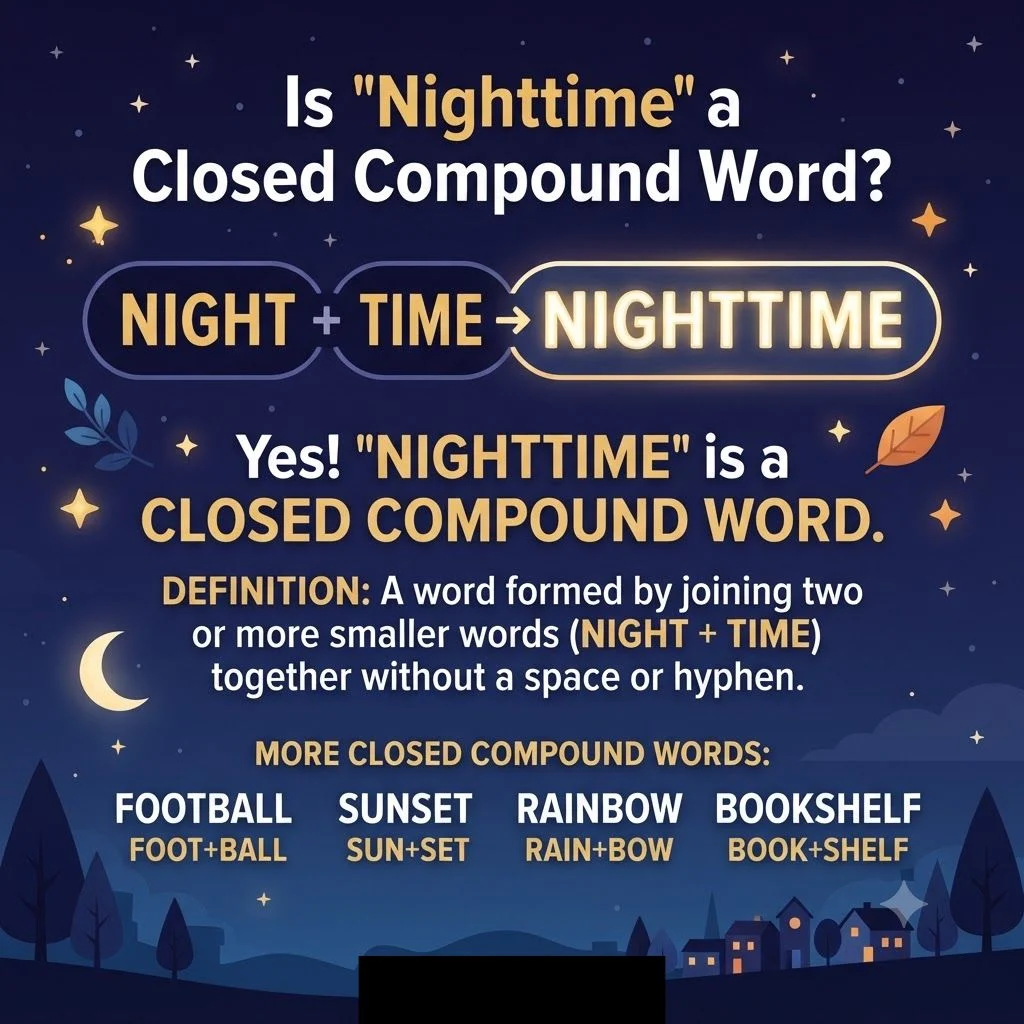
Yes. Nighttime is a closed compound word, meaning two separate words have permanently combined into one.
English contains many closed compounds because frequent usage gradually removes the space between words.
Examples include:
- Daytime
- Bedtime
- Lifetime
- Sunlight
- Moonlight
- Nighttime
Closed compounds improve reading flow by showing that both parts express a single idea rather than two separate concepts.
Is “Night Time” Outdated?
Compared with nighttime, the two-word spelling is becoming increasingly outdated.
While it is not technically wrong in every context, most current dictionaries, publishers, schools, and professional writers recommend using the one-word form.
You may still find night time in:
- Older books
- Archived newspapers
- Historical writing
- Direct quotations
- Certain regional publications
For modern blogs, academic papers, workplace communication, marketing copy, and digital content, nighttime is the preferred spelling because it reflects today’s standard English conventions.
Understanding the Word Structure
The difference between nighttime and night time becomes much clearer when you understand how English builds words. English often combines two separate words into a compound word when they frequently appear together and express a single idea.
In this case, night refers to the period of darkness, while time refers to a span or period. Together, they describe one specific concept—the hours between evening and morning. Because the two words function as a single unit, modern English increasingly treats them as one word: nighttime.
Consider these examples:
- Nighttime temperatures often fall below freezing.
- Many animals are active during nighttime.
- We avoid long drives at nighttime.
Although night time is still understandable, the one-word form better reflects how modern English naturally combines words that represent a single concept.
Read More: Become vs Became: What’s the Difference? 2026
Compound Nouns
A compound noun is created when two or more words join together to form one noun with a specific meaning. English has three main types of compound nouns:
| Compound Type | Example | Usage |
| Closed compound | Nighttime, bedtime, daytime | Written as one word |
| Hyphenated compound | Mother-in-law, editor-in-chief | Joined with hyphens |
| Open compound | Ice cream, post office | Written as separate words |
Nighttime is classified as a closed compound noun because it represents one complete idea instead of two separate ones.
Other similar closed compounds include:
- Daytime
- Sunlight
- Moonlight
- Lifetime
- Bedtime
As words become more common in everyday communication, English often merges them into closed compounds, making reading smoother and more efficient.
Two-Word Phrases That Stay Separate
Not every pair of words eventually becomes a compound. Many expressions remain open compounds, meaning they continue to be written as two separate words because each word keeps its own meaning.
Examples include:
- High school
- Living room
- Coffee table
- Post office
- Full moon
In these phrases, each word contributes independently to the overall meaning.
By contrast, nighttime has become one word because English speakers generally treat it as a single period rather than simply combining the words night and time.
A useful guideline is this:
- If dictionaries list the expression as one word, use the closed compound.
- If dictionaries keep the words separate, continue writing them as two words.
Checking a trusted dictionary is the easiest way to confirm the accepted spelling.
The Transition from “Night Time” to “Nighttime”
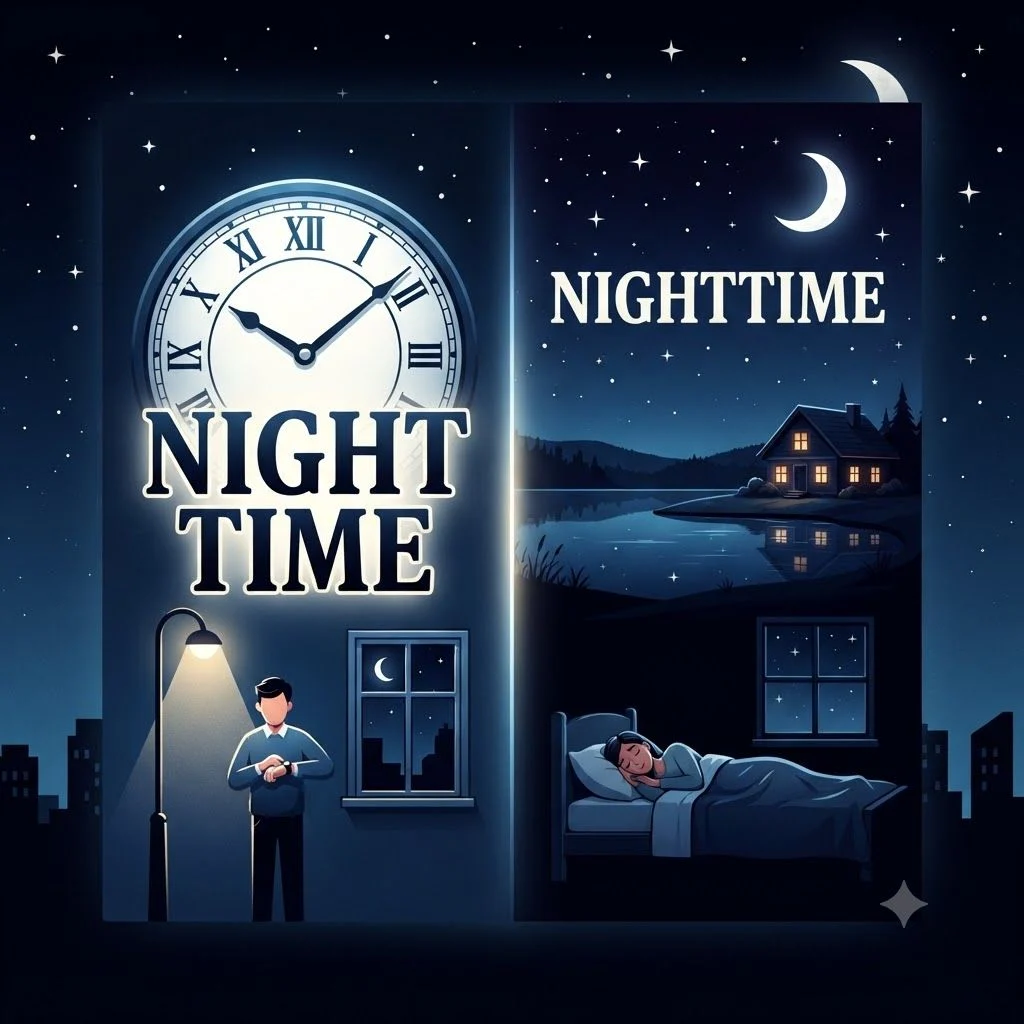
English spelling constantly evolves. Many words begin as separate terms before gradually becoming hyphenated and eventually merging into a single word.
The development of nighttime followed this familiar pattern:
- Night time (open compound)
- Night-time (hyphenated compound)
- Nighttime (closed compound)
This transition happened because writers, publishers, and dictionaries recognized that the expression referred to one unified concept rather than two independent words.
The same pattern can be seen in words such as:
- Today
- Tomorrow
- Bedtime
- Daytime
- Online
As language becomes more standardized, the closed form usually becomes the preferred spelling in newspapers, books, educational materials, and digital writing.
Historical Development
The spelling of nighttime reflects centuries of gradual language change rather than a sudden grammar rule.
Earlier English writing often separated words that are now written together. As printing became more standardized and dictionaries established preferred spellings, many commonly used expressions evolved into permanent compound words.
Today, major dictionaries and modern style guides recognize nighttime as the standard spelling because it is the form most readers expect to see.
This historical development shows that spelling conventions are influenced by actual language use. When enough writers consistently adopt a new form, it often becomes the accepted standard.
Early Use: “Night Time”
In older English texts, night time was the normal way to write the expression. Writers treated night and time as separate words because compound spelling had not yet become fully standardized.
You may still encounter night time in:
- Historical literature
- Early newspapers
- Classic novels
- Archived magazines
- Older legal or academic documents
Its appearance in older sources does not make it incorrect within its historical context. It simply reflects the spelling conventions of that period.
For modern writing, however, most publishers and editors recommend nighttime to match current English standards.
Emergence of “Nighttime”
As English evolved throughout the twentieth century, dictionaries increasingly listed nighttime as a closed compound noun. The one-word spelling became more common in journalism, education, publishing, and digital media.
Today, you’ll regularly see nighttime in:
- News articles
- School textbooks
- Scientific writing
- Government publications
- Professional websites
- Everyday communication
This shift mirrors the evolution of many other English compounds that gradually merged into a single word through frequent use.
For consistency, clarity, and modern grammar, nighttime is now the preferred spelling for nearly all contemporary writing.
Dictionaries and Style Guides
Modern dictionaries and respected style guides overwhelmingly recommend nighttime as the standard spelling. While you may still see night time or night-time in older texts, today’s reference works favor the closed compound because it reflects current English usage.
Whether you’re writing an essay, business email, blog post, or social media content, choosing nighttime helps your writing match modern publishing standards.
Most editors encourage consistency. If you use nighttime once, continue using the same spelling throughout your document rather than switching between different forms.
Major Dictionary Positions (Summarized)
Leading dictionaries generally agree that nighttime is the preferred modern spelling.
| Dictionary Position | Preferred Form | Notes |
| Modern English dictionaries | Nighttime | Standard spelling in current English |
| Educational dictionaries | Nighttime | Recommended for students and formal writing |
| Historical references | Night time / Night-time | May appear in older sources or quotations |
| Current publishing references | Nighttime | Preferred for consistency and readability |
Although wording may differ slightly between dictionaries, the overall recommendation remains the same: nighttime is the accepted spelling for contemporary writing.
Editorial and Publishing Standards
Professional editors aim for clarity and consistency. That’s why newspapers, magazines, academic publishers, and online publications generally use nighttime.
You’ll commonly find the one-word spelling in:
- News articles
- Educational materials
- Government publications
- Business documents
- Digital media
- Marketing content
Editors also prefer nighttime because it matches other well-established closed compound words, including daytime, bedtime, and lifetime.
Modern Usage and Language Trends
Language changes as people use words more frequently. Over time, commonly paired words often merge into a single compound.
Today, nighttime appears far more often in:
- Online articles
- Printed books
- School textbooks
- Workplace communication
- Professional websites
- Everyday writing
Digital publishing has accelerated this trend because consistency helps readers recognize words quickly. As a result, the closed compound has become the default spelling for most writers.
Read More: In Process vs In Progress: Which One Should You Use? 2026
American, British, and International English
The preference for nighttime extends across many English-speaking regions, although small differences still exist.
| Variety | Most Common Form | Notes |
| American English | Nighttime | Standard in nearly all writing |
| British English | Nighttime or Night-time | Both appear, but nighttime is becoming more common |
| Canadian English | Nighttime | Widely accepted in modern usage |
| Australian English | Nighttime | Frequently used in current publications |
| International English | Nighttime | Best choice for a global audience |
If your writing targets readers from multiple countries, nighttime is usually the safest and most universally recognized option.
Why the One-Word Form Became Dominant
The shift toward nighttime happened because English naturally simplifies frequently used expressions.
Several factors contributed to its popularity:
- Readers recognize closed compounds more quickly.
- Dictionaries standardized the spelling.
- Publishers adopted consistent editorial rules.
- Digital writing favors shorter, cleaner word forms.
- Similar compounds like daytime and bedtime had already become standard.
As a result, nighttime gradually replaced the older spellings in most forms of modern communication.
Grammar Guide: How to Use “Nighttime” Correctly
Use nighttime whenever you mean the period between evening and morning.
Correct examples:
- I enjoy reading at nighttime.
- Nighttime temperatures are expected to fall.
- Many birds become quiet during nighttime.
Avoid mixing spellings within the same piece of writing. Consistent usage improves readability and demonstrates strong writing skills.
Remember these quick rules:
- ✅ Use nighttime in modern writing.
- ✅ Capitalize it only when required by sentence rules or titles.
- ✅ Treat it as a single noun.
- ⚠️ Reserve night time mainly for historical quotations or older texts.
Nighttime as a Noun
In grammar, nighttime functions as a noun because it names a period of the day.
Examples:
- Nighttime is my favorite part of the day.
- We usually relax during nighttime.
- Nighttime arrives earlier in winter.
In each sentence, nighttime acts as the subject or object, making it a noun rather than an adjective or verb.
Nighttime as an Adjectival Noun
Although nighttime is a noun, it often works attributively, meaning it modifies another noun.
Examples:
- Nighttime routine
- Nighttime photography
- Nighttime visibility
- Nighttime exercise
- Nighttime safety
Here, nighttime describes the type of routine, photography, visibility, exercise, or safety. It still remains a noun grammatically, but it functions like an adjective by modifying another noun.
Examples of “Nighttime” in Real Writing
Modern English uses nighttime across many forms of communication. Seeing it in context helps reinforce the correct spelling.
Examples:
- Nighttime driving requires extra attention.
- The garden looks peaceful during nighttime.
- Children often develop a consistent nighttime routine.
- Wildlife becomes more active at nighttime.
- Nighttime skies are perfect for stargazing.
These examples reflect the spelling most readers expect in contemporary writing.
Everyday Conversation
People naturally use nighttime when talking about daily life.
Examples:
- I usually study during nighttime.
- The neighborhood is quiet at nighttime.
- Do you enjoy walking at nighttime?
- We avoid traveling late at nighttime.
- My dog sleeps throughout the nighttime.
Using the one-word form makes your writing sound current and natural.
Books and Literature
Contemporary authors generally use nighttime, although older literature may contain night time or night-time.
Example sentences:
- The forest became mysterious at nighttime.
- Nighttime wrapped the village in silence.
- They waited until nighttime before leaving.
When quoting historical works, preserve the original spelling. Otherwise, use nighttime in your own writing.
Professional Writing
Business and professional communication benefits from consistent spelling.
Examples:
- Nighttime maintenance will begin at 10:00 p.m.
- Employees should report any nighttime security concerns.
- The report includes nighttime traffic data.
- Nighttime operations require additional safety checks.
Using the accepted spelling strengthens clarity and professionalism.
Practical Usage Table
| Situation | Recommended Form | Example |
| Blog writing | Nighttime | Nighttime walks improve relaxation. |
| School assignments | Nighttime | Nighttime temperatures decrease rapidly. |
| Business writing | Nighttime | Nighttime maintenance is scheduled. |
| News articles | Nighttime | Nighttime traffic increased this weekend. |
| Historical quotations | Night time | Preserve the original wording. |
| Older British publications | Night-time | Acceptable in historical contexts. |
Memory Trick to Remember the Difference
A simple memory trick is to compare nighttime with other familiar closed compound words.
Think of these examples:
- Daytime
- Bedtime
- Lifetime
Since all of these are written as one word, nighttime follows the same pattern.
Another easy reminder is:
If it names one period of the day, write it as one word: nighttime.
This quick association makes it easier to remember the correct spelling whenever you write.
Read More: Violet vs Indigo vs Purple: What’s the Real Difference? 2026
FAQs
1. Is nighttime one word or two?
Nighttime is the preferred modern spelling and is written as one word.
2. Is night time incorrect?
Not entirely. It is understandable and appears in older writing, but nighttime is the standard form today.
3. Should I use night-time with a hyphen?
Only if you’re following a style guide that specifically recommends it or quoting older material. Otherwise, nighttime is the better choice.
4. Is nighttime a noun?
Yes. Nighttime is a noun that refers to the period between evening and morning.
5. Can nighttime describe another noun?
Yes. It can function as an attributive noun, as in nighttime routine or nighttime photography.
6. Which spelling is more common in American English?
Nighttime is overwhelmingly preferred in American English.
7. What about British English?
British English may still use night-time occasionally, but nighttime is increasingly common.
8. Should I keep the same spelling throughout my article?
Yes. Choose one form—preferably nighttime—and use it consistently.
9. Why did nighttime become one word?
Frequent usage caused the two separate words to merge into a closed compound, following the pattern of many other English words.
10. Which spelling should students use?
Students should generally use nighttime, as it matches current dictionary recommendations and modern writing conventions.
Conclusion
Choosing between nighttime and night time is much easier once you understand how English compound words develop. Although the two-word version appeared frequently in older writing, nighttime has become the accepted modern standard in dictionaries, style guides, and professional publications.
For most situations—including school assignments, business communication, online content, and everyday writing—nighttime is the spelling you should use. It reflects current grammar conventions, improves consistency, and matches the expectations of today’s readers.
Whenever you’re unsure, remember this simple rule: if you’re referring to the period between evening and morning as a single idea, write it as one word—nighttime. Following this guideline will help you write with greater confidence, accuracy, and clarity.

Hi, I am Zadie Smith, the author of Grammargide.com. I write clear, easy-to-understand guides that explain commonly confused words and phrases, helping readers choose the right expression with confidence.