
In everyday writing, small spelling differences can change how clearly a sentence communicates its meaning. Any Time or Anytime is a common point of confusion because both forms are correct, but they do not always work in the same grammatical situations. Many writers are unsure when to use “any time” as two words and when “anytime” should appear as one word, especially in emails, conversations, formal writing, and academic work.
Understanding this distinction helps you choose the right word form, sentence structure, and grammar usage without second-guessing your writing. In this guide, you’ll learn the meaning of any time and anytime, when each form fits, how usage can differ in American and British English, and which common mistakes to avoid. You’ll also see practical sentence examples that make the rule easier to remember. Keep reading to learn how to use both forms naturally and confidently.
Any Time or Anytime – Quick Answer
Any time and anytime can both be correct, but they serve different grammatical roles. Any time is usually written as two words when it functions as a noun phrase, especially when it refers to an unspecified point or period of time. Anytime is generally used as an adverb meaning “at any time” and is common in informal and conversational English.
- Any time = an unspecified time or point in time
You can call me at any time. - Anytime = at any time, usually used as an adverb
You can call me anytime.
A useful rule is to look at the grammar of the sentence, not simply the meaning. If the expression follows a preposition such as at, the two-word form is normally the safer choice: at any time. The one-word form works naturally when it acts as an adverb: You can visit anytime.
Any Time vs Anytime: What’s the Real Difference?
The main difference between any time and anytime is their grammatical function. Any time uses time as a noun, while anytime works as an adverb meaning “at any time” or “whenever.”
| Feature | Any Time | Anytime |
| Word form | Two words | One word |
| Grammar | Noun phrase | Adverb |
| Basic meaning | Any particular or available time | At any time; whenever |
| Common use | “Any time after lunch” | “Call me anytime” |
| With “at” | At any time | ❌ At anytime |
| With “soon” | Usually not used | Anytime soon |
| Example | Any time between 2 and 5 works. | You can visit anytime. |
The Simple Rule
Use any time when time behaves like a noun:
- Do you have any time to talk?
- Any time after dinner works for me.
- I can meet you at any time.
Use anytime when the whole word acts as an adverb:
- Call me anytime.
- You can come anytime.
- Are you coming anytime soon?
The easiest way to remember the difference is to check the role of time in the sentence. If time refers to an amount or specific period, choose any time. If the word means “whenever,” anytime is usually the right choice.
Any Time or Anytime Meaning
The meaning of any time is generally connected with an unspecified time, moment, or period. It can describe a point that has not been fixed or a period that could occur at an unknown moment.
For example:
- You can visit at any time.
- We can discuss the issue at any time.
- She may arrive at any time.
In these sentences, the writer does not identify a particular time. The phrase leaves the exact timing open.
Anytime usually means “at any time” and functions as an adverb. It is particularly common when describing an action that can happen whenever a person chooses.
Examples include:
- Call me anytime.
- You can stop by anytime.
- Feel free to contact me anytime.
The meanings are closely related, which explains why writers often confuse them. The key difference is grammatical usage rather than basic meaning. Paying attention to the structure of the sentence makes the correct choice much easier.
Read More: Freshman or Freshmen: Which One Is Correct? 2026
The Origin and Evolution of Any Time and Anytime
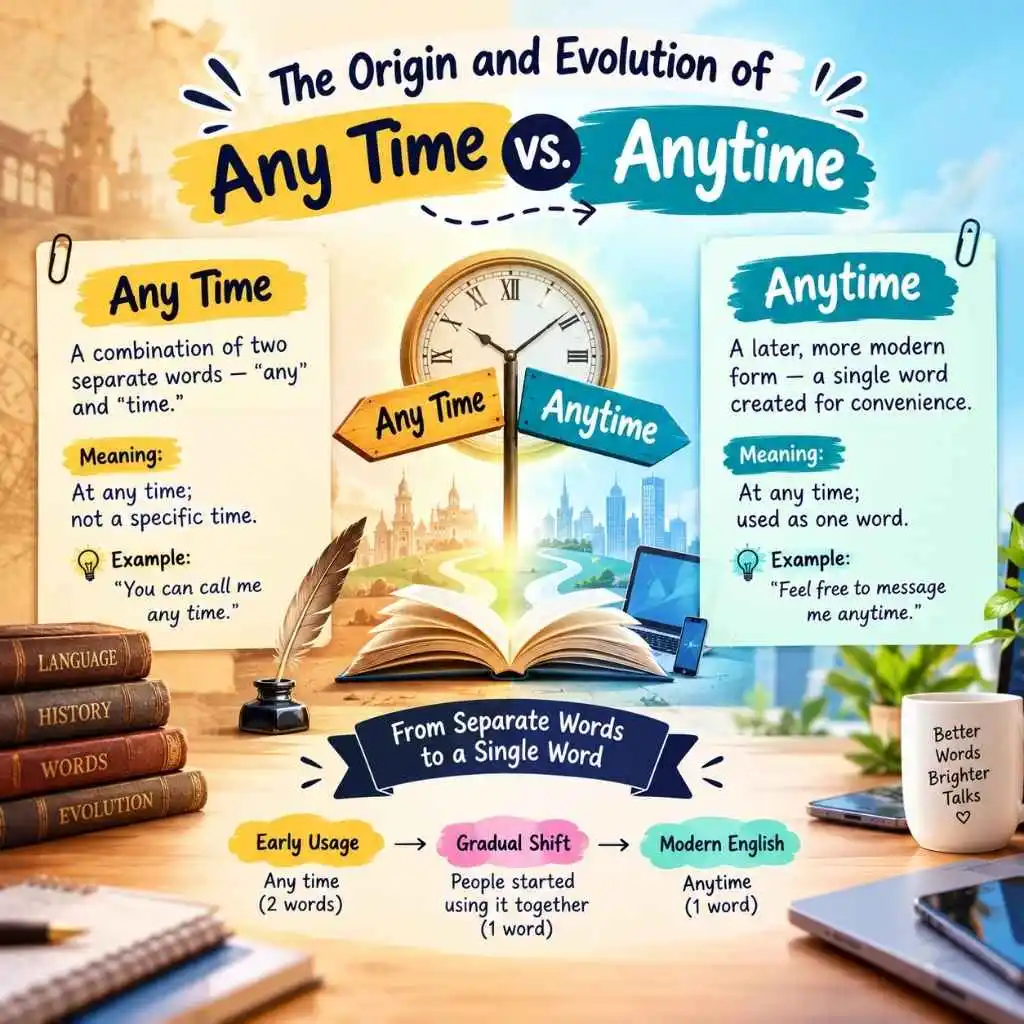
Any time developed naturally as a combination of the words any and time. English has long used any noun to describe an unspecified person, thing, amount, or time. The phrase therefore follows a familiar grammatical pattern.
Over time, frequent use of any time in phrases meaning “at any time” encouraged the development of the single-word form anytime. This type of change is common in English. Frequently used word combinations can gradually become established as single lexical units.
Today, anytime is widely recognized as an adverb, especially in informal and conversational English. Any time remains important because the two-word construction has grammatical uses that the one-word form does not always replace.
This evolution explains why both spellings appear in modern English. They are not simply two random spellings of the same word. Their forms reflect different stages and patterns of English word formation and grammatical usage.
When Should You Use “Any Time”?
Use any time as two words when time functions as a noun or when the phrase forms a noun phrase within a larger sentence. This is especially common after prepositions such as at.
For example:
- You can contact me at any time.
- She could arrive at any time.
- We are ready to discuss the matter at any time.
- He can visit at any time during the afternoon.
The phrase can also appear when any directly modifies the noun time:
- Do you have any time to talk?
- I don’t have any time today.
- She didn’t spend any time on the task.
Here, replacing any time with anytime would be incorrect because time clearly acts as a noun.
A simple test is to check if you could replace the phrase with another noun phrase such as any moment or any period. If that works naturally, the two-word form is often the better choice.
Use “Any Time” After a Preposition
The two-word form is particularly important after at.
- Correct: You may call me at any time.
- Less suitable: You may call me at any time.
The first sentence uses any time as a noun phrase governed by the preposition at. In careful formal writing, at any time is the standard construction.
Other prepositions can also introduce the phrase:
- We can meet at any time.
- She can work at any time.
- The service may stop at any time.
Use “Any Time” When “Time” Is a Noun
Use any time when you are talking about time itself as a noun.
- Do you have any time available today?
- I don’t have any time to waste.
- She needs any time she can get to finish the project.
In these examples, time carries its normal noun meaning. The word any describes an unspecified amount or period of time.
This distinction is useful because it gives you a reliable grammatical test: if “time” is the noun in the phrase, keep the words separate.
“Any Time” in Formal Writing
Any time is often the safer choice in formal, academic, business, and professional writing when the phrase follows at or clearly functions as a noun phrase.
For example:
- Employees may report concerns at any time.
- Applicants can submit questions at any time during the process.
- The policy may be reviewed at any time.
Using the two-word form in these structures makes the grammatical relationship clear and follows established formal usage.
Common Examples With “Any Time”
Understanding the pattern becomes easier through familiar sentences:
- You can call me at any time.
- Do you have any time this week?
- We can arrange the meeting at any time.
- I don’t have any time to finish another task.
- The schedule may change at any time.
The most important point is to examine the role of “time” in the sentence. When it operates as a noun, any time is the appropriate form.
| Situation | Why Use “Any Time”? | Example |
| Time is a noun | Time refers to an amount, moment, or period. | Do you have any time to talk? |
| After “at” | Any time forms a noun phrase after the preposition at. | You can call me at any time. |
| Talking about an amount of time | Any directly modifies the noun time. | I don’t have any time today. |
| Referring to an unspecified moment | The exact moment is not known or stated. | She could arrive at any time. |
| Formal or professional writing | The two-word form is especially clear in standard constructions such as at any time. | Employees may report concerns at any time. |
| Describing an available period | Time represents an available or possible period. | Do you have any time this week? |
| Using “time” with another phrase | The noun time is modified by words that follow it. | I don’t have any time to finish the report. |
When Should You Use “Anytime”?
Use anytime as one word when it functions as an adverb and means “at any time” or “whenever you choose.” It commonly appears in everyday conversations, messages, emails, and other informal communication.
For example:
- Call me anytime.
- You can visit anytime.
- Feel free to ask anytime.
- Stop by anytime you are in town.
Unlike any time, the one-word form does not treat time as a separate noun. Instead, anytime modifies the verb by explaining when an action can happen.
| Use “Anytime” When… | Example |
| It means “at any time” | You can call me anytime. |
| It modifies a verb | She can leave anytime. |
| You are writing conversationally | Come over anytime. |
| You are giving someone freedom to choose a time | Feel free to contact me anytime. |
A quick test is to replace “anytime with “at any time.” If the sentence still makes sense and the expression is functioning as an adverb, anytime may be appropriate.
Anytime is especially natural when it appears without a preposition:
- Call anytime.
- Visit anytime.
- Ask anytime.
In contrast, standard careful usage generally prefers at any time, not at any time.
Read More: Fiancé or Fiancée: What’s the Difference and When to Use Each?
Any Time or Anytime in Formal and Informal Writing
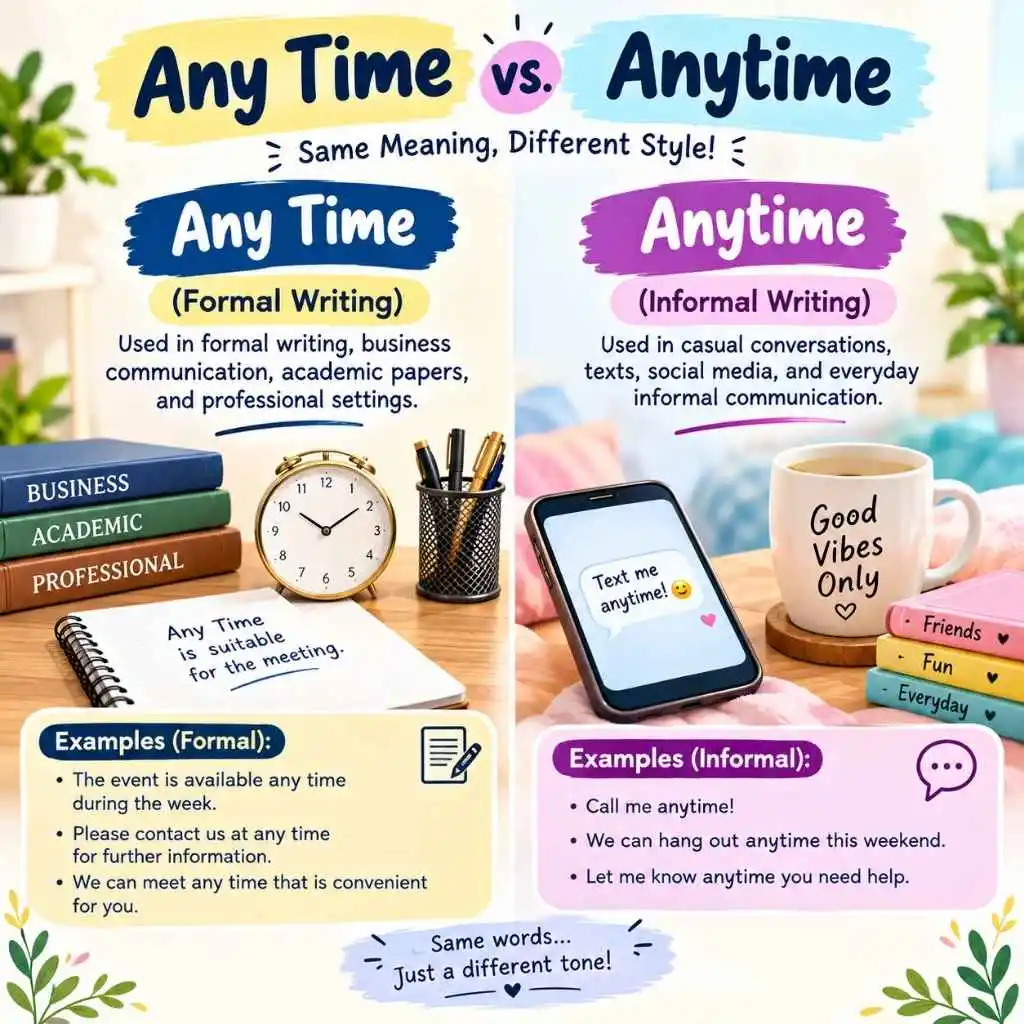
The choice between any time and anytime can also depend on the level of formality. Both forms have legitimate uses, but any time is often the clearer choice in formal constructions, especially after a preposition.
For example, professional or academic writing may use:
- Employees may submit their concerns at any time.
- Applicants can contact the office at any time.
- The policy may be changed at any time.
In informal communication, anytime is very natural:
- Text me anytime.
- Come over anytime.
- You can call anytime.
The key is to prioritize grammatical function and clarity. Formal writing does not make anytime automatically incorrect, but any time is often preferable when the phrase functions as a noun phrase.
Any Time or Anytime After “Thank You”
After someone says “thank you,” both “anytime” and “any time” may appear in informal replies, but “anytime” is the more natural one-word adverbial response in modern everyday English.
For example:
- “Thank you for helping me.” “Anytime!”
- “Thanks for picking me up.” “Anytime!”
- “Thank you for your advice.” “Anytime!”
Here, anytime expresses the idea that you are happy to help again whenever needed. It works as an adverb and does not contain time as a separate noun.
Any time can also appear when the sentence has a grammatical structure that requires the two-word phrase:
- “Thank you for helping me.” “You can ask me at any time.”
- “Thanks for your help.” “I’m available at any time you need me.”
Therefore, a short response such as “Anytime!” is natural, while a complete sentence may require any time depending on its structure.
Any Time or Anytime as a Response to “Thank You”
“Anytime!” is a common friendly response to “Thank you.” It communicates that the speaker was happy to help and would be willing to help again.
For example:
- Person A: Thank you for helping with my project.
- Person B: Anytime!
The word works naturally as an adverbial expression because it means something close to “at any time” or “whenever you need help.”
Other natural responses include:
- Anytime! Happy to help.
- Anytime!
- Sure, anytime.
- You can ask anytime.For a simple response to “Thank you,” “Anytime!” is the natural choice in everyday American English and is also widely understood in British English.
Any Time or Anytime in American and British English
Both any time and anytime appear in American English and British English, but usage preferences can vary depending on the sentence and writing style. The grammatical distinction between the two forms remains important in both varieties.
In both forms of English, any time is standard when time functions as a noun, such as Do you have any time? It is also the standard form after at, as in You can contact me at any time.
Anytime is used as an adverb, particularly in conversational writing:
- Call me anytime.
- You can visit anytime.
- Feel free to ask anytime.
| English Variety | Any Time | Anytime |
| American English | Standard | Common, especially as an adverb |
| British English | Standard | Used as an adverb |
| Formal structures | Common | May be less preferred in some contexts |
| After at | at any time | Generally avoid at anytime in careful writing |
The main rule is therefore not simply American vs. British spelling. Grammar and sentence structure matter more. When time acts as a noun, use any time. When the expression acts as an adverb, anytime can work naturally.
Any Time or Anytime for Offers, Invitations, and Availability
Use anytime when you are making a casual offer or telling someone they can choose a convenient moment.
Examples include:
- You can call me anytime.
- Come over anytime.
- Feel free to visit anytime.
- You can message me anytime.
- Stop by anytime.
These sentences use anytime as an adverb because it describes when the action can happen.
For more formal communication, at any time may sound clearer and more professional:
- You may contact our office at any time.
- Customers may request assistance at any time.
- Applicants may submit questions at any time.
The choice should match the sentence structure, audience, and tone. Casual communication often favors anytime, while formal contexts are frequently used at any time.
Any Time or Anytime With “Soon,” “After,” and “Between”
Words such as soon, after, and between can create different sentence structures, so it is important to check how any time or anytime functions in each sentence.
With soon, the common expression is anytime soon:
- Will you be visiting anytime soon?
- I don’t expect the problem to disappear anytime soon.
Here, anytime functions as an adverb.
With after, the two-word form may appear when time is functioning as a noun:
- Any time after lunch works for me.
- You can arrive at any time after three o’clock.
With between, any time is also common when referring to a time period:
- You can call at any time between 2 and 5 p.m.
- Any time between Monday and Wednesday works for me.
The important point is that anytime and any time are not chosen simply because a sentence contains a word such as soon or after. Look at the grammatical role and structure of the complete expression.
Any Time or Anytime in Everyday Sentences
Both forms are common in everyday English, but they appear in different sentence patterns. Anytime is especially natural when it works as an adverb, while any time is used when time remains a noun.
Here are common examples:
- Call me anytime.
- You can visit anytime.
- Feel free to ask anytime.
- Will you be here anytime soon?
- Do you have any time today?
- You can contact me at any time.
- Any time after lunch works for me.
- We can meet at any time between 2 and 5 p.m.
The easiest way to choose correctly is to check the grammatical role of the expression. Use anytime when it works as an adverb, and use any time when time functions as a noun or appears in a noun phrase such as at any time.
Any Time or Anytime in Emails, Texts, and Conversations
In emails, texts, and everyday conversations, both any time and anytime can be correct. The best choice depends on how the phrase works in the sentence.
Use anytime when it acts as an adverb and means “at any time” or “whenever you want.” This form is very common in casual messages and friendly conversations.
- Call me anytime if you need help.
- You can text me anytime.
- Come over anytime this weekend.
- Feel free to ask me anytime.
Use any time when time functions as a noun, especially after at or before a phrase that describes a specific period.
- You can contact me at any time.
- Do you have any time to talk today?
- Any time after 6 p.m. works for me.
- I am available any time between 2 and 4 p.m.
In a professional email, at any time can sound slightly more formal and polished, while anytime often feels natural in friendly communication. However, anytime is not limited to informal writing.
Read More: Skillset or Skill Set: Which Spelling Is Correct?
How to Remember Any Time vs Anytime Easily
A simple grammar test can make the difference easier to remember.
Think of any time as two separate words when time is a noun. Think of anytime as one word when the entire expression acts as an adverb.
| Quick Test | Use | Example |
| Is “time” a noun? | Any time | Do you have any time? |
| Does it follow “at”? | Any time | Call me at any time. |
| Does it mean “at any time”? | Anytime can work | Call me anytime. |
| Does it describe when an action happens? | Anytime | You can visit anytime. |
You can also remember this simple pattern:
At + any time = two words
You can call me at any time.
Verb + anytime = one word
You can call me anytime.
This is not a rule that replaces grammar in every situation, but it provides a useful shortcut for common sentences.
Common Mistakes With Any Time or Anytime
Writers often confuse these forms because they sound the same when spoken. The following mistakes are especially common:
- ❌ Call me at anytime.
✅ Call me at any time. - ❌ Do you have anytime to talk?
✅ Do you have any time to talk? - ❌ I don’t have anytime today.
✅ I don’t have any time today. - ❌ Anytime after lunch works for me.
✅ Any time after lunch works for me. - ❌ I am available anytime between 2 and 5 p.m.
✅ I am available any time between 2 and 5 p.m.
The most important mistake to avoid is “at any time.” In careful standard English, write “at any time.”
At the same time, do not assume that anytime is always wrong. Sentences such as “Call me anytime” and “Come anytime” are completely natural.
Any Time vs Anytime – Comparison Table
The difference becomes much clearer when the two forms are compared directly.
| Feature | Any Time | Anytime |
| Number of words | Two | One |
| Main grammatical role | Noun phrase | Adverb |
| Basic idea | An unspecified time or amount of time | At any time |
| Example | Do you have any time? | Call me anytime. |
| Common after “at” | Yes | No in careful standard usage |
| Common in casual conversation | Yes | Yes |
| Useful in formal writing | Yes | Sometimes, depending on structure |
| Can refer to an amount of time | Yes | No |
| Example with “soon” | Usually not the same construction | Anytime soon |
| Example with “between” | Any time between 2 and 5 | Not normally used in this noun phrase |
The most important distinction is grammar, not pronunciation. Both forms can express an idea related to an unspecified time, but their sentence roles determine which spelling works.
Any Time or Anytime – Usage Trends and Data
Modern English uses both any time and anytime regularly. The one-word form is especially common in conversational phrases such as “call anytime,” “come anytime,” “anytime soon,” and “feel free to contact me anytime.”
The two-word form remains important when time functions as a noun. This includes phrases such as “at any time,” “any time after lunch,” “any time between 2 and 5,” and “do you have any time?”
Digital communication has also made anytime very familiar in texts, chats, emails, and social media. However, this does not mean that the two-word form is becoming incorrect. Both forms continue to serve different grammatical purposes.
If you are unsure, focus on the sentence structure instead of regional preference. Ask yourself whether time is acting as a noun or the whole word is acting as an adverb. That simple check will usually lead you to the correct choice.
Any Time or Anytime – Final Examples
These examples show how any time and anytime work in different sentence patterns:
- Call me anytime.
- You can call me at any time.
- Do you have any time to talk?
- Come over anytime.
- Any time after lunch works for me.
- Will you visit anytime soon?
- You may leave at any time.
- Feel free to contact me anytime.
- I am available any time between 3 and 5 p.m.
- You can reach out anytime you need help.
- Any time before Friday is fine with me.
- Stop by anytime this week.
- We can meet at any time that suits you.
- Do you have any time this afternoon?
The key is to look at the grammatical role of time rather than simply choosing the spelling that looks more familiar.
Frequently Asked Questions
1. Is “Any Time” or “Anytime” Correct?
Both any time and anytime are correct. Use anytime as an adverb meaning “whenever,” while any time is used when time functions as a noun phrase.
2. What Is the Difference Between Any Time and Anytime?
Anytime usually means “whenever,” as in “Call me anytime.” Any time refers to an amount or period of time, as in “I don’t have any time today.”
3. Is It “At Any Time” or “At Anytime”?
The correct form is “at any time.” When any time follows the preposition at, write it as two words.
4. Is “Call Me Anytime” Grammatically Correct?
Yes, “Call me anytime” is grammatically correct. Here, anytime works as an adverb and means “call me whenever you want.”
5. Should I Write “Anytime Soon” or “Any Time Soon”?
“Anytime soon” is the common one-word form when anytime means “at any time.” For example, “Are you planning to visit anytime soon?”
6. Is It “I Don’t Have Any Time” or “I Don’t Have Anytime”?
Use “I don’t have any time.” Here, time is a noun referring to an amount of available time, so any time should remain as two words.
7. Is “Anytime” Formal or Informal English?
Anytime is a standard English word and is widely used as an adverb. It is especially common in everyday communication, while any time is required in noun-phrase constructions such as “at any time.”
Conclusion
Understanding Any Time or Anytime becomes much easier once you focus on how the phrase works in a sentence. Use any time when time acts as a noun, especially in phrases like “at any time,” “any time after lunch,” or “any time between 2 and 5.” Use anytime when it works as an adverb, such as “Call me anytime” or “Come anytime.” Both forms are correct, but choosing the right one improves grammar, clarity, and natural communication.
Knowing this simple difference can help you write more confidently in emails, texts, conversations, and formal writing. When you are unsure, look at the role of time in the sentence and choose the form that fits its meaning and structure. With a little practice, using any time and anytime correctly will feel natural.

I’m Jane Austen, the admin of GrammarGuide.com, where words come to life in smarter, sharper, and more creative ways. I focus on simplifying grammar, exploring powerful synonyms, and sharing fun, engaging expressions that make everyday communication more effective. My goal is to help readers write with clarity, confidence, and a touch of personality, whether it’s for professional use or just for fun.