
I still remember staring at an email, typing “After Careful Consideration” for what felt like the hundredth time. It did the job, but it sounded stiff and repetitive. That’s when I started looking for other ways to say “After Careful Consideration”, including professional alternatives, formal alternatives, conversational alternatives, synonyms, alternative expressions, and better wording alternatives. I wanted words that reflected thoughtful consideration, thoughtful deliberation, serious reflection, a careful review, careful evaluation, and a well-considered decision without making every message sound the same.
The truth is, the words you choose can change how people feel about your message. Whether you’re sending business emails, formal emails, letters, official statements, announcements, or handling workplace communication and school communication, the right decision phrases help you express an informed decision, thoughtful decision, deliberate decision, reasoned decision, final decision, or logical conclusion with respect and confidence. A thoughtful communication style improves message clarity, clear communication, clear intent, and effective communication. It lets you express sincerity, express warmth, express thoughtfulness, maintain a professional tone, natural tone, or warm tone, and avoid overly stiff language or a cold tone.
In this guide, you’ll find the best language alternatives, thoughtful expressions, and professional phrases, along with practical examples, usage examples, explanations, key insights, and best practices. You’ll also learn how to review facts, evaluate facts, review choices, evaluate options, weigh options, compare pros and cons, and use critical thinking, clear thinking, reflective thinking, and the reasoning process to make a well-considered decision with sound judgment instead of hasty judgment, impulsive choices, or rushed decisions. By the end, you’ll feel more confident writing messages that show fairness, patience, empathy, and professionalism while making every decision sound genuine, respectful, and thoughtfully communicated.
What Does “After Careful Consideration” Mean?
“After careful consideration” means a decision was made only after taking enough time to review facts, evaluate options, and weigh the pros and cons. It tells the reader that the conclusion was not rushed or emotional but based on a thoughtful decision-making process.
The phrase is commonly used before delivering a final decision, especially when the outcome may disappoint someone. It signals fairness, professionalism, and respect, making it easier for the reader to understand that the choice came from careful evaluation rather than impulse.
In professional writing, it often communicates that you have:
- Reviewed all relevant information
- Considered different possibilities
- Used critical thinking and sound judgment
- Reached a well-considered or informed decision
Example:
“After careful consideration, we have decided to move forward with another candidate.”
In this example, the phrase reassures the recipient that the hiring decision followed a fair and structured review process rather than a quick or personal judgment.
When Should You Use “After Careful Consideration”?
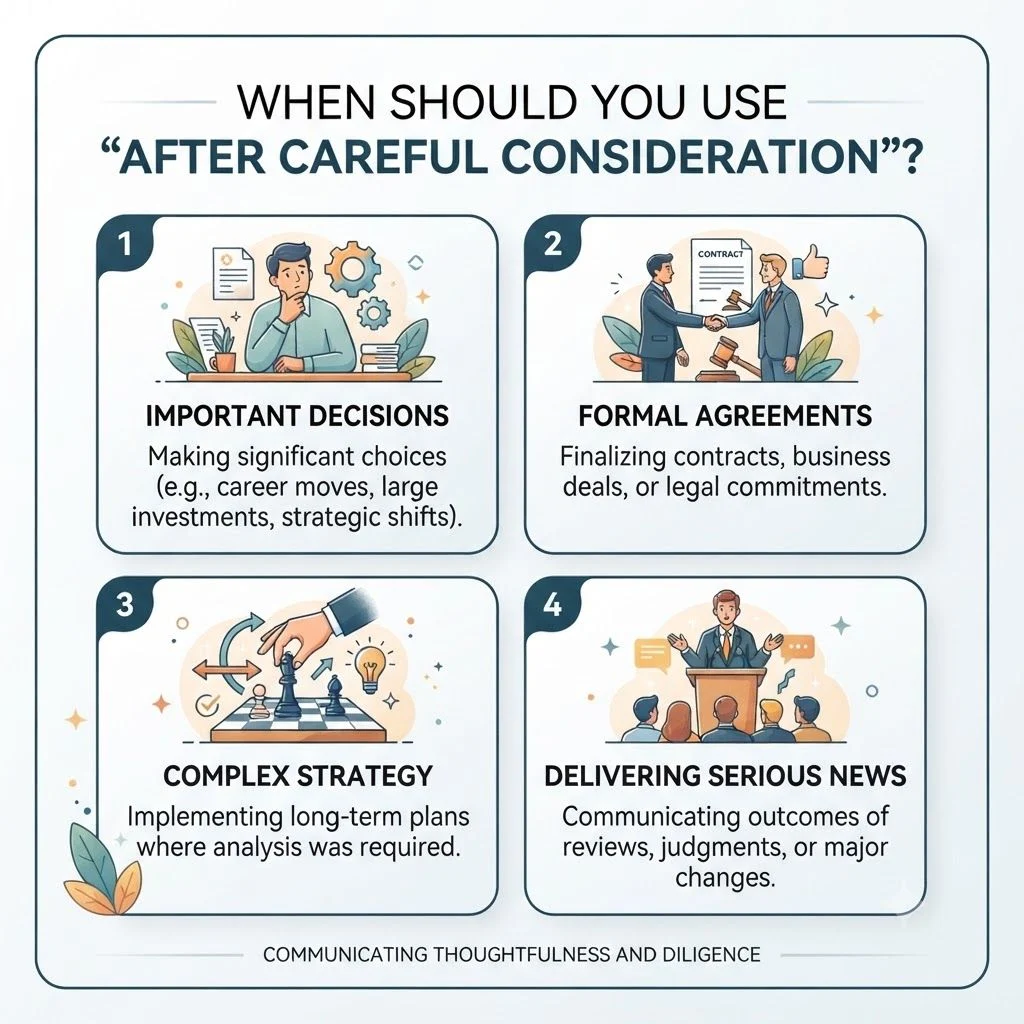
Use “after careful consideration” when you want to show that your final decision came after thoughtful analysis instead of a quick reaction. It is most effective in situations where transparency, professionalism, and empathy matter.
Common situations include:
- Job rejection emails
- Scholarship or college admission decisions
- Business proposals
- Client communications
- Performance reviews
- Project approvals or rejections
- Contract decisions
- Formal letters and official statements
The phrase works well because it creates confidence in your decision process. It tells the reader that you took time to review choices, evaluate facts, and make a reasoned decision based on evidence rather than emotion.
However, avoid using it in casual conversations or everyday text messages. In informal communication, simpler phrases like “I’ve thought it over,” “After thinking about it,” or “I’ve decided” usually sound more natural.
Choose this expression when your goal is to:
- Show respect for the recipient
- Communicate a difficult decision politely
- Demonstrate professional communication
- Maintain a formal and respectful tone
- Build trust through clear and honest wording
Read More: Ways to Say “My Mind is Made Up”(With Examples)
Is “After Careful Consideration” Professional and Polite?
Yes. “After careful consideration” is both professional and polite, which is why it appears so often in business communication, formal writing, and workplace communication.
Professionally, it suggests that the decision was based on careful judgment, logical reasoning, and an objective review of the available information. Politeness comes from acknowledging that the decision was not made lightly, especially when delivering disappointing news.
The phrase helps create:
- A respectful tone
- Clear communication
- Decision confidence
- Sincere communication
- Professional feedback
- Message clarity
For example, compare these two sentences:
❌ “We rejected your application.”
✅ “After careful consideration, we have decided not to move forward with your application.”
The second version feels more respectful because it shows the organization followed a thoughtful review process before reaching its conclusion.
Although it remains an excellent phrase for formal communication, repeating it too often can make your writing feel predictable. Rotating between suitable alternatives keeps your writing fresh while maintaining the same level of professionalism.
Why “After Careful Consideration” Sounds Overused?
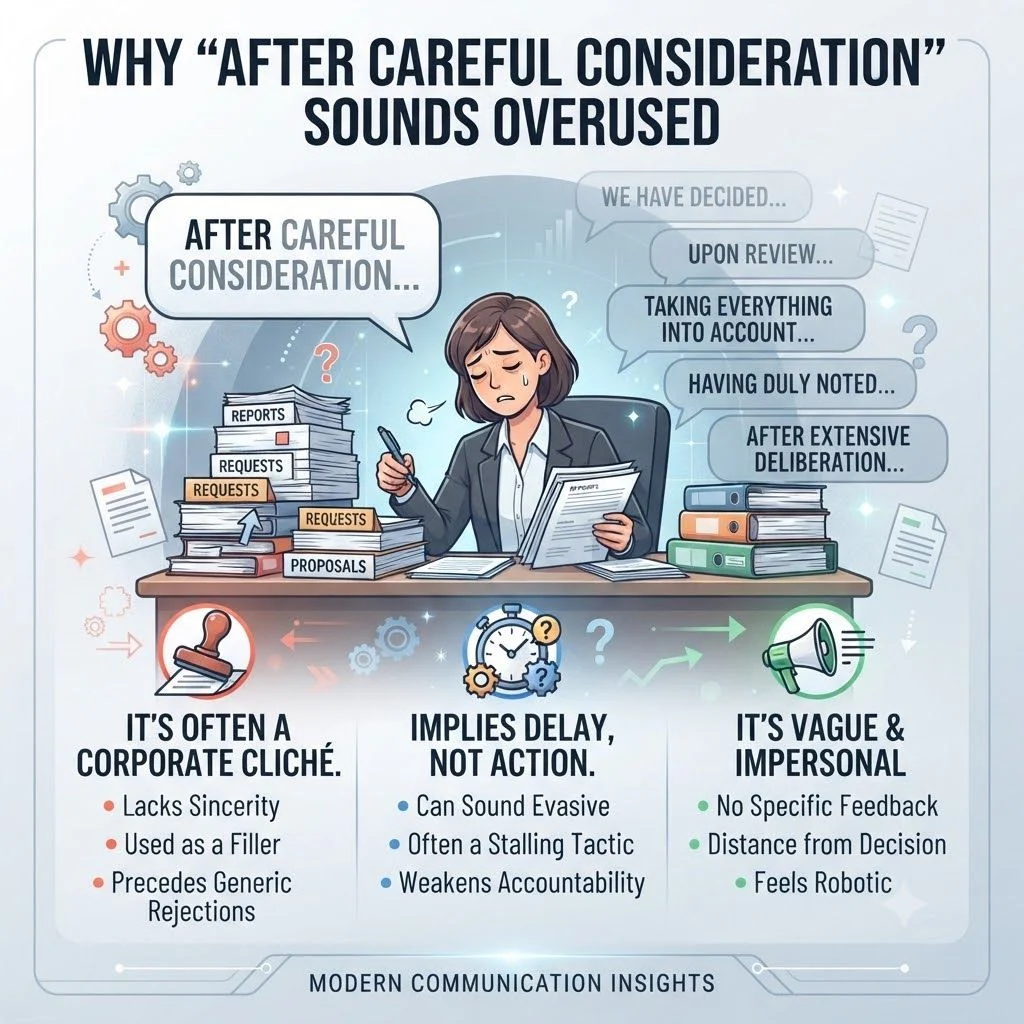
Although “after careful consideration” is accurate and professional, it has become one of the most frequently used phrases in business emails and rejection letters. Because readers encounter it so often, it may sound like a standard template instead of a personal message.
Many companies use the exact wording in hiring decisions, scholarship notifications, and customer responses. As a result, the phrase sometimes feels distant or impersonal, even when the writer genuinely wants to communicate with empathy.
Overusing the phrase can:
- Reduce the emotional impact of your message
- Make emails sound copied or automated
- Create a formal but less human tone
- Weaken your unique communication style
Instead of repeating the same expression, consider choosing an alternative that matches your audience and purpose. For example, “after reviewing all the information,” “after thoughtful deliberation,” “following a careful evaluation,” or “after weighing all the options” often sound more natural while expressing the same idea.
The best approach is to match your wording to the situation. Formal business decisions may require a traditional phrase, while everyday workplace communication often benefits from language that feels warmer, clearer, and more personal. Using varied yet thoughtful expressions improves readability, strengthens your writing, and helps every message feel genuine rather than routine.
Better Ways to Say “After Careful Consideration”
1. After Thorough Review
Scenario:
A hiring manager finishes reading dozens of job applications before sending the final email to each candidate.
Meaning:
After thorough review means a decision was made only after a complete and careful examination of all the information. It is a professional alternative to After Careful Consideration.
Explanation:
This phrase shows that time was spent reviewing facts, documents, and available options before reaching a final decision. It reflects fairness, careful evaluation, and professional communication, making it ideal for workplace decisions and formal writing.
Example:
“After thorough review, we have decided to move forward with another applicant.”
Best Use:
- Hiring decisions
- Business emails
Worst Use:
- Casual chats with friends
Tone:
Professional, objective, respectful
2. Following Careful Review
Scenario:
A teacher carefully checks every assignment before publishing the final grades.
Meaning:
Following careful review means a decision was made after examining all important information. It is a formal alternative to After Careful Consideration.
Explanation:
People use this phrase to show that they reviewed the facts before making an informed decision. It builds trust by emphasizing a fair and thoughtful review process.
Example:
“Following careful review, your request has been approved.”
Best Use:
- Academic communication
- Workplace announcements
Worst Use:
- Everyday text messages
Tone:
Formal, clear, professional
3. After Much Thought
Scenario:
Someone spends several days thinking before accepting a new job offer.
Meaning:
After much thought means a person took plenty of time to reflect before making a thoughtful decision.
Explanation:
This phrase sounds more personal than After Careful Consideration. It expresses sincerity and shows that the choice was made with care instead of being rushed.
Example:
“After much thought, I’ve decided to accept the new position.”
Best Use:
- Personal emails
- Career decisions
Worst Use:
- Legal agreements
Tone:
Warm, sincere, thoughtful
4. After Thoughtful Evaluation
Scenario:
A company reviews several proposals before selecting the best solution.
Meaning:
After thoughtful evaluation means the decision followed a careful review of every important detail.
Explanation:
The phrase highlights analytical thinking and careful evaluation. It tells readers that every option was considered before reaching a well-considered decision.
Example:
“After thoughtful evaluation, we selected the proposal that best meets our requirements.”
Best Use:
- Project approvals
- Vendor selection
Worst Use:
- Casual conversations
Tone:
Professional, analytical, confident
5. Upon Careful Assessment
Scenario:
A department manager reviews a project’s performance before approving the next phase.
Meaning:
Upon careful assessment means a decision was made after thoroughly examining the facts, evidence, or situation. It is a formal alternative to After Careful Consideration.
Explanation:
This phrase shows that the decision followed a detailed assessment rather than a quick opinion. It reflects responsibility, sound judgment, and a structured decision-making process, making it common in professional communication and official reports.
Example:
“Upon careful assessment, we have approved your request.”
Best Use:
- Performance evaluations
- Official business decisions
Worst Use:
- Friendly text conversations
Tone:
Formal, thoughtful, professional
Read More: Ways to Say “Go Big or Go Home”(With Examples)
6. After Meticulous Analysis
Scenario:
A financial analyst studies quarterly reports before recommending an investment.
Meaning:
After meticulous analysis means the decision was reached only after a very detailed and careful examination. It is a strong formal substitute for After Careful Consideration.
Explanation:
This phrase emphasizes accuracy, research, and logical thinking. It tells readers that every detail was analyzed before reaching a well-considered decision, making it ideal for technical and professional writing.
Example:
“After meticulous analysis, we recommend moving forward with the proposal.”
Best Use:
- Financial reports
- Research and technical documents
Worst Use:
- Personal conversations
Tone:
Analytical, precise, authoritative
7. Following Extensive Deliberation
Scenario:
A board of directors discusses several business strategies before announcing the final decision.
Meaning:
Following extensive deliberation means the decision came after lengthy discussions and careful thinking. It is a formal variation of After Careful Consideration.
Explanation:
This expression highlights collaboration and thoughtful decision-making. It reassures readers that different viewpoints were considered before reaching a reasoned conclusion.
Example:
“Following extensive deliberation, the board approved the new policy.”
Best Use:
- Executive meetings
- Corporate announcements
Worst Use:
- Informal emails
Tone:
Formal, authoritative, confident
8. Upon Close Examination
Scenario:
An editor carefully checks a manuscript before giving final approval for publication.
Meaning:
Upon close examination means a conclusion was reached after inspecting every important detail. It serves as a professional alternative to After Careful Consideration.
Explanation:
The phrase emphasizes detailed observation and careful evaluation. It is often used when accuracy and evidence are important, especially in academic, legal, and professional contexts.
Example:
“Upon close examination, we identified several areas that required improvement.”
Best Use:
- Academic writing
- Legal and compliance documents
Worst Use:
- Everyday conversations
Tone:
Objective, formal, precise
9. After Thoughtful Assessment
Scenario:
A client compares several agencies before choosing one for a long-term project.
Meaning:
After thoughtful assessment means a decision was made after carefully evaluating all available options. It is a professional synonym for After Careful Consideration.
Explanation:
People use this phrase to show that they considered the facts, weighed the options, and made an informed decision. It communicates fairness and careful judgment without sounding overly rigid.
Example:
“After thoughtful assessment, we believe your proposal is the best fit.”
Best Use:
- Client communications
- Proposal evaluations
Worst Use:
- Casual social media posts
Tone:
Professional, balanced, respectful
10. After Pondering Deeply
Scenario:
Someone reflects on a difficult life decision before sharing it with family.
Meaning:
After pondering deeply means a person spent significant time reflecting before making a thoughtful choice. It is a more personal alternative to After Careful Consideration.
Explanation:
Unlike formal business phrases, this expression focuses on personal reflection and emotion. It works well when you want readers to understand that the decision came from genuine thought and sincere consideration.
Example:
“After pondering deeply, I’ve decided to pursue a different career path.”
Best Use:
- Personal letters
- Reflective blog posts
Worst Use:
- Corporate legal documents
Tone:
Reflective, sincere, thoughtful
11. After Reviewing the Matter
Scenario:
A manager investigates an employee’s request before making a final decision.
Meaning:
After reviewing the matter means a decision was made after carefully examining the issue. It is a professional alternative to After Careful Consideration.
Explanation:
This phrase shows that the situation was reviewed fairly before reaching a conclusion. It is commonly used in workplace communication and formal correspondence.
Example:
“After reviewing the matter, we have approved your request.”
Best Use:
- HR decisions
- Workplace emails
Worst Use:
- Casual conversations
Tone:
Professional, fair, respectful
12. With Due Consideration
Scenario:
A company responds to a client’s proposal after carefully evaluating every detail.
Meaning:
With due consideration means proper attention and careful thought were given before making a decision.
Explanation:
This phrase emphasizes responsibility and fairness. It is often used in legal, corporate, and formal writing to show that all relevant factors were considered.
Example:
“With due consideration, we have decided to revise the agreement.”
Best Use:
- Legal documents
- Business agreements
Worst Use:
- Friendly text messages
Tone:
Formal, respectful, authoritative
13. Upon Thoughtful Review
Scenario:
A scholarship committee carefully examines applications before announcing the winners.
Meaning:
Upon thoughtful review means a conclusion was reached after a careful and balanced review. It is a polished substitute for After Careful Consideration.
Explanation:
The phrase communicates fairness, careful evaluation, and thoughtful decision-making while maintaining a professional tone.
Example:
“Upon thoughtful review, your application has been accepted.”
Best Use:
- Scholarship decisions
- Professional emails
Worst Use:
- Informal chats
Tone:
Professional, thoughtful, clear
14. After Deliberate Reflection
Scenario:
A professional reflects on several career options before making a life-changing decision.
Meaning:
After deliberate reflection means someone intentionally spent time thinking before making an informed decision.
Explanation:
This expression highlights deep reflection and careful judgment. It is useful when emphasizing personal responsibility and thoughtful communication.
Example:
“After deliberate reflection, I have chosen to pursue another opportunity.”
Best Use:
- Career decisions
- Personal statements
Worst Use:
- Technical reports
Tone:
Reflective, sincere, thoughtful
15. After Thoughtful Review
Scenario:
A project team evaluates every proposal before selecting the best solution.
Meaning:
After thoughtful review means a decision followed a careful examination of the available information.
Explanation:
The phrase reassures readers that every option received fair attention before the final decision was made.
Example:
“After thoughtful review, we selected the most suitable proposal.”
Best Use:
- Project evaluations
- Business communication
Worst Use:
- Everyday texting
Tone:
Professional, balanced, confident
Read More: Ways to Say “Don’t Make A Fuss”(With Examples)
16. Upon Further Consideration
Scenario:
After discussing new information, a manager decides to change the original decision.
Meaning:
Upon further consideration means additional thought led to a revised or final decision.
Explanation:
This phrase is often used when new facts or perspectives influence the decision-making process. It signals openness and careful reasoning.
Example:
“Upon further consideration, we have decided to extend the deadline.”
Best Use:
- Policy updates
- Follow-up emails
Worst Use:
- Casual conversations
Tone:
Professional, flexible, thoughtful
17. After Careful Reflection
Scenario:
Someone spends time thinking before resigning from a long-term job.
Meaning:
After careful reflection means a decision was made after sincere and thoughtful consideration.
Explanation:
Unlike analytical expressions, this phrase focuses on personal reflection and emotional awareness while still sounding professional.
Example:
“After careful reflection, I have decided to step down from my role.”
Best Use:
- Resignation letters
- Personal announcements
Worst Use:
- Financial reports
Tone:
Reflective, respectful, sincere
18. Following a Detailed Review
Scenario:
An audit team examines company records before submitting its findings.
Meaning:
Following a detailed review means the decision came after a thorough examination of all relevant information.
Explanation:
This phrase highlights accuracy and careful evaluation, making it suitable for formal reports and business communication.
Example:
“Following a detailed review, we identified several improvements.”
Best Use:
- Audit reports
- Corporate emails
Worst Use:
- Personal messages
Tone:
Formal, analytical, professional
19. After Examining the Details
Scenario:
A customer compares different service plans before making a purchase.
Meaning:
After examining the details means the decision was based on a close review of important information.
Explanation:
The phrase communicates careful analysis and informed decision-making while remaining easy to understand.
Example:
“After examining the details, we chose the premium package.”
Best Use:
- Client communication
- Product comparisons
Worst Use:
- Formal legal contracts
Tone:
Clear, practical, thoughtful
20. Upon Thorough Consideration
Scenario:
A university committee evaluates applications before making admission decisions.
Meaning:
Upon thorough consideration means every important factor was carefully reviewed before reaching the final decision.
Explanation:
This formal expression emphasizes fairness, critical thinking, and a complete evaluation process.
Example:
“Upon thorough consideration, your application has been approved.”
Best Use:
- Academic decisions
- Official announcements
Worst Use:
- Casual conversations
Tone:
Formal, respectful, authoritative
21. After Weighing the Options
Scenario:
A business owner compares several suppliers before signing a contract.
Meaning:
After weighing the options means different choices were carefully compared before making a final decision.
Explanation:
This phrase highlights logical thinking and balanced decision-making. It clearly shows that alternatives were considered before choosing the best solution.
Example:
“After weighing the options, we selected the vendor offering the best value.”
Best Use:
- Business decisions
- Strategic planning
Worst Use:
- Informal chats
Tone:
Practical, balanced, professional
22. Following a Comprehensive Assessment
Scenario:
A hospital reviews a patient’s condition before recommending treatment.
Meaning:
Following a comprehensive assessment means the decision came after a complete evaluation of all relevant information.
Explanation:
The phrase communicates accuracy, responsibility, and a thorough review process, making it suitable for professional and technical settings.
Example:
“Following a comprehensive assessment, we recommend the revised approach.”
Best Use:
- Healthcare communication
- Technical reports
Worst Use:
- Personal messages
Tone:
Professional, objective, thorough
23. After Giving It Serious Thought
Scenario:
A friend carefully considers moving to another city before making the final choice.
Meaning:
After giving it serious thought means someone spent significant time thinking before making an informed decision.
Explanation:
This expression sounds natural and personal while showing genuine reflection. It is less formal than After Careful Consideration but still communicates sincerity.
Example:
“After giving it serious thought, I’ve decided to stay where I am.”
Best Use:
- Personal conversations
- Career choices
Worst Use:
- Legal documents
Tone:
Warm, sincere, thoughtful
24. Upon In-Depth Review
Scenario:
An editor carefully checks a report before publication.
Meaning:
Upon in-depth review means a conclusion was reached after a detailed examination of the available information.
Explanation:
This phrase emphasizes careful analysis and supports clear, evidence-based decision-making in professional writing.
Example:
“Upon in-depth review, several revisions were recommended.”
Best Use:
- Editorial work
- Business reports
Worst Use:
- Casual conversations
Tone:
Formal, analytical, precise
25. After Considering All Factors
Scenario:
A family discusses budget, location, and timing before buying a new home.
Meaning:
After considering all factors means every important detail was evaluated before making the final decision.
Explanation:
The phrase shows balanced thinking and careful judgment. It reassures readers that nothing important was overlooked.
Example:
“After considering all factors, we decided to postpone the launch.”
Best Use:
- Business planning
- Personal decisions
Worst Use:
- Quick text replies
Tone:
Balanced, thoughtful, professional
26. Following a Careful Examination
Scenario:
A quality control team inspects products before approving them for sale.
Meaning:
Following a careful examination means a decision was made after thoroughly checking the facts or materials.
Explanation:
This phrase emphasizes accuracy, detailed evaluation, and a structured review process.
Example:
“Following a careful examination, the product met all quality standards.”
Best Use:
- Quality assurance
- Technical communication
Worst Use:
- Friendly conversations
Tone:
Formal, precise, objective
Read More: Ways to Say “I Have a Proposition”(With Examples)
27. After Taking Everything Into Account
Scenario:
A manager reviews costs, deadlines, and resources before approving a project.
Meaning:
After taking everything into account means every important factor was considered before reaching a final decision.
Explanation:
This expression sounds natural while showing balanced thinking. It works well in both professional and everyday communication.
Example:
“After taking everything into account, we’ve decided to move forward.”
Best Use:
- Team discussions
- Workplace decisions
Worst Use:
- Highly technical legal writing
Tone:
Natural, balanced, thoughtful
28. Upon Full Evaluation
Scenario:
A review panel assesses every submission before announcing the winners.
Meaning:
Upon full evaluation means the decision followed a complete review of all available information.
Explanation:
The phrase highlights fairness, objectivity, and careful assessment, making it suitable for formal communication.
Example:
“Upon full evaluation, your proposal was selected.”
Best Use:
- Evaluation reports
- Official announcements
Worst Use:
- Casual messaging
Tone:
Professional, formal, objective
29. After Reflecting on the Situation
Scenario:
Someone thinks about a disagreement before responding to a friend.
Meaning:
After reflecting on the situation means the person carefully considered what happened before making a decision or giving a response.
Explanation:
This phrase emphasizes emotional awareness and thoughtful communication. It is useful when discussing personal or sensitive matters.
Example:
“After reflecting on the situation, I realized we needed a different approach.”
Best Use:
- Personal conversations
- Conflict resolution
Worst Use:
- Legal contracts
Tone:
Reflective, calm, sincere
30. After Looking at All the Facts
Scenario:
A business owner reviews customer feedback and sales reports before changing company policies.
Meaning:
After looking at all the facts means the decision was based on reviewing every important piece of information.
Explanation:
This expression uses simple language while showing logical thinking and informed decision-making. It works well when you want your message to sound clear and trustworthy.
Example:
“After looking at all the facts, we decided to keep our current strategy.”
Best Use:
- Business discussions
- Everyday professional communication
Worst Use:
- Formal legal documents
Tone:
Clear, practical, confident
Comparison Table of Tone and Usage
Choosing the right alternative depends on tone, audience, and the purpose of your message. While every phrase communicates a decision, each creates a different impression. Using the right wording improves message clarity, professional communication, and effective communication.
| Phrase | Tone | Best Used For | Level of Formality |
| After careful consideration | Professional, respectful | Job rejections, formal decisions | Very Formal |
| After reviewing all the information | Neutral, objective | Business reports, workplace emails | Formal |
| After thoughtful deliberation | Serious, reflective | Executive decisions, official announcements | Very Formal |
| After weighing all the options | Balanced, transparent | Team discussions, proposals | Formal |
| After careful evaluation | Analytical | Performance reviews, assessments | Formal |
| After much thought | Warm, personal | Personal messages, recommendations | Semi-formal |
| After reflecting on the situation | Empathetic | Difficult conversations | Semi-formal |
| Having considered your request | Courteous | Client communication | Formal |
| Based on our review | Direct, business-focused | Company emails | Formal |
| Following a detailed assessment | Technical | Academic, legal, compliance writing | Very Formal |
How to Choose the Best Alternative
The best alternative depends on who will read your message and what you want to achieve. There is no single phrase that works in every situation.
Before selecting an expression, ask yourself:
- Is the message formal or conversational?
- Am I delivering good news or disappointing news?
- Do I need to sound warm, neutral, or highly professional?
- Will the reader expect detailed reasoning?
For example:
- Use “After careful evaluation” for reports and assessments.
- Use “After much thought” when writing a personal message.
- Use “After reviewing all the information” in business communication.
- Use “Following careful deliberation” for executive announcements.
- Use “After weighing the options” when explaining a decision-making process.
Matching your word choice to the context helps you express thoughtfulness, fairness, and sound judgment without sounding repetitive.
Professional Email Wording for Workplace Decisions
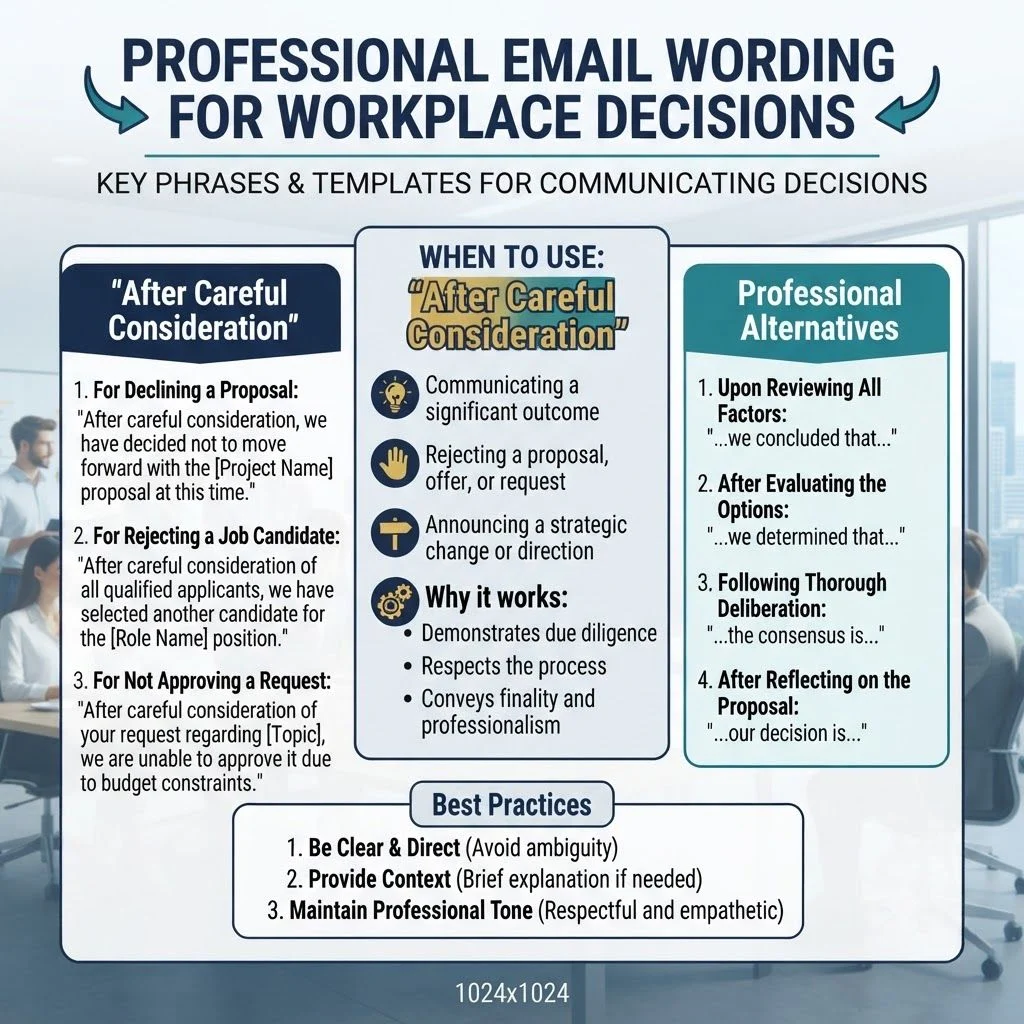
Workplace emails should communicate decisions with confidence while maintaining respect. Strong wording shows that the decision resulted from a structured review process rather than emotion.
Professional alternatives include:
- After reviewing your application
- Following careful evaluation
- After considering all available information
- Based on our assessment
- Following an internal review
- After evaluating the available options
These phrases work well for:
- Hiring decisions
- Promotion announcements
- Project approvals
- Client responses
- Budget decisions
- Internal policy updates
Using precise language strengthens business communication, improves professional writing, and helps recipients understand the reasoning behind the decision.
Polite Ways to Decline an Offer Without Sounding Harsh
Declining an offer becomes easier when the wording shows appreciation before communicating the final decision.
Examples include:
- After careful consideration, I have decided to decline.
- Thank you for your generous offer. After much thought, I have chosen another opportunity.
- After reviewing my current priorities, I must respectfully decline.
- I sincerely appreciate your time and consideration.
- After evaluating my options, I believe another path is a better fit.
These expressions communicate respect, gratitude, and professionalism while avoiding language that sounds cold or abrupt.
Decision Announcement Wording for Leaders and Executives
Leaders often announce decisions that affect employees, customers, or stakeholders. Their wording should inspire confidence while demonstrating fairness and transparency.
Strong executive phrases include:
- Following extensive review
- After careful strategic consideration
- Based on a comprehensive evaluation
- After consulting all relevant stakeholders
- Following thoughtful deliberation
- After assessing every available option
These expressions reinforce:
- Leadership credibility
- Decision confidence
- Accountability
- Clear communication
- Organizational transparency
The goal is to explain that the decision came from careful analysis rather than personal opinion.
Formal Writing Alternatives for Academic and Legal Contexts
Academic and legal writing requires objective, precise language. Emotional expressions are usually avoided in favor of evidence-based wording.
Suitable alternatives include:
- Following careful examination
- Based on the available evidence
- Upon detailed review
- After comprehensive analysis
- Following extensive evaluation
- In light of the findings
- Based on the documented record
These phrases communicate authority while maintaining the neutral tone expected in research papers, legal documents, policy statements, and official reports.
How Word Choice Shapes Thoughtful Decision-Making
Words influence how readers interpret your decisions. A carefully chosen phrase can make the same conclusion appear more respectful, logical, and trustworthy.
Compare these examples:
Direct:
“We rejected your proposal.”
Thoughtful:
“After carefully reviewing your proposal, we have decided not to proceed.”
The second sentence sounds more professional because it reflects:
- Critical thinking
- Fair evaluation
- Careful judgment
- Respectful communication
- Deliberate decision-making
Thoughtful wording also helps reduce misunderstandings and strengthens relationships in professional settings.
Resume Language Improvement Through Stronger Phrasing
Strong language is valuable beyond emails. It also improves resumes by making achievements sound more intentional and results-driven.
Instead of writing:
- Made decisions
Use:
- Evaluated strategic options
- Conducted detailed assessments
- Analyzed complex information
- Applied sound judgment
- Led data-driven decision-making
- Reviewed operational outcomes
- Recommended well-considered solutions
These action-oriented phrases highlight analytical thinking and professional expertise while making accomplishments more persuasive.
Case Study: Rewriting a Rejection Email
A small change in wording can significantly improve the reader’s experience.
Before
We reviewed your application. You were not selected.
This version sounds abrupt and impersonal.
After
After careful consideration and a thorough review of your qualifications, we have decided to move forward with another candidate. We sincerely appreciate your interest in our organization and wish you continued success in your future endeavors.
Why the revised version works:
- Shows appreciation
- Explains the decision respectfully
- Demonstrates fairness
- Maintains professionalism
- Leaves a positive impression
This approach is widely used in HR communication, business emails, and recruitment because it balances honesty with empathy.
Common Mistakes to Avoid
Many writers unintentionally weaken their message by relying on repetitive or unclear language.
Avoid these common mistakes:
- Using “After careful consideration” in every email.
- Choosing overly formal wording for casual conversations.
- Sounding robotic instead of sincere.
- Giving no explanation when context requires one.
- Mixing formal and conversational tones.
- Using vague phrases without clear intent.
- Writing long, complicated sentences.
- Forgetting to match the wording to the audience.
Good communication combines clarity, respect, professional tone, and natural language.
Frequently Asked Questions
What is another professional way to say “After Careful Consideration”?
You can use phrases like “After reviewing all the information,” “Following careful evaluation,” “After thoughtful deliberation,” or “Based on our assessment.” Choose the expression that best matches the context.
Is “After Careful Consideration” too formal?
It is formal but still appropriate for business communication, official letters, and workplace decisions. For everyday conversations, simpler alternatives often sound more natural.
Can I use it in a job rejection email?
Yes. It is one of the most common phrases used in hiring communications because it conveys fairness, professionalism, and respect.
What is the difference between “After Careful Consideration” and “After Much Thought”?
“After Careful Consideration” emphasizes an objective review process, while “After Much Thought” feels more personal and conversational.
Should I always replace this phrase?
No. The phrase remains effective in many formal situations. However, using different alternatives helps avoid repetition and makes your writing feel more authentic.
Conclusion
“After Careful Consideration“ remains one of the strongest phrases for communicating thoughtful decisions, but it is not your only option. Choosing the right alternative allows you to match your tone, audience, and purpose while making your writing sound more natural, sincere, and professional.
Whether you’re drafting a business email, responding to a client, writing a rejection letter, preparing an executive announcement, or improving everyday workplace communication, varied wording demonstrates clear thinking, sound judgment, and effective communication. By selecting the right phrase for each situation, you’ll create messages that are respectful, confident, and memorable.

Hi, I am Zadie Smith, the author of Grammargide.com. I write clear, easy-to-understand guides that explain commonly confused words and phrases, helping readers choose the right expression with confidence.